Management of Diabetes Mellitus in Acromegaly and Cushing’s Disease with Focus on Pasireotide Therapy

Abstract: Patients suffering from acromegaly and Cushing’s Disease (CD) face the risk of several clinical complications. The onset of diabetes mellitus (DM) is among the most important: exposure to elevated growth hormone or cortisol levels is associated with insulin resistance (IR). DM contributes to increasing cardiovascular risk for these subjects, which is higher compared to healthy individuals. Hyperglycemia may also be caused by pasireotide, a second-generation somatostatin receptor ligand (SRLs), currently used for the treatment of these diseases. Accordingly, with 2014 medical expert recommendations, the management of hyperglycemia in patients with CD and treated with pasireotide is based on lifestyle changes, metformin, DPP-4 inhibitors (DPP-4i) and, subsequently, GLP-1 Receptor Agonists (GLP-1 RAs). There is no position for SGLT2-inhibitors (SGLT2-i). However, a very recent experts’ consensus regarding the management of pasireotide-induced hyperglycemia in patients with acromegaly suggests the use of GLP-1 RAs as first line treatment (in suitable patients) and the use of SGLT2-i as second line treatment in patients with high cardiovascular risk or renal disease. As a matter of fact, beyond the hypoglycemic effect of GLP1-RAs and SGLT2-i, there is increasing evidence regarding their role in the reduction of cardiovascular risk, commonly very high in acromegaly and CD and often tough to improve despite biochemical remission. So, an increasing use of GLP1-RAs and SGLT2-i to control hyperglycemia is desirable in these diseases. Obviously, all of that must be done with due attention in order to minimize the occurrence of adverse events. For this reason, large studies are needed to analyze the presence of potential limitations.

Keywords: acromegaly, Cushing’s disease, pasireotide, hyperglycemia, diabetes mellitus, cardiovascular risk

Introduction

Acromegaly and Cushing’s Disease (CD) are rare but weakening endocrine diseases.

Acromegaly is usually caused by a growth hormone (GH)-secreting pituitary adenoma, with subsequent excess of insulin-like growth factor (IGF-1).1 CD is characterized by hyperproduction of cortisol due to an adrenocorticotropic hormone (ACTH)-secreting pituitary adenoma.2 Impaired glucose metabolism and the onset of DM are common clinical conditions resulting from these diseases. The worsening of glycemic control might also be caused by treatment with somatostatin receptor analogs, more specifically with pasireotide.

Pasireotide, a second-generation somatostatin receptor ligand (SRLs), is currently used for the treatment of acromegaly and CD.3,4

In the management of acromegaly, long-acting pasireotide is recommended at a starting dose of 40 mg monthly (potentially up-titrated to 60 mg) in patients with poorly controlled or uncontrolled disease after failure with first generation SRLs. Several Randomized Control Trials (RCTs) have shown better outcomes in achieving biochemical control compared to octreotide and lanreotide, both in parallel arms as well as in a cross-over evaluation.5,6 In CD, pasireotide is approved for the treatment of persistent hypercortisolism after a surgical procedure or when surgery is not feasible or refused, at a start dose of 0.6 mg twice daily (potentially up titrated to 0.9 mg twice daily).7,8

Hyperglycemia and Increased Cardiovascular Risk in Acromegaly and CD

Impaired glucose metabolism is one of the comorbidities associated with acromegaly and CD, uniquely linked to the pathophysiology of the diseases. As a matter of fact, in acromegaly, the prevalence of altered basal glucose ranges between 7 and 22%, of altered glucose tolerance between 6 and 45%, and of diabetes between 19 and 56%.9 Additionally, disorders of carbohydrate metabolism occur in 14–74% of the patients among the various forms of hypercortisolism while the prevalence of diabetes varies between 21 and 47%.10

The pathogenesis of insulin resistance (IR) in acromegaly is due to multiple factors: GH exerts its effects both directly by inducing gluconeogenesis, glycogenolysis and lipolysis and promoting IR in the liver and peripheral tissues, as well as indirectly through IGF-1.11 GH stimulates the hydrolysis of triglycerides and the production of free fatty acids from adipose tissue, and this increased synthesis of free fatty acids leads to a decrease in insulin-mediated glucose uptake by inhibiting glucose transporters GLUT-1 and GLUT-4.12,13 Moreover, GH suppresses key insulin signaling pathways involved in stimulating glucose transport in muscle and adipose tissue and inhibiting glucose production in the liver.14

The effects of IR secondary to the excess of GH are initially compensated by the increased secretion of insulin from the pancreatic beta cells, which, however, diminishes over time, favoring the onset of prediabetes and diabetes.15,16 Once the beta cell function is affected, the glucose metabolism disorders persist even after the acromegaly is cured.17 Although physiologically IGF-1 improves glucose homeostasis, the chronic excess of GH in acromegaly that causes IR greatly exceeds the possible beneficial effects of IGF-1 on insulin sensitivity.18

Similar to the excess of GH, hypercortisolism affects carbohydrate metabolism mainly in liver, skeletal muscles, and adipose tissue.19 In the liver, excess glucocorticoids stimulate gluconeogenesis by activating numerous genes involved in the hepatic gluconeogenesis, stimulating lipolysis and proteolysis with increasing substrates for gluconeogenesis, potentiating the action of glucagon and inhibiting glycogenogenesis.20

In the muscle, hypercortisolism induces IR by interfering with different components of the insulin-signaling cascade, as well as by stimulating proteolysis and loss of muscle mass. All this reduces the capacity of the muscle to synthesize glycogen and uptake most of the postprandial glucose from circulation.21

Additionally, hypercortisolism causes an increase in visceral obesity and a relative reduction in peripheral adipose tissue, and this “shift” is closely associated with metabolic syndrome and worsens IR. Moreover, the excess of cortisol influences the synthesis and release of hormones from adipose tissue, mainly adipokines, further contributing to the development of IR.21

Glucocorticoids inhibit the synthesis and secretion of insulin. Also in CD, there is an initial transient phase characterized by the increase in insulin secretion as an adaptive mechanism to IR, but later the chronic exposure to higher levels of cortisol induces pancreatic beta cell apoptosis, loss of beta cell function and the subsequent development of diabetes.20,22

The involvement of the bone system in affecting glucose homeostasis has also been found: in fact, long-term exposure to glucocorticoids causes a reduction in circulating osteocalcin that can increase IR.23

Furthermore, two studies in humans24,25 suggested that secretion of incretins (glucagon-like peptide-1, GLP-1 and glucose dependent insulinotropic peptide, GIP) was unaffected by dexamethasone administration, but their insulinotropic effects of on beta-cells were reduced.

The worsening of glycemic control and the onset of DM are also important limitations in the management of some patients treated with pasireotide.26,27 This topic will be further explored in a subsequent paragraph.

As is well known, hyperglycemia contributes to increasing cardiovascular risk, which is already very high in patients with acromegaly or CD.28,29

Cardiovascular disease is the leading cause of death in 23–50% of patients with acromegaly in different studies.9 Hypertension affects about 33% of the patients, ranging from 11 to 54.7%,30 and it is strongly related with typical cardiac implications of acromegaly as valvulopathy, arrhythmias and cardiomyopathy.

In the large Liege Acromegaly Survey database of 3173 acromegalic patients from 10 European countries,31 left ventricular hypertrophy was present in 15.5% at time of diagnosis. The most common manifestations of cardiopathy are biventricular hypertrophy, diastolic-systolic dysfunction, and valvular regurgitation.32 Certainly, the severity of cardiac disease is correlated with age, duration of acromegaly, GH and IGF-1 levels (both vascular growth factors which stimulate collagen deposition) and long-standing hypertension.33 In the worst cases, hypertrophic cardiopathy can evolve into Left Ventricular Systolic Dysfunction (LVSD), the last stage of cardiac disease, with recurring hospitalizations and very high mortality rates.34 Acromegaly is also associated with sleep apnea (ranging from 45 to 80% of the cases).35

Similarly, in CD cardiovascular disease is the leading cause of death: a retrospective study involving 502 patients (83% in remission) with a median follow-up of 13 years36 demonstrated a standardized mortality ratio (SMR) of 3.3 (95% CI 2.6–4.3) for CV disease, in particular 3.6 (95% CI 2.5–5.1) for ischemic cardiac disease and 3.0 (95% CI 1.4–5.7) for stroke. SMR related cardiovascular disease remained higher also after biochemical remission (2.5, 95% CI 1.8–3.4).36 Cardiovascular remodeling caused by hypercortisolism is frequently irreversible: at 5 years post-remission, coronary artery plaques persisted in 27% of subjects vs 3% of control.37 As a result, the risk for ischemic events remains above that of the general population.38

Hypertension is highly prevalent in patients with hypercortisolism: the majority (80–85%) of patients have hypertension at diagnosis and 9% may have required hospital admission because of the hypertension crisis before the diagnosis of hypercortisolism.39 Also, after remission, hypertension results are highly prevalent, as shown in two different studies (50% and 40%, respectively).40,41 Up to 70% of the patients with active CD present abnormal left ventricular mass parameters, whereas systolic and diastolic function were usually normal. Rarely, patients present dilatative cardiopathy and severe HF.42 Moreover, greater incidence of hypokalemia exposes patients to fatal arrhythmias.

Finally, both obesity and dyslipidemia, frequently occurring in these diseases, do not normalize despite biochemical remission.

Mechanisms of Pasireotide-Induced Hyperglycemia

Pasireotide is a multi-receptor targeted SRL, with action on different somatostatin receptors (SSTR). Pasireotide binds with high affinity to SSTR-1, 3 and 5 and lower to SSTR-2 than first generation SSA. More specifically, the affinity for SSTR-5, several times greater than those of octreotide and lanreotide, explains the efficacy of pasireotide: this binding causes the suppression of ACTH and GH, accompanied by tumor volume reduction.43,44

However, this mechanism causes the alteration of glucose metabolism because the binding is not specific to pituitary cells. Stimulation of pancreatic SSTR-5, expressed more in Langerhans islet beta cells than alfa cells (87% vs 44%), suppresses insulin secretion much more than glucagon secretion.45

Pasireotide appears to inhibit the secretion of incretin hormones GIP (glucose-dependent insulinotropic polypeptide) and GLP-1 (glucagon-like peptide-1) in health volunteers after oral glucose tolerance test (OGTT),46 even if a recent study showed no differences in incretin levels and their response to mixed meal tolerance test (MMTT) in CD patients,47 suggesting a main role of direct inhibition of beta-cells activity. However, a reduced intra-islet paracrine effect of GLP-1 cannot be excluded whereas an increased IL-6 mediated GLP-1 secretion in CD may disguise pasireotide inhibitory effect.47,48 Furthermore, pasireotide has no effect on hepatic and peripheral insulin sensitivity.46

Pasireotide-induced hyperglycemia is less pronounced following multiple dosing, and it appears even reversible upon discontinuation of the drug,49 as shown in a pharmacokinetic analysis of single-dose administration, in which mean glucose levels increased to 200 mg/dL (11.1 mmol/L) and returned to euglycemia approximately 23 hours later.50

Not all patients treated with pasireotide develop impaired glucose tolerance or DM: the prevalence of these conditions in CD is respectively 21–64% and 20–47%,51 whereas in acromegaly it is 6–45% and 16–65%.9 This suggests that glycemic control prior to the treatment and a preceding DM, could be predictive of the extent of hyperglycemia.

In the PAOLA study6 a fasting blood glucose (FBG) > 100 mg/dL (5.5 mmol/L) at baseline correlated with higher FBG and higher HbA1c during treatment with pasireotide, while patients with acromegaly < 40 years of age were less likely to experience hyperglycemia than older patients.

Moreover, in acromegalic patients, the up-titration to a dose of 60 mg was associated with a 21–36% increased risk of hyperglycemia.52,53 Other factors that could increase the risk of hyperglycemia were a Body Mass Index > 30 kg/m², hypertension and dyslipidemia at baseline.54

Superimposable results were obtained in another Phase III study,55 always performed in subjects with acromegaly: it was reported that up to 45% of patients with baseline FBG between 100 (5.5 mmol/L) and 126 mg/dL (7.0 mmol/L) had FBG levels ≥126 mg/dL (7.0 mmol/L) after 26 months of pasireotide.55

Also, in CD, preexisting DM or impaired glucose tolerance increased the risk of hyperglycemia-related adverse events (AEs) with pasireotide, although severe AEs were not reported.7

A meta-analysis showed a lower frequency of hyperglycemia-related AEs in acromegalic patients treated with pasireotide monthly (57.3–67.0%) in comparison to those who received it twice daily for CD (68.4–73.0%).27 Also, the rate of discontinuation due to hyperglycemia was higher in CD trials (6.0% and 5.3%) than that in acromegaly trials (3.4% and 4.0%).5–7,56 The reasons for these findings are unknown.

On the other hand, it has been acknowledged that other drugs, commonly used for the treatment of acromegaly or CD, may affect glucose metabolism leading to clinical benefits, even during pasireotide therapy. In fact, in acromegalic subjects, cabergoline can improve glucose tolerance,57 whereas pegvisomant reduces fasting glucose levels and improves insulin sensitivity.58,59 Similar results have been highlighted for ketoconazole,60 metyrapone61 and osilodostrat62 in studies involving patients with CD.

Antidiabetic Drugs with Proven Cardiovascular Benefits

The evidence from Cardio Vascular Outcome Trials with GLP-1 RAs and SGLT2-i have revolutionized the management of Type 2 Diabetes Mellitus (T2DM). As reaffirmed in the recent American Diabetes Association-European Association for the Study of Diabetes (ADA-EASD) Consensus, the treatment approach must be holistic and person-centered, with four main areas of interest: glycemic control, weight loss, CV risk reduction and renal protection.63

In a network meta-analysis of 453 trials assessing glucose-lowering medications from nine drug classes, the greatest reductions in HbA1c were seen with GLP-1 RAs.64 Another meta-analysis comparing the effects of glucose-lowering drugs on body weight and blood pressure indicated the greatest efficacy for reducing body weight with GLP-1 RAs, whereas the greatest reduction in blood pressure is seen with the SGLT2-i.65

Among GLP-1 RAs, liraglutide (at a dose of 1.8 mg daily),66 dulaglutide (at a dose 1.5 mg weekly)67 and injectable semaglutide (at a dose of 0.5 and 1 mg weekly)68 reduced the incidence of three point-MACE (Major Adverse Cardiovascular Events) and the progression of CKD (Chronic Kidney Disease) through the reduction of albuminuria.

With regard to SGLT2-i, empagliflozin and canagliflozin reduced the incidence of three point-MACE.69,70 Empagliflozin, dapagliflozin and canagliflozin demonstrated improvement of CKD in trials with specific renal outcomes, and the first two also demonstrated this benefit in patients without T2DM.71–73 Another significant clinical benefit is the reduction of hospitalization for heart failure (HF), demonstrated also in patients without T2DM for empagliflozin and dapagliflozin, both with reduced ejection fraction (HFrEF)74,75 and preserved ejection fraction (HFpEF).76,77

The Current Management of Pasireotide-Induced Hyperglycemia

Several studies, performed with different designs, evaluated the impact of pasireotide on glucose metabolism. The principal results are summarized in Table 1.5–8,78–85

Table 1 Main Studies Regarding the Use of Pasireotide in Acromegaly and in Cushing’s Disease

It’s undeniable that impairment of glucose metabolism occurred: generally, in all studies the number of subjects with diabetes and prediabetes increased, HbA1c levels were higher and anti-hyperglycemic treatments were required. Metformin, DPP-4i and insulin were commonly used to treat hyperglycemia, whereas GLP-1 RAs and SGLT2-i were given only in a small number of cases.

Nevertheless, a recent randomized multicenter study involving 81 patients with acromegaly or CD receiving pasireotide86 and uncontrolled hyperglycemia with metformin or other oral antidiabetic medications (acarbose or sulfonylureas), evaluated the effects of two different regimens of treatment (incretin-based therapy vs insulin). All 38 patients randomized to an incretin-based therapy (acromegaly, n = 26; CD, n =12) received sitagliptin; 28 of them switched to liraglutide. Twelve patients (31.6% [CD, n = 6; acromegaly, n = 6]) randomized to incretin-based therapy received insulin as rescue therapy. The results have shown a trend for better control of HbA1c with incretin-based therapy. Furthermore, in the same study, 109 patients who received pasireotide did not develop hyperglycemia requiring antidiabetic treatment.86 These findings suggest that impaired glucose metabolism or onset of DM during pasireotide therapy are manageable in most patients, without the need for treatment discontinuation.

Accordingly, given the above-mentioned evidence, glycemia should be monitored in all patients treated with pasireotide in order to intercept an initial alteration of glucose metabolism which could be either prediabetes or DM, according to the indications of ADA.87 In patients treated with pasireotide, FBG and HbA1c levels tend to increase during the first 1–3 months of treatment and stabilize thereafter.88

Regarding CD, in 2014, a medical expert recommendation on pasireotide-induced hyperglycemia was published.89 In this, an HbA1c target value less than 7.0–7.5% (53–58 mmol/L) is established, avoiding as much as possible the risk of hypoglycemia. Patients in euglycemia prior to therapy must be monitored: they should self-check FBG and postprandial glucose (PPG) levels during the day, precisely twice in the first week and once weekly later. Instead, patients with prediabetes and DM must be monitored closely (after 1, 2 and 4 weeks), and they should self-check blood glucose values up to six times per day during the first week, and at least four times per day thereafter.26,89

Medical treatment should always include dietary modification and exercise. Metformin is the first line-therapy, unless contraindicated or not tolerated. If glycemic control is not reached or maintained with monotherapy, combination therapy with drugs targeting the incretinic axis is recommended:89 a Phase I study90 in 19 healthy volunteers randomized to pasireotide 600 μg sc bid alone or co-administered with antidiabetic drugs (metformin 500 mg bid, nateglinide 60 mg tid, vildagliptin 50 mg bid and liraglutide 0.6 daily) demonstrated greater effects of vildagliptin and liraglutide in minimizing hyperglycemia.

Therefore, therapy with a DDP-4i is suggested in a first step combination. Only in the case of failure to reach the HbA1c target, the replace of DDP-4i with a GLP-1 RAs is recommended. If pasireotide-induced hyperglycemia remains uncontrolled with combinations containing metformin and DPP-4i or GLP-1 RAs, experts’ recommendations suggest the beginning of basal insulin therapy. If the individual HbA1c targets are not achieved or the postprandial glucose levels remains elevated, prandial insulin can be added.89

Instead, in acromegaly, a very interesting experts’ consensus statement regarding the management of pasireotide-induced hyperglycemia has been recently published.91 It suggests monitoring blood glucose prior to initiation of pasireotide treatment, through the determination of HbA1c or FBG or the execution of OGTT. Patients are divided into three risk categories related to glycemic status: normal glucose tolerance (NGT) patients at low risk, NGT patients at high risk and prediabetic or diabetic patients. In low-risk patients with no worsening of glycemic control, self-measurement of blood glucose (FBG and PPG) once every week is considered sufficient. In high-risk patients who do not have elevated blood glucose levels, weekly self-monitoring (FBG and PPG) is recommended in the first three months. In patients with pre-existing hyperglycemia, daily self-monitoring in recommended with at least one FBG and one PPG, ideally as multiple-point profiles.91 Further, when possible and economically feasible, high-risk patients should temporarily be equipped with continuous glucose monitors (CGMs) to detect elevated blood glucose levels early and determine deviations from the time in range precisely. During treatment with pasireotide, HbA1c measurements should be routinely performed every three months and at least with each IGF-1measurement.91

For the treatment of hyperglycemia, this recent experts’ consensus statement represents an important leap forward from a conceptual point of view. As a matter of fact, glycemic targets are not strictly fixed but an individualized approach for each patient is suggested. Moreover, CV risk is introduced as a factor influencing the choice of antidiabetic drugs.

Obviously, lifestyle intervention (physical activity, healthy sleep, high-quality nutrition) is always suggested. Metformin is indicated as a first-line medication but, considering the high CV risk of acromegalic subjects, GLP-1 RAs with proven CV benefits could also be considered as a first-line treatment. DPP-4i are considered a viable alternative to GLP-1 RAs in case of gastrointestinal side-effects.91

However, studies demonstrated that 10–30% of acromegalic patients show a paradoxical increase in GH (PI-GH) during 75-g OGTT.3 This is probably due to the action of GIP, which is higher in acromegalic patients, particularly in those with hyperglycemia, and that is likely able to increase the secretion of GH.92,93 As is well known, DPP-4i reduce the incretin-degrading enzyme DPP-4 and thus increase the concentration of active incretins, including GIP. Accordingly, a recent study showed that sitagliptin, administered one hour before 75-g OGTT, increase GH in acromegalic patients, especially in those with PI-GH.94 For this reason, acromegalic patients should be carefully monitored for a potential worsening of the underlying disease during treatment with a DPP- 4i.

The use of SGLT2-i is recommended only as second-line treatment for patients with high CV risk and/or renal disease, despite their high prevalence in acromegaly.91 This is justified by the increased risk of diabetic ketoacidosis (DKA), a severe condition related to treatment with SGLT2-i, in acromegalic subjects.95–97 However, patients safely treated with pasireotide and SGLT2-i are reported.98

The addition of insulin may be considered, but it should ideally be used as an adjunct to metformin and at least one other therapeutic agent.

Obviously, in case of poor glycemic control despite treatment with several anti-hyperglycemic drugs, the dose reduction or even the discontinuation of pasireotide should be considered.

A Potential Change of Perspective and Open Issues

Considering the complex cardiovascular profile of patients with acromegaly and CD, a much greater use of GLP-1 RAs and SGLT2-i might be necessary if DM occurs. There are at least three important aspects that support this consideration: glycemic control, cardiovascular protection, and weight loss.

Accordingly, both in acromegaly and CD, the use of GLP-1 RAs contributes to the achievement of these three main goals, providing an important possibility to enhance the quality of life and to decrease the mortality of patients, with evident advantages compared to DDP-4i and insulin.86,91,99 In this regard, co-agonists of GLP-1 and GIP, such as tirzepatide, with their extraordinary impact in terms of HbA1c reduction and weight loss, represent a theoretically intriguing therapeutic option for the future, despite the current lack of data in acromegaly and CD.

SGLT2-i are not included in the expert recommendations for the patients with CD.89 Currently, there is not enough evidence to support their use, even if their impact on cardiorenal risk might be valuable.

The same reasoning could apply to the acromegalic subjects. In particular, the very favorable benefit of SGLT2-i on HF risk could be extremely crucial.

A proposal for an approach to contrasting hyperglycemia, also taking into account the higher cardio-renal risk, in acromegaly and CD is depicted in Figure 1.

Figure 1 Proposal for a new approach to treat hyperglycemia in patients with acromegaly or Cushing’s Disease, with or without pasireotide treatment. The restoration of euglycemia should be achieved with concomitant reduction in terms of weight and cardiovascular risk, improving quality of life and decreasing mortality.

Notes: The choice of anti-hyperglycemic drugs should be driven by high CV risk and not by the concomitant treatment for acromegaly and CD. In patients with dual therapy at baseline (Metformin + SGLT2-i or GLP-1 RAs) and glycemic control not achieved, follow the same indications reported in the figure. Consider DPP-4i in case of intolerance at SGLT2-i and GLP-1 Ras; Consider BASAL INSULIN as first therapy in case of severe glycometabolic state (HbA1c > 10%, FBG > 300 mg/dL, clinical signs of catabolism). In patients with high risk of ketoacidosis and positive anamnesis for recurrent genitourinary infections, SGLT2-i should be avoided.

Potential limits are higher costs and the risk of AEs. It is well known that the most common AEs of GLP-1 RAs are gastrointestinal (nausea, vomiting, and diarrhea) and tend to occur during initiation and dose escalation, diminishing over time.100 Same AEs are noted with pasireotide, even if described as non-severe.

Another AE common to both treatments (pasireotide and GLP-1 RAs) are cholelithiasis and gallbladder disease. Different meta-analysis of RCTs confirmed that GLP1-RAs are associated with an increased risk of cholelithiasis, in the absence of any relevant increase in the risk of pancreatitis and pancreatic cancer.101,102 It is notable that in the study which compared incretin-based and insulin therapy, patients in the latter group had a higher incidence of gallbladder or biliary-related AEs (23.3% vs 13.2%).86

Instead, as reported in the recent consensus about the management of hyperglycemia in acromegaly, a potential limit for the use of SGLT2-i is the risk of DKA, a condition characterized by hyperglycemia, metabolic acidosis and ketosis (pH ≤ 7.3, bicarbonate ≤ 15 mmol/L, anion gap > 12 mmol/L), fortunately rare in acromegaly, considering it concerns only 1% of all cases and it often occurs only in the initial disease manifestation.103 During treatment with SGLT2-i, DKA occurs in the absence of hyperglycemia, and so it also known as euglycemic diabetic ketoacidosis (EuDKA).104 The suggested mechanism behind the EuDKA is the reduction of insulin requirement in patient treated with SGLT2-i due to massive glycosuria, with concomitant increased gluconeogenesis (driven by an increase of glucagon), release of free fatty acid and subsequent propensity to ketone production.105

It is noteworthy that GH and cortisol themselves increase lipolysis, the lipid oxidation rate and so ketone bodies. Moreover, the shift in the insulin/glucagon ratio as observed in pasireotide treatment is thought to be especially prone to this metabolic complication, warranting greater caution.103

It’s essential to consider the higher risk of DKA or EuDKA during treatment with SGLT2-i, but it’s equally necessary to specify that their incidence appears significantly lower compared to that of a fatal cardiovascular event, both in acromegaly and CD. As a matter of fact, a multicenter retrospective study, during 2015–2020, in 9940 persons with T2DM treated with SGLT2-i has shown that the overall prevalence of DKA is around 0.43% (with 0.25% for EuDKA).106 Furthermore, even some real-life evaluations conducted in subjects with Type 1 Diabetes, a clinical condition with a well-known high risk of DKA and in which the use of SGLT2-i is actually contraindicated, have shown similar data: Stougard et al107 have observed an incidence of DKA equal to 0% in patients treated with SGLT2-i whereas Anson et al108 have observed a lower risk of DKA and associated hospitalization in subjects treated with SGLT-2i compared to those treated with GLP-1 RAs (obviously, as an adjunct to insulin therapy).

Additionally, in acromegalic subjects treated with pegvisomant, in monotherapy or in combination with pasireotide, the incidence of the EuDKA should be reduced. In fact, a reciprocal positive interaction could be achieved because SGLT2-i attenuate the hyperglycemic effect by decreased insulin secretion, meanwhile pasireotide in combination with pegvisomant mitigates the hyperglucagonemia induced by SGLT2-i. Also, pegvisomant decreases lipid oxidation via extrahepatic suppression of Growth Hormone Receptor in different tissues.109

Hence, it seems reasonable to encourage the use of SGLT2-i even in acromegalic patients treated with pasireotide, especially in those with well-controlled disease, modest hyperglycemia and undergoing combined treatment with pegvisomant. It should be helpful to advise them to discontinue therapy with SGLT2-i in case of intercurrent illnesses that may cause a reduction in carbohydrates intake and dehydration (eg, infections and gastroenteritis), and to not skip doses in the case of contextual insulin therapy. SGLT2-i should be avoided in patients with poorly controlled disease.

The same considerations could also be applied to patients with poorly controlled CD.

Another potential limit for the use of SGLT2-i, especially in CD patients for the overall increased risk of infection in this disease, is the higher prevalence of genitourinary infections, reported in both clinical trials and real world evidence. These infectious events are usually mild, and their prevalence is related to sex and a prior positive history of genital infections. In fact, the risk appears higher in females, and among them, in those with previous infections.110 Moreover, it is interesting to underline that in the study of McGovern et al110 the use of corticosteroids, a clinical condition similar to CD, higher values of HbA1c were not associated with significant additional infection risk in subjects treated with SGLT2-i.

Therefore, it is good clinical practice to suggest meticulous intimate hygiene to patients treated with SGLT-2i, avoiding the use of this class of drugs in those with positive anamnesis for genitourinary infections, especially for females.

It is also worth noting that neither GLP-1 RAs nor SGLT2-i cause hypoglycemia, another condition that significantly increases cardiovascular risk and mortality, as demonstrated in the ACCORD trial.111

Finally, a recent case report112 showed the positive effect of a combined therapy of GLP-1 RAs and SGLT2-i on pasireotide-induced hyperglycemia in a patient with CD. After the failure of metformin and DPP-4i, multiple daily insulin injections and, after two days, dulaglutide 0.75 mg were initiated. After improvement of glycemic control, 10 mg of empagliflozin was started and insulin discontinued. After 3 months, hypercortisolemia and glucose impairment were well-regulated, and the patient’s health improved overall.112

Despite several limits (not optimal use of insulin, short follow-up, lack of data regarding other parameters), this is an example of a treatment that is not glycemic-centered but focused to prevent and improve hypercortisolemia-related complications.

Needless to say, further investigations are needed to analyze the above-mentioned considerations and to overcome the limited findings available.

Ethics Statement

This article is based on previously conducted studies and does not contain any new studies with human participants or animals performed by any of the authors.

Author Contributions

All authors made a significant contribution to the work reported, whether that is in the conception, study design, execution and considerations, or in all these areas; took part in drafting, revising or critically reviewing the article; gave final approval of the version to be published; have agreed on the journal to which the article has been submitted; and agree to be accountable for all aspects of the work.

Funding

The authors did not receive support from any organization for the submitted work.

Disclosure

The authors declare that they have no competing interests in this work.

References

1. Sanno N, Teramoto A, Osamura RY, et al. Pathology of pituitary tumors. Neurosurg Clin N Am. 2003;14(1):25–39. doi:10.1016/s1042-3680(02)00035-9

2. Tritos NA, Miller KK. Diagnosis and management of pituitary adenomas: a review. JAMA. 2023;239(16):1386–1389. doi:10.1001/jama.2023.5444

3. Katznelson L, Laws ER, Helmed S, et al. Acromegaly: an Endocrine Society clinical practice guideline. J Clin Endocrinol Metab. 2014;99(11):3933–3951. doi:10.1210/jc.2014-2700

4. Nieman LK, Biller BMK, Findling JW, et al. Treatment of Cushing’s syndrome: an Endocrine Society clinical practice guidelines. J Clin Endocrinol Metab. 2015;100(8):2807–2831. doi:10.1210/jc.2015-1818

5. Colao A, Bronstein MD, Freda P, et al. Pasireotide versus octreotide in acromegaly: a head-to-head superiority study. J Clin Endocrinol Metab. 2014;99(3):791–799. doi:10.1210/jc.2013-2480

6. Gadelha MR, Bronstein MD, Brue T, et al. Pasireotide versus continued treatment with octreotide or lanreotide in patients with inadequately controlled acromegaly (PAOLA): a randomised, Phase 3 trial. Lancet Diabetes Endocrinol. 2014;2(11):875–884. doi:10.1016/S2213-8587(14)70169-X

7. Colao A, Petersenn S, Newell-Price J, et al. A 12-month Phase 3 study of pasireotide in Cushing’s disease. N Engl J Med. 2012;366(10):914–924. doi:10.1016/S2213-8587(14)70169-X

8. Lacroix A, Gu F, Gallardo W, et al. Efficacy and safety of once-monthly pasireotide in Cushing’s disease: a 12 month clinical trial. Lancet Diabetes Endocrinol. 2018;6(1):17–26. doi:10.1016/S2213-8587(17)30326-1

9. Pivonello R, Auriemma RS, Grasso LF, et al. Complications of acromegaly, cardiovascular, respiratory and metabolic comorbidities. Pituitary. 2017;20:46–62. doi:10.1007/s11102-017-0797-7

10. Li D, El Kawkgi OM, Henriquez AF, Bancos I. Cardiovascular risk and mortality in patients with active and treated hypercortisolism. Gland Surg. 2020;9(1):43–58. doi:10.21037/gs.2019.11.03

11. Ershadinia N, Tritos NA. Diagnosis and treatment of acromegaly: an update. Mayo Clin Proc. 2022;97:333–346. doi:10.1016/j.mayocp.2021.11.007

12. Ferraù F, Albani A, Ciresi A, Giordano C, Cannavò S. Diabetes secondary to acromegaly, physiopathology, clinical features and effects of treatment. Front Endocrinol. 2018;9:358. doi:10.3389/fendo.2018.00358

13. Dal J, List EO, Jørgensen JOL, Berryman DE. Glucose and fat metabolism in acromegaly: from mice models to patient care. Neuroendocrinology. 2015;103:96–105. doi:10.1159/000430819

14. Del Rincon JP, Iida K, Gaylinn BD, et al. Growth hormone regulation of p85α expression and phosphoinositide 3-kinase activity in adipose tissue. Diabetes. 2007;56:1638–1646. doi:10.2337/db06-0299

15. Moustaki M, Paschou SA, Xekouki P, et al. Secondary diabetes mellitus in acromegaly. Endocrine. 2023;81(1):1–15. doi:10.1007/s12020-023-03339-1

16. Kasayama S, Otsuki M, Takagi M, et al. Impaired β-cell function in the presence of reduced insulin sensitivity determines glucose tolerance status in acromegalic patients. Clin Endocrinol. 2000;52:549–555. doi:10.1046/j.1365-2265.2000.00986.x

17. Kinoshita Y, Fujii H, Takeshita A, et al. Impaired glucose metabolism in Japanese patients with acromegaly is restored after successful pituitary surgery if pancreatic β-cell function is preserved. Eur J Endocrinol. 2011;164:467–473. doi:10.1530/EJE-10-1096

18. Frara S, Maffezzoni F, Mazziotti G, Giustina A. Current and emerging aspects of diabetes mellitus in acromegaly. Trends Endocrinol Metab. 2016;27:470–483. doi:10.1016/j.tem.2016.04.014

19. Popovicu MS, Paduraru L, Nutas RM, et al. Diabetes mellitus secondary to endocrine diseases: an update of diagnostic and treatment particularities. Int J Mol Sci. 2023;24(16):12676. doi:10.3390/ijms241612676

20. Scaroni C, Zilio M, Foti M, Boscaro M. Glucose metabolism abnormalities in Cushing syndrome: from molecular basis to clinical management. Endocr Rev. 2017;38(3):189–219. doi:10.1210/er.2016-1105

21. Barbot M, Ceccato F, Scaroni C. Diabetes mellitus secondary to Cushing’s disease. Front Endocrinol. 2018;5(9):284. doi:10.3389/fendo.2018.00284

22. Pivonello R, De Leo M, Vitale P, et al. Pathophysiology of diabetes mellitus in Cushing’s syndrome. Neuroendocrinology. 2010;92(Suppl 1):77–81. doi:10.1159/000314319

23. Brennan-Speranza TC, Henneicke H, Gasparini SJ, et al. Osteoblasts mediate the adverse effects of glucocorticoids on fuel metabolism. J Clin Investig. 2012;122:4172–4189. doi:10.1172/JCI63377

24. Eriksen M, Jensen DH, Tribler S, Holst JJ, Madsbad S, Krarup T. Reduction of insulinotropic properties of GLP-1 and GIP after glucocorticoid-induced insulin resistance. Diabetologia. 2015;58(5):920–928. doi:10.1007/s00125-015-3522-y

25. Jensen DH, Aaboe K, Herniksen JE, et al. Steroid-induced insulin resistance and impaired glucose tolerance are both associated with a progressive decline of incretin effect in first-degree relatives of patients with type 2 diabetes mellitus. Diabetologia. 2012;55(5):1406–1416. doi:10.1007/s00125-012-2459-7

26. Vergès B. Effects of anti-somatostatin agents on glucose metabolism. Diabetes Metab. 2017;43(5):411–415. doi:10.1016/j.diabet.2017.05.003

27. Silvertstein JM. Hyperglycemia induced by Pasireotide in patients with Cushing’s disease or acromegaly. Pituitary. 2016;19:536–543. doi:10.1007/s11102-016-0734-1

28. Puglisi S, Ferraù F, Ragonese M, Spagnolo F, Cannavò S. Cardiometabolic risk in acromegaly: a review with a focus on pasireotide. Front Endocrinol. 2020;11:28. doi:10.3389/fendo.2020.00028

29. Coulden A, Hamblin R, Wass J, Karavitaki N. Cardiovascular health and mortality in Cushing’s disease. Pituitary. 2022;25(5):750–753. doi:10.1007/s11102-022-01258-4

30. Puglisi S, Terzolo M. Hypertension and acromegaly. Endocrinol Metab Clin North Am. 2019;48:779–793. doi:10.1016/j.ecl.2019.08.008

31. Petrossians P, Daly AF, Natchev E, et al. Acromegaly at diagnosis in 3173 patients from the Liege Acromegaly Survey (LAS) Database. Endocr Relat Cancer. 2017;24(10):505–518. doi:10.1530/ERC-17-0253

32. Sharma AN, Tan M, Amsterdam EA, Singh GD. Acromegalic cardiomyopathy: epidemiology, diagnosis and management. Clin Cardiol. 2018;41(3):419–425.

33. Colao A, Marzullo P, Di Somma C, Lombardi G. Growth hormone and the heart. Clin Endocrinol. 2001;54(2):137–154. doi:10.1046/j.1365-2265.2001.01218.x

34. Marstrand P, Han L, Day SM, et al. Hypertrophic cardiomyopathy with left ventricular systolic dysfunction: insights from the SHaRe Registry. Circulation. 2020;141(17):1371–1383. doi:10.1161/CIRCULATIONAHA.119.044366

35. Davì MV, Giustina A. Sleep apnea in acromegaly, a review on prevalence, pathogenetic aspects and treatment. Expert Rev Endocrinol Metab. 2012;7:55–62. doi:10.1586/eem.11.82

36. Ragnarsson O, Olsson DS, Papakokkinou E, et al. Overall and disease-specific mortality in patients with Cushing disease: a Swedish nationwide study. J Clin Endocrinol Metab. 2019;104(6):2375–2384. doi:10.1210/jc.2018-02524

37. Colao A, Pivonello R, Spiezia S, et al. Persistence of increased cardiovascular risk in patients with Cushing’s disease after five years of successful care. J Clin Endocrinol Metab. 1999;84(8):2664–2672. doi:10.1210/jcem.84.8.5896

38. Varlamov EV, Langlois F, Vila G, Fleseriu M. Management of endocrine disease: cardiovascular risk assessment, thromboembolism, and infection prevention in Cushing’s syndrome: a practical approach. Eur J Endocrinol. 2021;184(5):R207–R224. doi:10.1530/EJE-20-1309

39. Fallo F, Di Dalmazi G, Beuschlein F, et al. Diagnosis and management of hypertension in patients with Cushing’s syndrome: a position statement and consensus of the Working Group on Endocrine Hypertension of the European Society of Hypertension. J Hypertens. 2022;40(11):2085–2101. doi:10.1097/HJH.0000000000003252

40. Giordano R, Picu A, Marinazzo E, et al. Metabolic and cardiovascular outcomes in patients with Cushing’s syndrome of different aetiologies during active disease and 1 year after remission. Clin Endocrinol. 2011;75(3):354–360. doi:10.1111/j.1365-2265.2011.04055.x

41. Faggiano A, Pivonello R, Spiezia S, et al. Cardiovascular risk factors and common carotid artery caliber and stiffness in patients with Cushing’s disease during active disease and 1 year after disease remission. J Clin Endocrinol Metab. 2003;88(6):2527–2533. doi:10.1210/jc.2002-021558

42. Toja PM, Branzi G, Ciambellotti F, et al. Clinical relevance of cardiac structure and function abnormalities in patients with Cushing’s syndrome before and after cure. Clin Endocrinol. 2012;76(3):332–338. doi:10.1111/j.1365-2265.2011.04206.x

43. Bruns C, Lewis I, Briner U, Meno-Tetang G, Weckbecker G. SOM230: a novel somatostatin peptidomimetic with broad somatotropin release inhibiting factor (SRIF) receptor binding and a unique antisecretory profile. Eur J Endocrinol. 2002;146(5):707–716. doi:10.1530/eje.0.1460707

44. Moloney KJ, Mercado JU, Ludlam WH, Mayberg MR. Pasireotide (SOM230): a novel pituitary-targeted medical therapy for the treatment of patients with Cushing’s disease. Expert Rev Endocrinol Metab. 2012;7(5):491–502. doi:10.1586/eem.12.49

45. Singh V, Brendel MD, Zacharias S, et al. Characterization of somatostatin receptor subtype-specific regulation of insulin and glucagon secretion: an in vitro study on isolated human pancreatic islets. J Clin Endocrinol Metab. 2007;92:673–680. doi:10.1210/jc.2006-1578

46. Henry RR, Ciaraldi TP, Armstrong D, Burke P, Ligueros-Saylan M, Mudaliar S. Hyperglycaemia associated with pasireotide: results from a mechanistic study in healthy volunteers. J Clin Endocrinol Metab. 2013;98:3446–3453. doi:10.1210/jc.2013-1771

47. Barbot M, Mondin A, Regazzo D, et al. Incretin response to mixed meal challenge in active Cushing’s disease and after pasireotide therapy. Int J Mol Sci. 2022;23:5217. doi:10.3390/ijms23095217

48. Schmid AH, Brueggen J. Effects of somatostatin analogs on glucose homeostasis in rats. J Endocrinol. 2012;212:49–60. doi:10.1530/JOE-11-0224

49. MacKenzie Feder J, Bourdeau I, Vallette S, Beauregard H, Marie LG S, Lacroix A. Pasireotide monotherapy in Cushing’s disease: a single-centre experience with 5-year extension of phase III trial. Pituitary. 2014;17(6):519–529. doi:10.1007/s11102-013-0539-4

50. Golor G, Hu K, Ruffin M, et al. A first-in-man study to evaluate the safety, tolerability, and pharmacokinetics of pasireotide (SOM230), a multireceptor-targeted somatostatin analog, in healthy volunteers. Drug Des Devel Ther. 2012;6:71–79. doi:10.2147/DDDT.S29125

51. Feelders RA, Pulgar SJ, Kempel A, Pereira AM. The burden of Cushing’s disease: clinical and health-related quality of life aspects. Eur J Endocrinol. 2012;167(3):311–326. doi:10.1530/EJE-11-1095

52. Shen G, Darstein C, Hermosillo Resendiz K, Hu K. Pharmacokinetic and pharmacodynamic analyses of pasireotide LAR and octreotide LAR: randomized, double-blind, phase III study in patients with medically naïve acromegaly. Poster presented at: European congress of endocrinology; May 3–7; 2014; Wroclaw, Poland.

53. Shen G, Darstein C, Hermosillo Resendiz K, Hu K. Analysis of pharmacokinetic (PK) and pharmacodynamic (PD) data for efficacy and safety from a randomized phase III study of pasireotide LAR in patients with acromegaly inadequately controlled on first-generation somatostatin analogs (SSA). Poster presented at: Endocrine society annual meeting; March 5–8; 2015; San Diego, CA.

54. Gadelha MR, Gu F, Bronstein MD, et al. Risk factors and management of pasireotide-associated hyperglycemia in acromegaly. Endocr Connect. 2020;9(12):1178–1190. doi:10.1530/EC-20-0361

55. Sheppard M, Bronstein MD, Freda P, et al. Pasireotide LAR maintains inhibition of GH and IGF-1 in patients with acromegaly for up to 25 months: results from the blinded extension phase of a randomized, double- blind, multicenter, phase III study. Pituitary. 2015;18(3):385–394. doi:10.1007/s11102-014-0585-6

56. Boscaro M, Bertherat J, Findling J, et al. Extended treatment of Cushing’s disease with pasireotide: results from a 2-year, Phase II study. Pituitary. 2014;17(4):320–326. doi:10.1007/s11102-013-0503-3

57. Higham CE, Atkinson AB, Aylwin S, et al. Effective combination treatment with cabergoline and low-dose pegvisomant in active acromegaly: a prospective clinical trial. J Clin Endocrinol Metab. 2012;97:1187–1193. doi:10.1210/jc.2011-2603

58. van der Lely AJ, Hutson RK, Trainer PJ, et al. Long-term treatment of acromegaly with pegvisomant, a growth hormone receptor antagonist. Lancet. 2001;358:1754–1759. doi:10.1016/s0140-6736(01)06844-1

59. Schreiber I, Buchfelder M, Droste M, et al. Treatment of acromegaly with the GH receptor antagonist pegvisomant in clinical practice: safety and efficacy evaluation from the German Pegvisomant Observational Study. Eur J Endocrinol. 2007;156:75–82. doi:10.1530/eje.1.02312

60. Castinetti F, Guignat L, Giraud P, et al. Ketoconazole in Cushing’s disease: is it worth a try? J Clin Endocrinol Metab. 2014;99(5):1623–1630. doi:10.1210/jc.2013-3628

61. Valassi E, Crespo I, Gich I, Rodrìguez J, Webb SM. A reappraisal of the medical therapy with steroidogenesis inhibitors in Cushing’s syndrome. Clin Endocrinol. 2012;77:735–742. doi:10.1111/j.1365-2265.2012.04424.x

62. Gadelha M, Bex M, Feelders RA, et al. Randomized trial of osilodrostat for the treatment of Cushing’s disease. J Clin Endocrinol Metab. 2022;107(7):e2882–e2895. doi:10.1210/clinem/dgac178

63. Davies MJ, Aroda VR, Collins BS, et al. Management of hyperglycemia in type 2 diabetes. A consensus report by the American Diabetes Association (ADA) and the European Association for the Study of Diabetes (EASD). Diabetes Care. 2022;45(11):2753–2786. doi:10.2337/dci22-0034

64. Tsapas A, Avgerinos I, Karagiannis T, et al. Comparative effectiveness of glucose-lowering drugs for type 2 diabetes: a systematic review and network meta-analysis. Ann Intern Med. 2020;173:278–286. doi:10.7326/M20-0864

65. Tsapas A, Karagiannis T, Kakotrichi P, et al. Comparative efficacy of glucose-lowering medications on body weight and blood pressure in patients with type 2 diabetes: a systematic review and network meta-analysis. Diabetes Obes Metab. 2021;23:2116–2124. doi:10.1111/dom.14451

66. Marso SP, Daniels GH, Brown-Frandsen K, et al.; for the LEADER Steering Committe on behalf of the LEADER Trial Investigators. Liraglutide and cardiovascular outcomes in type 2 diabetes. N Engl J Med. 2016;375:311–322. doi:10.1056/NEJMoa1603827

67. Gerstein HC, Colhoun HM, Dagenais GR, et al.; for the REWIND Investigators. Dulaglutide and cardiovascular outcomes in type 2 diabetes (REWIND): a double-blind, randomised placebo-controlled trial. Lancet. 2019;394:121–130. doi:10.1016/S0140-6736(19)31149-3

68. Marso SP, Bain CS, Consoli A, et al.; for the SUSTAIN-6 Investigators. Semaglutide and cardiovascular outcomes in patients with type 2 diabetes. N Eng J Med. 2016;375:1834–1844. doi:10.1056/NEJMoa1607141

69. Zinman B, Wanner C, Lachin JM, et al.; for the EMPA-REG OUTCOME Investigators. Empagliflozin, cardiovascular outcomes, and mortality in type 2 diabetes. N Engl J Med. 2015;375:2117–2128. doi:10.1056/NEJMoa1504720

70. Neal B, Perkovic V, Mahaffey KW, et al.; for the CANVAS Program Collaborative group. Canagliflozin and cardiovascular and renal events in type 2 diabetes. N Engl J Med. 2017;377:644–657. doi:10.1056/NEJMc1712572

71. The EMPA-KIDNEY Collaborative group. Empagliflozin in patients with chronic kidney disease. N Engl J Med. 2023;388:117–127. doi:10.1056/NEJMoa2204233

72. Heerspink HJL, Stefánsson BV, Correa-Rotter R, et al.; for the DAPA-CKD Trial committees and investigators.. Dapagliflozin in patients with chronic kidney disease. N Engl J Med. 2020;383:1436–1446. doi:10.1056/NEJMoa2024816

73. Perkovic V, Jardine MJ, Neal B, et al.; for the CREDENCE Trial investigators. Canagliflozin and renal outcome in type 2 diabetes and nephropathy. N Engl J Med. 2019;380:2295–2306. doi:10.1056/NEJMoa1811744

74. Packer M, Anker SD, Butler J, et al.; for the EMPEROR-Reduced Trial investigators. Cardiovascular and renal outcomes with empagliflozin in heart failure. N Engl J Med. 2020;383:1413–1424. doi:10.1056/NEJMoa2022190

75. McCurray JJV, Solomon SD, Inzucchi SE, et al.; for the DAPA-HF Trial committees and investigators. Dapagliflozin in patients with heart failure and reduced ejection fraction. N Engl J Med. 2019;381:1995–2008. doi:10.1056/NEJMoa1911303

76. Anker SD, Butler J, Filippatos G, et al.; fort the EMPEROR-Preserved Trial investigators. Empagliflozin in heart failure with a preserved ejection fraction. N Engl J Med. 2021;385:1451–1461. doi:10.1056/NEJMoa2107038

77. Solomon SD, McMurray JJV, Clagget B, et al.; for the DELIVER Trial committees and investigators. Dapagliflozin in heart failure with mildly reduced of preserved ejection fraction. N Engl J Med. 2022;387:1089–1098. doi:10.1056/NEJMoa2206286

78. Fleseriu M, Rusch E, Geer EB; on behalf of the ACCESS Study Investigators. Safety and tolerability of pasireotide long-acting release in acromegaly-results from the acromegaly, open-label, multicenter, safety monitoring program for treating patients who have a need to receive medical therapy (ACCESS) study. Endocrine. 2017;55:247–255. doi:10.1007/s12020-016-1182-4

79. Lasolle H, Ferriere A, Vasilijevic A, Eimer S, Nunes ML, Tabarin A. Pasireotide-LAR in acromegaly patients treated with a combination therapy: a real-life study. Endocr Connect. 2019;8:1383–1394. doi:10.1530/EC-19-0332

80. Witek P, Bolanowski M, Szamotulska K, Wojciechowska-Luzniak A, Jawiarczyk-Przybylowska A, Kaluzny M. The effect of 6 month’s treatment with pasireotide LAR on glucose metabolism in patients with resistant acromegaly in Real-World clinical settings. Front Endocrinol. 2021;10(12):633944. doi:10.3389/fendo.2021.633944

81. Wolf P, Dormoy A, Maione L, et al. Impairment in insulin secretion without changes in insulin resistance explains hyperglycemia in patients with acromegaly treated with pasireotide LAR. Endocr Connect. 2022;11:e220296. doi:10.1530/EC-22-0296

82. Fleseriu M, Petersenn S, Biller BMK, et al. Long-term efficacy and safety of once-monthly pasireotide in Cushing’s disease: a phase III extension study. Clin Endocrinol. 2019;91:776–785. doi:10.1111/cen.14081

83. Pivonello R, Arnaldi G, Scaroni C, et al. The medical treatment with pasireotide in Cushing’s disease: an Italian multicentre experience based on “real-world experience”. Endocrine. 2019;64:657–672. doi:10.3389/fendo.2020.00648

84. Simeoli C, Ferrigno R, De Martino MC, et al. The treatment with pasireotide in Cushing’s disease: effect of long-term treatment on clinical picture and metabolic profile and management of adverse events in the experience of a single center. J Endocrinol Invest. 2020;43:57–73. doi:10.1007/s12020-015-0557-2

85. Sahin S, Karimova G, Özcan SG, Durcan E, Özkaya HM, Kadıoğlu P. Pasireotide treatment in Cushing’s Disease: a single tertiary center’s experience. Turk J Med Sci. 2022;52:467–476. doi:10.55730/1300-0144.5335

86. Samson SL, Gu F, Feldt-Rasmussen U, et al. Managing pasireotide-associated hyperglycemia: a randomized, open-label, Phase IV study. Pituitary. 2021;24:887–903. doi:10.1007/s11102-021-01161-4

87. ElSayed NA, Aleppo G, Aroda VR, et al. Classification and diagnosis of diabetes: standard of Care in Diabetes- 2023. Diabetes Care. 2023;46(Suppl.1):S19–S40. doi:10.2337/dc23-S002

88. Samson SL. Management of hyperglycemia in patients with acromegaly treated with pasireotide LAR. Drugs. 2016;76(13):1235–1243. doi:10.1007/s40265-016-0615-y

89. Colao A, De Block C, Gaztambide MS, Kumar S, Seufert J, Casanueva FF. Managing hyperglycemia in patients with Cushing’s disease treated with pasireotide: medical expert recommendations. Pituitary. 2014;17:180–186. doi:10.1007/s11102-013-0483-3

90. Breitschaft A, Hu K, Hermosillo Resendiz K, Darstein C, Golor G. Management of hyperglycemia associated with pasireotide (SOM230): healthy volunteer study. Diabet Res Clin Pract. 2014;103:458–465. doi:10.1016/j.diabres.2013.12.011

91. Störmann S, Meyhöfer SM, Groener JB, et al. Management of pasireotide-induced hyperglycemia in patients with acromegaly: an experts’ consensus statement. Front Endocrinol. 2024;15:1348990. doi:10.3389/fendo.2024.1348990

92. Peracchi M, Porretti S, Gebbia C, et al. Increased glucose-dependent insulinotropic polypeptide (GIP) secretion in acromegaly. Eur J Endocrinol. 2001;145:R1–R4. doi:10.1530/eje.0.145r001

93. Shekhawat VS, Bhansali S, Dutta P, et al. Glucose-dependent insulinotropic polypeptide (GIP) resistance and β-cell dysfunction contribute to hyperglycaemia in acromegaly. Sci Rep. 2019;9:5646. doi:10.1038/s41598-019-41887-7

94. Oba-Yamamoto C, Kameda H, Miyoshi H, et al. Acromegaly cases exhibiting increased Growth Hormone levels during oral glucose loading with preadministration of dipeptidyl peptidase-4 inhibitor. Intern Med. 2021;60(15):2375–2383. doi:10.2169/internalmedicine.4755-20

95. Quarella M, Walser D, Brandle M, Fournier JY, Bilz S. Rapid onset of diabetic ketoacidosis after SGLT2 inhibition in a patient with unrecognized acromegaly. J Clin Endocrinol Metab. 2017;102(5):1451–1453. doi:10.1210/jc.2017-00082

96. Yoshida N, Goto H, Suzuki H, et al. Ketoacidosis as the initial clinical condition in nine patients with acromegaly: a review of 860 cases at a single institute. Eur J Endocrinol. 2013;169(1):127–132. doi:10.1530/eje-13-0060

97. Prencipe N, Bioletto F, Bona C, Gatti F, Grottoli S. Diabetic ketoacidosis in acromegaly: a case study-somatostatin analogs adverse event or disease complication? Acta Diabetol. 2020;57(4):491–493. doi:10.1007/s00592-019-01437-z

98. Zaina A, Grober Y, Abid A, Arad E, Golden E, Badarny S. Sodium glucose cotransporter 2 inhibitors treatment in acromegalic patients with diabetes-a case series and literature review. Endocrine. 2021;73(1):65–70. doi:10.1007/s12020-021-02718-w

99. Mehlich A, Bolanowski M, Mehlich D, Witek P. Medical treatment of Cushing’s disease with concurrent diabetes mellitus. Front Endocrinol. 2023;14:1174119. doi:10.3389/fendo.2023.1174119

100. Wharton S, Davies M, Dicker D, et al. Managing the gastrointestinal side effects of GLP-1 receptor agonists in obesity: recommendations for clinical practice. Postgrad Med. 2022;134(1):14–19. doi:10.1080/00325481.2021.2002616

101. He L, Wang J, Ping F, et al. Association of Glucagon-Like Peptide-1 Receptor Agonist use with risk of gallbladder and biliary disease: a systematic review and meta-analysis of Randomized Clinical Trials. JAMA. 2022;182(5):513.519. doi:10.1001/jamainternmed.2022.0338

102. Monami M, Nreu B, Scatena A, et al. Safety issues with glucagon-like peptide-1 receptor agonists (pancreatitis, pancreatic cancer and cholelithiasis): data from Randomized Controlled Trials. Diabetes Obes Metab. 2017;19(9):1233–1241. doi:10.1111/dom.12926

103. Zaina A, Prencipe N, Golden E, et al. How to position sodium-glucose co-transporter 2 inhibitors in the management of diabetes in acromegaly patients. Endocrine. 2023;80(3):491–499. doi:10.1007/s12020-023-03352-4

104. Peteres AL, Buschur EO, Buse JB, Cohan P, Diner JC, Hirsch IB. Euglycemic Diabetic Ketoacidosis: a potential complication of treatment with Sodium-Glucose Cotransporter 2 Inhibition. Diabetes Care. 2015;38(9):1687–1693. doi:10.2337/dc15-0843

105. Sampani E, Sarafidis P, Papagianni A. Euglycaemic diabetic ketoacidosis as a complication of SGLT-2 inhibitors: epidemiology, pathophysiology, and treatment. Expert Opin Drug Saf. 2020;19(6):673–682. doi:10.1080/14740338.2020.1764532

106. Ata F, Yousaf Z, Khan AA, et al. SGLT-2 inhibitors associated euglycemic and hyperglycemic DKA in multicentric cohort. Sci Rep. 2021;11:10293. doi:10.1038/s41598-021-89752-w

107. Stougaard EB, Kristensen PL, Kielgast U, et al. Real life evaluation of sodium-glucose cotransporter 2 inhibition in type 1 diabetes and the risk of diabetic ketoacidosis. Diab Vasc Dis Res. 2022;19:14791641221130043.

108. Anson M, Zhao SS, Austin P, Ibarburu GH, Malik RA, Alam U. SGLT2i and GLP-1 RA therapy in type 1 diabetes and Reno-vascular outcomes: a real-world study. Diabetologia. 2023;66:1869–1881.

109. Adnan Z. Sodium Glucose Co-transporter Inhibitors in patients with acromegaly and diabetes. Trends Endocrinol Metab. 2019;30(2):77–79. doi:10.1016/j.tem.2018.11.007

110. McGovern AP, Hogg M, Shields BM, et al.; BM MASTERMIND consortium. Risk factors for genital infections in people initiating SGLT2 inhibitors and their impact on discontinuation. BMJ Open Diabetes Res Care. 2020;8(1):e001238. doi:10.1136/bmjdrc-2020-001238

111. The Action to Control Cardiovascular Risk in Diabetes Study Group. Effects of intensive glucose lowering in type 2 diabetes. N Engl J Med. 2008;358:2545–2559. doi:10.1056/NEJMoa0802743

112. Shikata M, Ashida K, Goto Y, et al. Pasireotide-induced hyperglycemia in a patient with Cushing’s disease: potential use of sodium-glucose cotransporter 2 inhibitor and glucagon-like peptide-1 receptor agonist for treatment. Clin Case Rep. 2020;8(12):2613–2618. doi:10.1002/ccr3.3230

Creative Commons License © 2024 The Author(s). This work is published and licensed by Dove Medical Press Limited. The full terms of this license are available at https://www.dovepress.com/terms.php and incorporate the Creative Commons Attribution – Non Commercial (unported, v3.0) License. By accessing the work you hereby accept the Terms. Non-commercial uses of the work are permitted without any further permission from Dove Medical Press Limited, provided the work is properly attributed. For permission for commercial use of this work, please see paragraphs 4.2 and 5 of our Terms.

Is Cushing Syndrome More Common in the US Than We Think?

I think members of the Cushing’s Help boards have been saying this forever!  Cushing’s isn’t all that rare.  Just rarely diagnosed,


BOSTON — The prevalence of Cushing syndrome (CS) in the United States may be considerably higher than currently appreciated, new data from a single US institution suggest.

In contrast to estimates of 1 to 3 cases per million patient-years from population-based European studies, researchers at the University of Wisconsin, Milwaukee, estimated that the incidence of CS in Wisconsin is a minimum of 7.2 cases per million patient-years. What’s more, contrary to all previous studies, they found that adrenal Cushing syndrome was more common than pituitary adrenocorticotropic hormone (ACTH)– secreting tumors (Cushing disease), and that fewer than half of individuals with adrenal Cushing syndrome had classic physical features of hypercortisolism, such as weight gain, round face, excessive hair growth, and stretch marks.

“Cases are absolutely being missed…. Clinicians should realize that cortisol excess is not rare. It may not be common, but it needs to be considered in patients with any constellation of features that are seen in cortisol excess,” study investigator Ty B. Carroll, MD, Associate Professor of Medicine, Endocrinology and Molecular Medicine, and the Endocrine Fellowship Program Director at Medical College of Wisconsin in Milwaukee, told Medscape Medical News.

There are several contributing factors, he noted, “including the obesity and diabetes epidemics which make some clinical features of cortisol excess more common and less notable. Providers get used to seeing patients with some features of cortisol excess and don’t think to screen. The consequence of this is more difficult-to-control diabetes and hypertension, more advance metabolic bone disease, and likely more advanced cardiovascular disease, all resulting from extended exposure to cortisol excess,” he said.

Are Milder Cases the Ones Being Missed?

Asked to comment, session moderator Sharon L. Wardlaw, MD, professor of medicine at Columbia University College of Physicians and Surgeons, New York City, said “When we talk about Cushing [syndrome], we usually think of pituitary ACTH as more [common], followed by adrenal adenomas, and then ectopic. But they’re seeing more adrenal adenoma…we are probably diagnosing this a little more now.”

She also suggested that the Wisconsin group may have a lower threshold for diagnosing the milder cortisol elevation seen with adrenal Cushing syndrome. “If you screen for Cushing with a dexamethasone suppression test…[i]f you have autonomous secretion by the adrenal, you don’t suppress as much…. When you measure 24-hour urinary cortisol, it may be normal. So you’re in this in-between [state]…. Maybe in Wisconsin they’re diagnosing it more. Or, maybe it’s just being underdiagnosed in other places.”

She also pointed out that “you can’t diagnose it unless you think of it. I’m not so sure that with these mild cases it’s so much that it’s more common, but maybe it’s like thyroid nodules, where we didn’t know about it until everybody started getting all of these CT scans. We’re now seeing all these incidental thyroid nodules…I don’t think we’re missing florid Cushing.”

However, Wardlaw said, it’s probably worthwhile to detect even milder hypercortisolism because it could still have long-term damaging effects, including osteoporosis, muscle weakness, glucose intolerance, and frailty. “You could do something about it and normalize it if you found it. I think that would be the reason to do it.”

Is Wisconsin Representative of Cushing Everywhere?

Carroll presented the findings at the annual meeting of the Endocrine Society. He began by noting that most of the previous CS incidence studies, with estimates of 1.2-3.2 cases per million per year, come from European data published from 1994 to 2019 and collected as far back as 1955. The method of acquisition of patients and the definitions of confirmed cases varied widely in those studies, which reported CS etiologies of ACTH-secreting neoplasms (pituitary or ectopic) in 75%-85% and adrenal-dependent cortisol excess in 15%-20%.

The current study included data from clinic records between May 1, 2017, and December 31, 2022, of Wisconsin residents newly diagnosed with and treated for CS. The CS diagnosis was established with standard guideline-supported biochemical testing and appropriate imaging. Patients with exogenous and non-neoplastic hypercortisolism and those who did not receive therapy for CS were excluded.

A total of 185 patients (73% female, 27% male) were identified from 27 of the total 72 counties in Wisconsin, representing a population of 4.5 million. On the basis of the total 5.9 million population of Wisconsin, the incidence of CS in the state works out to 7.2 cases per million population per year, Carroll said.

However, data from the Wisconsin Hospital Association show that the University of Wisconsin’s Milwaukee facility treated just about half of patients in the state who are discharged from the hospital with a diagnosis of CS during 2019-2023. “So…that means that an actual or approximate incidence of 14-15 cases per million per year rather than the 7.2 cases that we produce,” he said.

Etiologies were 60% adrenal (111 patients), 36.8% pituitary (68 patients), and 3.2% ectopic (6 patients). Those proportions were similar between genders.

On biochemical testing, values for late-night salivary cortisol, dexamethasone suppression, and urinary free cortisol were highest for the ectopic group (3.189 µg/dL, 42.5 µg/dL, and 1514.2 µg/24 h, respectively) and lowest for the adrenal group (0.236 µg/dL, 6.5 µg/dL, and 64.2 µg/24 h, respectively). All differences between groups were highly statistically significant, at P < .0001, Carroll noted.

Classic physical features of CS were present in 91% of people with pituitary CS and 100% of those ectopic CS but just 44% of individuals with adrenal CS. “We found that adrenal-dependent disease was the most common form of Cushing syndrome. It frequently presented without classic physical features that may be due to the milder biochemical presentation,” he concluded.

Carroll reports consulting and investigator fees from Corcept Therapeutics. Wardlaw has no disclosures. 

Miriam E. Tucker is a freelance journalist based in the Washington DC area. She is a regular contributor to Medscape, with other work appearing in The Washington Post, NPR’s Shots blog, and Diatribe. She is on X (formerly Twitter) @MiriamETucker.

1

Credit

Lead image: Designer491/Dreamstime

Medscape Medical News © 2024 WebMD, LLCSend comments and news tips to news@medscape.net.

Cite this: Is Cushing Syndrome More Common in the US Than We Think? – Medscape – June 07, 2024.

Talus Avascular Necrosis as a Rare Complication of Cushing’s Disease

Abstract

Avascular necrosis (AVN), also called osteonecrosis, stems from blood supply interruption to the bone and is often idiopathic. It has risk factors like trauma, alcohol, and corticosteroids. AVN in the talus (AVNT) is less common than in the femoral head. Most cases of talar osteonecrosis are associated with trauma, while a smaller proportion is linked to systemic conditions such as sickle cell disease or prolonged prednisone use. Glucocorticoids are a key nontraumatic cause. We report a middle-aged woman with Cushing’s syndrome symptoms, such as hypertension and moon face, since her youth. A few years ago, she experienced pain and swelling in her ankle, which was diagnosed as atraumatic AVNT and treated with hindfoot fusion. Years later, she was diagnosed with Cushing’s disease caused by an adrenocorticotropic hormone (ACTH)-producing pituitary adenoma in laboratory tests and imaging, which was resected in 2020. She experienced significant weight loss, and her Cushing’s syndrome symptoms were relieved after tumor resection. Mechanisms behind AVN in hypercortisolism involve fat cell hypertrophy, fat embolization, osteocyte apoptosis, and glucocorticoid-induced hypertension. Traditional X-rays may miss early AVN changes; MRI is preferred for early detection. Although there are some cases of femoral AVN caused by endogenous hypercortisolism in the literature, as far as we know, this is the first case of AVNT due to Cushing’s disease. AVNT treatment includes conservative approaches, hindfoot fusion, and core decompression. Cushing’s disease is a rare cause of AVNT, and a multidisciplinary approach aids in the rapid diagnosis of elusive symptoms.

Introduction

Avascular necrosis (AVN), also known as osteonecrosis, is a condition arising from the temporary interruption or permanent cessation of blood supply to a bone, leading to tissue necrosis or its demise. While AVN is frequently idiopathic, certain established risk factors are known including trauma, alcohol abuse, and the use of exogenous corticosteroids [1]. While not as prevalent as in the femoral head, AVN of the talus (AVNT) in the ankle presents a painful and disabling issue for patients and poses a challenging dilemma for orthopedic surgeons [2]. About 75% of cases of talar osteonecrosis stem from traumatic injuries, while approximately 25% of nontraumatic instances are typically associated with systemic conditions such as sickle cell disease or prolonged use of prednisone, which impede blood flow. [3]

The use of glucocorticoids is one of the most important non-traumatic causes of AVN. Nevertheless, there are some case reports where AVN in the femoral head is reported as a manifestation of endogenous hypercortisolism, particularly associated with Cushing’s syndrome [4-12].

In this article, we describe the case of a middle-aged woman who was diagnosed with idiopathic severe progressive AVNT for two years. She had retrogradely diagnosed masked symptoms of Cushing’s disease since her youth, but the diagnosis was confirmed after undergoing ankle arthrodesis.

Case Presentation

A 43-year-old woman visited our office in June 2018 with a complaint of severe pain and swelling in her left ankle, which had persisted for the past two years. She had hypertension since her youth and blurry vision since 2013 but had no other significant medical or family history. She was also diagnosed with major depressive disorder (MDD) in 2015 when she lost her husband. She had no history of smoking, alcohol consumption, or addiction. She had not experienced any significant trauma during this period and sought consultations from various specialties, including neurology, psychology, internal medicine, nephrology, rheumatology, and orthopedics. She had received a platelet-rich plasma (PRP) injection in the ankle, but it did not improve her symptoms. Despite undergoing various diagnostic workups, no precise diagnosis had been established.

Back in 2013, she remembers suddenly experiencing blurry vision in her right eye. This condition underwent a misdiagnosis, which almost led to a loss of vision. She had been struggling with her eye problems until her last visit, during which she received intravitreal bevacizumab injections. Additionally, she previously had iron deficiency anemia, which was treated with ferrous sulfate before 2018.

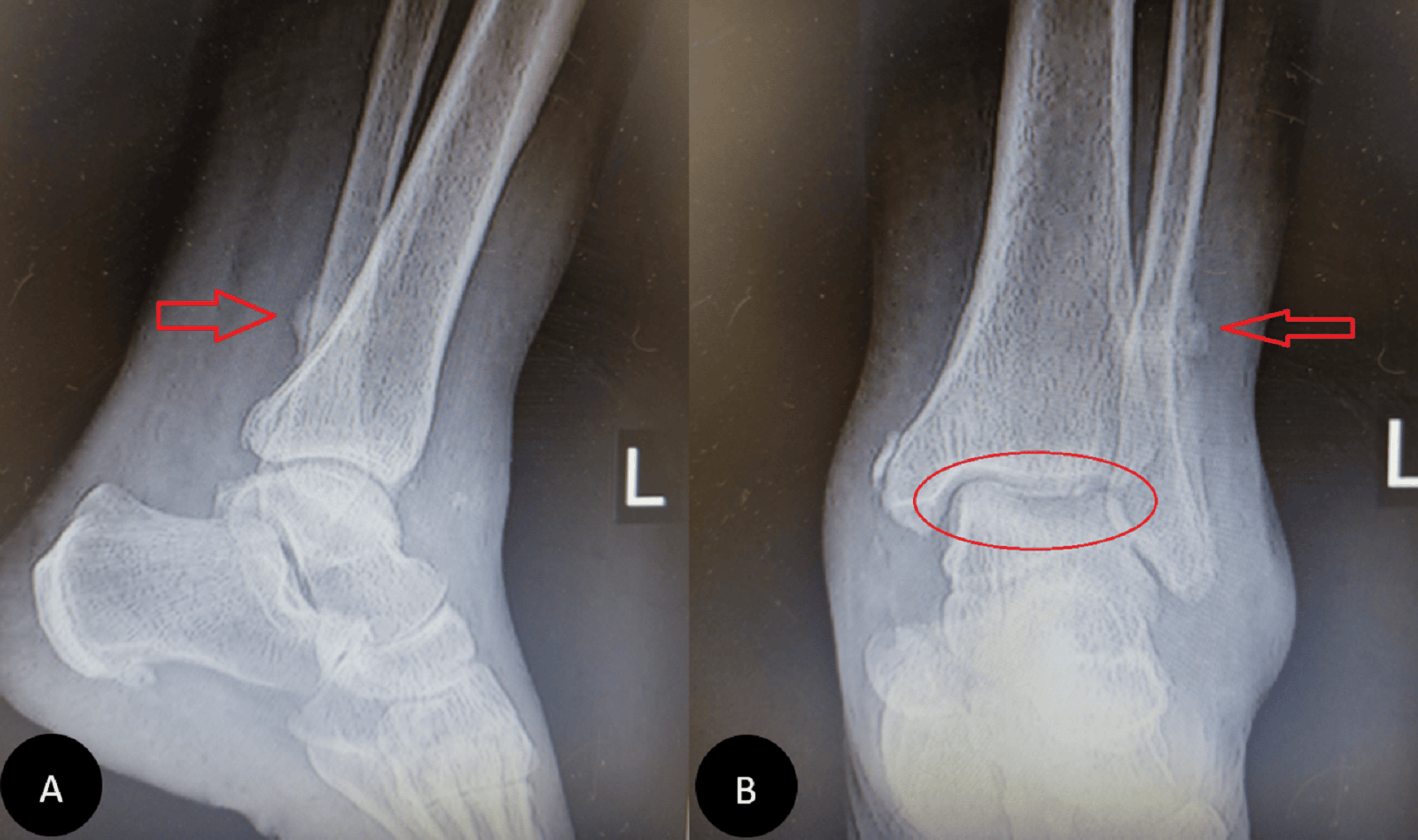
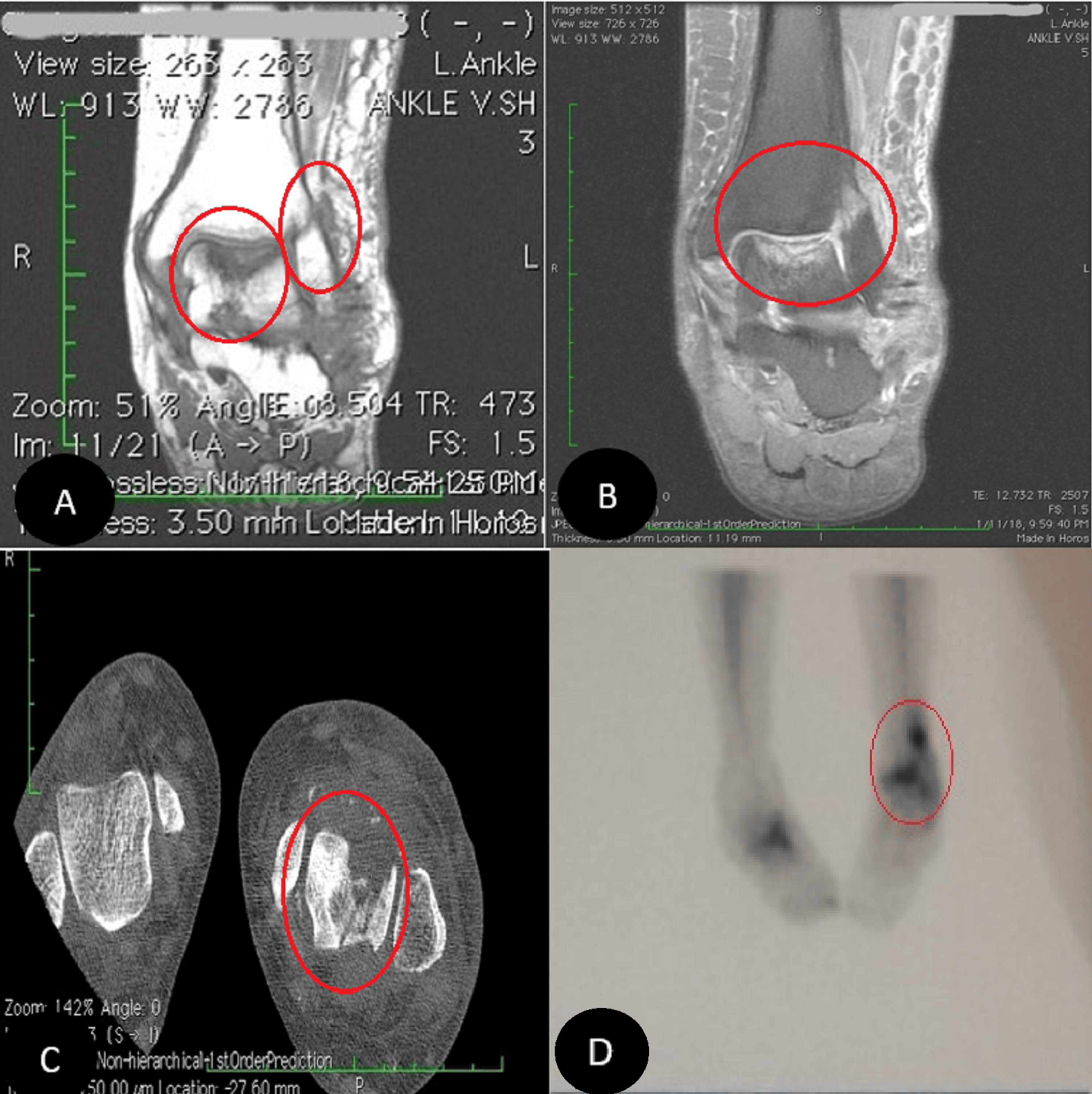
In our first visit, during the physical examination, the pain was localized in the ankle mortise with some posterolateral pain along the course of the peroneal tendons posterior to the fibula. Based on the physical examination and available ankle radiographs, we diagnosed AVNT. The patient subsequently underwent ankle arthroscopy through the standard anterior portals, the joint was cleaned, the synovium was shaved, and a small incision was conducted for peroneal assessment; this procedure revealed a subchondral collapse and extensive necrosis in the talus. Following the procedure, she experienced a partial improvement in her symptoms. However, six months later, she returned with a recurrence of symptoms (Figure 1). Upon further inquiry, she mentioned that her symptoms had recurred a month ago when she was dancing at a family party. Radiographs showed a stress fracture in her fibula and extensive AVNT. This diagnosis was confirmed through a CT scan, MRI, and bone scan (Figure 2).

Ankle-X-ray-six-months-after-arthroscopy
Figure 1: Ankle X-ray six months after arthroscopy

Pain had reduced for four months, then pain increased with activity and disabled her after a night of dancing. Subchondral fracture and fibular stress fracture are evident (A and B, respectively).

MRI,-CT-scan,-and-technetium-99m-(Tc-99m)-bone-scan
Figure 2: MRI, CT scan, and technetium-99m (Tc-99m) bone scan

Coronal MRI confirmed avascular necrosis of the talar dome with subchondral fracture (A and B, respectively). CT scan (C) and Tc-99 bone scan (D) images also revealed the pathologies.

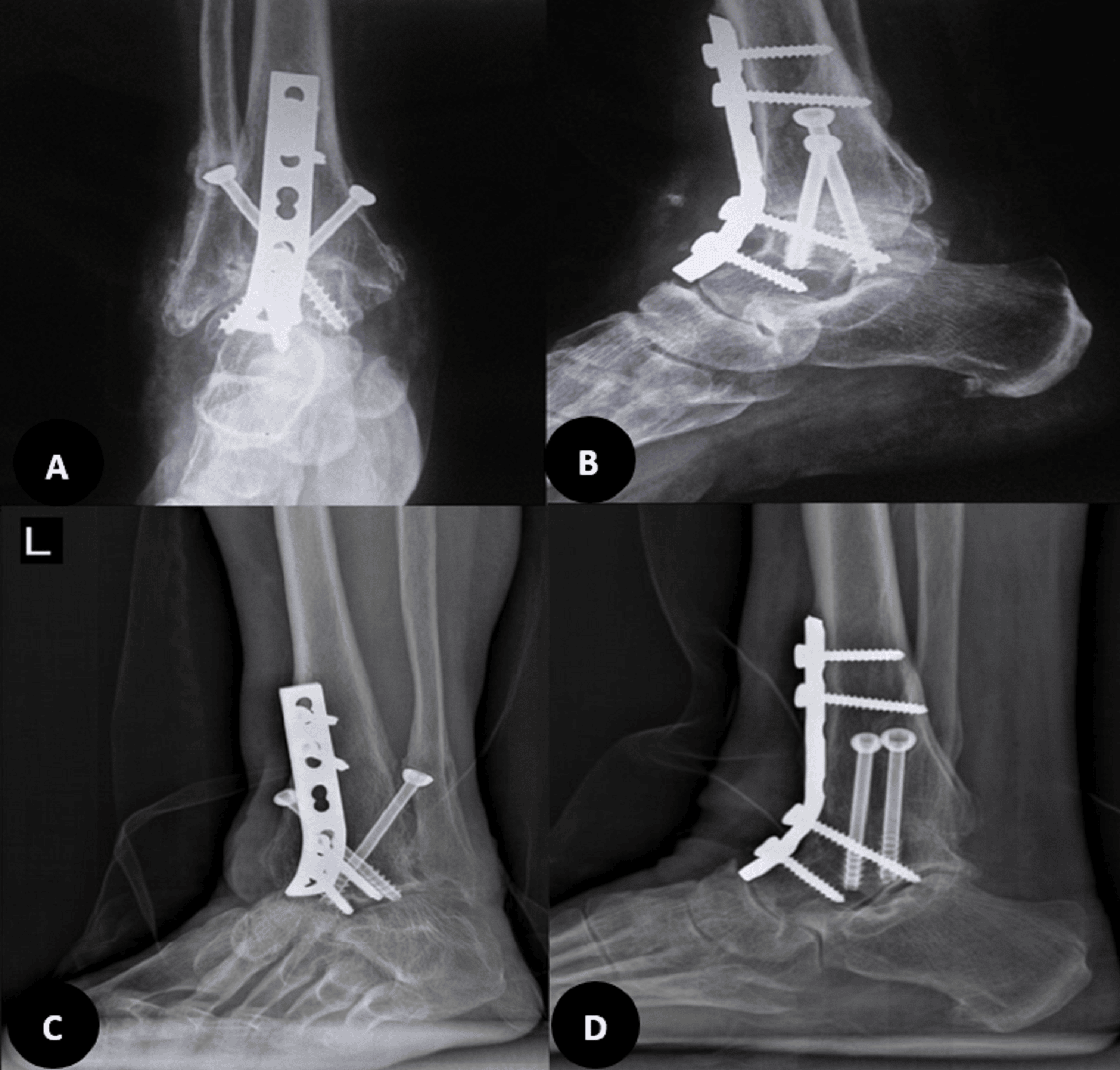
In the second visit after arthroscopy, upon confirmation of a fibular stress fracture and significant subchondral collapse, and following a discussion of the next available options with the patient, the second procedure was performed as an ankle arthrodesis with an anterior approach. A 6 cm longitudinal incision was made anteriorly, and through the plane between the tibialis anterior and extensor hallucis longus, the ankle joint was accessed. Joint preparation was done with an osteotome, ensuring a bleeding surface on both sides. Then, manual compression with provisional pin fixation in the corrective position was performed. The fusion was planned at less than 5 degrees of valgus, 10 degrees of external rotation, and approximately 10 degrees of plantar flexion, suitable for the high-heeled shoes that she was using in her daily living activities. After confirming fluoroscopy in two planes, final 6.5 mm cannulated cancellous screws were used, and fixation was augmented with an anterior molded 4.5 mm narrow dynamic compression plate (DCP), according to our previously published anterior ankle fusion technique [13]. The foot was placed in a splint for 10 days, after which stitches were removed, and a cast was applied for four weeks. Then, walking with gradual, as-tolerated weight-bearing was initiated (Figure 3). Three months after surgery, she was pain-free, and by the sixth month, she could walk without any boot or brace, only using high-heeled shoes.

Post-operative-radiographies
Figure 3: Post-operative radiographies

Six months after the ankle surgery, a huge osteonecrosis and fibular stress fracture were managed with an acceptable, painless ankle fusion (not solid) despite the remaining necrosis (A and B, respectively). In 2024, four years after the tumor resection, complete healing of talus necrosis and solid fusion were achieved (C and D, respectively).

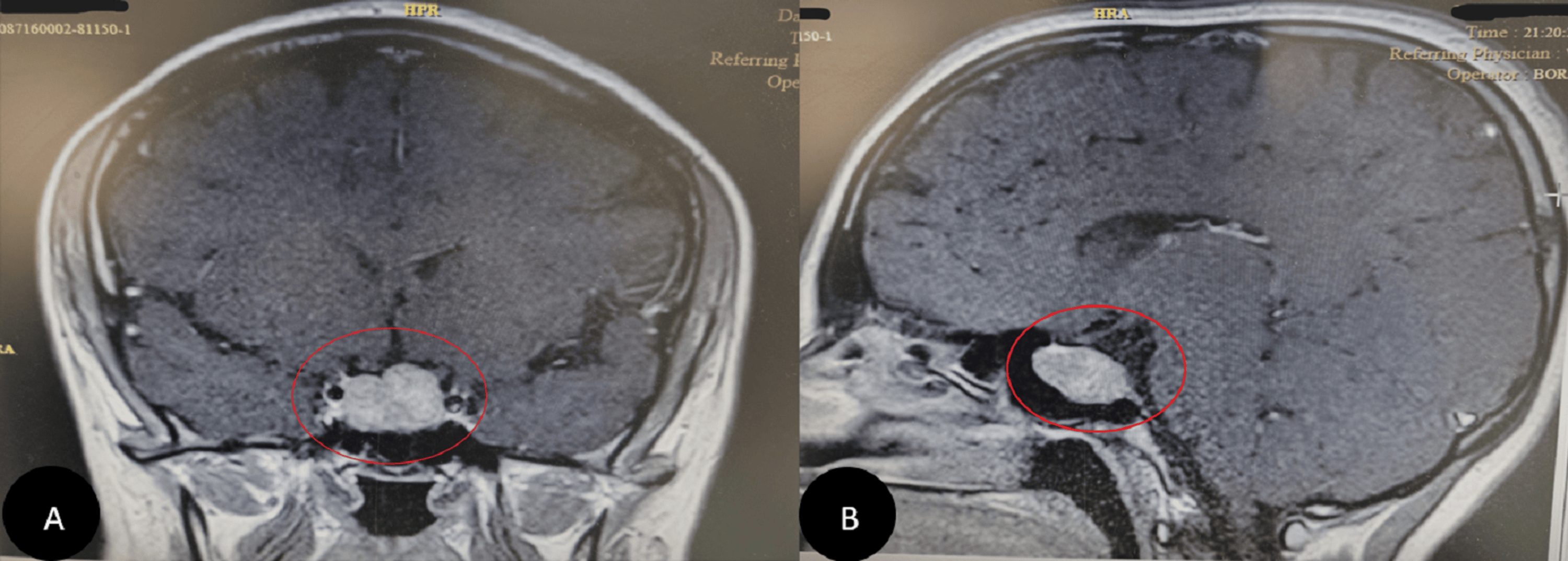
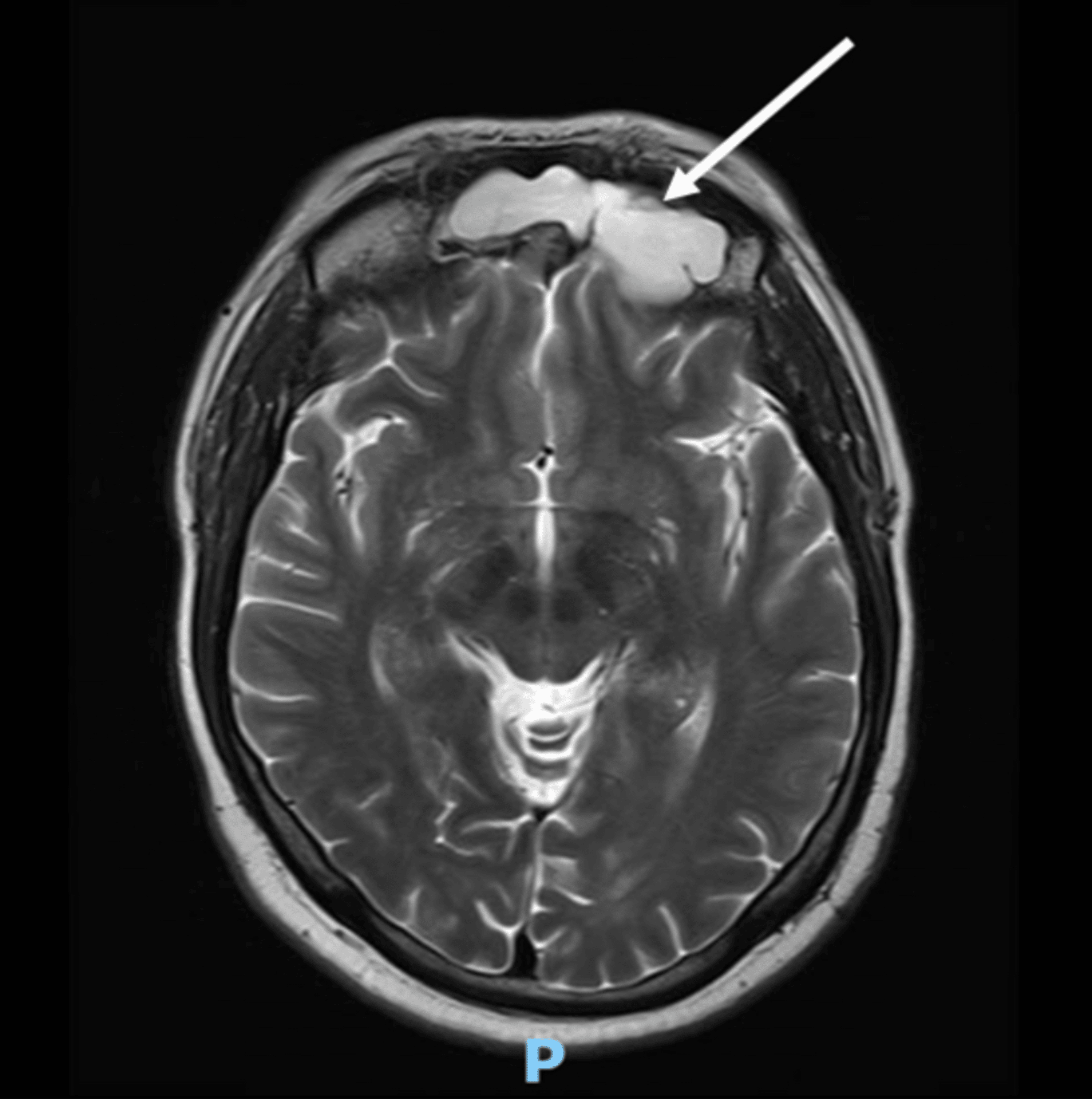
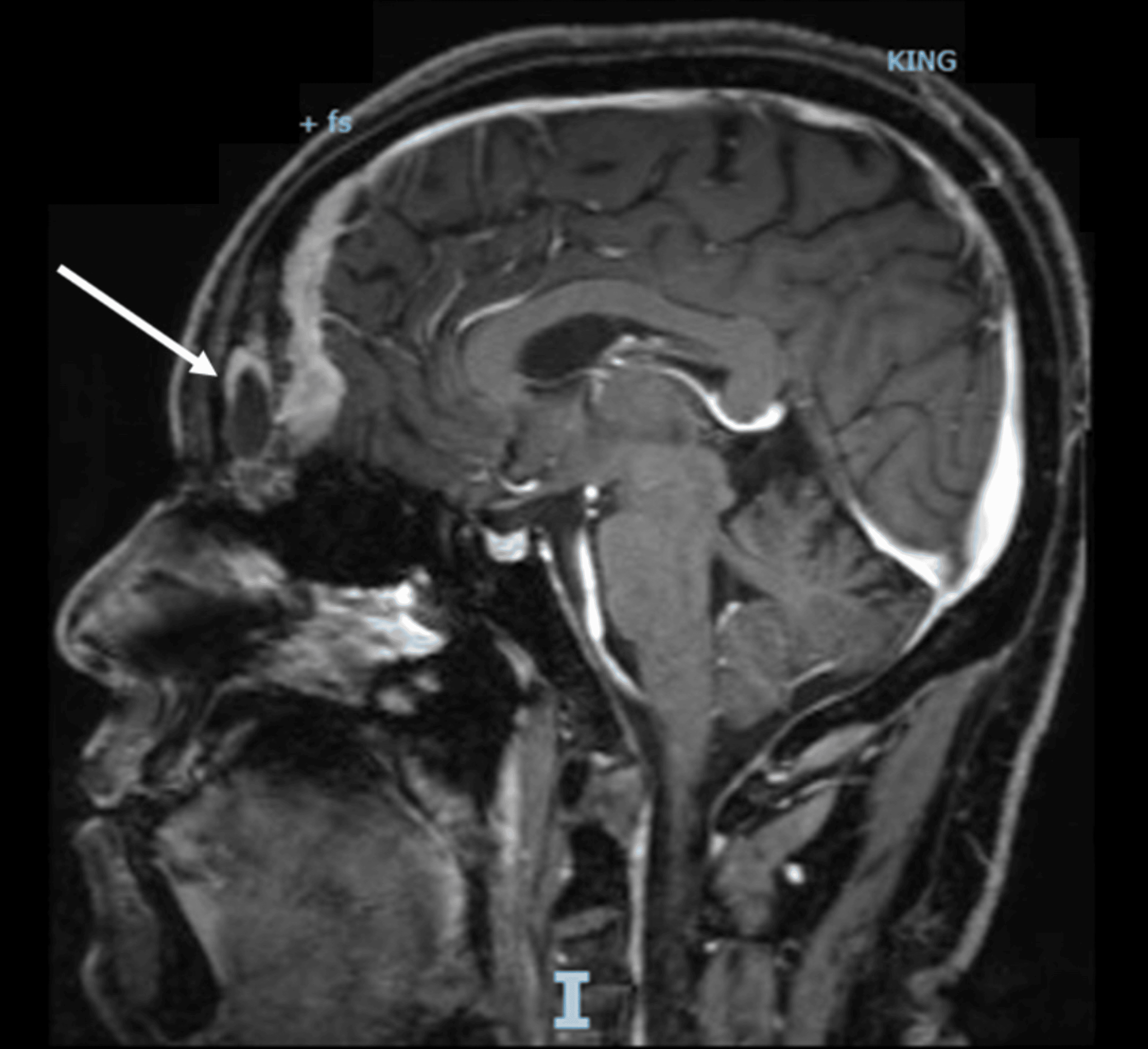
In 2020, two years after her ankle surgery, she was referred to an endocrinologist due to excessive weight gain and hirsutism. The biochemical assessment revealed the following: cortisol (8 AM) (chemiluminescence immunoassay (CLIA)) was 96 µg/dl (normal range: 4.82 – 19.5 µg/dl), and it was 22.1 µg/dl after overnight dexamethasone (normal range: < 1.8 µg/dl). Adrenocorticotropic hormone (ACTH) (CLIA) was 44.4 pg/ml (normal range: 7.2-63.3 pg/ml), and cortisol measured 5.7 µg/dl after the 48-hour low-dose dexamethasone suppression test (normal < 5 µg/dl). The results, along with symptoms (Table 1), are documented in the laboratory tests (Table 2). She was diagnosed with Cushing’s syndrome, which was subsequently confirmed as Cushing’s disease due to an ACTH-producing pituitary adenoma observed in the MRI and Brain CT (Figure 4).

Sign/symptom Severity
Weight Gain Severe
Hirsutism Severe
Hypertension Severe
Easy bruising Severe
Depression Severe
Moon face Moderate (masked with makeup)
Lethargy Moderate
Headache Moderate
Peripheral edema       _
Buffalo hump       _
Myopathy       _
Acne       _
Purple striae       _
Table 1: Cushing’s disease symptoms and signs

The hyphens in the table indicate that the patient does not have those symptoms or signs.

Laboratory test Result Reference range
Cortisol (8 AM) (CLIA) 96 µg/dl 4.82-19.5 µg/dl
Cortisol (8 AM) (after overnight dexamethasone) (CLIA) 22.1 µg/dl <1.8 µg/dl
ACTH (CLIA) 44.4 pg/ml 7.2-63.3 pg/ml
Cortisol after 48 hours of LDDST (CLIA) 5.7 µg/dl < 5 µg/dl
Table 2: Laboratory tests

CLIA: chemiluminescence immunoassay; ACTH: adrenocorticotropic hormone; LDDST: low-dose dexamethasone suppression test

Brain-MRI
Figure 4: Brain MRI

Finally, a pituitary adenoma was diagnosed using a Brain MRI as the cause of Cushing’s disease symptoms (A and B).

Finally, she underwent a tumor resection and had a dramatic response after treatment (30 kg weight loss). She revealed that she had Cushing’s syndrome symptoms since she was young. These symptoms included a puffy face, which she covered with makeup, high blood pressure, and hirsutism. In January 2024, four years after her brain surgery, during our last visit, her symptoms had significantly improved. She reported no problems with her ankle, and talus necrosis was completely healed, with a solid fusion achieved in radiographs (Figure 3).

Discussion

As far as we are aware, this case presentation represents the first instance of AVNT attributed to Cushing’s disease in the existing literature. Nevertheless, some individuals with endogenous Cushing’s syndrome have been reported to experience AVN of the femoral head [4-12].

Cushing’s syndrome is an uncommon endocrine condition marked by manifestations of hypercortisolism. The predominant cause is often an adenoma in the anterior pituitary gland that produces ACTH, referred to as Cushing’s disease [14]. The presentation of Cushing’s syndrome can vary significantly in both adults and children, influenced by the extent and duration of hypercortisolemia. However, the typical signs and symptoms of Cushing’s syndrome are widely known [15]. Although some individuals may perceive these alterations as normal and physiological, the disease can go unnoticed for an extended period, as in our case, in which it remained undiagnosed for more than 20 years.

However, it is known that steroid use is a significant contributing factor to the occurrence of bone osteonecrosis, accounting for up to 40% of non-traumatic instances of AVN [16]. The mechanisms leading to AVN due to either endogenous hypercortisolism or excess exogenous glucocorticoids are not completely understood. There are just some hypotheses that suggest that the hypertrophy of fat cells, embolization of fat, and osteocytes’ apoptosis result in impaired blood flow in the bone, ultimately causing ischemic tissue necrosis [17]. An alternative proposed theory suggests that elevated levels of glucocorticoids may cause insulin resistance and subsequently contribute to AVN [18].

Traditional X-rays often fail to detect the initial changes of AVN (as observed in our case). MRI stands as the preferred method for identifying AVN in its early phases, providing an opportunity for timely therapeutic interventions [19,20].

In an analysis of 321 cases of AVNT, the predominant treatment modalities included conservative therapies (n = 104), hindfoot fusion (n = 62), and core decompression (n = 85) [21]. These approaches reflect the primary methods employed in contemporary clinical practice for addressing AVNT.

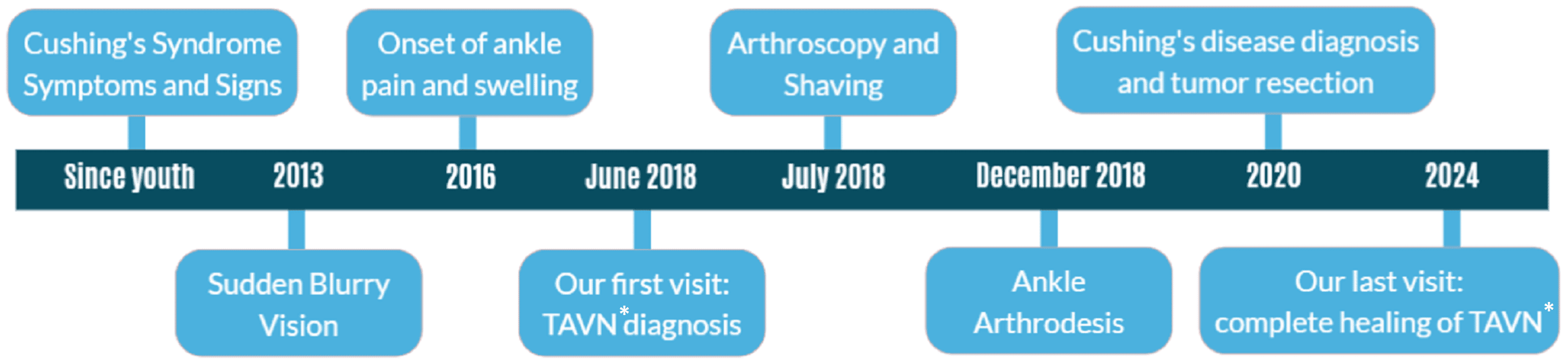
After all, we confirmed the AVNT diagnosis using MRI and bone scan and managed it with hindfoot fusion. Subsequently, the underlying issue, endogenous hypercortisolism due to an ACTH-producing pituitary adenoma, was identified and treated through resection of the tumor (Figure 5).

Case-report-timeline
Figure 5: Case report timeline

* Avascular necrosis in the talus

Conclusions

Cushing’s syndrome is a rare endocrine disorder characterized by excessive cortisol levels, commonly caused by an ACTH-producing adenoma in the pituitary gland, known as Cushing’s disease. Cushing’s disease may be one of the rare causes of AVNT. To the best of our knowledge, this is the first instance of AVNT due to Cushing’s disease described in the literature. Since atraumatic AVNT is rare in itself, a multidisciplinary approach can lead us to a more rapid and proper diagnosis, as each symptom may be masked or considered rare within its subspecialty field.

References

  1. Chang CC, Greenspan A, Gershwin ME: Osteonecrosis: current perspectives on pathogenesis and treatment. Semin Arthritis Rheum. 1993, 23:47-69. 10.1016/s0049-0172(05)80026-5
  2. Zhang H, Fletcher AN, Scott DJ, Nunley J: Avascular osteonecrosis of the talus: current treatment strategies. Foot Ankle Int. 2022, 43:291-302. 10.1177/10711007211051013
  3. Parekh SG, Kadakia RJ: Avascular necrosis of the talus. J Am Acad Orthop Surg. 2021, 29:e267-78. 10.5435/JAAOS-D-20-00418
  4. Belmahi N, Boujraf S, Larwanou MM, El Ouahabi H: Avascular necrosis of the femoral head: an exceptional complication of Cushing’s disease. Ann Afr Med. 2018, 17:225-7. 10.4103/aam.aam_75_17
  5. Salazar D, Esteves C, Ferreira MJ, Pedro J, Pimenta T, Portugal R, Carvalho 😧 Avascular femoral necrosis as part of Cushing syndrome presentation: a case report. J Med Case Rep. 2021, 15:287. 10.1186/s13256-021-02882-7
  6. Alaya Z, Braham M, Bouajina E: Aseptic femur head necrosis revealing Cushing’s disease: a rare presentation. J Clin Surg Res. 2020, 1:10.31579/2768-2757/002
  7. Phillips KA, Nance EP Jr, Rodriguez RM, Kaye JJ: Avascular necrosis of bone: a manifestation of Cushing’s disease. South Med J. 1986, 79:825-9. 10.1097/00007611-198607000-00011
  8. Koch CA, Tsigos C, Patronas NJ, Papanicolaou DA: Cushing’s disease presenting with avascular necrosis of the hip: an orthopedic emergency. J Clin Endocrinol Metab. 1999, 84:3010-2. 10.1210/jcem.84.9.5992
  9. Modroño N, Torán CE, Pavón I, Benza ME, Guijarro G, Navea 😄 Cushinǵs syndrome and avascular hip necrosis: presentation of two patients [Article in Spanish]. Rev Clin Esp (Barc). 2014, 214:e93-6. 10.1016/j.rce.2014.05.003
  10. Camporro F, Bulacio E, Gutiérrez Magaldi I: Bilateral osteonecrosis of the hip secondary to endogenous Cushing’s syndrome due to a recently-diagnosed carcinoid tumour of the lung [Article in Spanish]. Med Clin (Barc). 2016, 147:228. 10.1016/j.medcli.2016.03.042
  11. Ha JS, Cho HM, Lee HJ, Kim SD: Bilateral avascular necrosis of the femoral head in a patient with asymptomatic adrenal incidentaloma. Hip Pelvis. 2019, 31:120-3. 10.5371/hp.2019.31.2.120
  12. Anand A, Jha CK, Singh PK, Sinha U, Ganesh A, Bhadani PP: Avascular necrosis of femur as a complication of Cushing’s syndrome due to adrenocortical carcinoma. Am Surg. 2023, 89:2701-4. 10.1177/00031348221129510
  13. Gharehdaghi M, Rahimi H, Mousavian A: Anterior ankle arthrodesis with molded plate: technique and outcomes. Arch Bone Jt Surg. 2014, 2:203-9.
  14. Lindholm J, Juul S, Jørgensen JO, et al.: Incidence and late prognosis of cushing’s syndrome: a population-based study. J Clin Endocrinol Metab. 2001, 86:117-23. 10.1210/jcem.86.1.7093
  15. Nieman LK, Biller BM, Findling JW, Newell-Price J, Savage MO, Stewart PM, Montori VM: The diagnosis of Cushing’s syndrome: an Endocrine Society Clinical Practice Guideline. J Clin Endocrinol Metab. 2008, 93:1526-40. 10.1210/jc.2008-0125
  16. Konarski W, Poboży T, Konarska K, Śliwczyński A, Kotela I, Hordowicz M, Krakowiak J: Osteonecrosis related to steroid and alcohol use-an update on pathogenesis. Healthcare (Basel). 2023, 11:1846. 10.3390/healthcare11131846
  17. Chan KL, Mok CC: Glucocorticoid-induced avascular bone necrosis: diagnosis and management. Open Orthop J. 2012, 6:449-57. 10.2174/1874325001206010449
  18. Hartmann K, Koenen M, Schauer S, Wittig-Blaich S, Ahmad M, Baschant U, Tuckermann JP: Molecular actions of glucocorticoids in cartilage and bone during health, disease, and steroid therapy. Physiol Rev. 2016, 96:409-47. 10.1152/physrev.00011.2015
  19. Kaste SC, Karimova EJ, Neel MD: Osteonecrosis in children after therapy for malignancy. AJR Am J Roentgenol. 2011, 196:1011-8. 10.2214/AJR.10.6073
  20. Pierce TP, Jauregui JJ, Cherian JJ, Elmallah RK, Mont MA: Imaging evaluation of patients with osteonecrosis of the femoral head. Curr Rev Musculoskelet Med. 2015, 8:221-7. 10.1007/s12178-015-9279-6
  21. Gross CE, Haughom B, Chahal J, Holmes GB Jr: Treatments for avascular necrosis of the talus: a systematic review. Foot Ankle Spec. 2014, 7:387-97. 10.1177/1938640014521831

From https://www.cureus.com/articles/221491-talus-avascular-necrosis-as-a-rare-complication-of-cushings-disease-a-case-report?score_article=true#!/

Delayed Diagnosis of Ectopic Cushing Syndrome

Abstract

Here, we present the case of a 40-year-old man in whom the diagnosis of ectopic adrenocorticotropin (ACTH) syndrome went unrecognized despite evaluation by multiple providers until it was ultimately suspected by a nephrologist evaluating the patient for edema and weight gain. On urgent referral to endocrinology, screening for hypercortisolism was positive by both low-dose overnight dexamethasone suppression testing and 24-hour urinary free cortisol measurement. Plasma ACTH values confirmed ACTH-dependent Cushing syndrome. High-dose dexamethasone suppression testing was suggestive of ectopic ACTH syndrome. Inferior petrosal sinus sampling demonstrated no central-to-peripheral gradient, and 68Ga-DOTATATE scanning revealed an avid 1.2-cm left lung lesion. The suspected source of ectopic ACTH was resected and confirmed by histopathology, resulting in surgical cure. While many patients with Cushing syndrome have a delayed diagnosis, this case highlights the critical need to increase awareness of the signs and symptoms of hypercortisolism and to improve the understanding of appropriate screening tests among nonendocrine providers.

Introduction

Even in the face of overt clinical signs and symptoms of hypercortisolism, diagnosing Cushing syndrome requires a high index of suspicion, and people with hypercortisolism experience a long road to diagnosis. In a recent meta-analysis including more than 5000 patients with Cushing syndrome, the mean time to diagnosis in all Cushing syndrome, including Cushing disease and ectopic adrenocorticotropin (ACTH) syndrome, was 34 months (1). Reasons for delayed diagnosis are multifactorial, including the nonspecific nature of subjective symptoms and objective clinical signs, as well as notorious challenges in the interpretation of diagnostic testing. Furthermore, the health care system’s increasingly organ-specific referral patterns obfuscate multisystem disorders. Improving the recognition of and decreasing time to diagnosis in Cushing syndrome are critical factors in reducing morbidity and mortality.

Here, we present the case of a patient who, despite classic signs of Cushing syndrome as well as progressive physical and mental decline, remained undiagnosed for more than 3 years while undergoing repeated evaluation by primary care and subspecialty providers. The case (1) highlights the lack of awareness of Cushing syndrome as a potential unifying diagnosis for multiorgan system problems; (2) underscores the necessity of continued education on the signs and symptoms of hypercortisolism, appropriate screening for hypercortisolism, and early referral to endocrinology; and (3) provides an opportunity for systemic change in clinical laboratory practice that could help improve recognition of pathologic hypercortisolism.

Case Presentation

In August 2018, a previously healthy 40-year-old man with ongoing tobacco use established care with a primary care provider complaining that he had been ill since the birth of his son 13 months prior. He described insomnia, headaches, submandibular swelling, soreness in his axillary and inguinal regions, and right-sided chest discomfort (Fig. 1). Previously, he had been diagnosed with sinusitis, tonsillitis, and allergies, which had been treated with a combination of antibiotics, antihistamines, and intranasal glucocorticoids. He was referred to otolaryngology where, in the absence of cervical lymphadenopathy, he was diagnosed with sternocleidomastoid pain with recommendations to manage conservatively with stretching and massage. A chest x-ray demonstrated a left apical lung nodule. Symptoms continued unabated throughout 2019, now with a cough. Repeat chest x-ray demonstrated opacities lateral to the left hilum that were attributed to vascular structures.


Figure 1.

Timeline of development of subjective symptoms and objective clinical findings preceding diagnosis and surgical cure of ectopic Cushing syndrome.

In May 2020, increasingly frustrated with escalating symptoms, the patient transitioned care to a second primary care provider and was diagnosed with hypertension. He complained of chronic daily headaches that prompted brain imaging with magnetic resonance imaging (MRI), which noted findings consistent with left maxillary silent sinus syndrome. He was sent back to otolaryngology, which elected to proceed with sinus surgery. During this time, he suffered a fibular fracture for which he was evaluated by orthopedic surgery. In the second half of 2020, he was seen by neurology to evaluate his chronic headaches and paresthesias with electromyography demonstrating a left ulnar mononeuropathy consistent with cubital tunnel syndrome. His primary care provider diagnosed him with fibromyalgia for which he started physical therapy, and he was referred to a pain clinic for cognitive behavioral therapy. Unfortunately his wife, dealing with her husband’s increasing cognitive and personality changes including irritability and aggression, filed for divorce.

At the end of 2020, the patient developed bilateral lower extremity edema and was prescribed hydrochlorothiazide, subsequently developing hypokalemia attributed to diuretic use. With worsening bilateral lower extremity edema and new dyspnea on exertion, he was evaluated for heart failure with an echocardiogram, which was unremarkable. Over the next several months, he gained approximately 35 pounds (∼16 kg). It was in the setting of weight gain that he was first evaluated for hypercortisolism with random serum cortisol of 22.8 mcg/dL (629 nmol/L) and 45.6 mcg/dL (1258 nmol/L) in the late morning and mid-day, respectively. No reference range was provided for the times of day at which these laboratory values were drawn. Although these serum cortisol values were above provided reference ranges for other times of day, they were not flagged as abnormal by in-house laboratory convention, and they were overlooked. The search for other etiologies of his symptoms continued.

In early 2021, diuretic therapy and potassium supplementation were escalated for anasarca. He developed lower extremity cellulitis and received multiple courses of antibiotics. Skin biopsy performed by dermatology demonstrated disseminated Mycobacterium and later Serratia (2), prompting referral to infectious disease for management. Additional subspecialty referrals included rheumatology (polyarthralgia) and gastroenterology (mildly elevated alanine transaminase with planned liver biopsy). In July 2021, he was evaluated for edema by nephrology, where the constellation of subjective symptoms and objective data including hypertension, central weight gain, abdominal striae, fracture, edema, easy bruising, medication-induced hypokalemia, atypical infections, and high afternoon serum cortisol were noted, and the diagnosis of Cushing syndrome was strongly suspected. Emergent referral to endocrinology was placed.

Diagnostic Assessment

At his first clinic visit with endocrinology in June 2021, the patient’s blood pressure was well-controlled on benazepril. Following weight gain of 61 pounds (∼28 kg) in the preceding 2 years, body mass index was 33. Physical examination demonstrated an ill-appearing gentleman with dramatic changes when compared to prior pictures (Fig. 2), including moon facies, dorsocervical fat pad, violaceous abdominal striae, weeping lower extremity skin infections, an inability to stand without assistance from upper extremities, and depressed mood with tangential thought processes.


Figure 2.

Photographic representation of physical changes during the years leading up to diagnosis of ectopic Cushing syndrome in June 2021 and after surgical resection of culprit lesion.

Diagnostic workup for hypercortisolism included a morning cortisol of 33.4 mcg/dL (922 nmol/L) (normal reference range, 4.5-22.7 mcg/dL) and ACTH of 156 pg/mL (34 pmol/L) (normal reference range, 7.2-63 pg/mL) following bedtime administration of 1-mg dexamethasone, and 24-hour urine free cortisol of 267 mcg/24 hours (737 nmol/24 hours) (normal reference range, 3.5-45 mcg/24 hours). Morning serum cortisol and plasma ACTH following bedtime administration of 8-mg dexamethasone were 27.9 mcg/dL (770 nmol/L) and 98 pg/mL (22 pmol/L), respectively. Given concern for potential decompensation, he was hospitalized for expedited work-up. Brain MRI did not demonstrate a pituitary lesion (Fig. 3), and inferior petrosal sinus sampling under desmopressin stimulation showed no central-to-peripheral gradient (Table 1). He underwent a positron emission tomography–computed tomography 68Ga-DOTATATE scan that demonstrated a 1.2-cm left pulmonary nodule with radiotracer uptake (Fig. 4).


Figure 3.

A, Precontrast and B, postcontrast T1-weighted sagittal magnetic resonance imaging of the sella. Images were affected by significant motion degradation, precluding clear visualization of the pituitary gland on coronal imaging.


Figure 4.

68Ga-DOTATATE imaging. A, Coronal and B, axial views of the chest after administration of radiopharmaceutical. Arrow in both panels indicates DOTATATE-avid 1.2-cm left lung lesion.


Table 1.

Bilateral petrosal sinus and peripheral adrenocorticotropin levels preintravenous and postintravenous injection of desmopressin acetate 10 mcg

Time post DDAVP, min Left petrosal ACTH Left petrosal:peripheral ACTH Right petrosal ACTH Right petrosal:peripheral ACTH Peripheral ACTH Left:right petrosal ACTH
0 172 pg/mL
(37.9 pmol/L)
1.1 173 pg/mL
(38.1 pmol/L)
1.2 150 pg/mL
(33.0 pmol/L)
1.0
3 288 pg/mL
(63.4 pmol/L)
1.8 292 pg/mL
(64.3 pmol/L)
1.8 162 pg/mL
(35.7 pmol/L)
1.0
5 348 pg/mL
(76.6 pmol/L)
1.8 341 pg/mL
(75.1 pmol/L)
1.8 191 pg/mL
(42.1 pmol/L)
1.0
10 367 pg/mL
(80.8 pmol/L)
1.3 375 pg/mL
(82.6 pmol/L)
1.3 278 pg/mL
(61.2 pmol/L)
1.0

Abbreviations: ACTH, adrenocorticotropin; DDAVP, desmopressin acetate.

Treatment

The patient was started on ketoconazole 200 mg daily for medical management of ectopic ACTH-induced hypercortisolism while awaiting definitive surgical treatment. Within a month of initial endocrinology evaluation, he underwent thoracoscopic left upper lobe wedge resection with intraoperative frozen histopathology section consistent with a well-differentiated neuroendocrine tumor and final pathology consistent with a well-differentiated neuroendocrine tumor. Staining for ACTH was positive (Fig. 5). Postoperative day 1 morning cortisol was 1.4 mcg/dL (39 nmol/L) (normal reference range, 4.5-22.7 mcg/dL). He was started on glucocorticoid replacement with hydrocortisone and was discharged from his surgical admission on hydrocortisone 40 mg in the morning and 20 mg in the afternoon.


Figure 5.

Lung tumor histopathology. A, The tumor was epicentered around a large airway (asterisk) and showed usual architecture for carcinoid tumor. B, The tumor cells had monomorphic nuclei with a neuroendocrine chromatin pattern, variably granulated cytoplasm, and a delicate background vascular network. By immunohistochemistry, the tumor cells were strongly positive for C, synaptophysin; D, CAM5.2; and E, adrenocorticotropin. F, Ki-67 proliferative index was extremely low (<1%).

Outcome and Follow-up

Approximately 12 days after discharge, the patient was briefly readmitted from the skilled nursing facility where he was receiving rehabilitation due to a syncopal event attributed to hypovolemia. This was felt to be secondary to poor oral intake in the setting of both antihypertensive and diuretic medications as well as an episode of emesis earlier in the morning precluding absorption of his morning hydrocortisone dose. Shortly after this overnight admission, he was discharged from his skilled nursing facility to home. In the first month after surgery, he lost approximately 30 pounds (∼14 kg) and had improvements in sleep and mood.

Eight months after surgery, hydrocortisone was weaned to 10 mg daily. Cosyntropin stimulation testing holding the morning dose showed 1 hour cortisol 21.5 mcg/dL (593 nmol/L). Hydrocortisone was subsequently discontinued. In June 2022, 1 year following surgery, 3 sequential midnight salivary cortisol tests were undetectable. At his last visit with endocrinology in June 2023, he felt well apart from ongoing neuropathic pain in his feet and continued but improved mood disturbance. Though his health has improved dramatically, he continues to attribute his divorce and substantial life disruption to his undiagnosed hypercortisolism.

Discussion

Endogenous neoplastic hypercortisolism encompasses a clinical spectrum from subclinical disease, as is common in benign adrenal cortical adenomas, to overt Cushing syndrome of adrenal, pituitary, and ectopic origin presenting with dramatic clinical manifestations (3) and long-term implications for morbidity and mortality (4). Even in severe cases, a substantial delay in diagnosis is common. In this case, despite marked hypercortisolism secondary to ectopic ACTH syndrome, the patient’s time from first symptoms to diagnosis was more than 3 years, far in excess of the typical time to diagnosis in this subtype, noted to be 14 months in 1 study (1).

He initially described a constellation of somatic symptoms including subjective neck swelling, axillary and inguinal soreness, chest discomfort, and paresthesias, and during the year preceding diagnosis, he developed hypertension, fibular fracture, mood changes, weight gain, peripheral edema, hypokalemia, unusual infections, and abdominal striae. Each of these symptoms in isolation is a common presentation in the primary care setting, therefore the challenge arises in distinguishing common, singular causes from rare, unifying etiologies, especially given the present epidemics of diabetes, obesity, and associated cardiometabolic abnormalities. By Endocrine Society guidelines, the best discriminatory features of Cushing syndrome in the adult population are facial plethora, proximal muscle weakness, abdominal striae, and easy bruising (5). Furthermore, Endocrine Society guidelines suggest evaluating for Cushing disease when consistent clinical features are present at a younger-than-expected age or when these features accumulate and progress, as was the case with our patient (5).

However, even when the diagnosis is considered, the complexities of the hypothalamic-pituitary-adrenal axis make selection and interpretation of screening tests challenging outside the endocrinology clinic. We suspect that in most such situations, a random serum cortisol measurement is far more likely to be ordered than a validated screening test, such as dexamethasone suppression testing, urine free cortisol, and late-night salivary cortisol per Endocrine Society guidelines (5). Although random serum cortisol values are not considered a screening test for Cushing syndrome, elevated values can provide a clue to the diagnosis in the right clinical setting. In this case, 2 mid-day serum cortisols were, by in-house laboratory convention, not flagged as abnormal despite the fact that they were above the upper limit of provided reference ranges. We suspect that the lack of electronic medical record flagging of serum cortisol values contributed to these values being incorrectly interpreted as ruling out the diagnosis.

Cushing syndrome remains among the most evasive and difficult diagnoses in medicine due to the doubly difficult task of considering the disorder in the face of often protean signs and symptoms and subsequently conducting and interpreting screening tests. The challenges this presents for the nonendocrinologist have recently been recognized by a group in the United Kingdom after a similarly overlooked case (6). We believe that our case serves as a vivid illustration of the diagnostic hurdles the clinician faces and as a cautionary tale with regard to the potential downstream effects of a delay in diagnosis. Standardization of clinical laboratory practices in flagging abnormal cortisol values is one such intervention that may aid the busy clinician in more efficiently recognizing laboratory results suggestive of this diagnosis. While false-positive case detection is a significant downside to this approach, given the potential harm in delayed or missed diagnosis, the potential benefits may outweigh the risks.

Learning Points

  • People with Cushing syndrome frequently experience a prolonged time to diagnosis, in part due to lack of recognition in the primary care and nonendocrine subspecialty settings of the constellation of clinical findings consistent with hypercortisolism.
  • Endocrine Society guidelines recommend against random serum cortisol as initial testing for Cushing syndrome in favor of dexamethasone suppression testing, urine free cortisol, and late-night salivary cortisol.
  • Increased awareness of Cushing syndrome by primary care providers and specialists in other fields could be an important and impactful mechanism to shorten the duration of symptom duration in the absence of diagnosis and hasten cure where cure is achievable.
  • We suggest clinical laboratories consider standardizing flagging abnormal cortisol values to draw attention to ordering providers and perhaps lower the threshold for endocrinology referral if there is any uncertainty in interpretation, especially in the context of patients with persistent symptoms and elusive diagnoses.

Acknowledgments

We are grateful to the patient for allowing us to present his difficult case to the community with the hopes of improving time to diagnosis for patients with hypercortisolism.

Contributors

All authors made individual contributions to authorship. J.M.E., E.M.Z., and K.R.K. were involved in the diagnosis and management of this patient. B.C.M., J.M.E., E.M.Z., and K.R.K. were involved in manuscript submission. S.M.J. performed and analyzed histopathology and prepared the figure for submission. All authors reviewed and approved the final draft.

Funding

No public or commercial funding.

Disclosures

J.M.E. was on the editorial board of JCEM Case Reports at the time of initial submission.

Informed Patient Consent for Publication

Signed informed consent obtained directly from the patient.

Data Availability Statement

Data sharing is not applicable to this article as no data sets were generated or analyzed during the current study.

References

1

Rubinstein
G

,

Osswald
A

,

Hoster
E

, et al.

Time to diagnosis in Cushing’s syndrome: a meta-analysis based on 5367 patients

.

J Clin Endocrinol Metab

.

2020

;

105

(

3

):

dgz136

.

2

Park
MA

,

Gaghan
LJ

,

Googe
PB

,

Klein
KR

,

Mervak
JE

.

Disseminated cutaneous Mycobacterium chelonae infection as a presenting sign of ectopic adrenocorticotropic hormone syndrome

.

JAAD Case Rep

.

2021

;

18

:

79

81

.

3

Reincke
M

,

Fleseriu
M

.

Cushing syndrome: a review

.

JAMA

.

2023

;

330

(

2

):

170

181

.

4

Puglisi
S

,

Perini
AME

,

Botto
C

,

Oliva
F

,

Terzolo
M

.

Long-term consequences of Cushing’s syndrome: a systematic literature review

.

J Clin Endocrinol Metab

. 2024;

109

(

3

):

e901

e909

.

5

Nieman
LK

,

Biller
BMK

,

Findling
JW

, et al.

The diagnosis of Cushing’s syndrome: an Endocrine Society clinical practice guideline

.

J Clin Endocrinol Metab

.

2008

;

93

(

5

):

1526

1540

.

6

Scoffings
K

,

Morris
D

,

Pullen
A

,

Temple
S

,

Trigell
A

,

Gurnell
M

.

Recognising and diagnosing Cushing’s syndrome in primary care: challenging but not impossible

.

Br J Gen Pract

.

2022

;

72

(

721

):

399

401

.

Abbreviations


  • ACTH

    adrenocorticotropin

  • MRI

    magnetic resonance imaging

© The Author(s) 2024. Published by Oxford University Press on behalf of the Endocrine Society.
This is an Open Access article distributed under the terms of the Creative Commons Attribution-NonCommercial-NoDerivs licence (https://creativecommons.org/licenses/by-nc-nd/4.0/), which permits non-commercial reproduction and distribution of the work, in any medium, provided the original work is not altered or transformed in any way, and that the work is properly cited. For commercial re-use, please contact journals.permissions@oup.com

Olfactory Neuroblastoma Causing Cushing’s Syndrome Due to the Ectopic Adrenocorticotropic Hormone (ACTH) Secretion

Abstract

Cushing’s syndrome is a constellation of features occurring due to high blood cortisol levels. We report a case of a 47-year-old male with a history of recurrent olfactory neuroblastoma (ONB). He presented with bilateral lower limb weakness and anosmia and was found to have Cushing’s syndrome due to high adrenocorticotropic hormone (ACTH) levels from an ectopic source, ONB in this case. Serum cortisol and ACTH levels declined after tumor removal.

Introduction

Olfactory neuroblastoma (ONB), or esthesioneuroblastoma, is a rare malignancy arising from neuroepithelium in the upper nasal cavity. It represents approximately 2% of all nasal passage tumors, with an incidence of approximately 0.4 per 2.5 million individuals [1]. ONB shares similar histological features with small round blue cell neoplasms of the nose. Ectopic hormone secretion is a very rare feature associated with these tumors. Five-year overall survival is reported to be between 60% and 80% [2,3]. The age distribution is either in the fifth to sixth decade of life [4,5], or in the second and sixth decades [6].

Features of Cushing’s syndrome (moon face, buffalo hump, central obesity hypertension, fragile skin, easy bruising, fatigue, muscle weakness) are due to high blood cortisol levels [7]. It can be either primary (cortisol-secreting adrenal tumor), secondary (adrenocorticotropic hormone (ACTH)-secreting pituitary tumor, also called Cushing disease), or ectopic ACTH secretion (from a non-pituitary source). All three types share similar features [8].

Ectopic ACTH syndrome (EAS) is due to an extra pituitary tumor, producing ACTH. It accounts for 12-17% of Cushing’s syndrome cases [9]. Most cases of EAS-producing tumors are in the lungs, mediastinum, neuroendocrine tumors of the gastrointestinal tract, and pheochromocytomas [9]. Ectopic ACTH secretion from an ONB is very rare. As of 2015, only 18 cases were reported in the literature [10]. Here, we report such a case.

Case Presentation

Our patient is a 47-year-old Bangladeshi male, with a history of recurrent ONB that was resected twice in the past (transsphenoidal resection in 2016 and 2019) with adjuvant radiotherapy, no chemotherapy was given. He also had diabetes mellitus type 1 (poorly controlled) and hypertension. He presented with bilateral lower limb weakness, anosmia, decreased oral intake, loss of taste for one week, and bilateral submandibular swelling that increased in size gradually over the past two years. There was no history of fever, cough, abdominal pain, or exposure to sick contacts. The patient reported past episodes of similar symptoms, but details are unclear. The patient’s family history is positive for diabetes mellitus type 1 in both parents. Lab tests in the emergency department showed hypokalemia and hyperglycemia as detailed in Table 1. He was admitted for further workup of the above complaints.

Test Patient Results Reference Range Unit Status
Hemoglobin 14.7 13-17 g/dL Normal
White blood cell (WBC) 17.9 4-10 10*9/L High
Neutrophils 15.89 2-7 10*9/L High
Lymphocytes 1.07 1-3 10*9/L Normal
Sodium 141 136-145 mmol/L Normal
Potassium 2.49 3.5-5.1 mmol/L Low (Panic)
Chloride 95 98-107 mmol/L Low
Glucose 6.52 4.11-5.89 mmol/L Elevated
C-reactive protein (CRP) 0.64 Less than 5 mg/L Normal
Erythrocyte sedimentation rate (ESR) 2 0-30 mm/h Normal
Creatinine 73 62-106 µmol/L Normal
Uric acid 197 202.3-416.5 µmol/L Normal
Alanine aminotransferase (ALT) 33.2 0-41 U/L Normal
Aspartate aminotransferase (AST) 18.6 0-40 U/L Normal
International Normalised Ratio (INR) 1.21 0.8-1.2 sec High
Prothrombin time (PT) 15.7 12.3-14.7 sec High
Lactate dehydrogenase (LDH) 491 135-225 U/L High
Thyroid-stimulating hormone (TSH) 0.222 0.27-4.20 mIU/L Low
Adrenocorticotropic hormone (ACTH) 106 ≤50 ng/L Elevated
Cortisol (after dexamethasone suppression) 1750 Morning hours (6-10 am): 172-497 nmol, Afternoon hours (4-8 pm): 74.1-286 nmol nmol/L Elevated (failure of suppression)
24-hour urine cortisol (after dexamethasone suppression) 5959.1 <120 nmol/24 hrs nmol/24hr Elevated (failure of suppression)
Table 1: Results of blood test at the time of hospitalization. Hypokalemia and high values of adrenocorticotropic hormone and cortisol were confirmed.

On examination, the patient’s vital signs were as follows: blood pressure was 154/77 mmHg, heart rate of 60 beats per minute, respiratory rate was 18 breaths per minute, oxygen saturation of 98% on room air, and a temperature of 36.7°C. The patient had a typical Cushingoid appearance with a moon face, buffalo hump, purple striae on the abdomen, central obesity, and hyperpigmentation of the skin. Submandibular lymph nodes were enlarged bilaterally. The examination of the submandibular lymph nodes showed a firm, fixed mass extending from the angle of the mandible to the submental space on the left side. Neurological examination showed weakness in both legs bilaterally (strength 3/5) and anosmia (checked by orthonasal smell test). The rest of the neurological exam was normal.

Laboratory findings revealed (in Table 1) a marked hypokalemia of 2.49 mmol/L and hyperglycemia of 6.52 mmol/L. The serum cortisol level was elevated at 1587 nmol/L. Serum ACTH levels were raised at 106 ng/L (normal value ≤50 ng/L). Moreover, the high-dose dexamethasone suppression test failed to lower the serum ACTH levels and serum and urine cortisol. Serum cortisol level after the suppression test was 1750 nmol/L, while 24-hour urine cortisol after the test was 5959.1 nmol/24hr. Serum ACTH levels after the test also remained high at 100mg/L. This indicated failure of ACTH suppression by high-dose dexamethasone, which points towards ectopic ACTH production. Other blood tests (complete blood count, liver function tests) were insignificant.

A computed tomography scan with contrast (CT scan) of the chest, abdomen, and pelvis, with a special focus on the adrenals, was negative for any malignancy or masses. CT scan of the neck showed bilaterally enlarged submandibular lymph nodes and an enlarged right lobe of the thyroid with nodules. Fine needle aspiration (FNA) of the thyroid nodules revealed a benign nature. Magnetic resonance imaging (MRI) of the brain showed a contrast-enhancing soft tissue lesion (18x18x10mm) in the midline olfactory groove area with extension into the frontal dura and superior sagittal sinus, suggesting recurrence of the previous ONB. There was evidence of previous surgery also. The pituitary gland was normal (Figures 12).

A-brain-MRI-(T1-weighted;-without-contrast;-sagittal-plane)-shows-a-soft-tissue-lesion-located-in-the-midline-olfactory-groove-area.-Dural-surface-with-extension-into-anterior-frontal-dura.
Figure 1: A brain MRI (T1-weighted; without contrast; sagittal plane) shows a soft tissue lesion located in the midline olfactory groove area. Dural surface with extension into anterior frontal dura.

MRI: Magnetic resonance imaging

A-brain-MRI-(T2-weighted;-without-contrast;-axial-plane)-shows-a-soft-tissue-lesion-located-in-the-midline-olfactory-groove-area.
Figure 2: A brain MRI (T2-weighted; without contrast; axial plane) shows a soft tissue lesion located in the midline olfactory groove area.

MRI: Magnetic resonance imaging

Octreotide scintigraphy showed three focal abnormal uptakes in the submandibular cervical nodes. Additionally, there was a moderate abnormal uptake at the midline olfactory groove with bilateral extension (Figure 3).

Whole-body-octreotide-scan-(15-mCi-99mTc-Octreotide-IV)-demonstrates-three-focal-abnormal-uptakes:-the-largest-(5.2-x-2.4-cm)-in-the-left-submandibular-region,-and-two-smaller-ones-on-the-right,-suggestive-of-lymph-node-uptake.-Additional-abnormal-uptake-was-seen-along-the-midline-of-the-olfactory-groove-region-with-bilateral-extension.-No-other-significant-abnormal-uptake-was-identified.
Figure 3: Whole-body octreotide scan (15 mCi 99mTc-Octreotide IV) demonstrates three focal abnormal uptakes: the largest (5.2 x 2.4 cm) in the left submandibular region, and two smaller ones on the right, suggestive of lymph node uptake. Additional abnormal uptake was seen along the midline of the olfactory groove region with bilateral extension. No other significant abnormal uptake was identified.

On microscopic examination, an excisional biopsy after the transcranial resection surgery of the frontal skull base tumor showed nests and lobules of round to oval cells with clear cytoplasm, separated by vascular and hyalinized fibrous stroma (Figures 4A4B). Tumor cells show mild to moderate nuclear pleomorphism, and fine chromatin (Figure 4C). A fibrillary neural matrix is also present. Some mitotic figures can be seen. Immunohistochemical stains revealed positive staining for synaptophysin (Figure 4D) and chromogranin (Figure 4E). Stains for CK (AE1/AE3), CD45, Desmin, and Myogenin are negative. Immunostaining for ACTH was focally positive (Figure 4F), while the specimen of the cervical lymph nodes showed the same staining, indicating metastases. The cytomorphologic and immunophenotypic features observed are consistent with a Hyams grade II ONB, with ectopic ACTH production.

Histopathological-and-immunohistochemical-findings-of-olfactory-neuroblastoma.
Figure 4: Histopathological and immunohistochemical findings of olfactory neuroblastoma.

A (100x magnification) and B (200x magnification) – hematoxylin and eosin (H-E) staining shows cellular nests of round blue cells separated by hyalinized stroma. C (400x magnification) – nuclei show mild to moderate pleomorphism with fine chromatin. D (100x magnification) – an immunohistochemical stain for synaptophysin shows diffuse, strong cytoplasmic positivity within tumor cells. E (200x magnification) – tumor cells are positive for chromogranin. F (400x magnification) – ACTH cytoplasmic expression in tumor cells.

ACTH: adrenocorticotropic hormone

For his resistant hypokalemia, he had to be given intravenous (IV) and oral potassium chloride (KCL) repeatedly. The patient underwent transcranial resection of the frontal skull base tumor. The patient received cefazolin for seven days, and hydrocortisone for four days. After transcranial resection, his cortisol level decreased to 700 nmol/L. Furthermore, ACTH dropped, and serum potassium also normalized. Subsequently, the patient was transferred to the intensive care unit (ICU) for meticulous monitoring and continued care. In the ICU, the patient developed one episode of a generalized tonic-clonic seizure, which aborted spontaneously, and the patient received phenytoin and levetiracetam to prevent other episodes. A right-sided internal jugular vein and left transverse sinus thrombosis were also developed and treated with enoxaparin sodium. Following surgery, his low potassium levels improved, resulting in an improvement in his limb weakness. His other symptoms also gradually improved after surgery. Three weeks following the primary tumor resection, he underwent bilateral neck dissection with right hemithyroidectomy, for removal of the metastases. The patient opted out of chemotherapy and planned for an international transfer to his home country for further management. Other treatments that he received during hospitalization were ceftriaxone, azithromycin, and Augmentin®. Insulin was used to manage his diabetes, perindopril to regulate his blood pressure, and spironolactone to increase potassium retention. Omeprazole was administered to prevent GI bleeding and heartburn/gastroesophageal reflux disease relief after discharge.

Discussion

ONB was first described in 1924, and it is a rare neuroectodermal tumor that accounts for 2% of tumors affecting the nasal cavity [11]. Even though ONB has a good survival rate, long-term follow-up is necessary due to the disease’s high recurrence rate [2]. ONB recurrence has been approximated to range between 30% and 60% after successful treatment of the primary tumor [12]. Recurrent disease is usually locoregional and tends to have a long interval to relapse with a mean of six years [12]. The first reported case of ectopic ACTH syndrome caused by ONB was in 1987 by M Reznik et al., who reported a 48-year-old woman with ONB who developed a Cushing-like syndrome 28 months before her death [13].

The occurrence of Cushing’s syndrome due to ectopic ACTH can occur either in the initial tumor or even years later during its course or after recurrence [3,6,9,14]. Similar to the case of Abe et al. [3], our patient also presented with muscle weakness due to hypokalemia, which is a feature of Cushing’s syndrome. Hypokalemia is present at diagnosis in 64% to 86% of cases of EAS and is resistant to treatment [9,14], as seen in our case. In our patient, the exact time of development of Cushing’s syndrome could not be ascertained due to the non-availability of previous records. However, according to the patient, he started developing abdominal obesity, pigmentation, and buffalo hump in 2021 about two years after his second surgery for ONB.

The distinction between pituitary ACTH and ectopic ACTH involves utilizing CT/MRI of the pituitary, corticotropin-releasing hormone (CRH) stimulation test with petrosal sinus blood sampling, high dose dexamethasone suppression test, and checking serum K+ (more commonly low in ectopic ACTH) [2,15,16]. In our case, a CRH stimulation test was not available but CT/MRI brain, dexamethasone test, low serum potassium, plus the postoperative fall in cortisol levels, all pointed towards an ectopic ACTH source.

Conclusions

In conclusion, this case highlights the rare association between ONB and ectopic ACTH syndrome, which developed after tumor recurrence. The patient’s unique presentation of bilateral lower limb weakness and hypokalemia can cause diagnostic challenges, emphasizing the need for comprehensive diagnostic measures. Surgical intervention proved crucial, with postoperative cortisol values becoming normal, highlighting the efficacy of this approach. The occurrence of ectopic ACTH production in ONB patients, although very rare, is emphasized, so that healthcare professionals who deal with these tumors are aware of this complication. This report contributes valuable insights shedding light on the unique ONB manifestation causing ectopic ACTH syndrome. The ongoing monitoring of the patient’s clinical features will further enrich the understanding of the course of this uncommon phenomenon in the medical literature.

References

  1. Thompson LD: Olfactory neuroblastoma. Head Neck Pathol. 2009, 3:252-9. 10.1007/s12105-009-0125-2
  2. Abdelmeguid AS: Olfactory neuroblastoma. Curr Oncol Rep. 2018, 20:7. 10.1007/s11912-018-0661-6
  3. Abe H, Suwanai H, Kambara N, et al.: A rare case of ectopic adrenocorticotropic hormone syndrome with recurrent olfactory neuroblastoma. Intern Med. 2021, 60:105-9. 10.2169/internalmedicine.2897-19
  4. Yin Z, Wang Y, Wu Y, et al.: Age distribution and age-related outcomes of olfactory neuroblastoma: a population-based analysis. Cancer Manag Res. 2018, 10:1359-64. 10.2147/CMAR.S151945
  5. Platek ME, Merzianu M, Mashtare TL, Popat SR, Rigual NR, Warren GW, Singh AK: Improved survival following surgery and radiation therapy for olfactory neuroblastoma: analysis of the SEER database. Radiat Oncol. 2011, 6:41. 10.1186/1748-717X-6-41
  6. Elkon D, Hightower SI, Lim ML, Cantrell RW, Constable WC: Esthesioneuroblastoma. Cancer. 1979, 44:3-1087. 10.1002/1097-0142(197909)44:3<1087::aid-cncr2820440343>3.0.co;2-a
  7. Nieman LK, Biller BM, Findling JW, Newell-Price J, Savage MO, Stewart PM, Montori VM: The diagnosis of Cushing’s syndrome: an Endocrine Society Clinical Practice Guideline. J Clin Endocrinol Metab. 2008, 93:1526-40. 10.1210/jc.2008-0125
  8. Chabre O: Cushing syndrome: physiopathology, etiology and principles of therapy [Article in French]. Presse Med. 2014, 43:376-92. 10.1016/j.lpm.2014.02.001
  9. Isidori AM, Lenzi A: Ectopic ACTH syndrome. Arq Bras Endocrinol Metabol. 2007, 51:1217-25. 10.1590/s0004-27302007000800007
  10. Kunc M, Gabrych A, Czapiewski P, Sworczak K: Paraneoplastic syndromes in olfactory neuroblastoma. Contemp Oncol (Pozn). 2015, 19:6-16. 10.5114/wo.2015.46283
  11. Finlay JB, Abi Hachem R, Jang DW, Osazuwa-Peters N, Goldstein BJ: Deconstructing olfactory epithelium developmental pathways in olfactory neuroblastoma. Cancer Res Commun. 2023, 3:980-90. 10.1158/2767-9764.CRC-23-0013
  12. Ni G, Pinheiro-Neto CD, Iyoha E, et al.: Recurrent esthesioneuroblastoma: long-term outcomes of salvage therapy. Cancers (Basel). 2023, 15:1506. 10.3390/cancers15051506
  13. Reznik M, Melon J, Lambricht M, Kaschten B, Beckers A: Neuroendocrine tumor of the nasal cavity (esthesioneuroblastoma). Apropos of a case with paraneoplastic Cushing’s syndrome [Article in French]. Ann Pathol. 1987, 7:137-42.
  14. Kadoya M, Kurajoh M, Miyoshi A, et al.: Ectopic adrenocorticotropic hormone syndrome associated with olfactory neuroblastoma: acquirement of adrenocorticotropic hormone expression during disease course as shown by serial immunohistochemistry examinations. J Int Med Res. 2018, 46:4760-8. 10.1177/0300060517754026
  15. Clotman K, Twickler MTB, Dirinck E, et al.: An endocrine picture in disguise: a progressive olfactory neuroblastoma complicated with ectopic Cushing syndrome. AACE Clin Case Rep. 2017, 3:278-83. 10.4158/EP161729.CR
  16. Chung YS, Na M, Ku CR, Kim SH, Kim EH: Adrenocorticotropic hormone-secreting esthesioneuroblastoma with ectopic Cushing’s syndrome. Yonsei Med J. 2020, 61:257-61. 10.3349/ymj.2020.61.3.257

From https://www.cureus.com/articles/226080-olfactory-neuroblastoma-causing-cushings-syndrome-due-to-the-ectopic-adrenocorticotropic-hormone-acth-secretion-a-case-report?score_article=true#!/