Depressed? Anxious? It Could Be An Early Symptom Of These Illnesses

In the January 2015 edition of Psychotherapy and Psychsomatics, a group of Italian researchers explored whether depression, anxiety, and other psychiatric mood disorders might be early symptoms of medical disorders, as opposed to being “just” psychological symptoms.

Their research showed that depression in particular can be a strong indicator of other forms of illness, finding it “to be the most common affective prodrome [early symptom] of medical disorders and was consistently reported in Cushing’s syndrome, hypothyroidism, hyperparathyroidism, pancreatic and lung cancer, myocardial infarction, Wilson’s disease, and AIDS.”

Read the entire article here: Depressed? Anxious? It Could Be An Early Symptom Of These Illnesses.

Myth: Even Though You Are Chronically Ill, You Should Have The Same Amount Of Energy Every Day,,,

myth-busted


Myth: Even though you are chronically ill, you should have the same amount of energy every day. “You look SO good and you went to that party last month! Why can’t you come to MY party?!” When you say you are not well enough to do something, you are just making excuses. You could do it, just like you did that other thing; you are just choosing not to!


Fact: You may have heard me talk about “The Spoon Theory”. It was created by someone named Christine Miserandino, to explain the experience of someone with chronic illness in terms of using energy to live and to complete tasks every day. Though the myth assumes that one should have the same amount of energy all the time; the fact is that energy levels fluctuate and people who are chronically ill must make conscious decisions about what they can spend their energy on.

Christine Miserandino (2010) uses the spoon theory to answer the question, “What does it feel like to be sick?” The spoons serve as a symbol for resources available and energy spent to get through every moment of every day. Miserandino states that “The difference in being sick and being healthy is having to make choices or to consciously think about things when the rest of the world doesn’t have to”. Most people who get sick feel a loss of a life they once knew. When you are healthy, you expect to have a never ending supply of spoons. But, when you are not well, you need to count your spoons to keep track and you can never forget about it or take it for granted. Each task costs a spoon and each spoon is not to be taken for granted. Miserandino (2010) asks, “Do you know how many spoons people waste every day?”

Patients use the metaphor of a banking system. In this system, patients must make a withdrawal of a spoon every time they complete a task. Cushing’s and Adrenal Insufficiency patients talk about the “Cortisol Bank” metaphor. The concept is the same and the idea is that certain stressors and/or tasks cause one’s body to make a cortisol withdrawal from the body. Bad things happen when there is a cortisol deficit, meaning that there is not enough cortisol in the body for one to live everyday because of the amount of cortisol that has already been used up. If a person continues to draw from the bank on an account that is already negative, the situation can become worse and worse as each day passes.

Something needs to happen in order to start making appropriate deposits. This can include, taking more medication (stress dosing or an emergency shot), resting, getting adequate physical and emotional support and help, and saying “NO!”. Even when in a deficit, many patients have a difficult time saying “no” to an invitation to an event, completing a task, or engaging someone in a way that will use up more energy because of their fear of their loved one’s reactions. Much of the time, this fear is warranted because of the actual reactions they have received. Ever heard, “But you volunteered for the bake sale last week! You must be better! Why can’t you come to church this week?!”. You may have heard something similar.

It is important for loved ones to understand the amount of “spoons” it takes for a chronically ill person just to get through every single day. EVERYTHING costs spoons! The amount of spoons paid by each person varies from person to person. It all depends on that individual’s situation, body, level of illness, etc. What is common for all, though, is that spoons must be used and eventually those spoons run out. In order to avoid becoming sick or to recuperate from getting sick, the chronically ill patient must evaluate how he/she will use spoons and what tasks can be feasibly completed that day or week. Please understand that when the chronically ill patient says, “YES” to you; he/she is making a conscious choice to use up spoons to meet your need, request, or demand. Talking on the phone, going out to lunch, making dinner, coming to your event all required a sacrifice of another task that day or week. Your friend may have come to lunch with you but that required that she skipped washing the dishes that day or washing her hair, or is even giving up doing something important the next day. Instead of being angry at your friend, please consider why the request is denied at times.
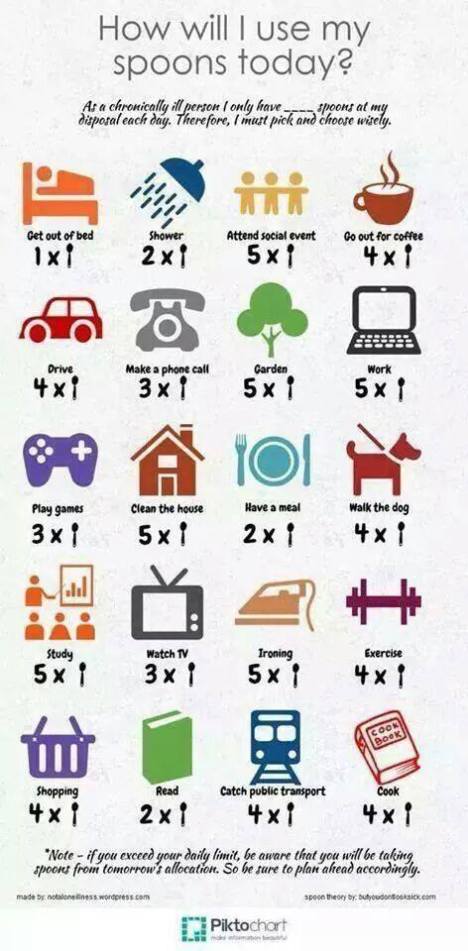
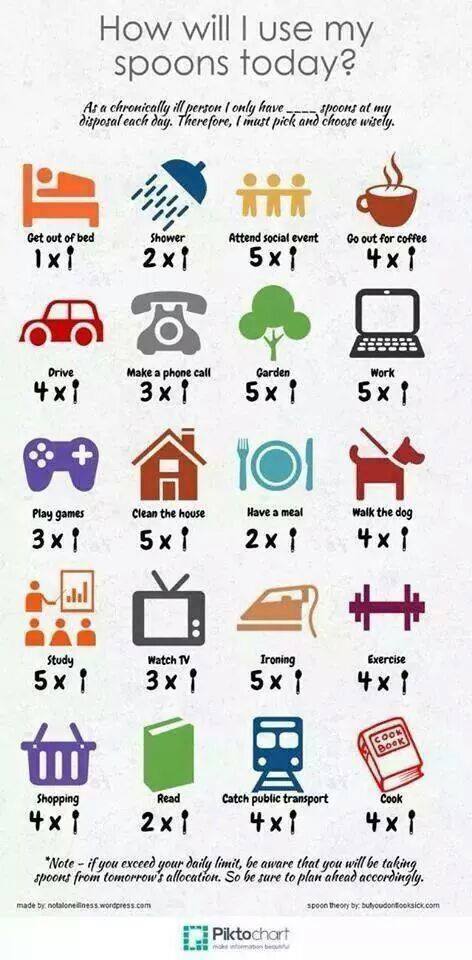
spoons-mythsRefer to the attached picture. This is not an exact science but gives some idea of the spoon bank. If you have time, try doing this exercise: Lay out 8-12 physical spoons. As you complete certain tasks throughout the day, use this chart to subtract spoons from your pile.

Each and every thing requires a spoon. Taking a shower, washing your hair, cooking, cleaning, watching a movie, going out to lunch, working, writing this post (Ha)! When you are done with your day, notice how many spoons you have left. Observe your feelings after this exercise. You can even do it for a week. Lay out a certain amount of spoons for every day for seven days. If you go into a deficit, borrow spoons from the following day. However, if you do borrow spoons; you must take away a task that you WERE planning to originally do that day. Notice what happens and notice how you feel at the end of the week.

You can view “The Spoon Theory” in its entirety at: http://www.butyoudontlooksick.com/articles/written-by-christine/the-spoon-theory/

Can you think of any other tasks that are not on this chart? Help our friends who are doing the activity. List those tasks and assign how many spoons each task will require.
Spoon Bank
Get out of bed- 1 Spoon
Shower- 2 Spoons
Attend Special Event- 5 Spoons
Go out for Coffee- 4 Spoons
Drive- 4 Spoons
Make a Phone Call- 3 Spoons
Work- 5 spoons
Play Games-3 Spoons
Clean the House- 5 Spoons
Have a Meal- 2 Spoons
Walk the Dog- 4 Spoons
Study- 5 Spoons
Watch TV- 3 Spoons
Ironing- 5 Spoons
Exercise- 4 Spoons
Shopping- 4 Spoons
Read- 2 Spoons
Catch Public Transport- 4 Spoons
Cook- 4 Spoons

HOME | Sitemap | Adrenal Crisis! | Abbreviations | Glossary | Forums | Donate | Bios | Add Your Bio

Official Rare Disease Day 2015 Video

world-rare-disease-2015

Bring People Living with a Rare Disease out of the Shadows and into the Spotlight:

Watch and Share the Official Rare Disease Day 2015 Video!

Following the Rare Disease Day theme Living with a Rare Disease, the 2015 video poignantly recognises the millions of families, friends and carers whose daily lives are impacted by rare diseases.

A big round of applause goes out to the many individuals involved in the creation of the video. Special thanks to video participants RitaPietro and Beatrice who are each living with a rare disease, as well as their family members who accompanied them to the filming of the video. Thanks also to UNIAMO, the Italian national rare disease alliance, for making the video production possible and to director Carlo Hintermann, animators Lulu Cancrini and Marco Varriale and all of their team for their in-kind contribution of the creation and production of the video.

The cooperation between all those involved in this year’s video is symbolic of the unity and solidarity that families, professionals, policy makers, researchers and industry are demonstrating by living day-by-day, hand-in-hand with rare disease patients. Get involved today!

Be a part of the Rare Disease Day momentum – share the Rare Disease Day 2015 video and show the world how to live in solidarity day-by-day, hand-in-hand.

The video has been translated in 20 languages:

Englishfrançaisdeutschespañolitalianoportuguês – čeština – dansk – العربيةmagyarsuomalainenromân polskiTürkslovaški中国的 – CroatianUkrainian – Bulgarian – Dutch


World RARE Disease Day is only two weeks away!

world-rare-disease-2015

World Rare Disease Day is an annual observance to raise awareness for rare diseases, and improve access to treatments and medical representation for individuals with rare diseases and their families. Created by European organization EURORDIS in 2008, this day is celebrated on the last day of February each year. The 8th annual World Rare Disease Day will be held on Saturday, February 28, 2015. On this day, various activities take place globally.

Looking for ways to get involved?

Global Genes™ holds a variety of awareness raising activities starting on World Rare Disease Day and continuing throughout the month of March (because RARE deserves more than a day). Please join patients, families, friends, caregivers, scientists, physicians, researchers, health care providers, policy experts and our team to raise RARE disease awareness. Here are a few ways you can get involved!

February/March Events for Rare Disease Awareness
•    Tweet Chat in Partnership with WEGO Health – Focusing on community events and facts & stats surrounding World Rare Disease Day. Thursday, February 19 at 2PM EST, participants can log on to Twitter and follow hashtags #RARETalk and #hachat to share ideas and win Global Genes & Wego Health swag bags, Walgreens gift cards, and more!

•    Global Genes 1st Annual Denim Dash Virtual 5k Run/Walk for Rare Disease (Virtual/Global) March 21-29, 2015 –The Denim Dash was created through collaborative efforts between Orphan Drug Solutions and Global Genes as their first annual virtual 5K event. This virtual 5k is designed to ensure that anyone, anywhere, can participate and show their support and raise awareness for patients, family and friends of the Rare Disease Community. The cost to register is $35 and includes Denim Dash t-shirt, race bib and Blue Denim Genes Ribbon. In order to receive a t-shirt, registration must be completed by 3/6/2015. Register here.

•    Give RARE (Online) – Give RARE, on March 3rd, is a single day for the world to GIVE to RARE disease! In partnership with Zenzaga, the Give RARE technology platform allows rare disease nonprofits to sign-up easily to create a donation page, raise funds for their cause and get access to win prize funds from sponsors. Grants will be given throughout the day. Register by February 15th and your nonprofit will have a chance to win a year’s worth of URS charity filings (worth $5000) from launch partners Charity ComplianceRegister your cause today!

•    ‘I Love Someone RARE & Beautiful.’ T-shirts in Partnership with the Gwendolyn Strong Foundation – Global Genes and the Gwendolyn Strong Foundation have partnered once again by bringing back the popular ‘I love someone RARE & beautiful.‘ tee in celebration of World Rare Disease Day. This is a LIMITED EDITION item, so get them while they last! They can be purchased here.

•    Wear That You Care campaign – All across the world people participate in supporting rare disease awareness and Wear That You Care by wearing the Blue Denim Genes Ribbon™ and their favorite pair of jeans on World Rare Disease Day. Wear That You Care campaigns take place locally—supporters often urge their offices, teams or other groups to wear jeans on a specific day and make a donation.

•    Social Media Awareness – Patients, advocates, and industry alike can grow social awareness by sharing photos, information, and events with Global Genes’ Facebook, Twitter, and Instagram. Where supporters can tag their photos or posts with hashtags #WearThatYouCare, #WRDD2015, #RAREadvocate, and #CareAboutRare to help draw attention to their content. Additionally, supporters can visit www.globalgenes.org/CareAboutRare and upload their photo into photo frames to use as social media profile images to further help spread awareness.
WRDD template 6 version 3 2014       WRDD template 4 2014       WRDD template 5 2014 2       WRDD template 2 denim back 2014 1 2


Additional community events are located on the Global Genes website: 
http://globalgenes.org/2015-world-rare-disease-day-community-events/
Join the movement! Advocate for the over 350 million with a RARE disease today!      

GGP-Rare_logo-tagline-v4_final
Global Genes is a 501(c)(3) nonprofit organization advocating for rare disease globally.


Helpful Doctors are Returning!

harvey-surgery

We’ve done this in the past and I’d like to do it again.

Our earlier database was hacked and I didn’t feel it was worth rebuilding because so much of the info became outdated.

If you are happy with your team of doctors and feel like you have gotten good care please list them, their specialty, where they are located and anything else you’d like to say.

If you don’t want to list them here, you may use the form at http://www.cushings-help.com/forms/doctor.htm

I’m making a continually updating database so you can watch it unfold here: https://www.obvibase.com/p/dbz5EouPMSME

The Non-US doctors will be listed here: https://www.obvibase.com/p/opDSfNQ13ZHX

I can tell it’s going to be a wide page so you’ll have to scroll across the bottom. As more entries (besides my test one!) are added, you can sort by state, country, etc.

Thank you in advance! A good doctor can change a life…but not every good doctor is good for every patient.