Rare neuroendocrine tumours may be misdiagnosed as Cushing’s disease

By Eleanor McDermid, Senior medwireNews Reporter

Ectopic tumours secreting corticotropin-releasing hormone (CRH) and adrenocorticotropic hormone (ACTH) are very rare in children and can result in a misdiagnosis of Cushing’s disease (CD), say researchers.

Three of the patients in the reported case series had pituitary hyperplasia and underwent transsphenoidal surgery for apparent CD before the tumour that was actually causing their symptoms was located. The hyperplasia was probably caused by release of CRH from the ectopic tumour, which stimulated the pituitary gland, giving the impression of an ACTH-secreting pituitary adenoma, explain Maya Lodish (National Institutes of Health, Bethesda, Maryland, USA) and study co-authors.

These three patients were part of a series of seven, which Lodish et al describe as “a relatively large number of patients, considering the infrequency of this disease.”

The patients were aged between 1.8 and 21.3 years. Three had neuroendocrine tumours located in the pancreas ranging in size from 1.4 to 7.0 cm, two had thymic carcinoids ranging from 6.0 mm to 11.5 cm, one patient had a 12.0 cm tumour in the liver and one had a 1.3 cm bronchogenic carcinoid tumour of the right pulmonary lobe.

Four of the patients had metastatic disease and, during up to 57 months of follow-up, three died of metastatic disease or associated complications and two patients had recurrent disease.

“Our series demonstrates that these are aggressive tumors with a high mortality rate,” write the researchers in the Journal of Clinical Endocrinology & Metabolism. “It is important to follow the appropriate work up, regarding both biochemical and imaging tests, which can lead to the correct diagnosis and to the most beneficial therapeutic approach.”

The team found the CRH stimulation test to be helpful, noting, for example, that none of the patients had a rise in cortisol that was consistent with CD, with all patients showing smaller responses ranging from 2% to 15%. Likewise, just one patient had an ACTH rise higher than 35% on CRH administration, and four patients had a “flat” response, which has previously been associated with ectopic neuroendocrine tumours.

Of note, six patients had normal or high plasma CRH levels, despite all having high cortisol levels, which would be expected to result in undetectable plasma CRH due to negative feedback, implying another source of CRH production. Five patients had blunted diurnal variation of both cortisol and ACTH levels consistent with Cushing’s syndrome.

The patients also underwent a variety of imaging procedures to identify the source of ACTH/CRH production, some of which, such as octreotide scans, are specialist and not available in most hospitals, the researchers note, potentially contributing to inappropriate diagnosis and management.

From http://www.news-medical.net/news/20141030/Rare-neuroendocrine-tumours-may-be-misdiagnosed-as-Cushinge28099s-disease.aspx

Safety of DR-HC for adrenal insufficiency

Conventional treatment of adrenal insufficiency involves cortisol replacement therapy with twice- or thrice-daily oral hydrocortisone. Recently dual-release hydrocortisone (DR-HC) administered once daily to provide high levels of cortisol during the morning, followed by a gradual decrease throughout the day is being used. This results in considerably lower cortisol exposure during the afternoon and evening compared with immediate-release thrice-daily hydrocortisone, thereby mimicking normal cortisol secretion more closely than conventional therapy.

Nilsson et al. conducted a study to evaluate the long-term safety of DR-HC and whether the difference in the incidence of adverse events persisted over time and if it was related to different levels of exposure to cortisol. They conducted a randomised, open-label, crossover trial of DR-HC or thrice-daily hydrocortisone for 3 months each (stage 1) followed by two consecutive, prospective, open-label studies of DR-HC for 6 months (stage 2) and 18 months (stage 3) at five university clinics in Sweden. The results of the study of the newly developed DR-HC showed that long-term maintenance treatment and rescue therapy was well tolerated up to 27 months of continuous treatment.

Read full article titled ‘Prospective evaluation of long-term safety of dual-release hydrocortisone replacement administered once daily in patients with adrenal insufficiency’ by Nilsson et al., European Journal of Endocrinology 171 pp 369 – 377, DOI: 10.1530/EJE-14-0327

Cushing Syndrome in Children: Growth after Surgical Cure

Cushing syndrome (CS) occurs only rarely in children, but when it does, it causes weight gain and stunting. In young children, adrenal tumors are usually the cause while in adolescents, pituitary tumors are more likely.

The September 2014 issue of Endocrine-Related Cancer examines growth patterns in 19 pediatric patients with ACTH-dependent CS (CD) and 18 patients with a form of ACTH-independent CS, micronodular adrenal hyperplasia (MAH). The researchers gathered data at the time of surgery and also followed up one year later.

Patients in the CD and the MAH groups had similar demographic characteristics, baseline heights and BMI scores before surgery. All patients experienced significant improvements in height and BMI after surgery. Patients with MAH, however, fared significantly better than those with CD and had better post-operative growth.

The researchers propose several reasons:

  • When ACTH-secreting pituitary adenoma requires extensive surgical exploration, remaining pituitary cells often lose some of their function.
  • CD patients tend to be older and have consistent and increased glucocorticoid exposure; they develop vertebral fractures more often leading to compromised skeletal and overall growth potential. MAH patients often have cyclical CS, with intermittent hypercortisolism and an overall milder CS.
  • CD patients often need a longer-than-expected course of therapy with steroids after surgery, which alters metabolism and growth.
  • CD patients have been shown to have advance bone age because of ACTH-induced metabolic changes.

The authors indicate that CS patients are often considered for growth hormone therapy once the underlying problem is corrected. They remind clinicians that MAH patients are less likely to need growth hormone. They recommend close monitoring for CD patients, and early intervention with growth hormone if growth does not meet expectation. –

See more at: http://www.hcplive.com/articles/Cushing-Syndrome-in-Children-Growth-after-Surgical-Cure

Webinar: Hypothalamic Pituitary Dysfunction in Young Athletes with Head Injury (THI)

Don’t miss this great opportunity.
Join us tomorrow for a free webinar!

Date: October 23, 2014
Time: 12:00 – 1:00 PM Pacific Daylight Time

Hypothalamic Pituitary Dysfunction in Young Athletes with Head Injury (THI)
Presented by: Saad Sakkal, MD, FACP, FACE, FACPE
Director, Metabolic Care Center, Mason, Ohio

Traumatic brain Injury has been recently of great attraction to researchers, retired football players, and the public. But years before it is documented clinically the Hypothalamic pituitary Dysfunction symptoms appear at much earlier age and need more vigorous attention.

We present in this webinar the early symptoms and recognition of the syndrome from clinical perspective. Describe the Hypothalamic Dysfunction in its widest picture, its relation to Fibromyalgia/Chronic fatigue, and its present therapy available .

If you are unable to attend the live webinar, we will have it available on our website starting Monday. I will post a link when it is available.

http://bit.ly/1qvUcZO

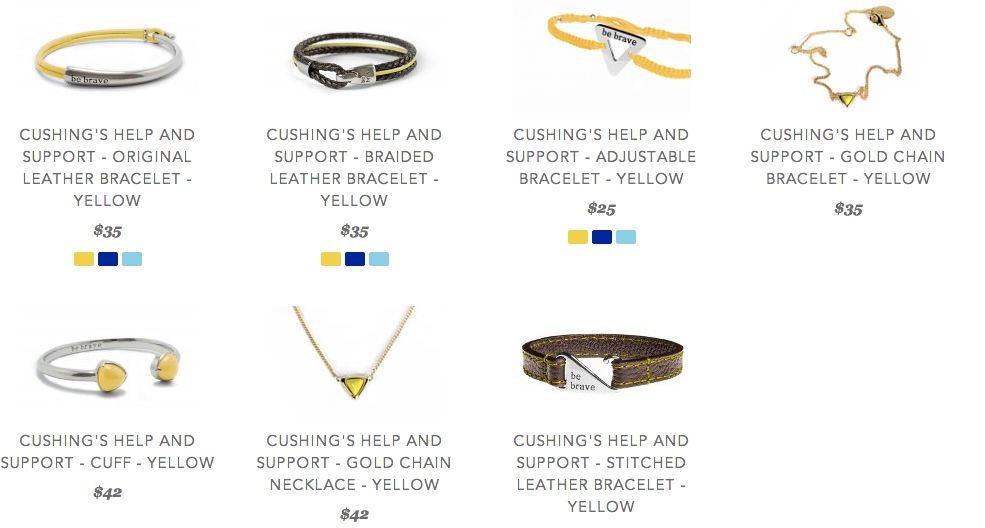
Thanks to Those Who Have Bought Bravelets!

I was very surprised this week to get a check from Bravelets – I only wish I knew who to thank for supporting Cushing’s Help in this way.

They’re running a sale today.  Only a few hours left to get 10% OFF with our Columbus Day Sale!  Support Cushing’s Help and discover savings with coupon code COLUMBUS14.

All items come in yellow, dark or light blue although only yellow are shown in the image below.

Thanks for your support!

bravelets