Interview May 7 with Kathy C, Pituitary Patient

My name is Kathy Casey. I am a 63 year old retired school nurse. I am married with two wonderful sons and a grandson. My husband and I live in the mountain town of Mt. Shasta in northern California. I have always been athletic.

In 1995, I was diagnosed with a pituitary tumor. At the time the only symptom I was aware of was a severe headache. I had a transphenoidal resection by Dr. Wilson at UCSF Medical Center followed by radiation therapy for 23 days. At the time they said they could not remove all of the tumor.

In 2008/2009. I exhibited symptoms of Cushing’s and my cortisol level was outrageous, and I had to be hospitalized initially for a potassium level of 2. I returned to UCSF and Dr. Anwar Sandeep operated . By removing part of the tumor. My Cushing symptoms resolved. However, he said that the tumor was not encapsulated and was invading the cavernous sinus and stella turcica so it was still not possible to remove it all.

I was OK until December 2013 when I began exhibiting the symptoms of Cushings. One of my 24 hr. urines was 14,000. I had to be hospitalized for a potassium level of 1.9. Dr. Heaney said he has never seen a cortisol level that high. This time I decided to go to the UCLA Pituitary Tumor and Endocrinology Program where they were more oriented to follow-up and treating this disorder. Dr. Bergsneider decided that surgery was not an option. He and Dr. Heaney decided radiation was not an option. So now I am being followed by Dr. Heaney to see if medication can help.

I am now on Cabergoline 0.5 mg three tabs twice a week and Signifor 0.9 mg subcutaneosly twice a day. I think they are alleviating some of the symptoms. However, the Signifor caused my blood sugar to rise, and I had to go on Metformin which is causing nausea to a point where I have a hard time eating.

Anyway, this whole situation is depressing and overwhelming. I am tryng to stay positive, but I wonder how it will turn out. I am fortunate to have a supportive and helpful husband.

I am interested in communicating with people who may be going through a similar experience and learning more about this rare condition.

Kathy will be interviewed May 7, 2014 in BlogTalkRadio

HOME | Contents | Adrenal Crisis! | Abbreviations | Glossary | Forums | Donate | Bios | Add Your Bio

Subclinical Cushing’s syndrome and cardiovascular disease

Guido Di Dalmazi and colleagues1 reported that in patients with adrenal incidentalomas and either stable mild hypercortisolism or worsening of cortisol hypersecretion, all-cause and cardiovascular disease-specific mortality was higher compared with in those with adrenal incidentalomas that did not secrete cortisol, after a mean follow-up of 7·5 years. Moreover, cortisol concentrations measured after dexamethasone-suppression test were associated with all-cause mortality independent of the presence of traditional cardiovascular disease risk factors.
Subclinical Cushing’s syndrome is the most common hormonal abnormality in patients with adrenal incidentalomas (prevalence 1—29%).2 The proportion of adrenal incidentalomas that progress to subclinical Cushing’s syndrome is low (1·7%) and most are lesions of 3 cm or larger.2 Progression to overt Cushing’s syndrome is controversial (because both spontaneous normalisation of hypersecretion and stable disease have been reported during follow-up) and spontaneous normalisation of hypersecretion has been reported in 50% of cases.2 Results of the study by Di Dalmazi and co-workers1 are important because they show, for the first time, that patients with subclinical Cushing’s syndrome are at increased risk of cardiovascular disease and all-cause mortality (mainly attributable to cardiovascular disease). The association of cortisol with all-cause mortality might also be attributable to its potential role in the pathogenesis of metabolic syndrome.3
Findings of previous studies have shown an increased prevalence of cardiovascular disease risk factors in patients with subclinical Cushing’s syndrome, but data for optimum management are conflicting. Some criteria—such as large (>4—6 cm) adrenal incidentalomas, features suggestive of malignancy (eg, heterogeneity, irregular shape, calcification or necrosis, invasion to adjacent tissues), or potentially lethal hormonal hypersecretion (ie, pheochromocytomas)—support the need for adrenalectomy. However, universal surgical management of patients with subclinical Cushing’s syndrome has not been accepted.24 Uncertainty about the most effective management strategy for subclinical Cushing’s syndrome is attributable to the variable definitions used, and the small sample size and retrospective nature of most studies.4 Only one prospective study has been published so far showing that laparoscopic adrenalectomy is more beneficial than is conservative management for the normalisation or improvement of cardiovascular disease risk factors, such as diabetes, dyslipidaemia, hypertension, and obesity.5
Prospective studies and registries are needed to document the effect of different approaches on the incidence of cardiovascular disease events and mortality in patients with adrenal incidentalomas and subclinical Cushing’s syndrome. Until then, individualised treatment seems prudent. Surgical management of subclinical Cushing’s syndrome can be suggested in young patients (age <50 years) and in those with cardiovascular disease risk factors or bone disease associated with hypercortisolism that are of recent onset, difficult to control with drugs, or show progression over time.4
Another message from Di Dalmazi’s study1 is that hormonal deterioration might develop even after 4—5 years, which most studies reported as a reasonable and safe follow-up.2 This possibility should be kept in mind for the management of patients with adrenal incidentalomas, especially if clinical signs of Cushing’s syndrome develop or if cardiovascular disease risk factors become evident or increase in severity (ie, hormonal hypersecretion).
We declare that we have no competing interests.

References

1 Di Dalmazi GVicennati VGarelli S, et alCardiovascular events and mortality in patients with adrenal incidentalomas that are either non-secreting or associated with intermediate phenotype or subclinical Cushing’s syndrome: a 15-year retrospective studyLancet Diabetes Endocrinol 2014published online Jan 29 http://dx.doi.org/10.1016/S2213-8587(13)70211-0.
2 Anagnostis PKaragiannis ATziomalos KKakafika AIAthyros VGMikhailidis DPAdrenal incidentaloma: a diagnostic challengeHormones (Athens) 20098163-184PubMed
3 Anagnostis PAthyros VGTziomalos KKaragiannis AMikhailidis DPClinical review: The pathogenetic role of cortisol in the metabolic syndrome: a hypothesisJ Clin Endocrinol Metab 200994:2692-2701PubMed
4 Terzolo MPia AReimondo GSubclinical Cushing’s syndrome: definition and managementClin Endocrinol (Oxf) 20127612-18PubMed
5 Toniato AMerante-Boschin IOpocher GPelizzo MRSchiavi FBallotta ESurgical versus conservative management for subclinical Cushing syndrome in adrenal incidentalomas: a prospective randomized studyAnn Surg 2009249388-391PubMed
a Division of Endocrinology, Police Medical Centre, Thessaloniki, 54 640, Greece
b Department of Endocrinology and Metabolism, Agios Pavlos General Hospital, Thessaloniki, Greece
c Second Propedeutic Department of Internal Medicine, Medical School, Aristotle University of Thessaloniki, Hippokration Hospital, Thessaloniki, Greece
d Department of Clinical Biochemistry (Vascular Prevention Clinic) Royal Free Hospital Campus, University College London Medical School, University College London, London, UK

Irreversible Effects of Previous Cortisol Excess on Cognitive Functions in Cushing’s Disease | Laika’s MedLibLog

Irreversible Effects of Previous Cortisol Excess on Cognitive Functions in Cushing’s Disease | Laika’s MedLibLog.

If we listen to Cushing patients, who are “cured” and have traded Cushing’s disease for Addison’s disease, we notice that they feel better after their high levels of cortisol have normalized, but not fully cured (see two examples of ex-Cushing patients with longlasting if not irreversible health) problems in my previous post here. [added 2010-04-17)

To realize how this affects daily life, I recommend to read the photo-blog 365 days with Cushing by Robin (also author of Survive the Journey). Quite a few of her posts deal with the continuous weakness (tag muscle atrophy), tiredness (tag fatigue), problems with (short-term) memory (see tag memory)  or both (like here and here).

Scientifically the question is to which extent ex-Cushing patients score worse than other healthy individuals or chronically ill people and, if so, whether this can be attributed to the previous high levels of glucocorticoids….

via Irreversible Effects of Previous Cortisol Excess on Cognitive Functions in Cushing’s Disease | Laika’s MedLibLog.

Cushing’s Awareness Challenge 17

robin-causes

Another of Robin’s wonderful images.

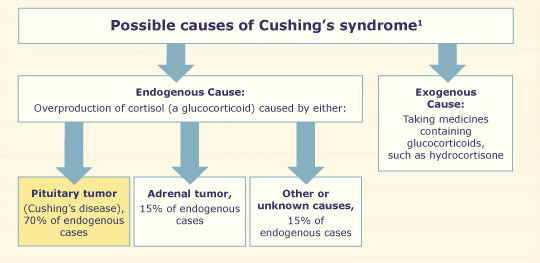
A similar image from the CushieWiki

cushings-causes

No wonder Cushing’s is so hard to diagnose!

maryo colorful zebra

Cushing’s Awareness Challenge 16

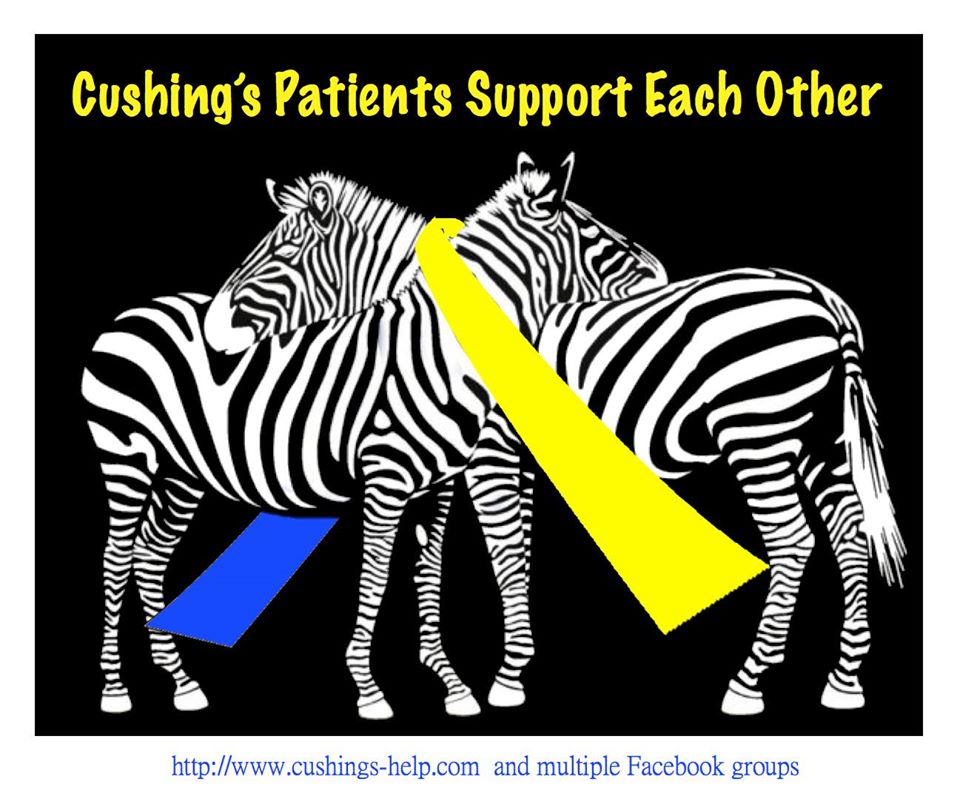
robin-support

That’s for sure!  Cushing’s patients have a lot of support these days, at least online.  I’m not seeing much offline in the way of regular group support meetings.

Over the years, there have been lots of local meetings but they’re mostly one-time events.  There are pictures of some of the past meetings here: https://www.facebook.com/CushingsInfo/photos_albums listed by place and date.

Many Cushing’s patients on the message boards and in Facebook groups exchange phone numbers and email addresses to get offline support.

Other ways to help support others you may never meet are to agree to be interviewed in a live voice chat (these are added to the podcast for later listening) or submit a bio.

The more you share, the more support others get…and the more they’ll share with you.


maryo colorful zebra