Adrenal Fatigue: Faux Diagnosis?

This article is based on reporting that features expert sources.

U.S. News & World Report

Adrenal Fatigue: Is It Real?

You may have heard of so-called ‘adrenal fatigue,’ supposedly caused by ongoing emotional stress. Or you might have come across adrenal support supplements sold online to treat it. But if someone suggests you have the controversial, unproven condition, seek a second opinion, experts say. And if someone tries to sell you dietary supplements or other treatments for adrenal fatigue, be safe and save your money.

Tired man sitting at desk in modern office

(GETTY IMAGES)

Physicians tend to talk about ‘reaching’ or ‘making’ a medical diagnosis. However, when it comes to adrenal fatigue, endocrinologists – doctors who specialize in diseases involving hormone-secreting glands like the adrenals – sometimes use language such as ‘perpetrating a diagnosis,’ ‘misdiagnosis,’ ‘made-up diagnosis,’ ‘a fallacy’ and ‘nonsense.’

About 20 years ago, the term “adrenal fatigue” was coined by Dr. James Wilson, a chiropractor. Since then, certain practitioners and marketers have promoted the notion that chronic stress somehow slows or shuts down the adrenal glands, causing excessive fatigue.

“The phenomenon emerged from the world of integrative medicine and naturopathic medicine,” says Dr. James Findling, a professor of medicine and director of the Community Endocrinology Center and Clinics at the Medical College of Wisconsin. “It has no scientific basis, and there’s no merit to it as a clinical diagnosis.”

An online search of medical billing code sets in the latest version of the International Classification of Diseases, or the ICD-10, does not yield a diagnostic code for ‘adrenal fatigue’ among the 331 diagnoses related either to fatigue or adrenal conditions or procedures.

In a March 2020 position statement, the American Association of Clinical Endocrinologists and American College of Endocrinology addressed the use of adrenal supplements “to treat common nonspecific symptoms due to ‘adrenal fatigue,’ an entity that has not been recognized as a legitimate diagnosis.”

The position statement warned of known and unknown health risks of off-label use and misuse of hormones and supplements in patients without an established endocrine diagnosis, as well as unnecessary costs to patients and the overall health care system.

Study after study has refuted the legitimacy of adrenal fatigue as a medical diagnosis. An August 2016 systematic review combined and analyzed data from 58 studies on adrenal fatigue including more than 10,000 participants. The conclusion in a nutshell: “Adrenal fatigue does not exist,” according to review authors in the journal BMC Endocrine Disorders.

Adrenal Action

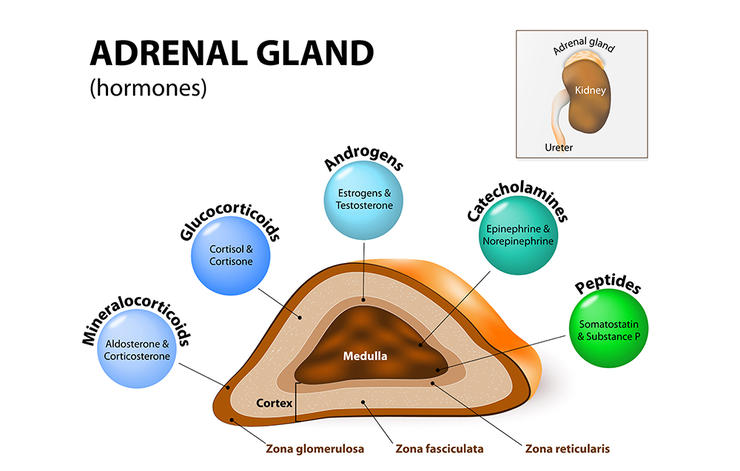
You have two adrenal glands in your body. These small triangular glands, one on top of each kidney, produce essential hormones such as aldosterone, cortisol and male sex hormones such as DHEA and testosterone.

Cortisol helps regulate metabolism: How your body uses fat, protein and carbohydrates from food, and cortisol increases blood sugar as needed. It also plays a role in controlling blood pressure, preventing inflammation and regulating your sleep/wake cycle.

As your body responds to stress, cortisol increases. This response starts with signals between two sections in the brain: The hypothalamus and the pituitary gland, which act together to release a hormone that stimulates the adrenal glands to make cortisol. This interactive unit is called the hypothalamic pituitary adrenal axis.

While some health conditions really do affect the body’s cortisol-making ability, adrenal fatigue isn’t among them.

“There’s no evidence to support that adrenal fatigue is an actual medical condition,” says Dr. Mary Vouyiouklis Kellis, a staff endocrinologist at Cleveland Clinic. “There’s no stress connection in the sense that someone’s adrenal glands will all of a sudden just stop producing cortisol because they’re so inundated with emotional stress.”

If anything, adrenal glands are workhorses that rise to the occasion when chronic stress occurs. “The last thing in the body that’s going to fatigue are your adrenal glands,” says Dr. William F. Young Jr., an endocrinology clinical professor and professor of medicine in the Mayo Clinic College of Medicine at Mayo Clinic in Rochester, Minnesota. “Adrenal glands are built for stress – that’s what they do. Adrenal glands don’t fatigue. This is made up – it’s a fallacy.”

The idea of adrenal glands crumbling under stress is “ridiculous,” Findling agrees. “In reality, if you take a person and subject them to chronic stress, the adrenal glands don’t shut down at all,” Findling says. “They keep making cortisol – it’s a stress hormone. In fact, the adrenal glands are just like the Energizer Bunny – they just keep going. They don’t stop.”

Home cortisol tests that allow consumers to check their own levels can be misleading, Findling says. “Some providers who make this (adrenal fatigue) diagnosis, provide patients with testing equipment for doing saliva cortisol levels throughout the day,” he says. “And then, regardless of what the results are, they perpetrate this diagnosis of adrenal fatigue.”

Saliva cortisol is a legitimate test that’s frequently used in diagnosing Cushing’s syndrome, or overactive adrenal glands, Findling notes. However, he says, a practitioner pursuing an adrenal fatigue diagnosis could game the system. “What they do is: They shape a very narrow normal range, so narrow, in fact, that no normal human subject could have all their saliva cortisol (levels) within that range throughout the course of the day,” he says. “Then they convince the poor patients that they have adrenal fatigue phenomena and put them on some kind of adrenal support.”

Loaded Supplements

How do you know what you’re actually getting if you buy a dietary supplement marketed for adrenal fatigue or ‘adrenal support’ use? To find out, researchers purchased 12 such supplements over the counter in the U.S.

Laboratory tests revealed that all supplements contained a small amount of thyroid hormone and most contained at least one steroid hormone, according to the study published in the March 2018 issue of Mayo Clinic Proceedings. “These results may highlight potential risks for hidden ingredients in unregulated supplements,” the authors concluded.

Supplements containing thyroid hormones or steroids can interact with a patient’s prescribed medications or have other side effects.

“Some people just assume they have adrenal fatigue because they looked it up online when they felt tired and they ultimately buy these over-the-counter supplements that can be very dangerous at times,” Vouyiouklis Kellis says. “Some of them contain animal (ingredients), like bovine adrenal extract. That can suppress the pituitary axis. So, as a result, your body stops making its own cortisol or starts making less of it, and as a result, you can actually worsen the condition rather than make it better.”

Any form of steroid from outside the body, whether a prescription drug like prednisone or extract from cows’ adrenal glands, “can shut off the pituitary,” Vouyiouklis Kellis explains. “Because it’s signaling to the pituitary like: Hey, you don’t need to stimulate the adrenals to make cortisol, because this patient is taking it already. So, as a result, the body ultimately doesn’t produce as much. And, so, if you rapidly withdraw that steroid or just all of a sudden decide not to take it anymore, then you can have this acute response of low cortisol.”

Some adrenal support products, such as herbal-only supplements, may be harmless. However, they’re unlikely to relieve chronic fatigue.

Fatigue: No Easy Answers

If you’re suffering from ongoing fatigue, it’s frustrating. And you’re not alone. “I have fatigue,” Young Jr. says. “Go to the lobby any given day and say, ‘Raise your hand if you have fatigue.’ Most of the people are going to raise their hands. It’s a common human symptom and people would like an easy answer for it. Usually there’s not an easy answer. I think ‘adrenal fatigue’ is attractive because it’s like: Aha, here’s the answer.”

There aren’t that many causes of endocrine-related fatigue, Young Jr. notes. “Hypothyroidism – when the thyroid gland is not working – is one.” Addison’s disease, or adrenal insufficiency, can also lead to fatigue among a variety of other symptoms. Established adrenal conditions – like adrenal insufficiency – need to be treated.

“In adrenal insufficiency, there is an intrinsic problem in the adrenal gland’s inability to produce cortisol,” Vouyiouklis Kellis explains. “That can either be a primary problem in the adrenal gland or an issue with the pituitary gland not being able to stimulate the adrenal to make cortisol.”

Issues can arise even with necessary medications. “For example, very commonly, people are put on steroids for various reasons: allergies, ear, nose and throat problems,” Vouyiouklis Kellis says. “And with the withdrawal of the steroids, they can ultimately have adrenal insufficiency, or decrease in cortisol.”

Opioid medications for pain also result in adrenal sufficiency, Vouyiouklis Kellis says, adding that this particular side effect is rarely discussed. People with a history of autoimmune disease can also be at higher risk for adrenal insufficiency.

Common symptoms of adrenal insufficiency include:

  • Fatigue.
  • Weight loss.
  • Decreased appetite.
  • Salt cravings.
  • Low blood pressure.
  • Abdominal pain.
  • Nausea, vomiting or diarrhea.
  • Muscle weakness.
  • Hyperpigmentation (darkening of the skin).
  • Irritability.

Medical tests for adrenal insufficiency start with blood cortisol levels, and tests for the ACTH hormone that stimulates the pituitary gland.

“If the person does not have adrenal insufficiency and they’re still fatigued, it’s important to get to the bottom of it,” Vouyiouklis Kellis says. Untreated sleep apnea often turns out to be the actual cause, she notes.

“It’s very important to tease out what’s going on,” Vouyiouklis Kellis emphasizes. “It can be multifactorial – multiple things contributing to the patient’s feeling of fatigue.” The blood condition anemia – a lack of healthy red blood cells – is another potential cause.

“If you are fatigued, do not treat yourself,” Vouyiouklis Kellis says. “Please seek a physician or a primary care provider for evaluation, because you don’t want to go misdiagnosed or undiagnosed. It’s very important to rule out actual causes that would be contributing to symptoms rather than ordering supplements online or seeking an alternative route like self-treating rather than being evaluated first.”

SOURCES

The U.S. News Health team delivers accurate information about health, nutrition and fitness, as well as in-depth medical condition guides. All of our stories rely on multiple, independent sources and experts in the field, such as medical doctors and licensed nutritionists. To learn more about how we keep our content accurate and trustworthy, read our editorial guidelines.

James Findling, MDFindling is a professor of medicine and director of the Community Endocrinology Center and Clinics at the Medical College of Wisconsin.

Mary Vouyiouklis Kellis, MDVouyiouklis Kellis is a staff endocrinologist at Cleveland Clinic.

William F. Young Jr., MDYoung Jr. is an endocrinology clinical professor and professor of medicine in the Mayo Clinic College of Medicine at Mayo Clinic in Rochester, Minnesota

From https://health.usnews.com/health-care/patient-advice/articles/adrenal-fatigue-is-it-real?

Basal Cortisol Elevated in Patients with ACTH-Staining Pituitary Macroadenoma

Preoperative identification of patients with silent adrenocorticotrophic hormone-secreting tumors could potentially change the approach to management. A new study aimed to determine whether a preoperative adrenocorticotrophic hormone stimulation test for evaluation of nonfunctional pituitary macroadenoma could aid in identifying adrenocorticotrophic hormone-staining pathology yielded large variability and did not allow clinical utility.

Thus, researchers concluded that larger, multicenter research is needed to determine whether this test can be useful.

“As ACTH stimulation tests are performed routinely when evaluating macroadenoma when there is no suspicion for a state of endogenous hypercortisolism, we sought to determine if the test could reliably identify these pathologies during the preoperative evaluation. We hypothesized that patients with subclinical Cushing’s disease or silent ACTH-secreting tumors would have a higher delta cortisol on the ACTH stimulation tests vs. other types of macroadenoma pathologies,” Kevin Pantalone, DO, ECNU, FACE, staff endocrinologist and director of clinical research in the department of endocrinology at Cleveland Clinic, told Endocrine Today.

Pantalone and colleagues performed a retrospective chart review of 148 patients with pituitary macroadenoma who underwent preoperative ACTH stimulation tests, with the goal of determining whether the test can aid in the identification of ACTH-staining pathology.

Overall, 9.5% of patients showed diffuse staining, 50.6% showed other-staining (diffuse staining for anterior pituitary hormones other than ACTH) and 39.9% showed no staining (no staining for any anterior pituitary hormones).

The researchers calculated delta total cortisol at 30 and 60 minutes from baseline and reviewed preoperative ACTH stimulation tests. Additionally, Pantalone and colleagues compared the basal and maximal delta cortisol between the ACTH-staining pituitary macroadenoma and the non-ACTH staining (n = 134), other staining (n = 75) and non-staining (n = 59) tumors.

According to data reported at the American Association of Clinical Endocrinologists Annual Scientific and Clinical Congress, the ACTH-staining group had higher mean basal cortisol levels compared with the non-ACTH-staining (P = .012), other staining (P = .018) and the non-staining (P = .012) tumors. The researchers found no significant differences in maximal delta cortisol between the groups.

“While we found basal cortisol levels were higher in patients with ACTH-staining pituitary microadenoma vs. non-ACTH-staining macroadenoma, the large variability in cortisol values did not allow for clinical utility,” Pantalone told Endocrine Today.

“Unfortunately, in the end, our study was limited by the number of cases with ACTH-staining pathology. Thus, we were unable to determine if the ACTH stimulation test could reliably assist clinicians in potentially identifying ACTH-staining pathology in the preoperative setting,” he said. “A multicenter study, affording a large number of ACTH-staining tumors, is needed. This may allow for us to determine if the ACTH-stimulation test can really be clinically useful in preoperatively identifying ACTH-staining pathology.” – by Amber Cox

8 Things You Should Know About Addison’s Disease

adrenal-insufficiency


Cortisol gets a bad rap these days. (Guilty!) Yes, this hormone surges when you’re stressed. And yes, chronic stress is bad news for your health. But while too much cortisol can lead to all sorts of stress-related side effects, too little cortisol is equally debilitating.

Just ask someone with Addison’s disease. If you suffer from this condition, your adrenal glands fail to make adequate amounts of cortisol, says Betul Hatipoglu, MD, an endocrinologist at Cleveland Clinic.

Cortisol plays a role in regulating your blood pressure, heart function, digestion, and a lot else, Hatipoglu explains. So if your adrenal glands poop out and your cortisol levels plummet, a lot can go wrong. (In as little as 30 days, you can be a whole lot slimmer, way more energetic, and so much healthier just by following the simple, groundbreaking plan in The Thyroid Cure!)

Here’s what you need to know about this condition—starting with its craziest symptom.

It can make your teeth appear whiter.

Hatipoglu once met with a patient who was suffering from fatigue, belly pain, and mild weight loss. “Her doctors thought she was depressed,” Hatipoglu recalls. Toward the end of their appointment, Hatipoglu noticed the woman’s teeth looked very white. She realized they looked white because the woman’s skin was tan. “I asked her if she’d been on vacation, and she said she hadn’t been in the sun, and that’s when I knew,” Hatipoglu says. Some Addison’s-related hormone shifts can make the skin appear darker, almost like a tan. “Addison’s is the only disease I know of that can cause darkening of the skin,” she says.

Its (other) symptoms are popular ones.

 Along with darker skin, other symptoms of Addison’s include nausea, mild-to-severe abdominal or bone pain, weight loss, a lack of energy, forgetfulness, and low blood pressure, Hatipoglu says. Of course, those same symptoms are linked to many other health issues, from thyroid disease to cancer. “It’s very easy to confuse with other disorders, so many people see a lot of doctors before finally receiving a proper diagnosis,” she says. (One exception: For young women who develop Addison’s disease, loss of body hair is a warning sign, Hatipoglu adds.)
It’s rare.
Doctors also miss or misinterpret the symptoms of Addison’s disease because it’s very uncommon. “I’m not sure if it’s quite one in a million, but it’s very rare,” Hatipoglu says. “It makes sense that many doctors don’t think of it when examining a patient with these symptoms.”
It’s often confused with adrenal insufficiency.

A lot of online resources mention Addison’s disease and adrenal insufficiency as though they were two names for the same condition. They’re not the same, Hatipoglu says. While a thyroid issue or some other hormone-related imbalance could mess with your adrenal function, Addison’s disease refers to an autoimmune disorder in which your body attacks and destroys your adrenal glands.

That destruction can happen quickly.

While it takes months or even years for some Addison’s sufferers to lose all hormone production in their adrenal glands, for others the disease can knock out those organs very rapidly—in a matter of days, Hatipoglu says. “That’s very uncommon,” she adds. But compared to other less-severe adrenal issues, the symptoms of Addison’s tend to present more dramatically, she explains. That means a sufferer is likely to experience several of the symptoms mentioned above, and those symptoms will continue to grow worse as time passes.

Anybody can get it.

Addison’s is not picky. It can strike at any age, regardless of your sex or ethnicity, Hatipoglu says. While there’s some evidence that genetics may play a role—if other people in your family have the disease or some other endocrine disorder, that may increase your risk—there’s really no way to predict who will develop the disease, she adds.

Screening for Addison’s is pretty simple.

If your doctor suspects Addison’s, he or she will conduct a blood test to check for your levels of cortisol and another hormone called ACTH. “Usually the results of that screening are very clear,” Hatipoglu says. If they’re not, some follow-up tests can determine for sure if you have the condition.

There are effective treatments.

Those treatments involve taking oral hormone supplements.  In extreme cases, if the patient’s body does not properly absorb those supplements, injections may be necessary, Hatipoglu explains. “But patients live a normal life,” she adds. “It’s a treatable disease, and the treatments are effective.”

From http://www.prevention.com/health/addisons-disease-symptoms

Interview May 13 with Michelle B (MichelleB), Cyclic Cushing’s Patient

Hello all, I’m Michelle mother of 3 beautiful children, I work part-time, 33yrs young, non-smoker, non-drinker, overall health is good for the most part…..Where do I even begin.

I just recently received the diagnosis of cyclic Cushing’s. I’m not really sure how long I have actually had Cushing’s because I have had a diagnosis of PCOS since I was 17 yrs. old ( I’m now the ripe young age of 33). However looking back through labs with my endocrinologist who I see every 6 months, my ACTH levels have been elevated for a bit over 1 yr. It was not until recently January of 2015- things were going terribly wrong.

Starting in January I started to feel genuinely unwell, on a regular basis. I cant really explain all my symptoms there were so many different sensations and feelings that were seemingly different daily. However the red flag was I was having blood pressure spikes from really high, to very low back to back. I never had any blood pressure issues so this was a concern that led me to see a cardiologist. Upon tons of testing the cardio MD felt that something was telling my otherwise very healthy heart to do this and I should see a endocrinologist. (thank goodness for him) I contacted my endo and let him know…. the testing began.

I did every test: the midnightcortisol saliva test, dex suppression, 24 hr urine test, CRH stimulation testing. And I did them more than once. Each time it was a different response either, inconclusive, normal high, or high. I was then referred to the head of the Cleveland clinics pituitary department Dr. Kennedy. He said he is having a hard time believing when he looks at me that its Cushing’s. However all my labs say it is. I will say I do fit the mold of PCOS to a tee- which symptoms of that do coincide with Cushing’s but he still said we have to be sure its Cushing’s. To add to the mix I did have a normal MRI as well.

Dr. Kennedy started me on a 2 week midnight cortisol saliva test- Upon completion we noted levels of cortisol all over the place, some Normal, normal on high range, high, and really high. He confirmed with all the other tests this is Cushing’s. Now we are trying to figure out what is next…. and where is this damn little tumor at. he feels that it is most likely in the pituitary from my test results, but we still are not ruling out else where. He is thinking that the next step would be exploratory neurosurgery or the IPSS. I’m not sure what to think of all this, except I want to hope for the best like everyone- and just be cured!!

On a side note during all of this I also had episodes of severe pain in my chest and nausea. I went to see a GI who did an upper endo scope. They found I had eosinpphilic esophagitis. I also have never had any GI problems until now; and they came on suddenly. Im also having pain in my pancreas area- not sure if any of the two are related at all to Cushing’s. But once again I was fine until recently with all these issues at once it seems.

wish me luck on further testing, treatment, and ultimately a CURE!!

interview

Michelle was our guest in an interview on BlogTalk Radio  Wednesday, May 13, 2015.

The archived interview is available now through iTunes Podcasts (Cushie Chats) or BlogTalkRadio. There are currently 83 other past interviews for your listening pleasure!

HOME | Sitemap | Adrenal Crisis! | Abbreviations | Glossary | Forums | Donate | Bios | Add Your Bio

Pituitary tumor size not definitive for Cushing’s

By: SHERRY BOSCHERT, Family Practice News Digital Network

SAN FRANCISCO – The size of a pituitary tumor on magnetic resonance imaging in a patient with ACTH-dependent Cushing’s syndrome can’t differentiate between etiologies, but combining that information with biochemical test results could help avoid costly and difficult inferior petrosal sinus sampling in some patients, a study of 131 cases suggests.

If MRI shows a pituitary tumor larger than 6 mm in size, the finding is 40% sensitive and 96% specific for a diagnosis of Cushing’s disease as the cause of adrenocorticotropic hormone (ACTH)-dependent Cushing’s syndrome, and additional information from biochemical testing may help further differentiate this from ectopic ACTH secretion, Dr. Divya Yogi-Morren and her associates reported at the Endocrine Society’s Annual Meeting.

Pituitary tumors were seen on MRI in 6 of 26 patients with ectopic ACTH secretion (23%) and 73 of 105 patients with Cushing’s disease (69%), with mean measurements of 4.5 mm in the ectopic ACTH secretion group and 8 mm in the Cushing’s disease group. All but one tumor in the ectopic ACTH secretion group were 6 mm or smaller in diameter, but one was 14 mm.

Because pituitary “incidentalomas” as large as 14 mm can be seen in patients with ectopic ACTH secretion, the presence of a pituitary tumor can’t definitively discriminate between ectopic ACTH secretion and Cushing’s disease, said Dr. Yogi-Morren, a fellow at the Cleveland Clinic.

That finding contradicts part of a 2003 consensus statement that said the presence of a focal pituitary lesion larger than 6 mm on MRI could provide a definitive diagnosis of Cushing’s disease, with no further evaluation needed in patients who have a classic clinical presentation and dynamic biochemical testing results that are compatible with a pituitary etiology (J. Clin. Endocrinol. Metab. 2003;88:5593-602). The 6-mm cutoff, said Dr. Yogi-Morren, came from an earlier study reporting that 10% of 100 normal, healthy adults had focal pituitary abnormalities on MRI ranging from 3 to 6 mm in diameter that were consistent with a diagnosis of asymptomatic pituitary adenomas (Ann. Intern. Med. 1994;120:817-20).

A traditional workup of a patient with ACTH-dependent Cushing’s syndrome might include a clinical history, biochemical testing, neuroimaging, and an inferior petrosal sinus sampling (IPSS). Biochemical testing typically includes tests for hypokalemia, measurement of cortisol and ACTH levels, a high-dose dexamethasone suppression test, and a corticotropin-releasing hormone (CRH) stimulation test. Although IPSS is the gold standard for differentiating between the two etiologies, it is expensive and technically difficult, especially in institutions that don’t regularly do the procedure, so it would be desirable to avoid IPSS if it’s not needed in a subset of patients, Dr. Yogi-Morren said.

The investigators reviewed charts from two centers (the Cleveland Clinic and the M.D. Anderson Cancer Center, Houston) for patients with ACTH-dependent Cushing’s syndrome seen during 2000-2012.

ACTH levels were significantly different between groups, averaging 162 pg/mL (range, 58-671 pg/mL) in patients with ectopic ACTH secretion, compared with a mean 71 pg/mL in patients with Cushing’s disease (range, 16-209 pg/mL), she reported. Although there was some overlap between groups in the range of ACTH levels, all patients with an ACTH level higher than 210 pg/mL had ectopic ACTH secretion.

Median serum potassium levels at baseline were 2.9 mmol/L in the ectopic ACTH secretion group and 3.8 mmol/L in the Cushing’s disease group, a significant difference. Again, there was some overlap between groups in the range of potassium levels, but all patients with a baseline potassium level lower than 2.7 mmol/L had ectopic ACTH secretion, she said.

Among patients who underwent a high-dose dexamethasone suppression test, cortisol levels decreased by less than 50% in 88% of patients with ectopic ACTH secretion and in 26% of patients with Cushing’s disease.

Most patients did not undergo a standardized, formal CRH stimulation test, so investigators extracted the ACTH response to CRH in peripheral plasma during the IPSS test. As expected, they found a significantly higher percent increase in ACTH in response to CRH during IPSS in the Cushing’s disease group, ranging up to more than a 1,000% increase. In the ectopic ACTH secretion group, 40% of patients did have an ACTH increase greater than 50%, ranging as high as a 200%-300% increase in ACTH in a couple of patients.

“Although there was some overlap in the biochemical testing, it is possible that it provides some additional proof to differentiate between ectopic ACTH secretion and Cushing’s disease,” Dr. Yogi-Morren said.

In the ectopic ACTH secretion group, the source of the secretion remained occult in seven patients. The most common identifiable cause was a bronchial carcinoid tumor, in six patients. Three patients each had small cell lung cancer, a thymic carcinoid tumor, or a pancreatic neuroendocrine tumor. One patient each had a bladder neuroendocrine tumor, ovarian endometrioid cancer, medullary thyroid cancer, or a metastatic neuroendocrine tumor from an unknown primary cancer.

The ectopic ACTH secretion group had a median age of 41 years and was 63% female. The Cushing’s disease group had a median age of 46 years and was 76% female.

Dr. Yogi-Morren reported having no financial disclosures.

sboschert@frontlinemedcom.com

On Twitter @sherryboschert

From Famiiy Practice News