Skeletal Maturation in Children With Cushing’s Syndrome is Not Consistently Delayed

Skeletal maturation in children with cushing syndrome is not consistently delayed: The role of corticotropin, obesity, and steroid hormones, and the effect of surgical cure.

J Pediatr. 2014 Jan 9. pii: S0022-3476(13)01500-X. doi: 10.1016/j.jpeds.2013.11.065. [Epub ahead of print]

The Journal of Pediatrics, 01/22/2014 Clinical Article

Lodish MB, et al. – The aim of this study is to assess skeletal maturity by measuring bone age (BA) in children with Cushing syndrome (CS) before and 1–year after transsphenoidal surgery or adrenalectomy, and to correlate BA with hormone levels and other measurements. Contrary to common belief, endogenous CS in children appears to be associated with normal or even advanced skeletal maturation. When present, BA advancement in CS is related to obesity, insulin resistance, and elevated adrenal androgen levels and aromatization. This finding may have significant implications for treatment decisions and final height predictions in these children.

Methods

  • This case series conducted at the National Institutes of Health Clinical Center included 93 children with Cushing disease (CD) (43 females; mean age, 12.3 ± 2.9 years) and 31 children with adrenocorticotropic hormone–independent CS (AICS) (22 females, mean age 10.3 ± 4.5 years).
  • BA was obtained before surgery and at follow-up.
  • Outcome measures were comparison of BA in CD vs AICS and analysis of the effects of hypercortisolism, insulin excess, body mass index, and androgen excess on BA.

Results

  • Twenty-six of the 124 children (21.0%) had advanced BA, compared with the expected general population prevalence of 2.5% (P < .0001). Only 4 of 124 (3.2%) had delayed BA.
  • The majority of children (76%) had normal BA.
  • The average BA z-score was similar in the children with CD and those with AICS (0.6 ± 1.4 vs 0.5 ± 1.8; P = .8865).
  • Body mass index SDS and normalized values of dehydroepiandrosterone, dehydroepiandrosterone sulfate, androsteonedione, estradiol, and testosterone were all significantly higher in the children with advanced BA vs those with normal or delayed BA.
  • Fifty-nine children who remained in remission from CD had follow-up BA 1.2 ± 0.3 years after transsphenoidal surgery, demonstrating decreased BA z-score (1.0 ± 1.6 vs 0.3 ± 1.4; P < .0001).

From http://www.ncbi.nlm.nih.gov/pubmed/24412141

Oncocytic Pituicytoma in a Patient with Cushing’s Disease

The final, formatted version of the article will be published soon.

1) Background: Posterior pituitary tumors (PPTs) are extremely rare, with fewer than 400 cases reported to date. In 2022, the WHO classified four types of tumors originating from the posterior pituitary: traditional pituicytoma, oncocytic pituicytoma, granular pituicytoma, and ependymal pituicytoma. To our knowledge, only one subject with coexistence of Cushing’s disease and oncocytic pituicytoma (spindle cell oncocytoma) has been reported, but the clinical features of this patient were not described in detail.

2) Case presentation: We presented a case of a patient with Cushing’s syndrome and a pituitary mass. Transsphenoidal surgery was performed, and pathologic examination revealed two distinct tumors: a corticotroph adenoma with a diameter of less than 2mm and a larger oncocytic pituicytoma. Post-surgery serum cortisol was 51 nmol/L, indicating complete remission. Corticotroph adenoma or corticotroph hyperplasia were identified after surgery in less than half of the subjects with Cushing’s disease and PPT. (3)

Conclusions: Our study indicates that Cushing’s disease in patients with PPT may be caused by the existence of collision lesions, with corticotroph adenoma or hyperplasia being difficult to detect due to their small dimensions.

Keywords: Cushing’s disease, oncocytic pituicytoma, Spindle cell oncocytoma, pituitary adenoma, Posterior pituitary tumors

Received: 27 Aug 2024; Accepted: 17 Feb 2025.

Copyright: © 2025 Li, Chen, Tan, Yu, Tang, Cai and Li. This is an open-access article distributed under the terms of the Creative Commons Attribution License (CC BY). The use, distribution or reproduction in other forums is permitted, provided the original author(s) or licensor are credited and that the original publication in this journal is cited, in accordance with accepted academic practice. No use, distribution or reproduction is permitted which does not comply with these terms.

* Correspondence:
Huiwen Tan, Department of Endocrinology and Metabolism, West China Hospital of Sichuan University, Chengdu, China
Ying Tang, Department of Pathology, West China Hospital, Sichuan University, Chengdu, Sichuan Province, China
Bowen Cai, Department of Neurosurgery, West China Hospital, Sichuan University, Chengdu, Sichuan Province, China
Jianwei Li, Department of Endocrinology and Metabolism, West China Hospital of Sichuan University, Chengdu, China

Disclaimer: All claims expressed in this article are solely those of the authors and do not necessarily represent those of their affiliated organizations, or those of the publisher, the editors and the reviewers. Any product that may be evaluated in this article or claim that may be made by its manufacturer is not guaranteed or endorsed by the publisher.


From https://www.frontiersin.org/journals/endocrinology/articles/10.3389/fendo.2025.1487120/abstract


Metformin Inhibits Cell Proliferation and ACTH Secretion In AtT20 Cells Via Regulating the Mapk Pathway

Abstract

We investigated the impact of metformin on ACTH secretion and tumorigenesis in pituitary corticotroph tumors. The mouse pituitary tumor AtT20 cell line was treated with varying concentrations of metformin. Cell viability was assessed using the CCK-8 assay, ACTH secretion was measured using an ELISA kit, changes in the cell cycle were analyzed using flow cytometry, and the expression of related proteins was evaluated using western blotting. RNA sequencing was performed on metformin-treated cells. Additionally, an in vivo BALB/c nude xenograft tumor model was established in nude mice, and immunohistochemical staining was conducted for further verification. Following metformin treatment, cell proliferation was inhibited, ACTH secretion decreased, and G1/S phase arrest occurred. Analysis of differentially expressed genes revealed cancer-related pathways, including the MAPK pathway. Western blotting confirmed a decrease in phosphorylated ERK1/2 and phosphorylated JNK. Combining metformin with the ERK1/2 inhibitor Ulixertinib resulted in a stronger inhibitory effect on cell proliferation and POMC (Precursors of ACTH) expression. In vivo studies confirmed that metformin inhibited tumor growth and reduced ACTH secretion. In conclusion, metformin inhibits tumor progression and ACTH secretion, potentially through suppression of the MAPK pathway in AtT20 cell lines. These findings suggest metformin as a potential drug for the treatment of Cushing’s disease.

Introduction

Pituitary neuroendocrine tumors (PitNETs) are common intracranial tumors with an incidence of 1/1000, and pituitary corticotroph tumors (corticotroph PitNETs) account for approximately 15% of all PitNETs. Most corticotroph PitNETs are functional tumors with clinical manifestations of Cushing’s disease characterized by central obesity, hypertension, diabetes mellitus, and psychosis (Cui et al., 2021). The increased cortisol due to the overproduction of adrenocorticotropic hormone (ACTH) significantly reduces the overall quality of survival and life expectancy of patients (Sharma et al., 2015; Barbot et al., 2018). Currently, treatment of corticotroph PitNETs mainly relies on surgery resection, pharmacologic therapy or radiotherapy may be considered for patients with residual tumors or those who are unable to undergo surgery. While several agents, such as cabergoline and pasireotide, are clinically approved, the effect is unsatisfactory, and potentially serious side effects exist. Therefore, there is an urgent need to develop novel therapeutic drugs for corticotroph PitNETs.

Metformin is a biguanide hypoglycemic agent for the treatment of type 2 diabetes. In addition to its hypoglycemic effect, numerous studies identified the therapeutic role of metformin in the prevention and treatment of various tumors including small cell lung cancer, colorectal cancer, breast cancer, ovarian cancer, and neuroendocrine tumors (Lu et al., 2022; Kamarudin et al., 2019; Wang et al., 2019; Thakur et al., 2019), making metformin a promising adjuvant drug in the therapy of cancers. Besides, it has been reported that metformin improves metabolic and clinical outcomes in patients treated with glucocorticoids. However, to date, limited studies explore the potential anti-cancer effect of metformin in corticotroph PitNETs. Recent studies report the use of metformin for blood glucose and body weight control in patients with Cushing’s disease (Ceccato et al., 2015), while the role of metformin on ACTH secretion and tumor growth in corticotroph PitNETs remains to be elucidated.

In the current study, we investigated the effect of metformin in corticotroph PitNETs and performed RNA-sequencing to identify the potential mechanisms of metformin. We found that metformin inhibited cell proliferation and ACTH secretion of AtT20 cells in a dose-dependent manner. Besides, metformin induced cell cycle arrest via decreased ERK1/2 phosphorylation and increased P38 phosphorylation. Our results revealed that metformin is a potential drug for corticotroph PitNET therapy.

Section snippets

Cell culture

The ACTH-secreting mouse pituitary tumor cell line AtT-20 was purchased from the American Type Culture Collection (ATCC; Manassas, VA, USA). Cells were cultured in F-12K medium (ATCC; Catalog No. 30-2004), supplemented with 15% fetal bovine serum (FBS; Gibco), and 2.5% horse serum (Gibco) as suggested. AtT20 cells were cultured in a humidified incubator at 37 °C in 5% CO2.

Reagents and drugs

Metformin and Ulixertinib were purchased from MedChemExpress (MCE), Metformin was dissolved in sterile H2O and prepared as a

Results

Metformin inhibits cell proliferation and ACTH secretion, and leads to cell cycle arrest in AtT20 cells.

We used CCK-8 assay to detect the cell viability of AtT20 cells after treatment with different concentrations of metformin at 24 h, 48 h, and 72 h. The results showed that metformin significantly inhibited the proliferation of AtT20 cells in a dose-dependent manner (Fig. 1A). Similarly, prolonged (6 days) treatment of AtT20 cells with a lower concentration (400 μM) of metformin also inhibited

Discussion

Metformin, acting by binding to PEN2 and initiating the subsequent AMPK signaling pathway in lysosomes, is the most commonly used oral hypoglycemic agent (Hundal et al., 2000; Ma et al., 2022). Previous reports demonstrated metformin as a potential anti-tumor agent in cancer therapy (Evans et al., 2005). Metformin, either alone or in combination with other drugs, has been shown to reduce cancer risk in a variety of tumors including pituitary neuroendocrine tumors (PitNETs) (Thakur et al., 2019;

Conclusion

Our study demonstrated that metformin suppressed cell proliferation and decreased ACTH secretion in AtT20 cells via the MAPK pathway. Our results revealed that metformin is a potential anti-tumor drug for the therapy of corticotroph PitNETs, which deserves further study.

Funding

This study was supported by the National Natural Science Foundation of China (82072804, 82071559).

CRediT authorship contribution statement

Yingxuan Sun: Conceptualization, Formal analysis, Investigation, Writing – original draft, Writing – review & editing. Jianhua Cheng: Data curation, Formal analysis, Visualization, Writing – original draft, Writing – review & editing. Ding Nie: Formal analysis, Writing – review & editing. Qiuyue Fang: Data curation, Formal analysis, Writing – review & editing. Chuzhong Li: Conceptualization, Supervision, Writing – original draft, Writing – review & editing, Funding acquisition. Yazhuo Zhang:

Declaration of competing interest

The authors declare that they have no known competing financial interests or personal relationships that could have appeared to influence the work reported in this paper.

Acknowledgement

We thank Mr. Hua Gao (Cell Biology Laboratory, Beijing Neurosurgical Institute, China) for support with the techniques.

References (30)

  • K. Jin et al.

    Metformin suppresses growth and adrenocorticotrophic hormone secretion in mouse pituitary corticotroph tumor AtT20 cells

    Mol. Cell. Endocrinol.

    (2018)
  • R. Krysiak et al.

    The effect of metformin on prolactin levels in patients with drug-induced hyperprolactinemia

    Eur. J. Intern. Med.

    (2016)
  • X. Liu et al.

    Combination treatment with bromocriptine and metformin in patients with bromocriptine-resistant prolactinomas: pilot study

    World neurosurgery

    (2018)
  • J. Sinnett-Smith et al.

    Metformin inhibition of mTORC1 activation, DNA synthesis and proliferation in pancreatic cancer cells: dependence on glucose concentration and role of AMPK

    Biochem. Biophys. Res. Commun.

    (2013)
  • C.R. Triggle et al.

    Metformin: is it a drug for all reasons and diseases?

    Metab., Clin. Exp.

    (2022)
  • J.C. Wang et al.

    Metformin inhibits metastatic breast cancer progression and improves chemosensitivity by inducing vessel normalization via PDGF-B downregulation

    J. Exp. Clin. Cancer Res. : CR

    (2019)
  • J. An et al.

    Metformin inhibits proliferation and growth hormone secretion of GH3 pituitary adenoma cells

    Oncotarget

    (2017)
  • M. Barbot et al.

    Diabetes mellitus secondary to Cushing’s disease

    Front. Endocrinol.

    (2018)
  • F. Ceccato et al.

    Clinical use of pasireotide for Cushing’s disease in adults

    Therapeut. Clin. Risk Manag.

    (2015)
  • M. Cejuela et al.

    Metformin and breast cancer: where are we now?

    Int. J. Mol. Sci.

    (2022)
From https://www.sciencedirect.com/science/article/abs/pii/S0303720723002915

High-resolution Contrast-enhanced MRI With Three-Dimensional Fast Spin Echo Improved the Diagnostic Performance for Identifying Pituitary Microadenomas In Cushing’s Syndrome

Abstract

Objectives

To assess the diagnostic performance of high-resolution contrast-enhanced MRI (hrMRI) with three-dimensional (3D) fast spin echo (FSE) sequence by comparison with conventional contrast-enhanced MRI (cMRI) and dynamic contrast-enhanced MRI (dMRI) with 2D FSE sequence for identifying pituitary microadenomas.

Methods

This single-institutional retrospective study included 69 consecutive patients with Cushing’s syndrome who underwent preoperative pituitary MRI, including cMRI, dMRI, and hrMRI, between January 2016 to December 2020. Reference standards were established by using all available imaging, clinical, surgical, and pathological resources. The diagnostic performance of cMRI, dMRI, and hrMRI for identifying pituitary microadenomas was independently evaluated by two experienced neuroradiologists. The area under the receiver operating characteristics curves (AUCs) were compared between protocols for each reader by using the DeLong test to assess the diagnostic performance for identifying pituitary microadenomas. The inter-observer agreement was assessed by using the κ analysis.

Results

The diagnostic performance of hrMRI (AUC, 0.95–0.97) was higher than cMRI (AUC, 0.74–0.75; p ≤ .002) and dMRI (AUC, 0.59–0.68; p ≤ .001) for identifying pituitary microadenomas. The sensitivity and specificity of hrMRI were 90–93% and 100%, respectively. There were 78% (18/23) to 82% (14/17) of the patients, who were misdiagnosed on cMRI and dMRI and correctly diagnosed on hrMRI. The inter-observer agreement for identifying pituitary microadenomas was moderate on cMRI (κ = 0.50), moderate on dMRI (κ = 0.57), and almost perfect on hrMRI (κ = 0.91), respectively.

Conclusions

The hrMRI showed higher diagnostic performance than cMRI and dMRI for identifying pituitary microadenomas in patients with Cushing’s syndrome.

Key Points

• The diagnostic performance of hrMRI was higher than cMRI and dMRI for identifying pituitary microadenomas in Cushing’s syndrome.

• About 80% of patients, who were misdiagnosed on cMRI and dMRI, were correctly diagnosed on hrMRI.

• The inter-observer agreement for identifying pituitary microadenomas was almost perfect on hrMRI.

Introduction

Cushing’s syndrome, caused by excessive exposure to glucocorticoids, is associated with considerable morbidity and increased mortality [1]. Cushing’s syndrome has diverse manifestations, including central obesity, moon facies, purple striae, and hypertension [2]. Cushing’s disease, due to adrenocorticotropic hormone (ACTH) hypersecretion from pituitary adenomas, is the most common etiology of ACTH-dependent Cushing’s syndrome [12]. According to the Endocrine Society Clinical Practice Guideline, transsphenoidal surgery is the first-line treatment for Cushing’s disease [3]. The identification of pituitary adenomas on preoperative MRI can significantly increase the postoperative remission rate from 50 to 98% [4]. Therefore, it is critical to identify pituitary adenomas on MRI before surgery.

However, there are considerable challenges in identifying ACTH-secreting pituitary adenomas. This is because about 90% of the tumors are microadenomas (less than 10 mm in size) and the median diameter at surgery is about 5 mm [56]. Conventional contrast-enhanced MRI (cMRI) using a two-dimensional (2D) fast spin echo (FSE) sequence has been routinely used to acquire images with 2- to 3-mm slice thickness, but some microadenomas are difficult to be identified on cMRI, resulting in false negatives reported in up to 50% of patients with Cushing’s disease [7]. Dynamic contrast-enhanced MRI (dMRI) increases the sensitivity of identifying pituitary adenomas to 66% [8], but it also increases false positives at the same time [910]. The 3D spoiled gradient recalled (SPGR) sequence has been introduced in high-resolution contrast-enhanced MRI (hrMRI) to acquire images with 1- to 1.2-mm slice thickness. It is reported that the 3D SPGR sequence is superior to the 2D FSE sequence in the identification of pituitary adenomas with a sensitivity of up to 80% [11,12,13], but it cannot satisfy the clinical needs that about 20% of the lesions are still missed. Therefore, techniques are needed that can help better identify pituitary adenomas, particularly microadenomas. Previously, the 3D FSE sequence was recommended in patients with hyperprolactinemia [14]. Recently, the 3D FSE sequence has developed rapidly and can provide superior image quality with diminished artifacts [15]. Sartoretti et al demonstrated in a very effective fashion that the 3D FSE sequence is a reliable alternative for pituitary imaging in terms of image quality [16]. However, to our knowledge, few studies have investigated the diagnostic performance of 3D FSE sequences for identifying ACTH-secreting pituitary adenomas, particularly microadenomas.

The aim of our study was to assess the diagnostic performance of hrMRI with 3D FSE sequence by comparison with cMRI and dMRI with 2D FSE sequence for identifying ACTH-secreting pituitary microadenomas in patients with Cushing’s syndrome.

Materials and methods

This single-institutional retrospective study was approved by the Institutional Review Board of our hospital. The study was conducted in accordance with the Helsinki Declaration. The informed consent was waived due to the retrospective nature of the study.

Study participants

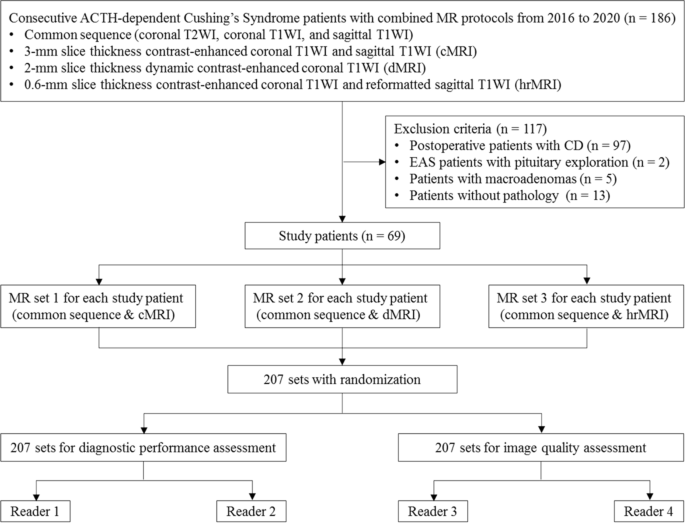
We retrospectively reviewed the medical records and imaging studies of 186 consecutive patients with ACTH-dependent Cushing’s syndrome, who underwent a combined protocol of cMRI, dMRI, and hrMRI from January 2016 to December 2020. Postoperative patients with Cushing’s disease (n = 97), patients with ectopic ACTH syndrome who underwent pituitary exploration (n = 2), and patients with macroadenomas (n = 5) or lack of pathology (n = 13) were excluded from the study. Finally, 69 patients with ACTH-dependent Cushing’s syndrome were included in the current study (Fig. 1) and the patients included were all surgically confirmed.

Fig. 1
figure 1

Flowchart of patient inclusion/exclusion process and image analysis. ACTH adrenocorticotropic hormone, CD Cushing’s disease, EAS ectopic ACTH syndrome, T1WI T1-weighted imaging, T2WI T2-weighted imaging

MRI protocol

All the patients were imaged on a 3.0 Tesla MR scanner (Discovery MR750w, GE Healthcare) using an 8-channel head coil. The MRI protocol included coronal T2-weighted imaging, coronal T1-weighted imaging, and sagittal T1-weighted imaging before contrast injection. After contrast injection of gadopentetate dimeglumine (Gd-DTPA) at 0.05 mmol/kg (0.1 mL/kg) with a flow rate of 2 mL/s followed by a 10-mL saline solution flush, dMRI and cMRI with 2D FSE sequence were obtained first, and hrMRI with 3D FSE sequence using variable flip angle technique was performed immediately afterward. Detailed acquisition parameters are presented in Table S1.

Image analysis: diagnostic performance

Image interpretation was independently conducted by two experienced neuroradiologists (F.F. and H.Y. with 25 and 16 years of experience in neuroradiology, respectively), who were blinded to patient information. The evaluation order of cMRI, dMRI, and hrMRI sequences was randomized. The identification of pituitary microadenomas on images was scored based on a three-point scale (0 = poor; 1 = fair; 2 = excellent). Scores of 1 or 2 represented the identification of the lesion. Reference standards were established by using all available imaging, clinical, surgical, and pathological resources, with a multidisciplinary team approach.

Image analysis: image quality

Two readers (Z.L. and B.H. with 4 years of experience in radiology, respectively) were asked to assess the image quality of cMRI, dMRI, and hrMRI. Before exposure to images used in the current study, these readers underwent a training session to make sure that they were comparable to the experienced neuroradiologists in terms of image quality assessment. Images were presented in a random order. Image quality was assessed by using a 5-point Likert scale [17], including overall image quality (1 = non-diagnostic; 2 = poor; 3 = fair; 4 = good; 5 = excellent), sharpness (1 = non-diagnostic; 2 = not sharp; 3 = a little sharp; 4 = moderately sharp; 5 = satisfyingly sharp), and structural conspicuity (1 = non-diagnostic; 2 = poor; 3 = fair; 4 = good; 5 = excellent). An example of image quality assessment is shown in Table S2. Final decision was made through a consensus agreement.

The mean signal intensity of pituitary microadenomas, pituitary gland, and noise on cMRI, dMRI, and hrMRI was measured using an operator-defined region of interest. For noise, a 10-mm2 region of interest was placed in the background, and noise was defined as the standard deviation of the signal intensity of the background [17]. For pituitary microadenomas and pituitary gland, the region of interest should include a representative portion of the structure. The mean signal intensity of the pituitary microadenoma was replaced with that of the pituitary gland when no microadenoma was identified. A signal-to-noise ratio (SNR) was defined as the mean signal intensity of the pituitary microadenoma divided by noise. A contrast-to-noise ratio (CNR) was defined as the absolute difference of the mean signal intensity between the normal pituitary gland and pituitary microadenomas divided by noise [17]. Supplementary Fig. 1 shows how to measure the SNR and CNR with the region of interest in a contrast-enhanced pituitary MRI. Supplementary Fig. 2 shows the selection of images for the SNR and CNR calculation.

Statistical analysis

The κ analysis was conducted to assess the inter-observer agreement for identifying pituitary microadenomas. The κ value was interpreted as follows: below 0.20, slight agreement; 0.21–0.40, fair agreement; 0.41–0.60, moderate agreement; 0.61–0.80, substantial agreement; greater than 0.80, almost perfect agreement.

To assess the diagnostic performance of cMRI, dMRI, and hrMRI for identifying pituitary microadenomas, the receiver operating characteristic curves were plotted and the area under curves (AUCs) were compared between MR protocols for each reader by using the DeLong test. Sensitivity, specificity, positive predictive value, and negative predictive value were calculated. The Mann–Whitney U test was used to evaluate the difference in image quality scores and the Wilcoxon signed-rank test was used to evaluate SNR and CNR measurements between MR protocols. A p value of less than 0.05 was considered statistically significant. Statistical analysis was performed using MedCalc Statistical Software (version 20.0.15; MedCalc Software) and SPSS Statistics (version 22.0; IBM).

Results

Clinical characteristics

A total of 69 patients (median age, 39 years; interquartile range [IQR], 29–54 years; 38 women [55%]) with ACTH-dependent Cushing’s syndrome were included in the study and their clinical characteristics are shown in Table 1. Among the 69 patients, 60 (87%) patients were diagnosed with Cushing’s disease and 9 (13%) were ectopic ACTH syndrome. The median disease course was 36 months (IQR, 12–78 months). The median serum cortisol, ACTH, and 24-h urine free cortisol level before surgery were 33.0 μg/dL (IQR, 25.1–40.1 μg/dL; normal range 4.0–22.3 μg/dL), 77.2 ng/L (IQR, 55.0–124.0 ng/L; normal range 0–46 ng/L), and 422.0 μg (IQR, 325.8–984.6 μg; normal range 12.3–103.5 μg), respectively. The median serum cortisol and 24-h urine free cortisol level after surgery were 3.0 μg/dL (IQR, 1.8–18.4 μg/dL) and 195.6 μg (IQR, 63.5–1240.3 μg), respectively. The median diameter of pituitary microadenomas was 5 mm (IQR, 4–5 mm), ranging from 3 to 9 mm.

Table 1 Clinical characteristics of the patients

Diagnostic performance of cMRI, dMRI, and hrMRI for identifying pituitary microadenomas

The inter-observer agreement for identifying pituitary microadenomas by κ statistic between two readers was moderate on cMRI (κ = 0.50), moderate on dMRI (κ = 0.57), and almost perfect on hrMRI (κ = 0.91), respectively.

The diagnostic performance for identifying pituitary microadenomas on cMRI, dMRI, hrMRI, and combined cMRI and dMRI is summarized in Table 2. For reader 1, the diagnostic performance of hrMRI (AUC, 0.95; 95%CI: 0.87, 0.99) was higher than that of cMRI (AUC, 0.75; 95%CI: 0.63, 0.85; p = 0.002), dMRI (AUC, 0.59; 95%CI: 0.47, 0.71; p < 0.001), and combined cMRI and dMRI (AUC, 0.65; 95%CI: 0.53, 0.76; p = 0.001). For reader 2, the diagnostic performance of hrMRI (AUC, 0.97; 95%CI: 0.89, 1.00) was higher than that of cMRI (AUC, 0.74; 95%CI: 0.63, 0.84; p = 0.001), dMRI (AUC, 0.68; 95%CI: 0.56, 0.79; p = 0.001), and combined cMRI and dMRI (AUC, 0.70; 95%CI: 0.58, 0.80; p = 0.003).

Table 2 Diagnostic performance of cMRI, dMRI, and hrMRI for identifying pituitary microadenomas

For reader 1, 23 of the 69 patients (33%) were misdiagnosed on both cMRI and dMRI, but 18 of the 23 misdiagnosed patients (78%) were correctly diagnosed on hrMRI. For reader 2, 17 of the 69 patients (25%) were misdiagnosed on both cMRI and dMRI, but 14 of the 17 misdiagnosed patients (82%) were correctly diagnosed on hrMRI.

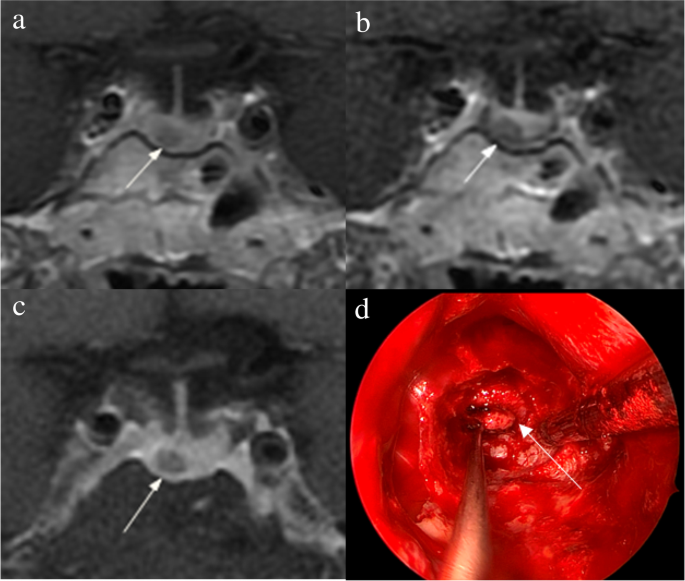
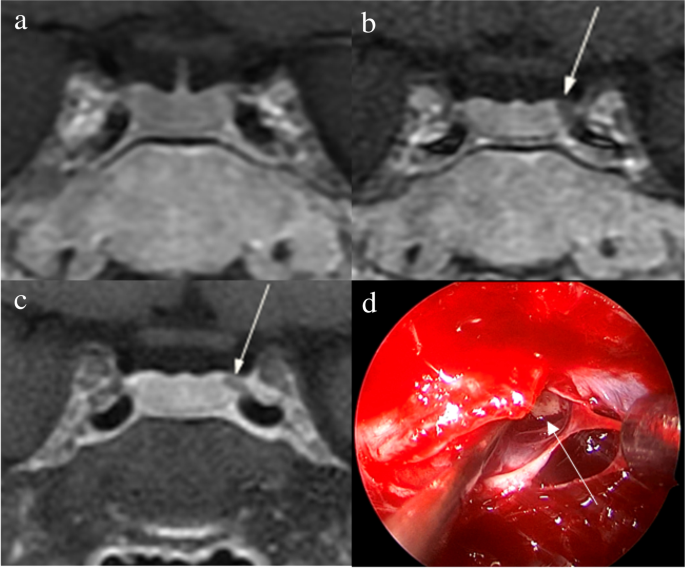
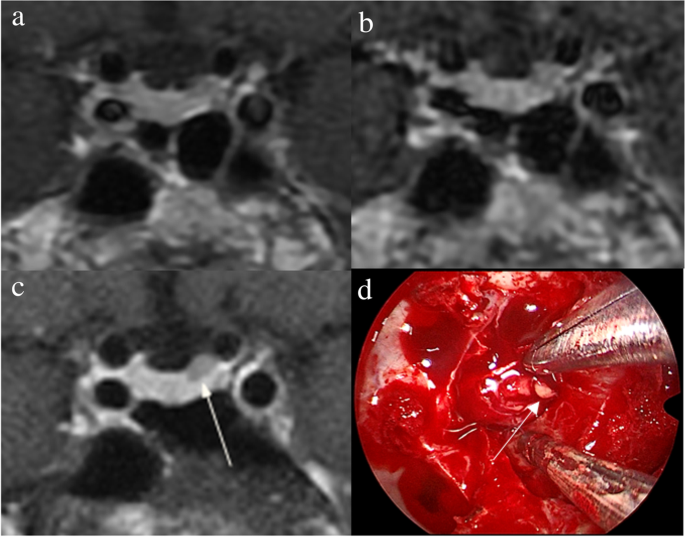
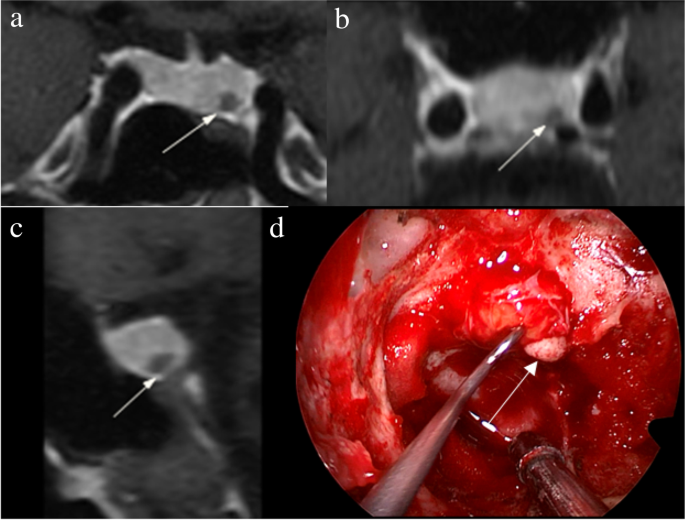
Figure 2 shows that a 5-mm pituitary microadenoma was identified on preoperative pituitary MRI. The margin of the lesion was fully delineated on hrMRI, but not on cMRI and dMRI. Figure 3 shows that a 3-mm pituitary microadenoma was missed on cMRI, but identified on dMRI and hrMRI. Figure 4 shows that a 5-mm pituitary microadenoma was correctly diagnosed on hrMRI, but missed on cMRI or dMRI. Figure 5 shows that a 4-mm pituitary microadenoma was evident on coronal images as well as reconstructed axial and reconstructed sagittal images on hrMRI.

Fig. 2

figure 2

Images in a 56-year-old man with Cushing’s disease. The 5-mm pituitary microadenoma (arrow) can be identified on (a) coronal contrast-enhanced T1-weighted image and (b) coronal dynamic contrast-enhanced T1-weighted image obtained with two-dimensional (2D) fast spin echo (FSE) sequence, but the margin is not fully delineated. The lesion (arrow) is well delineated on (c) coronal contrast-enhanced T1-weighted image on high-resolution MRI obtained with 3D FSE sequence. d Intraoperative endoscopic photograph during transsphenoidal surgery after exposure of the sellar floor shows a round pituitary microadenoma (arrow)

Fig. 3

figure 3

Images in a 34-year-old woman with Cushing’s disease. No tumor is identified on (a) coronal contrast-enhanced T1-weighted image obtained with two-dimensional (2D) fast spin echo (FSE) sequence. The 3-mm pituitary microadenoma (arrow) with delayed enhancement is identified on the left side of the pituitary gland on (b) coronal dynamic contrast-enhanced T1-weighted image obtained with 2D FSE sequence and (c) coronal contrast-enhanced T1-weighted image on high-resolution MRI obtained with 3D FSE sequence. d Intraoperative endoscopic photograph during transsphenoidal surgery shows a 3-mm pituitary microadenoma (arrow)

Fig. 4

figure 4

Images in a 43-year-old man with Cushing’s disease. The lesion is missed on (a) coronal contrast-enhanced T1-weighted image and (b) coronal dynamic contrast-enhanced T1-weighted image obtained with two-dimensional (2D) fast spin echo (FSE) sequence. c Coronal contrast-enhanced T1-weighted image on high-resolution MRI obtained with 3D FSE sequence shows a round pituitary microadenoma (arrow) measuring approximately 5 mm with delayed enhancement on the left side of the pituitary gland. d Intraoperative endoscopic photograph for microsurgical resection of the 5-mm pituitary microadenoma (arrow)

Fig. 5

figure 5

Images in a 48-year-old woman with Cushing’s disease. Preoperative high-resolution contrast-enhanced MRI using three-dimensional fast spin echo sequence shows a 4-mm pituitary microadenoma (arrow) with delayed enhancement is well delineated on the left side of the pituitary gland on (a) coronal, (b) reconstructed axial, and (c) reconstructed sagittal contrast-enhanced T1-weighted images. d Intraoperative endoscopic photograph during transsphenoidal surgery after exposure of the sellar floor shows a round pituitary microadenoma (arrow)

Image quality of cMRI, dMRI, and hrMRI

Image quality scores of cMRI, dMRI, and hrMRI are presented in Table 3. Scores for overall image quality, sharpness, and structural conspicuity on hrMRI (overall image quality, 5.0 [IQR, 5.0–5.0]; sharpness, 5.0 [IQR, 4.5–5.0]; structural conspicuity, 5.0 [IQR, 5.0–5.0]) were higher than those on cMRI (overall image quality, 4.0 [IQR, 3.5–4.0]; sharpness, 4.0 [IQR, 3.0–4.0]; structural conspicuity, 4.0 [IQR, 4.0–4.0]; p < 0.001 for all) and dMRI (overall image quality, 4.0 [IQR, 4.0–4.0]; sharpness, 4.0 [IQR, 4.0–4.0]; structural conspicuity, 4.0 [IQR, 4.0–4.5]; p < 0.001 for all).

Table 3 Image quality scores on cMRI, dMRI, and hrMRI

The SNR and CNR measurements are shown in Table 4. The SNR of the pituitary microadenomas on hrMRI (67.5 [IQR, 51.2–92.1]) was lower than that on cMRI (82.3 [IQR, 61.8–127.2], p < 0.001), but higher than that on dMRI (53.9 [IQR, 35.2–72.6], p = 0.001). The CNR on hrMRI (26.2 [IQR, 15.1–41.0]) was higher than that on cMRI (10.6 [IQR, 0–42.6], p = 0.023) and dMRI (11.2 [IQR, 0–29.8], p < 0.001).

Table 4 SNR and CNR on cMRI, dMRI, and hrMRI

Discussion

The identification of pituitary microadenomas is considerably challenging but critical in patients with ACTH-dependent Cushing’s syndrome. Our study demonstrated that hrMRI with 3D FSE sequence had higher diagnostic performance (AUC, 0.95–0.97) than cMRI (AUC, 0.74–0.75; p ≤ 0.002) and dMRI (AUC, 0.59–0.68; p ≤ 0.001) for identifying pituitary microadenomas. To our knowledge, there are no previous studies specifically evaluating the identification of pituitary microadenomas on hrMRI with 3D FSE sequence by comparison with cMRI and dMRI in patients with ACTH-dependent Cushing’s syndrome, and this is the largest study conducted in ACTH-secreting microadenomas with a sensitivity of more than 90%.

Recently, techniques for pituitary evaluation have developed rapidly. Because of false negatives and false positives on cMRI and dMRI using 2D FSE sequence [7910], a 3D SPGR sequence was introduced for identifying pituitary adenomas. Previous studies demonstrated that the 3D SPGR sequence performed better than the 2D FSE sequence in the identification of pituitary adenomas with a sensitivity of up to 80% [11,12,13]. In patients with hyperprolactinemia, the 3D FSE sequence was recommended [14] and the 3D FSE sequence has rapidly developed recently with superior image quality [1516], suggesting that the 3D FSE sequence may be a reliable alternative for identifying pituitary adenomas. However, to our knowledge, few studies have investigated the diagnostic performance of the 3D FSE sequence for identifying ACTH-secreting pituitary adenomas. To fill the gaps, we conducted the current study and revealed that images obtained with the 3D FSE sequence had higher sensitivity (90–93%) in identifying pituitary microadenomas, than that in previous studies using the 3D SPGR sequence [811,12,13].

There is a trade-off between spatial resolution and image noise. The reduced slice thickness can overcome the partial volume averaging effect, but it is associated with increased image noise [17]. Strikingly, our study showed that hrMRI had higher image quality scores than cMRI and dMRI, in terms of overall image quality, sharpness, and structural conspicuity. The SNR of the pituitary microadenomas on cMRI was slightly higher than that on hrMRI in our study. This is because the SNR was calculated as the mean signal intensity of the pituitary gland (instead of the pituitary microadenoma) divided by noise when no microadenoma was identified, and the mean signal intensity of the pituitary gland is higher than that of the pituitary microadenoma. About 40% of pituitary microadenomas were missed on cMRI, whereas less than 10% of pituitary microadenomas were missed on hrMRI. Given the situation mentioned above, the SNR on hrMRI was lower than that on cMRI. However, the CNR on hrMRI was significantly higher than that on cMRI and dMRI. Therefore, hrMRI in our study can dramatically improve the spatial resolution with high CNR, enabling the better identification of pituitary microadenomas.

The identification of pituitary adenomas on preoperative MRI in patients with ACTH-dependent Cushing’s syndrome could help the differential diagnosis of Cushing’s syndrome and aids surgical resection of lesions. It should be noted that most of the pituitary adenomas in patients with Cushing’s disease are microadenomas [56]. In our study, all the tumors are microadenomas with a median diameter of 5 mm (IQR, 4–5 mm), making the diagnosis more challenging. The sensitivity of identifying pituitary adenomas decreased from 80 to 72% after excluding macroadenomas in a previous study [12], whereas the sensitivity of identifying pituitary microadenomas in our study was 90–93% on hrMRI. In the current study, hrMRI performed better than cMRI, dMRI, and combined cMRI and dMRI, with high AUC (0.95–0.97), high sensitivity (90–93%), and high specificity (100%), superior to previous studies [811,12,13]. The high sensitivity of hrMRI for identifying pituitary adenomas will help surgeons improve the postoperative remission rate [4]. The high specificity of hrMRI will assist clinicians to consider ectopic ACTH syndrome, and then perform imaging to identify ectopic tumors. Besides, the inter-observer agreement for identifying pituitary microadenomas was almost perfect on hrMRI (κ = 0.91), which was moderate on cMRI (κ = 0.50) and dMRI (κ = 0.57). Therefore, hrMRI using the 3D FSE sequence is a potential alternative that can significantly improve the identification of pituitary microadenomas.

Limitations of the study included its retrospective nature and the relatively small sample size in patients with ectopic ACTH syndrome as negative controls. The bias may be introduced in the patient inclusion process. Only those patients who underwent all the cMRI, dMRI, and hrMRI scans were included. In fact, some patients will bypass hrMRI when obvious pituitary adenomas were detected on cMRI and dMRI. These patients were not included in the current study because of lack of hrMRI findings. Given the situation, the sensitivity of identifying pituitary adenomas will be higher with the enrollment of these patients. Besides, the timing of the sequence acquisition after contrast injection is essential [16] and bias may be introduced due to the postcontrast enhancement curve of both the pituitary gland and the microadenoma [14]. In the future, a prospective study with different sequence acquisition orders is needed to minimize possible interference caused by the postcontrast enhancement curve. Moreover, a larger sample size is also needed to verify the diagnostic performance of hrMRI using 3D FSE sequence for identifying pituitary microadenomas and to determine whether it can replace 2D FSE or 3D SPGR sequences for routinely evaluating the pituitary gland.

In conclusion, hrMRI with 3D FSE sequence showed higher diagnostic performance than cMRI and dMRI for identifying pituitary microadenomas in patients with Cushing’s syndrome.

Abbreviations

ACTH:
Adrenocorticotropic hormone
AUC:
Area under the receiver operating characteristics curve
cMRI:
Conventional contrast-enhanced MRI
CNR:
Contrast-to-noise ratio
dMRI:
Dynamic contrast-enhanced MRI
FSE:
Fast spin echo
hrMRI:
High-resolution contrast-enhanced MRI
IQR:
Interquartile range
SNR:
Signal-to-noise ratio
SPGR:
Spoiled gradient re

called

References

  1. Lacroix A, Feelders RA, Stratakis CA, Nieman LK (2015) Cushing’s syndrome. Lancet 386:913–927

    Article CAS PubMed Google Scholar

  2. Loriaux DL (2017) Diagnosis and differential diagnosis of Cushing’s syndrome. N Engl J Med 376:1451–1459

    Article CAS PubMed Google Scholar

  3. Nieman LK, Biller BM, Findling JW et al (2015) Treatment of Cushing’s syndrome: an Endocrine Society clinical practice guideline. J Clin Endocrinol Metab 100:2807–2831

    Article CAS PubMed PubMed Central Google Scholar

  4. Yamada S, Fukuhara N, Nishioka H et al (2012) Surgical management and outcomes in patients with Cushing disease with negative pituitary magnetic resonance imaging. World Neurosurg 77:525–532

    Article PubMed Google Scholar

  5. Vitale G, Tortora F, Baldelli R et al (2017) Pituitary magnetic resonance imaging in Cushing’s disease. Endocrine 55:691–696

    Article CAS PubMed Google Scholar

  6. Jagannathan J, Smith R, DeVroom HL et al (2009) Outcome of using the histological pseudocapsule as a surgical capsule in Cushing disease. J Neurosurg 111:531–539

    Article PubMed PubMed Central Google Scholar

  7. Boscaro M, Arnaldi G (2009) Approach to the patient with possible Cushing’s syndrome. J Clin Endocrinol Metab 94:3121–3131

    Article CAS PubMed Google Scholar

  8. Kasaliwal R, Sankhe SS, Lila AR et al (2013) Volume interpolated 3D-spoiled gradient echo sequence is better than dynamic contrast spin echo sequence for MRI detection of corticotropin secreting pituitary microadenomas. Clin Endocrinol (Oxf) 78:825–830

    Article CAS PubMed Google Scholar

  9. Lonser RR, Nieman L, Oldfield EH (2017) Cushing’s disease: pathobiology, diagnosis, and management. J Neurosurg 126:404–417

    Article PubMed Google Scholar

  10. Potts MB, Shah JK, Molinaro AM et al (2014) Cavernous and inferior petrosal sinus sampling and dynamic magnetic resonance imaging in the preoperative evaluation of Cushing’s disease. J Neurooncol 116:593–600

    Article PubMed Google Scholar

  11. Grober Y, Grober H, Wintermark M, Jane JA, Oldfield EH (2018) Comparison of MRI techniques for detecting microadenomas in Cushing’s disease. J Neurosurg 128:1051–1057

    Article PubMed Google Scholar

  12. Fukuhara N, Inoshita N, Yamaguchi-Okada M et al (2019) Outcomes of three-Tesla magnetic resonance imaging for the identification of pituitary adenoma in patients with Cushing’s disease. Endocr J 66:259–264

    Article PubMed Google Scholar

  13. Patronas N, Bulakbasi N, Stratakis CA et al (2003) Spoiled gradient recalled acquisition in the steady state technique is superior to conventional postcontrast spin echo technique for magnetic resonance imaging detection of adrenocorticotropin-secreting pituitary tumors. J Clin Endocrinol Metab 88:1565–1569

    Article CAS PubMed Google Scholar

  14. Magnaldi S, Frezza F, Longo R, Ukmar M, Razavi IS, Pozzi-Mucelli RS (1997) Assessment of pituitary microadenomas: comparison between 2D and 3D MR sequences. Magn Reson Imaging 15:21–27

    Article CAS PubMed Google Scholar

  15. Lien RJ, Corcuera-Solano I, Pawha PS, Naidich TP, Tanenbaum LN (2015) Three-Tesla imaging of the pituitary and parasellar region: T1-weighted 3-dimensional fast spin echo cube outperforms conventional 2-dimensional magnetic resonance imaging. J Comput Assist Tomogr 39:329–333

    PubMed Google Scholar

  16. Sartoretti T, Sartoretti E, Wyss M et al (2019) Compressed SENSE accelerated 3D T1w black blood turbo spin echo versus 2D T1w turbo spin echo sequence in pituitary magnetic resonance imaging. Eur J Radiol 120:108667

    Article PubMed Google Scholar

  17. Kim M, Kim HS, Kim HJ et al (2021) Thin-slice pituitary MRI with deep learning-based reconstruction: diagnostic performance in a postoperative setting. Radiology 298:114–122

    Article PubMed Google Scholar

Download references

Acknowledgements

We thank Dr. Kai Sun, Medical Research Center, Peking Union Medical College Hospital, for his guidance on the statistical analysis in this study.

Funding

This study has received funding from the National Natural Science Foundation of China (grant 82071899), the National Key Research and Development Program of China (grants 2016YFC1305901, 2020YFA0804500), the Chinese Academy of Medical Sciences Innovation Fund for Medical Sciences (grants 2017-I2M-3–008, 2021-I2M-1–025), the Beijing Natural Science Foundation (grant L182067) and National High Level Hospital Clinical Research Funding (2022-PUMCH-B-067, 2022-PUMCH-B-114).

Author information

Author notes

  1. Zeyu Liu and Bo Hou contributed equally to this work and share first authorship
  2. Hui You and Feng Feng contributed equally to this work and share corresponding authorship

Authors and Affiliations

  1. Department of Radiology, Peking Union Medical College Hospital, Chinese Academy of Medical Sciences and Peking Union Medical College, No. 1 Shuaifuyuan Wangfujing Dongcheng Distinct, Beijing, 100730, China

    Zeyu Liu, Bo Hou, Hui You, Mingli Li & Feng Feng

  2. Department of Endocrinology, Peking Union Medical College Hospital, Chinese Academy of Medical Sciences and Peking Union Medical College, No. 1 Shuaifuyuan Wangfujing Dongcheng Distinct, Beijing, 100730, China

    Lin Lu, Lian Duan & Huijuan Zhu

  3. Department of Neurosurgery, Peking Union Medical College Hospital, Chinese Academy of Medical Sciences and Peking Union Medical College, No. 1 Shuaifuyuan Wangfujing Dongcheng Distinct, Beijing, 100730, China

    Kan Deng & Yong Yao

  4. State Key Laboratory of Complex Severe and Rare Disease, Peking Union Medical College Hospital, Chinese Academy of Medical Sciences and Peking Union Medical College, No. 1 Shuaifuyuan Wangfujing Dongcheng Distinct, Beijing, 100730, China

    Yong Yao, Huijuan Zhu & Feng Feng

Corresponding authors

Correspondence to Hui You or Feng Feng.

Ethics declarations

Guarantor

The scientific guarantor of this publication is Feng Feng.

Conflict of interest

The authors of this manuscript declare no conflict of interest.

Statistics and biometry

No complex statistical methods were necessary for this paper.

Informed consent

Written informed consent was waived by the Institutional Review Board.

Ethical approval

Institutional Review Board approval was obtained.

Methodology

• retrospective

• diagnostic or prognostic study

• performed at one institution

Additional information

Publisher’s note

Springer Nature remains neutral with regard to jurisdictional claims in published maps and institutional affiliations.

Supplementary Information

Below is the link to the electronic supplementary material.

Cushing’s Disease Patients are More Likely to Have Ocular Hypertension

The following is the summary of “Increased Risk of Ocular Hypertension in Patients With Cushing’s Disease” published in the December 2022 issue of Glaucoma by Ma, et al.


Ocular hypertension was more common in people with Cushing’s illness. The usage of steroids in the body is a major contributor to high intraocular pressure (IOP). Topical or systemic glucocorticoid use may increase the prevalence of ocular hypertension in the general population from 30–40%. The prevalence of ocular hypertension in endogenous hypercortisolemia and the ophthalmological consequences following endocrine remission after surgical resection are unknown. During the period of January 2019 through July 2019, all patients with Cushing’s disease (CD) who were hospitalized at a tertiary pituitary facility for surgical intervention had their intraocular pressure (IOP), vision field, and peripapillary retinal nerve fiber layer thickness recorded.

Nonfunctioning pituitary adenoma (NFPA) patients and acromegaly patients from the same time period were used as comparison groups. Researchers showed postoperative changes in IOP, estimated the odds ratio (OR), and identified risk variables for the development of ocular hypertension. About 52 patients with CD were included in the study (mean age 38.4±12.4 years). Patients with CD had an IOP that was 19.4±5.4 mm Hg in the left eye and 20.0±7.1 mm Hg in the right eye, which was significantly higher than that of patients with acromegaly (17.5±2.3 mm Hg in the left eye and 18.6±7.0 mm Hg in the right eye, P=0.033) and NFPA (17.8±2.6 mm Hg in the left eye and 17.4±2.4 mm Hg in the right eye, Ocular hypertension was diagnosed in 21 eyes (20.2%) of CD patients, but only 4 eyes (4.7%) of acromegaly patients and 4 eyes (4.5%) of NFPA patients. Patients with CD had an odds ratio (OR) of 5.1 [95% CI, 1.3-25.1, P=0.029] and 6.6 [95% CI, 1.8-30.3, P=0.007] for developing ocular hypertension compared with the 2 control groups.

Higher levels of urine-free cortisol were associated with an increased risk of ocular hypertension in CD patients (OR=19.4, 95% CI, 1.7-72.6). Patients with CD saw a decrease in IOP at 1 month following surgery, and this improvement was maintained for another 2 months. Researchers conclude that endogenous hypercortisolemia should be included as part of the glaucoma assessment due to the increased risk of ocular hypertension in CD. Ophthalmologists and neuroendocrinologists should use their judgment in light of this finding.

Source:  journals.lww.com/glaucomajournal/Fulltext/2022/12000/Increased_Risk_of_Ocular_Hypertension_in_Patients.3.aspx