Pregnancy and pituitary disorders

Pituitary and pineal glands

Pituitary and pineal glands (Photo credit: Wikipedia)

Z Karaca, F Tanriverdi, K Unluhizarci and F Kelestimur
+ Author Affiliations

Department of Endocrinology,
Erciyes University Medical School, 38039 Kayseri, Turkey
(Correspondence should be addressed to F Kelestimur; Email: fktimur@erciyes.edu.tr)

Abstract

Major hormonal changes emerge during pregnancy. The pituitary gland is one of the most affected organs with altered anatomy and physiology. The pituitary gland is enlarged as a result of lactotroph hyperplasia. Due to physiological changes in the pituitary and target hormone levels, binding globulins, and placental hormones, hormonal evaluation becomes more complex in pregnant women. As a consequence of physiological hormonal changes, the evaluation of pituitary functions in pregnant women is quite different from that done in the prepregnant state. Pituitary adenomas may cause problems by their hormone secretion that affects the mother and the fetus besides causing an increased risk of tumor growth.

Furthermore, diagnosis, course, and treatment of pituitary diseases point out differences. The changes in anatomy and physiology of the pituitary gland during pregnancy are reviewed.

Pituitary disorders namely Cushing’s disease; acromegaly; prolactinoma; TSH-secreting, gonadotropin-producing, and clinically nonfunctioning adenomas; craniopharyngioma; and Sheehan’s syndrome, which is one of the most common causes of hypopituitarism, lymphocytic hypophysitis, and hypopituitarism, in relation to pregnancy are discussed. Being aware of all this information will prevent any serious problems which mother and child will be exposed to.

Read the entire article here: http://www.eje-online.org/content/162/3/453.full

Quality of Life and Other Outcomes in Children Treated for Cushing Syndrome

Abstract

Journal of Clinical Endocrinology and Metabolism, 05/16/2013  Review Article  Clinical Article

Keil MF – Cushing syndrome (CS) in children is associated with residual impairment in measures of health–related quality of life, even after successful resolution of hypercortisolemia, highlighting the need for early identification of morbidities and improvements in long–term management of these patients.

A review of the literature identifies significant morbidities associated with CS of pediatric onset, which must not be treated in isolation. CS affects children and adolescents in many ways that are different than adults.

Post–treatment challenges for the child or adolescent treated for CS include: optimize growth and pubertal development, normalize body composition, and promote psychological health and cognitive maturation. All these factors impact health–related quality of life, which is an important outcome measure to assess the burden of disease as well as the effect of treatment.

Get this article here

Research on Cushing’s Disease Presented at ENDO 2013

endo-chart

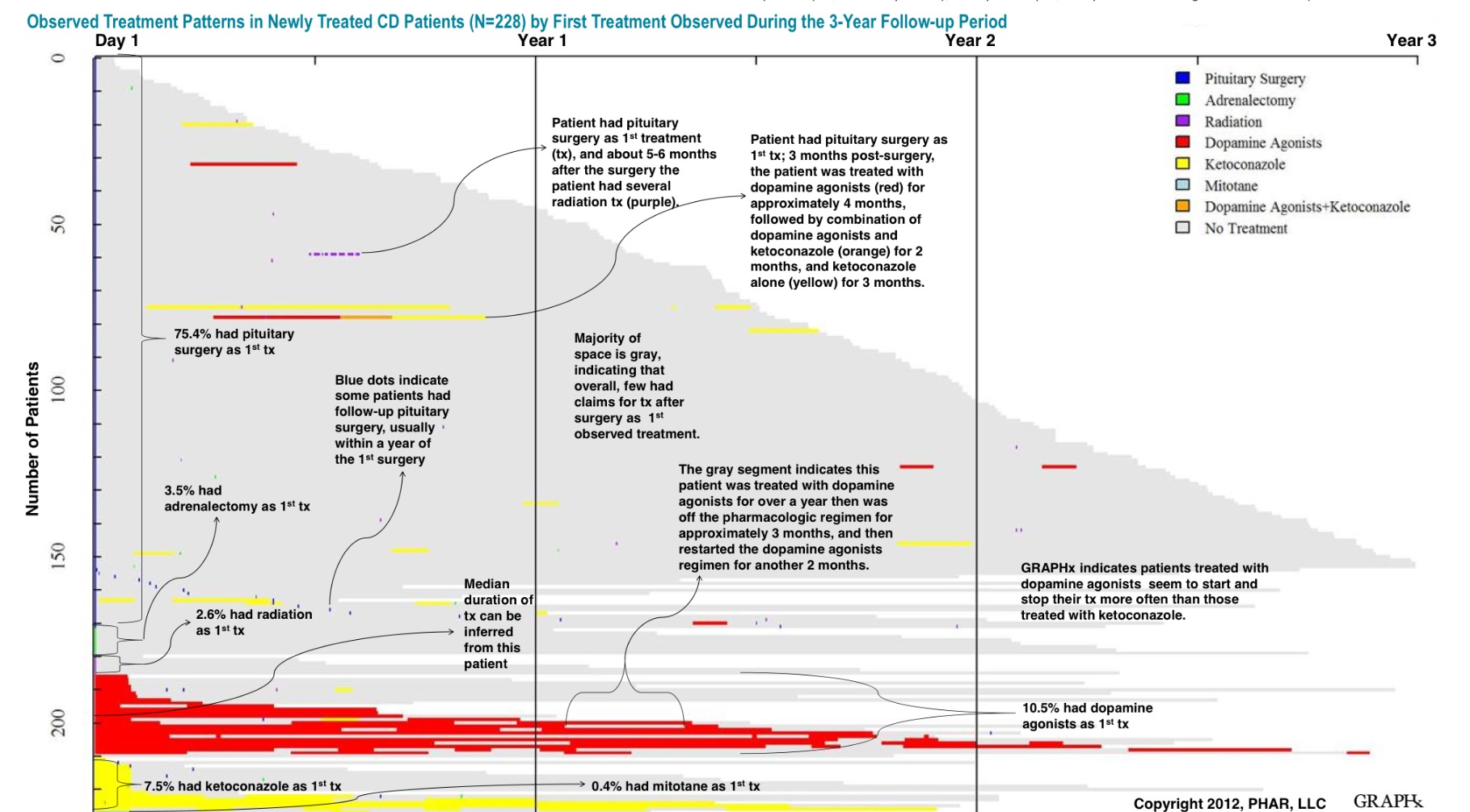
Researchers at PHAR, in conjunction with experts from Novartis Pharmaceuticals Corporation, presented the results of several studies on Cushing’s disease at the Endocrine Society’s 95th Annual Meeting on June 19th, 2013.

Cushing’s disease, a pituitary disorder, is poorly studied because of its rarity. The PHAR research team reported on the incidence, treatment patterns, and annual economic burden associated with the disease–topics on which very little was previously known.

The three posters presented at ENDO can be viewed by clicking the links below:

Incidence of Cushing’s Disease in the United States

Real-World Treatment Patterns in Cushing’s Disease Patients in Two Large US Nationwide Databases: Application of a Novel, Graphical Methodology

Annual Economic Burden Associated with Cushing’s Disease in the United States

Pasireotide for the treatment of Cushing’s disease

Posted online on June 17, 2013. (doi:10.1517/21678707.2013.807731)

Annamaria Colao Chiara Simeoli Monica De Leo Alessia Cozzolino Rosario Pivonello

Department of Clinical Medicine and Surgery, Section of Endocrinology, Federico II University, Via Sergio Pansini 5,

80131 Naples

, Italy +39 0817462132; +39 0815465443; colao@unina.it

Author for correspondence

Introduction: Pasireotide, a novel multireceptor targeted somatostatin analog is the first drug approved for treatment of adult patients with Cushing’s disease (CD) for whom pituitary surgery is not an option or has not been curative.

Areas covered: The review describes published data on efficacy and safety of pasireotide in CD patients. In particular, the review focuses on a Phase III study (CSOM230B2305) evaluating the outcomes of treatment with pasireotide at the doses of 600 and 900 µg twice daily for 12 months in 162 CD patients. This clinical trial reported a decrease in urinary free cortisol levels in the majority of patients, with a substantial reduction in nearly half and a normalization in > 25% of patients included in the study, accompanied by an improvement in clinical picture as well as a significant reduction in pituitary tumor size. Hyperglycemia appears as the most important side effect, requiring a careful monitoring and a prompt administration of glucose-lowering medications.

Expert opinion: Pasireotide seems to have a promising role as medical option for CD patients who experienced a failure or not candidate for neurosurgery; its employment will probably induce in the near future significant changes in the therapeutic approach to CD.

Read More: http://informahealthcare.com/doi/abs/10.1517/21678707.2013.807731

Research and Markets: Pituitary ACTH Hypersecretion (Cushing’s Disease) – Pipeline Review Report, H1 2013 Edition

Research and Markets(http://www.researchandmarkets.com/research/rdf6gm/pituitary_acth) has announced the addition of the “Pituitary ACTH Hypersecretion (Cushing’s Disease) – Pipeline Review, H1 2013” report to their offering.

‘Pituitary ACTH Hypersecretion (Cushing’s Disease) – Pipeline Review, H2 2013’, provides an overview of the indication’s therapeutic pipeline. This report provides information on the therapeutic development for Pituitary ACTH Hypersecretion (Cushing’s Disease), complete with latest updates, and special features on late-stage and discontinued projects. It also reviews key players involved in the therapeutic development for Pituitary ACTH Hypersecretion (Cushing’s Disease).

Scope

– A snapshot of the global therapeutic scenario for Pituitary ACTH Hypersecretion (Cushing’s Disease).

– A review of the Pituitary ACTH Hypersecretion (Cushing’s Disease) products under development by companies and universities/research institutes based on information derived from company and industry-specific sources.

– Coverage of products based on various stages of development ranging from discovery till registration stages.

– A feature on pipeline projects on the basis of monotherapy and combined therapeutics.

– Coverage of the Pituitary ACTH Hypersecretion (Cushing’s Disease) pipeline on the basis of route of administration and molecule type.

– Key discontinued pipeline projects.

– Latest news and deals relating to the products.

Companies Involved in Pituitary ACTH Hypersecretion (Cushing’s Disease) Therapeutics Development


  • Isis Pharmaceuticals, Inc.
  • Ipsen S.A.
  • Novartis AG
  • HRA Pharma, SA
  • Cortendo Invest AB


Drug Profiles: Product Description, Mechanism of Action and R&D Progress


  • LCI-699
  • mifepristone
  • ISIS-GCCRRx
  • Inhibitors of ACTH receptor
  • ketoconazole
  • Next Generation Cortisol Inhibitor
  • pasireotide Long Acting Release


For more information visit http://www.researchandmarkets.com/research/rdf6gm/pituitary_acth