


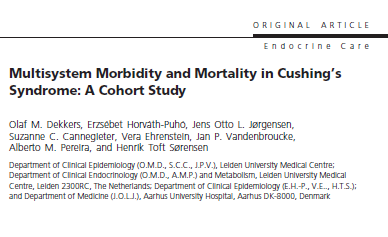
People with Cushing’s syndrome, even when treated, have higher morbidity and mortality rates that comparable controls. That is the conclusion of a new study published in the June issue of the Journal of Clinical Endocrinology Metabolism. The study by Olaf Dekkers et al, examined data records from the Danish National Registry of Patients and the Danish Civil Registration System of 343 patients with benign Cushing’s syndrome of adrenal or pituitary origin (i.e., Cushing’s disease) and a matched population comparison cohort (n=34,300). Due to the lengthy delay of many patients being diagnosed with Cushing’s syndrome, morbidity was investigated in the 3 years before diagnosis while morbidity and mortality were assessed during complete follow-up after diagnosis and treatment.
The study found that mortality was twice as high in Cushing’s syndrome patients (HR 2.3, 95% CI 1.8-2.9) compared with controls over a mean follow-up period of 12.1 years. Furthermore, patients with Cushing’s syndrome were at increased risk for:
- venous thromboembolism (HR 2.6, 95% CI 1.5-4.7)
- myocardial infarction (HR 3.7, 95% CI 2.4-5.5)
- stroke (HR 2.0, 95% CI 1.3-3.2)
- peptic ulcers (HR 2.0, 95% CI 1.1-3.6)
- fractures (HR 1.4, 95% CI 1.0-1.9)
- infections (HR 4.9, 95% CI 3.7-6.4).
The study also found that this increased multimorbidity risk was present before diagnosis indicating that it was due to cortisol overproduction rather than treatment.
Many of the Cushing’s syndrome patients underwent surgery to remove the benign tumor. For this group, the investigators performed a sensitivity analysis of the long-term mortality and cardiovascular risk in this subgroup (n=186) considered to be cured after operation (adrenal surgery and patients with pituitary surgery in combination with a diagnosis of hypopituitarism in the first 6 months after operation). The risk estimates for mortality (HR 2.31, 95% CI 1.62-3.28), venous thromboembolism (HR 2.03, 95% CI 0.75-5.48), stroke (HR 1.91, 95% CI 0.90-4.05), and acute myocardial infarction (HR 4.38, 95% CI 2.31-8.28) were also increased in this subgroup one year after the operation.
The standard treatment for endogenous Cushing’s syndrome is surgery. This past year, Signifor (pasireotide) was approved for treatment of adults patients with Cushing’s disease for whom pituitary surgery is not an option or has not been curative. Cushing’s disease, which accounts for the majority of Cushing’s syndrome patients, is defined as the presence of an ACTH producing tumor on the pituitary grand. In the study by Dekker’s et al, the percentage of patients with Cushing’s disease is not known. We look forward to reexamination of this dataset in a few years following the introduction of more treatment options for Cushing’s disease as well as an analysis that explores the differences in mortality/morbidity rates in the different subsets of patients that make of Cushing’s syndrome (Cushing’s disease, ectopic Cushing’s syndrome, Exogenous Cyshing’s syndrome).
References
Dekkers OM, Horvath-Pujo, Jorgensen JOL, et al, Multisystem morbidity and mortality in Cushing’s syndrome: a cohort study. J Clin Endocrinol Metab 2013 98(6): 2277–2284. doi: 10.1210/jc.2012-3582
– See more at: http://www.raredr.com/medicine/articles/cushing%E2%80%99s-syndrome-hazardous-your-health-0
Filed under: adrenal, Cushing's, pituitary, Rare Diseases | Tagged: ACTH, adrenal, adrenal surgery, cardiovascular risk, cortisol, Cushing's Disease, Cushing's Syndrome, ectopic, endogenous, fractures, hypopituitarism, infections, Journal of Clinical Endocrinology & Metabolism, Morbidity, mortality, myocardial infarction, pasireotide, peptic ulcers, pituitary, pituitary surgery, Signifor, stroke, surgery, venous thromboembolism | Leave a comment »

