Cushing’s Awareness Challenge 15

robin-dontsay

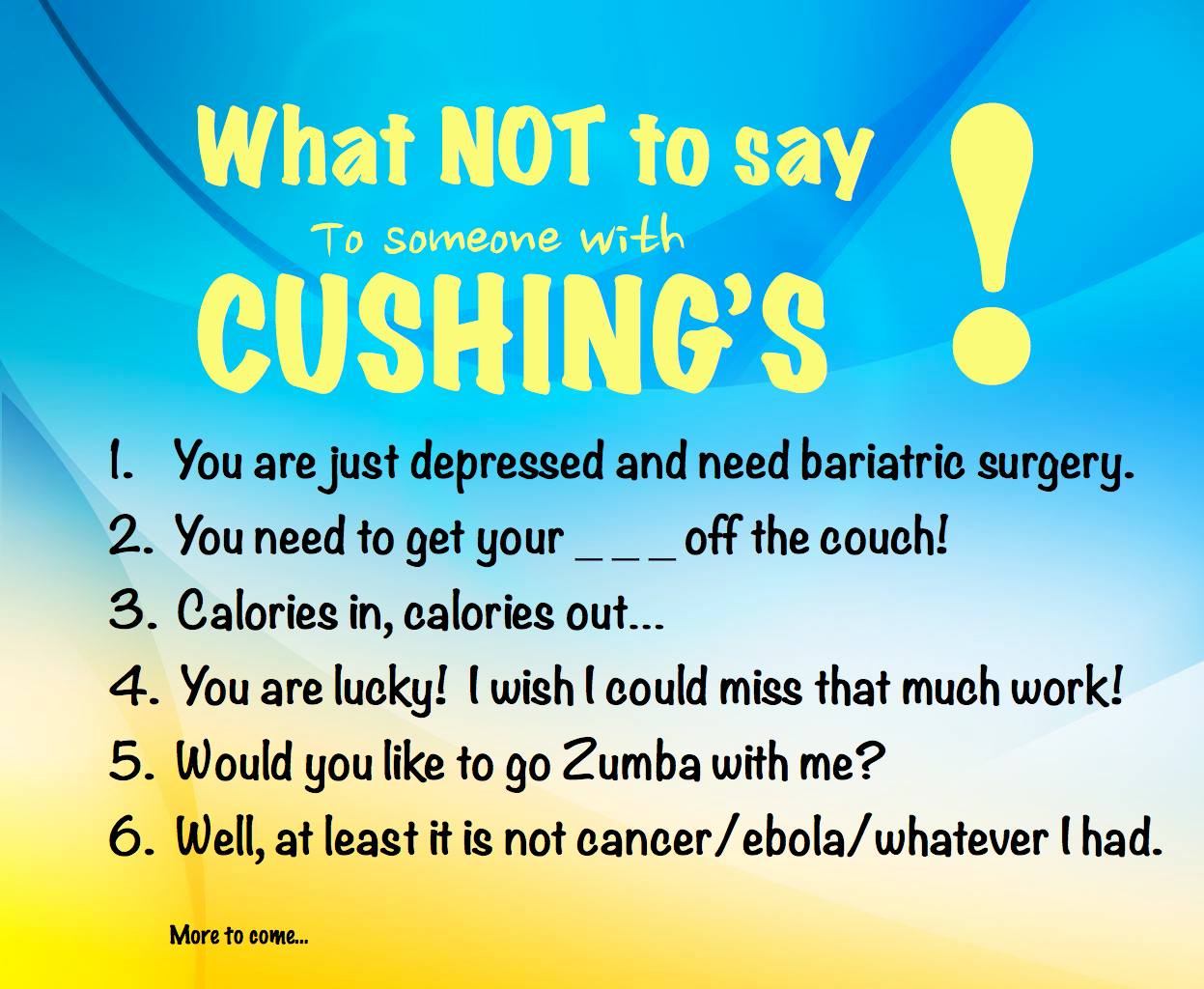
A continuation of the last post with another of Robin’s great images.  I’ve also heard many of these comments.

I did have #6, cancer – kidney cancer or renal cell carcinoma – in 2006 and the diagnosis was much faster/easier than Cushing’s.  My cancer diagnosis took about an hour in the emergency room.  Cushing’s took about 5 years or so.  Cancer surgery recovery was faster with fewer long-term consequences.

When I told people I had cancer, everyone understood.  When I told them I had Cushing’s, no one did.

That being said, I don’t recommend getting either cancer or Cushing’s!


maryo colorful zebra

Cushing’s Awareness Challenge: Day 11

robin-uncontrolled

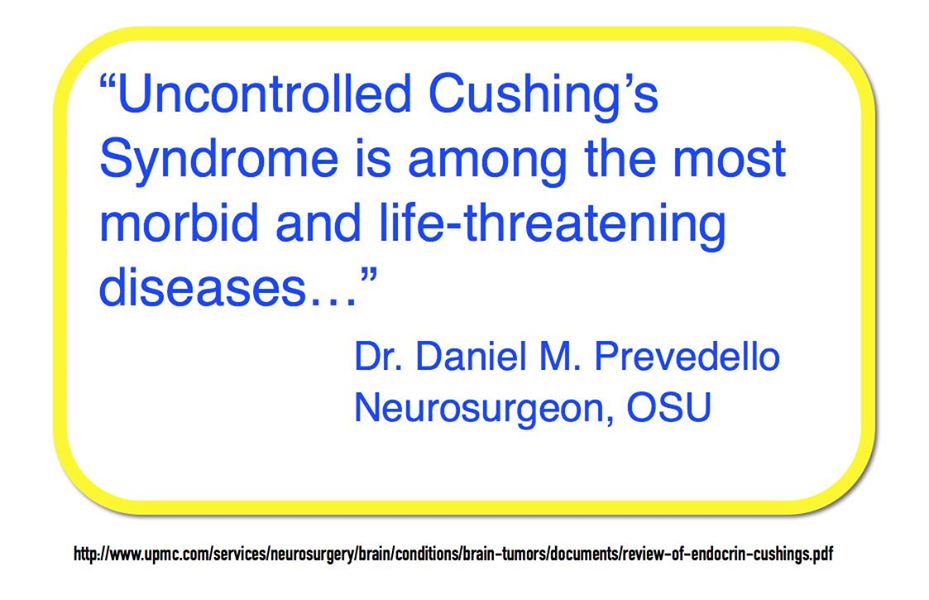
Robin has shared this quote from Dr. Prevedallo.  You can read more at the link at http://brainsurgery.upmc.com/_pdf/Review-of-Endocrin-Cushings.pdf

Over the years, I have seen that this is true, sometimes even for controlled Cushing’s.  Far too many Cushies have died.

Here are some of those that I know of:

Cushing’s is a terrible disease.

There is another Cushie I should add to this list. During the time I was home from NIH just before pituitary surgery, a college classmate of mine (I didn’t know her) did die at NIH of a Cushing’s-related problem. I’m so glad I didn’t find out until a couple months later!  I still have the college alumni magazine that mentioned this.  I’ll have to find that and add it to the In Memory list.

My husband shared a bit about her in my bio:

During the same time Mary was at NIH, another woman had the same operation. She came from Mary’s home town. They were class mates at college. They had the same major. They were the same age. They had the same surgical and medical team. Mary recovered. The other woman died during surgery.


I know we’re always fighting with doctors to get diagnosed, to get treated but reading the stories of these people will hopefully inspire people to fight even harder to be heard.

Stay safe – don’t get added to this list!

8e1d2-maryo_colorful_zebra


Cushing’s Awareness Challenge, Day Eight

It’s Here!


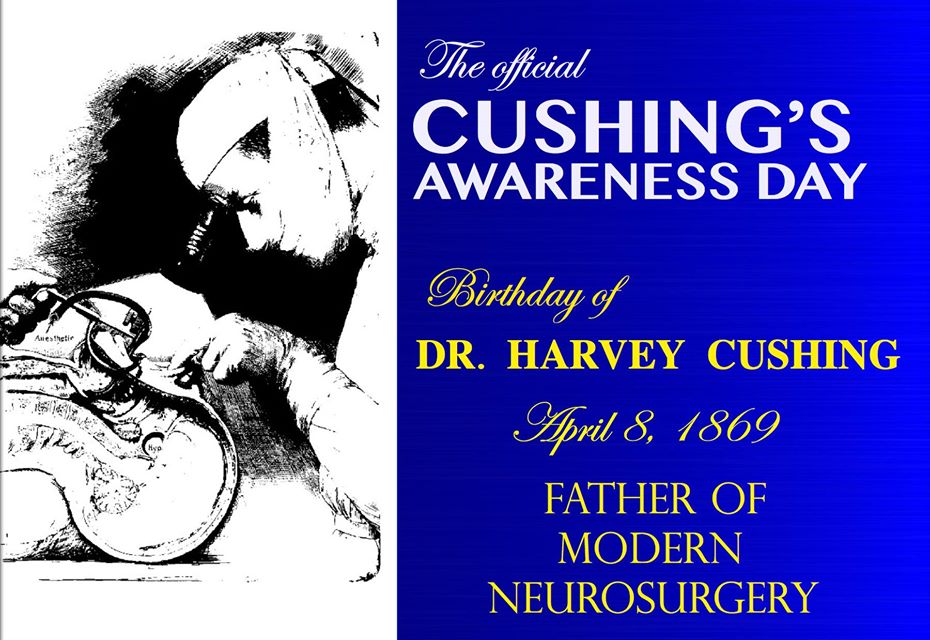
Dr. Cushing was born in Cleveland Ohio. The fourth generation in his family to become a physician, he showed great promise at Harvard Medical School and in his residency at Johns Hopkins Hospital (1896 to 1900), where he learned cerebral surgery under William S. Halsted

After studying a year in Europe, he introduced the blood pressure sphygmomanometer to the U.S.A. He began a surgical practice in Baltimore while teaching at Johns Hopkins Hospital (1901 to 1911), and gained a national reputation for operations such as the removal of brain tumors. From 1912 until 1932 he was a professor of surgery at Harvard Medical School and surgeon in chief at Peter Bent Brigham Hospital in Boston, with time off during World War I to perform surgery for the U.S. forces in France; out of this experience came his major paper on wartime brain injuries (1918). In addition to his pioneering work in performing and teaching brain surgery, he was the reigning expert on the pituitary gland since his 1912 publication on the subject; later he discovered the condition of the pituitary now known as “Cushing’s disease“.

Read more about Dr. Cushing

Today, April 8th, is Cushing’s Awareness Day. Please wear your Cushing’s ribbons, t-shirts, awareness bracelets or Cushing’s colors (blue and yellow) and hand out Robin’s wonderful Awareness Cards to get a discussion going with anyone who will listen.

And don’t just raise awareness on April 8.  Any day is a good day to raise awareness.
 

robin-harvey


MaryO

Cushing’s Patient Awareness Day Invitation

patient-day-sf


Location: Sheraton Fisherman’s Wharf 2500 Mason Street, San Francisco, California

The goal of the program is to Educate, Empower and Support. We will:
-Provide education on how Cushing’s Syndrome affects your body
-Share information and educational resources
-Enhance your support and referral network

The day will focus on endogenous Cushing’s, a condition caused by high cortisol in your body. The day will not cover exogenous Cushing’s caused by steroids taken for various health conditions including asthma, arthritis or lupus.

Hosted by Kate Tully, R.N. and Katherine Waidner, R.N.
Cushing’s Patient Advocates-Corcept Therapeutics


Outcome of Bilateral Adrenalectomy in Cushing’s Syndrome: A Systematic Review

  1. Katrin Ritzel,
  2. Felix Beuschlein,
  3. Anne Mickisch,
  4. Andrea Osswald,
  5. Harald J. Schneider,
  6. Jochen Schopohl and
  7. Martin Reincke

Author Affiliations


  1. Medizinische Klinik und Poliklinik IV, Klinikum der Universität München, D-80336 München, Germany
  1. Address all correspondence and requests for reprints to: Martin Reincke, M.D., Medizinische Klinik und Poliklinik IV, Klinikum der Universität München, Ziemssenstrasse 1, D-80336 München, Germany. E-mail:Martin.Reincke@med.uni-muenchen.de.

Abstract

Background: The outcome of bilateral adrenalectomy (BADx) in patients with Cushing’s syndrome (CS) is not well characterized.

Methods: A literature search was performed with the search terms “bilateral adrenalectomy” or “total adrenalectomy” and “Cushing’s” or “Cushing.” Immediate and long-term outcomes after BADx in CS were analyzed using descriptive statistics (median [range]).

Results: From 549 screened publications, 37 studies met inclusion criteria (1320 patients, 82% having Cushing’s disease [CD], 13% having ectopic CS, and 5% having primary adrenal hyperplasia).

Surgical morbidity and mortality of BADx (23 studies, 739 patients) were 18% (6–31) and 3% (0–15), respectively. In patients with CD, surgical mortality was below 1%. Although residual cortisol secretion due to accessory adrenal tissue or adrenal remnants was found in 3–34% (5 studies, 236 patients), less than 2% had a relapse of CS.

Symptoms of hypercortisolism (eg, hypertension, obesity, or depression) improved in the majority of the patients after BADx (7 studies, 195 patients). The number of adrenal crises per 100 patient-years was 9.3 (6 studies, 203 patients).

Nelson’s syndrome occurred in 21% (0–47) of the patients (24 studies, 768 patients). Mortality (23 studies, 690 patients) was 17% (0–88) at a follow-up of 41 months (14–294). Remarkably, 46% of the patients died in the first year after surgery. The median ages at death were 62 years (CD) and 53 years (ectopic CS).

Conclusion: BADx is relatively safe and provides adequate success. Excess mortality within the first year after surgery suggests that intensive clinical care for patients after BADx is warranted.

Footnotes

  • For editorial see page 3974

  • Abbreviations:

    BADx
    bilateral adrenalectomy
    BAH
    bilateral adrenal hypercortisolism
    CD
    Cushing’s disease
    CS
    Cushing’s syndrome
    ECS
    ectopic CS
    NS
    Nelson’s syndrome
    QOL
    quality of life
    TSS
    transsphenoidal surgery.


From http://jcem.endojournals.org/content/98/10/3939.abstract