Roundup may cause potentially fatal ‘adrenal insufficiency’

IMPORTANT!  A new study finds that the Roundup herbicide disrupts the hormonal system of rats at low levels at which it’s meant to produce no adverse effects. By the same mechanism It may be causing the potentially fatal condition of ‘adrenal insufficiency’ in humans.

Monsanto’s glyphosate-based herbicide Roundup is an endocrine (hormone) disruptor in adult male rats, a new study shows.

The lowest dose tested of 10 mg/kg bw/d (bodyweight per day) was found to reduce levels of corticosterone, a steroid hormone produced in the adrenal glands. This was only one manifestation of a widespread disruption of adrenal function.

No other toxic effects were seen at that dose, so if endocrine disruption were not being specifically looked for, there would be no other signs that the dose was toxic. However a 2012 study detected a 35% testosterone down-regulation in rats at a concentration of 1 part per million.

In both studies endocrine disruption was detected at the lowest level tested for, so we don’t know if, when it comes to endocrine disruption, there are ‘safe’ lower doses of Roundup. In technical parlance, this means that no NOAEL (no observed adverse effect level), was found.

Significantly, the authors believe that the hormonal disruption could lead to the potentially fatal condition know as ‘adrenal insufficiency’ in humans, which causes fatigue, anorexia, sweating, anxiety, shaking, nausea, heart palpitations and weight loss.

“A progressive increase in its prevalence has been observed in humans, while a very few studies relating to xenobiotic exposure and adrenal insufficiency development have been reported”, they write. The increasing levels of Roundup in the environment and food could be “one of the possible mechanisms of adrenal insufficiency.”

How does this level relate to safety limits set by regulators?

One problem with trying to work out how the endocrine disruptive level of 10 mg/kg bw/d relates to how ‘safe’ levels are set by regulators.

The experiment looked at Roundup, the complete herbicide formulation as sold and used, but regulators only look at the long-term safety of glyphosate alone, the supposed active ingredient of Roundup.

Safe levels for chronic exposure to the Roundup herbicide product have never been tested or assessed for regulatory processes. This is a serious omission because Roundup has been shown in many tests to be more disruptive to hormones than glyphosate alone, thanks to the numerous other ingredients it contains to enhance its weed-killing properties.

Given this yawning data gap, let’s for a moment assume that the regulatory limits set for glyphosate alone can be used as a guide for the safe level of Roundup.

The endocrine disruptive level of Roundup found in the experiment, of 10 mg/kg bw/d, is is well above the acceptable daily intake (ADI) set for glyphosate in Europe (0.3 mg/kg bw/d) and the US (1.75 mg/kg bw/d). But this isn’t a reason to feel reassured, since with endocrine effects, low doses can be more disruptive than higher doses.

Another worrying factor is that 10 mg/kg bw/d is well below the NOAEL (no observed adverse effect level) for chronic toxicity of glyphosate: 500 mg/kg bw/d for chronic toxicity, according to the US EPA.

In other words, the level of 500 mg/kg bw/d – a massive 50 times higher than the level of Roundup found to be endocrine disruptive in the experiment – is deemed by US regulators not to cause chronic toxicity.

This experiment shows they are wrong by a long shot. They failed to see toxicity below that level because they failed to take endocrine disruptive effects from low doses into account and industry does not test for them.

Hormone disruption take place at or below ‘no adverse effects’ levels

Interestingly, the NOAEL for glyphosate in industry’s three-generation reproductive studies in rats was much lower than that for chronic toxicity – 30 mg/kg bw/day for adults and 10 mg/kg bw/day for offspring.

However the latter figures – at which no adverse effects should be apparent from glyphosate – are at the same as or higher level than the level of Roundup found to be endocrine disruptive in the new study.

These results therefore show that the reproductive processes of the rats are sensitive to low doses that are apparently not overtly toxic. This in turn suggests that the reproductive toxicity findings are due to endocrine disruptive effects.

Regulatory tests still do not include tests for endocrine disruption from low doses, in spite of the fact that scientists have known about the syndrome since the 1990s.

In the final section of the new study, the researchers discuss its implications. They note that the effects seen in the Roundup-treated rats to the Adrenocorticotropic hormone receptor (ACTH) were similar to adrenal insufficiency in humans:

“The findings that Roundup treatment down regulates endogenous ACTH, is similar to the condition known as adrenal insufficiency in humans. This condition manifests as fatigue, anorexia, sweating, anxiety, shaking, nausea, heart palpitations and weight loss. Chronic adrenal insufficiency could be fatal, if untreated.

“A progressive increase in its prevalence has been observed in humans, while a very few studies relating to xenobiotic exposure and adrenal insufficiency development have been reported. The present study describes one of the possible mechanisms of adrenal insufficiency due to Roundup and suggests more systematic studies, to investigate the area further. “

Claire Robinson of GMWatch commented: “Since no safe dose has been established for Roundup with regard to endocrine disrupting effects, it should be banned.”


The study:Analysis of endocrine disruption effect of Roundup in adrenal gland of male rats‘ is by Aparamita Pandey and Medhamurthy Rudraiah, and published in Toxicology Reports 2 (2015) pp.1075-1085 on open access.

This article was originally published by GMWatch. This version has been subject to some edits and additions by The Ecologist.

From http://www.theecologist.org/News/news_round_up/2985058/roundup_may_cause_potentially_fatal_adrenal_insufficiency.html

Enzyme that triggers muscle wasting could be key to REVERSING signs of ageing | Daily Mail Online

Drawing on expertise from both the University of Birmingham and Queen Elizabeth Hospitals Birmingham, they applied their knowledge of Cushing’s syndrome to the new problem (sarcopenia).

Cushing’s is hormonal disorder caused by high levels of cortisol. Patients suffer from the syndrome see marked changes in their body composition.

The effects can be devastating for patients who can develop features such as muscle wasting and weakness, weight gain, thinning of the bones, diabetes, high blood pressure and heart disease.

Dr Hassan-Smith said: ‘Looking at this particular enzyme seemed like an intriguing way forward.

‘We knew how it works in relation to Cushing’s Syndrome, which is characterised by similar symptoms, and thought it would be worthwhile applying what we knew to the ageing population.’

Currently there are no treatments for sarcopenia, the team explained.

But pharmaceutical companies are developing and testing ways to block or switch off the enzyme, with a focus on treatments for conditions including diabetes.

The team is excited about taking the results of their study forward into future research, with one eye on adapting the inhibitors already in development to combat muscle ageing.

Dr Hassan Smith added: ‘The next stage is a “proof of concept” study to look at the effects of these inhibitive pharmaceuticals on muscle function, before opening it up into a clinical trial.

‘It’s an as yet unexplored area that could yield beneficial results for a problem that is becoming more prevalent as our lifespans increase.’

The study was published in the journal of Clinical Endocrinology and Metabolism.


via Enzyme that triggers muscle wasting could be key to REVERSING signs of ageing | Daily Mail Online.

The 3 Things That Wreck Your Hormones (Part 3) | Alan Christianson

adrenal-glands

When it comes to your hormones, stress is all about the adrenal glands. These are a couple of nickel-sized pieces of tissue that can completely make or break your health. The adrenal glands can be affected by diseases, but this is extremely rare and rather straightforward for doctors to diagnose. It is much more common for the adrenal glands to be free of disease but dysfunctional under a large stress load.

The adrenals are different from your other glands in that they make different amounts of hormones as the day goes on. They release a burst of cortisol to wake us up, and they shut it off at night to let us sleep.

Even when a disease or the aging process is the core problem with your hormones, the adrenals still play a role, and here is why: Hormones don’t really do anything until they go inside of your cells. Each cell has a wall around it that lets in just the right amount of hormones at just the right times.

Think of your cell as a castle wall with a drawbridge that only comes down to those who know the password phrase. The password phrase that lets hormones into your cell is “the cortisol rhythm.” The cortisol rhythm is controlled by the adrenal glands. When adrenal hormones are wrecked, it is important to understand what this means. It doesn’t mean they are unable to make hormones; it means their rhythm is disturbed. This is important because you may read that taking cortisol can help if you have low cortisol. At first, this makes sense and seems to fit the strategy for thyroid disease — if you have too little thyroid hormone, take some to replace what is lacking. The problem is that in the case of adrenal stress, low cortisol is not the result of the adrenals being unable to make cortisol. It is the result of all the parts involved in cortisol production being off in their timing. Putting more cortisol into the system just makes the problem worse.

If taking cortisol is not the answer, then what is?

Read the rest of the article at The 3 Things That Wreck Your Hormones (Part 3) | Alan Christianson.


Myth: YOU are the problem and the reason for your cortisol levels…

Myth: YOU are the problem and the reason for your cortisol levels. Having issues with too much or too little cortisol, the stress hormone, means that YOU are stressing too much or are too anxious. “YOU could control your levels if you would JUST calm down!”
myth-busted
Fact: YOU are NOT the problem! The dysfunction in your body is the problem. It is true that cortisol is your stress hormone or fight or flight hormone. This hormone helps your body compensate for and deal with trauma or stress, both physical and emotional. So, yes, your body does have a reaction to stress.
However, for people with Cushing’s, that hormone goes haywire. Too much cortisol leads to Cushing’s symptoms and having too little cortisol leads to Adrenal Insufficiency. Normally, our bodies’ response to stress is to pump out 10X the amount of your baseline cortisol to cope. If it is not able to do this, it will go into shock and can lead to death unless the emergency protocol is followed with an emergency injection of steroid. No amount of coping skills can “control” one’s physiological response to stress.

Today in Lab History

Jokichi Takamine was a Japanese-American biochemist and industrialist, born Nov. 3, 1854, who isolated the hormone produced in the adrenal gland that causes the body to respond to emergencies. This chemical was adrenalin — now called epinephrine — from the suprarenal gland. It was the first pure hormone to be isolated from natural sources.

He applied for and received a U.S. patent on the substance, and went on to make a fortune with his marketing of Adrenalin. In fact, the product that he marketed was not pure epinephrine, but a mixture of the hormone and its sibling compound, norepinephrine, or noradrenaline. It is now made synthetically. He also found takadastase, and played a key role in the introduction of phosphate fertilizer along with various other manufacturing and chemical industries to Japan.

~~~~~

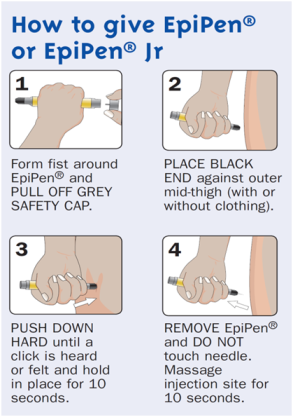
How_to_give_EpiPen

Epinephrine, an EpiPen or Auvi-Q/Allerject injection, should be given in the mid-anterior lateral thigh (not the outer thigh). We call this the EpiCenter of the thigh, and this video segment from the EpiCenter Medical (http://www.epicentermedical.com) online anaphylaxis first aid course has a thigh location graphic to help you pinpoint the most effective location for the injection.