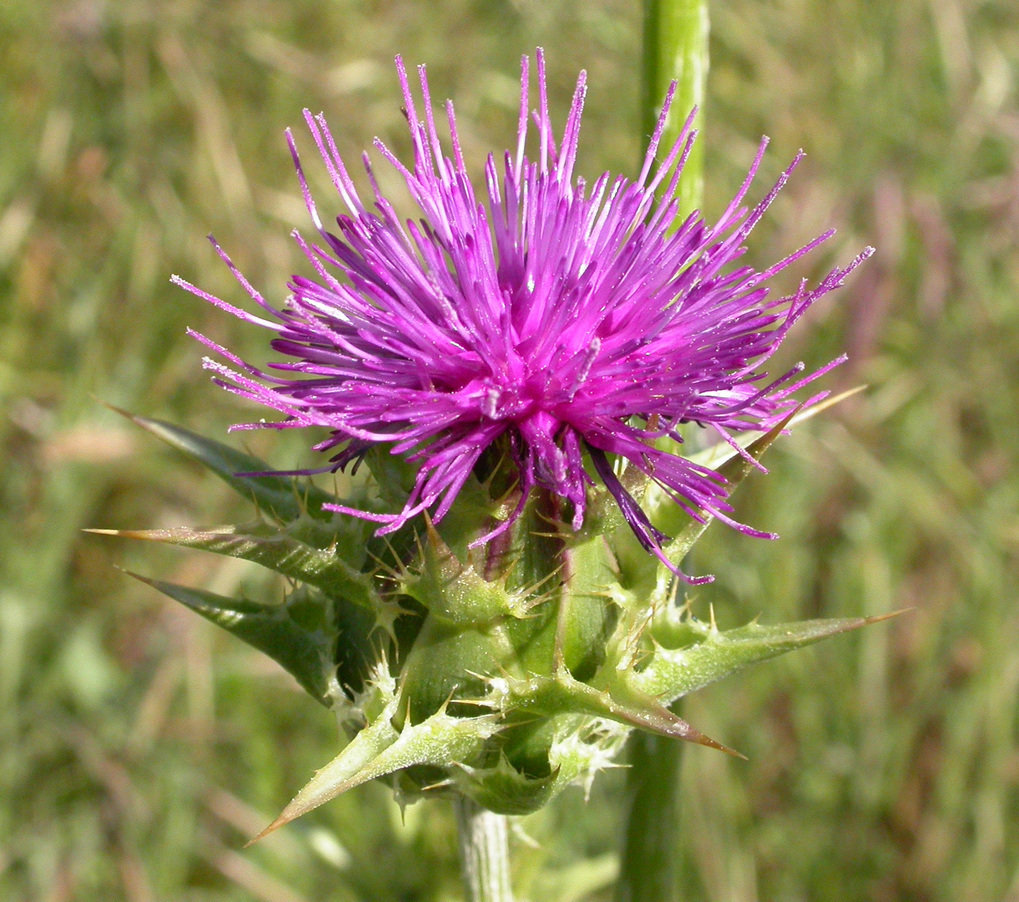
Silibinin from milk thistle seeds as novel, non-invasive treatment strategy for Cushing Disease

Silibinin has an outstanding safety profile in humans and is currently used for the treatment of liver disease and poisoning. Scientists at the Max Planck Institute of Psychiatry in Munich discovered in collaboration with scientists from the Helmholtz Zentrum München in cell cultures, animal models and human tumor tissue that silibinin can be applied to treat Cushing Disease, a rare hormone condition caused by a tumor in the pituitary gland in the brain. The researchers have filed a patent and now plan clinical trials using silibinin as a non-invasive treatment strategy. Thus, in future, patients might not have to undergo brain surgery anymore.
Treatment with silibinin, a constituent of milk thistle seeds, alleviated symptoms of Cushing Disease in cell cultures, animal models and human tumor tissue. In future, patients might not have to undergo brain surgery anymore.

Cushing Disease, not to be confused with Cushing’s Syndrome, is caused by a tumor in the pituitary gland in the brain. The tumor secrets increased amounts of the stress hormone adrenocorticotropin (ACTH) followed by cortisol release from the adrenal glands leading to rapid weight gain, elevated blood pressure and muscular weakness. Patients are prone to osteoporosis and infections and may show cognitive dysfunction or even depression. In 80 to 85 % of the patients, the tumor can be removed by uncomfortable brain surgery. For inoperable cases, there is currently only one targeted therapy approved, which unfortunately causes intense side effects such as hyperglycemia in more than 20 % of the patients.

Scientists around Günter Stalla, endocrinologist at the Max Planck Institute of Psychiatry in Munich, have now discovered in cell cultures, animal models and human tumor tissue that a harmless plant extract can be applied to treat Cushing Disease. “Silibinin is the major active constituent of milk thistle seeds. It has an outstanding safety profile in humans and is already used for the treatment of liver disease and poisoning,” explains Marcelo Paez-Pereda, leading scientist of the current study published in the renowned scientific journal Nature Medicine. After silibinin treatment, tumor cells resumed normal ACTH production, tumor growth slowed down and symptoms of Cushing Disease disappeared in mice.

In 2013, the Max Planck scientists filed a patent on a broad family of chemical and natural compounds, including silibinin, to treat pituitary tumors. Compared to humans, where only 5.5 in 100,000 people worldwide develop Cushing Disease, this condition is very common in several pets. For example, 4 % of dogs and even 7 % of horses suffer from Cushing Disease. Thus, the researchers now plan to test special formulations with a very pure substance and slow release of the active component silibinin in clinical trials.

Silibinin: Mode of action

“We knew that Cushing Disease is caused by the release of too much ACTH. So we asked ourselves what causes this over production and how to stop it,” says Paez-Pereda. In their first experiments, the researchers found tremendously high amounts of the heat shock protein 90 (HSP90) in tumor tissue from patients with Cushing Disease. In normal amounts, HSP90 helps to correctly fold another protein, the glucocorticoid receptor, which in turn inhibits the production of ACTH. “As there are too many HSP90 molecules in the tumor tissue, they stick to the glucocorticoid receptor,” explains Paez-Pereda. “We found that silibinin binds to HSP90 thus allowing glucocorticoid receptor molecules to dissolve from HSP90. With silibinin, we might have discovered a non-invasive treatment strategy not only for the rare Cushing Disease but also for other conditions with the involvement of glucocorticoid receptors, such as lung tumors, acute lymphoblastic leukemia or multiple myeloma,” concludes Paez-Pereda.

From http://www.psych.mpg.de/2034377/PM1507

Cushing’s syndrome vs simple obesity. How can a needle be found in the haystack?

Endocrinology Today 02/2015; 4(1):30-35.

Clinical recognition of Cushing’s syndrome should generally follow from the observation of a constellation of compatible clinical features that progress over time. Screening for Cushing’s syndrome in patients with individual features of the metabolic syndrome, such as obesity, hypertension and hyperglycaemia, is not recommended.

Early diagnosis reduces unnecessary suffering and the ultimate lifetime sequelae of Cushing’s syndrome. Confirmation involves the demonstration of biochemical hypercortisolism, and the extent of diagnostic testing needs to be based on the degree of clinical suspicion.
Read the whole article here, in PDF format

Higher Doses of ‘Abortion Pill’ Safe in Cushing’s?

Reviewed by Zalman S. Agus, MD; Emeritus Professor, Perelman School of Medicine at the University of Pennsylvania

LAS VEGAS — Higher doses of mifepristone for Cushing’s disease (Korlym) weren’t associated with increases in serious adverse events, researchers reported here.

Korlym is a glucocorticoid receptor antagonist better known as RU-486, or the “abortion pill.” It was approved for treating hyperglycemia associated with Cushing’s disease in 2012.

In an analysis of data from the SEISMIC trial, Dat Nguyen, MD, and colleagues found that similar percentages of patients had serious adverse events across all doses of the drug, reported.

They also reported at the American Association of Clinical Endocrinologists meeting here, that the proportion of the four most common adverse events — headache, fatigue, nausea, and hypokalemia — fell off after 10 weeks of the 24-week trial.

“Recent prescription data indicate that many physicians are not titrating beyond 300 mg per day, potentially limiting patients’ clinical response,” the researchers said.

The 2012 approval was based on the SEISMIC study, which followed 50 Cushing’s disease patients over 24-weeks in an open-label format. It found that daily doses improved blood sugar control and reduced insulin requirements.

Clinicians participating in the trial were told they could titrate beyond the starting dose of 300 mg a day. To look at the relationship between dose and safety, as well as response, Nguyen and colleagues looked at data on 40 of the patients who responded to therapy.

Most of them (90%) were taking at least 600 mg a day, 68% were taking at least 900 mg per day, and 44% took 1,200 mg daily.

Most of the responders (85%) had their initial clinical response at a dose of at least 600 mg daily.

Overall, there were 26 serious adverse events:

  • 10 at the 300 mg dose
  • 8 at the 600 mg dose
  • 3 at the 900 mg dose
  • 3 at the 1200 mg dose
  • 2 while off drug


When the researchers adjusted for the number of patients who had ever reached a given dose, the frequency of serious adverse events was similar across doses:

  • 10% of patients at 300 mg
  • 16% of patients at 600 mg
  • 15% of patients at 900 mg
  • 14% of patients at 1200 mg


The four most common adverse events decreased after week 10 – although that tracked an increase in dose (mean 588 mg/day before week 10 versus 895 mg/day thereafter).

Nguyen and colleagues concluded that higher doses of mifepristone weren’t associated with increases in serious adverse events or in the most common adverse events – and that better response was seen with higher doses.

Korlym was developed by Corcept Therapeutics of Menlo Park, Calif., as an orphan drug given that it is is believed only 5,000 patients are eligible for treatment. That gave the company 7 years of exclusive rights to market the agent for Cushing’s disease.

The label limits the drug’s indication to patients with endogenous Cushing’s disease who have type 2 diabetes or glucose intolerance and aren’t candidates for surgery, or failed to respond to surgical intervention.

The drug doesn’t reduce cortisol production but prevents it from binding to its receptor – an action separate from its blockade of the progesterone receptor, which makes it an effective agent in abortion.

Since the daily doses are in the same range as those used to induce abortion, the drug is contraindicated in pregnant women. It also carries a boxed warning that the drug will terminate a pregnancy.

From http://www.medpagetoday.com/MeetingCoverage/AACE/45790

Pasireotide for the treatment of Cushing’s disease

Posted online on June 17, 2013. (doi:10.1517/21678707.2013.807731)

Annamaria Colao Chiara Simeoli Monica De Leo Alessia Cozzolino Rosario Pivonello

Department of Clinical Medicine and Surgery, Section of Endocrinology, Federico II University, Via Sergio Pansini 5,

80131 Naples

, Italy +39 0817462132; +39 0815465443; colao@unina.it

Author for correspondence

Introduction: Pasireotide, a novel multireceptor targeted somatostatin analog is the first drug approved for treatment of adult patients with Cushing’s disease (CD) for whom pituitary surgery is not an option or has not been curative.

Areas covered: The review describes published data on efficacy and safety of pasireotide in CD patients. In particular, the review focuses on a Phase III study (CSOM230B2305) evaluating the outcomes of treatment with pasireotide at the doses of 600 and 900 µg twice daily for 12 months in 162 CD patients. This clinical trial reported a decrease in urinary free cortisol levels in the majority of patients, with a substantial reduction in nearly half and a normalization in > 25% of patients included in the study, accompanied by an improvement in clinical picture as well as a significant reduction in pituitary tumor size. Hyperglycemia appears as the most important side effect, requiring a careful monitoring and a prompt administration of glucose-lowering medications.

Expert opinion: Pasireotide seems to have a promising role as medical option for CD patients who experienced a failure or not candidate for neurosurgery; its employment will probably induce in the near future significant changes in the therapeutic approach to CD.

Read More: http://informahealthcare.com/doi/abs/10.1517/21678707.2013.807731