Cushing’s on Capitol Hill: Cushing’s Awareness Challenge

Earlier this year, I got this email:

Good morning Mary:

I hope everything is well.

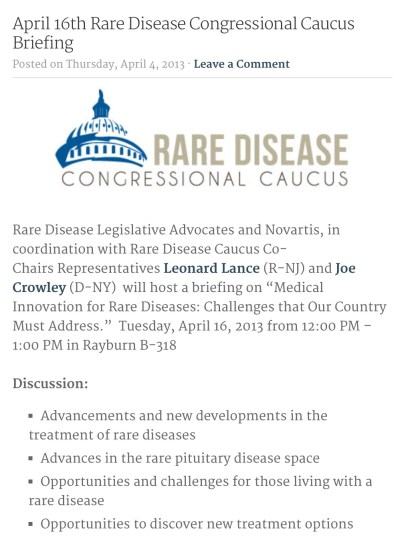
I would like to invite you to join us at the Rare Disease Congressional Caucus briefing scheduled for April 2013. The final date is still being discussed but we are looking into two possible dates of either April 16th or April 18th. The meeting will take place in Washington, D.C. and will be attended by members of the Rare Disease Caucus including co-chairs Rep. Joseph Crowley and Rep. Leonard Lance.

As you may know Rare Disease Congressional Caucus is a forum for members of Congress to voice constituent concerns, share ideas, and build support for legislation that will improve the lives of people with rare diseases. The goal of the meeting in April is to educate the members of the Caucus about rare pituitary disorders, including Cushing’s Disease – area that has received little to no recognition among legislators. The meeting will serve as an opportunity to raise legislators’ awareness about multiple issues that patients with rare pituitary diseases, such as Cushing’s disease and Acromegaly, face in their everyday lives.

In preparation for the meeting we drafted a Resolution that addresses some of the key challenges for the patient community including long diagnostic delays, limited treatment options, difficulty finding physicians or treatment centers with expertise in their disease and as a result – a  diminished quality of life for patients. Would you be willing to have a look at the draft in the attachment and provide your feedback? Your opinion as a leader of the patient community and expert in Cushing’s disease would be highly appreciated.

I sincerely hope that you will be able to join us at the meeting to share your perspective and talk about the work that you are doing to help patient afflicted by Cushing’s disease live happier and healthier lives.

Please feel free to call or email anytime if you have questions or if you would like to discuss this further. I look forward to hearing back from you soon.

Attached to the email was the House of Congress Resolution.  Read it here.

I got back quite quickly and said that I would love to attend.  If it was on the 16th, I could go, no problem.  If it was the 18th, probably not because I had plane tickets that day to attend the Magic Foundation Conference in Las Vegas.

In late March, I needed to make my final decision on Las Vegas.  I had been waffling about that trip for a while since my husband had surprise triple bypass surgery in late January.  When I made the decision not to go, he still couldn’t drive or walk the dog – and I was just afraid to leave him alone for 5 days.

caucus1

caucus2

As it turned out, the date was a non-issue since the Congressional Caucus would be on the 16th.

April 15 was a terrible day as news of the Boston Marathon came in.  Security was stepped up in several cities, including Washington, DC.

I looked online to see if the Caucus would be cancelled and found out that the 16th was Emancipation Day in DC – and the main route that I would take to get there would be closed for a parade.

I was already getting very nervous about the whole thing and not knowing how to get there added to the stress levels.

I had my talk printed out with 3 different places to stop, depending on the time.

We left about 10AM for a noon meeting.  I’d decided to park at the train station and take a taxi to the Rayburn House Office Building.

When we got to the Rayburn Building, there was a long line of folks waiting to get in.  I don’t know if they only open the front door at certain times but when the line started to move, it went fairly quickly.  They took 5 at a time through security then we were on our own to find out where to go.

It turned out that our meeting room – 318 – is the room usually used for the Ways and Means Committee.  We got there just about 11:30.  Robert Knutzen from the Pituitary Network Association was already there as was Alexey from Novartis.  Alexey said “Mary?” and I said “Alexey?” and we introduced ourselves.  I already knew Bob from several past meetings so the four of us just chatted a bit while others started arriving.

I had brought quite a few Cushing’s brochures with me and had planned to hand them out to people but Julia from the RDLA (Rare Disease Legislative Advocates) showed me a table where I could leave them for folks to take on their own – and quite a few did.  If they read them, that’s another story!

Right around noontime, lots of people came in.  Some were staffers gathering information to take back to their offices, many others were from rare disease organizations, a few were legislators.  It was standing room only and we estimated there were maybe 120-140 people there.  Only two were known pituitary patients:  Bob with Acromegaly and me with Cushing’s.  Bob mentioned the statistic again “1 in 5” so at least 24 others in that room should have had a pituitary tumor…

Representative Leonard Lance (NJ) spoke a bit about the need to recognize rare diseases in this country.  He mentioned that there were 7,000 rare diseases and it was important to focus on getting awareness for patients with them.  This Caucus focused on the pituitary, although only 2 pituitary diseases were represented.

Vijay Iyengar, Vice President the Rare Disease Franchise of Novartis oncology talked about their two drugs to either cure disease or improve quality of life through a  3-pronged approach:

  • Targeted research
  • Open collaboration
  • Patient inspired solutions

Novartis created the Rare Disease Franchise was recently created as a means of strengthening their involvement and has two drugs with FDA approvals, one for Cushing’s and one for Acromegaly. Their Acromegaly drug is 25 years old and their newest, Signifor, was approved on the anniversary of the discovery of Cushing’s Disease (December 2012) and three new applications are in the approval pipeline.

These diseases are rare because not many people have them and not much knowledge is available about them.

He also said he needs collaborative partners, particularly with Cushing’s.  He would like to have Clinical Trial centers.  However, usually enough patients are near one or two centers.  With Cushing’s, there would need to be 40 or more centers.  We talked to Vijay after the Caucus about this and connecting his company with Cushing’s patients.

Emily Acland, although not a Cushing’s patient, summed up some of the symptoms based on her contacts with patients through the Patient Access Network.

Alexey Salamakha, Manager of Rare Disorders for Novartis/Public Affairs and Communications,  read some thoughts on the need for disability benefits from Donna of John’s Foundation for Cushing’s Awareness.  This included the the fact that veterinarians are more knowledgeable about Cushing’s than endocrinologists. He talked about patient advocacy.

Alexey specifically mentioned me and thanked me for my work.

Bob Knutzen was not diagnosed until the age of 52.  He is currently 75.  He expressed his desire to have Centers of Excellence for Hormonal Health with the funds coming from NIH’s budget.

Pituitary disease isn’t rare, just the diagnosis. He also pointed out that pituitary patients generally die 10 years early.  Without treatment, pituitary patients can’t have children.

If I didn’t know what acromegaly was before this meeting, I wouldn’t have known when I left, either.

Sean O’Neil, Vice President at Novartis made comments about his company and what was being done to help patients.

Other topics during this Caucus were:

  • The issues of Cortisol withdrawal
  • Congressmen Snyder and Runyon proposed H con resolution 31 “Supporting Rare Pituitary Disease Awareness”.  Track this resolution through the Committee, House and Senate
  • The need for awareness of pituitary gland diseases
  • There are lifetime changes – people may be cured/in remission but they’re never the same
  • The possibility of a dipstick for cortisol similar to ones diabetics use
  • Faster diagnosis

My contribution to all this was speed of diagnosis.  I told a bit of my story, diagnosing myself in the pre-Internet 1980’s and how today, 26 years later, people are still having issues with diagnosis and wasting on average 6-20 years just getting to surgery.  I mentioned that I knew a few people who went for 20 years before getting diagnosed.

After the Caucus was over, there was a lot of discussion, and I talked with several people who had questions about my experiences, Cushing’s Help, what could be done to raise awareness…

Will anything come of it?  I don’t know but maybe some folks will start thinking a bit more.

From Tom, on Facebook:

Mary did a great job presenting the Cushings story at the April 16 hearing of the Congressional Caucus on Rare Diseases – Challenges our Country Must Address. Co- chairs Congressman Joe Crowley (D-NY) and Congressman Leonard Lance (R-NJ) both attended and endorsed the good work being done in this effort. Mary spoke with many of the sponsors and others both before and after the hearing discussing her personal experience. Mary has created multiple websites to get the message out on rare diseases especially Cushing’s Syndrome. That effort now extends to more than 40 countries and more than 10,000 participants. We will be doing follow ups with the Congressional Caucus on Rare Diseases and with Novartis, RDLA, EveryLife, Patient Access Network, the Pituitary Network Association and others to build on the gains.

And another email:

Dear Mary,

It was a pleasure to meet you and Tom today. Thank you for attending the Rare Disease Congressional Briefing. I think you did an excellent job by sharing your unique perspective on what a life with Cushing’s disease is like. I want to thank you for supporting our mission and educating general public about pituitary disorders. We at Novartis strongly believe that patient advocacy organizations such as Cushing’s Help and Support and passionate advocates like you are the future and the hope of the Cushing’s community.

As a follow up to our conversation I have reached out to my contacts at NORD and asked if they can help with filing for a 501(c)(3) status. I will keep you posted. Please stay in touch.

A Quarter of a Century

I had my one, and only, pituitary surgery on this date in 1987.  Of course, I was trying to get a diagnosis for several years before that.

I know it’s hard to get a diagnosis now – imagine how hard it was over 30 years ago – before the Internet, Facebook, Twitter, message boards, chatrooms.  No online support – no support anywhere.

Finding any information possible at the Public Library.  Days that you feel like death warmed over, heading out to the library to Xerox medical articles you don’t understand, poring over them at home, trying to find any kernel of hope for what you have.  Then trying to convince doctors when your family doesn’t even believe you.

Finally, a doctor believes you…but he’s the wrong kind of doctor so he sends you away.  Another year goes by.  The endo recommends surgery but there are only 3 possibilities anywhere.  NIH – close by and free, Montreal – they speak French – and San Francisco.

After a diagnosis, 6 weeks of inpatient testing at the NIH.

From my bio at http://www.cushings-help.com/maryos_story.htm

There were about 12 of us there and it was nice not to be alone with this mystery disease. Many of these Cushies (mostly women) were getting bald, couldn’t walk, having strokes, had diabetes. One was blind, one had a heart attack while I was there. Towards the end of my testing period, I was looking forward to the surgery just to get this whole mess over with. While I was at NIH, I was gaining about a pound a day!

The MRI still showed nothing, so they did a Petrosal Sinus Sampling Test. That scared me more than the prospect of surgery. (This test carries the risk of stroke and uncontrollable bleeding from the incision points.) Catheters were fed from my groin area to my pituitary gland and dye was injected. I could watch the whole procedure on monitors. I could not move during this test or for several hours afterwards to prevent uncontrolable bleeding from a major artery. The test did show where the tumor probably was located. Also done were more sophisticated dexamethasone suppression tests where drugs were administered by IV and blood was drawn every hour (they put a heplock in my arm so they don’t have to keep sticking me). I got to go home for a weekend and then went back for the surgery – the Transsphenoidal Resection. I fully expected to die during surgery (and didn’t care if I did) so I signed my will and wrote last letters to those I wanted to say goodbye to. During the time I was home just before surgery, a college classmate of mine (I didn’t know her) did die at NIH of a Cushing’s-related problem. I’m so glad I didn’t find out until a couple months later!

November 3, 1987, the surgeon, Dr. Ed Oldfield, cut the gum above my front teeth under my upper lip so there is no scar. He used tiny tools and microscopes. My tumor was removed successfully. In some cases (not mine) the surgeon uses a plug of fat from the abdomen to help seal the cut. Afterwards, I was in intensive care overnight and went to a neurology ward for a few days until I could walk without being dizzy. I had some major headaches for a day or two but they gave me drugs (morphine) for those. Also, I had cotton plugs in my nostrils. It was a big day when they came out. I had diabetes insipidus (DI) for a little while, but that went away by itself – thank goodness!

I had to use a foam product called “Toothies” to brush my teeth without hitting the incision. Before they let me go home, I had to learn to give myself an injection in my thigh. They sent me home with a supply of injectible cortisone in case my level ever fell too low (it didn’t). I was weaned gradually off cortisone pills (scary). I now take no medications. I had to get a Medic Alert bracelet. I will always need to tell medical staff when I have any kind of procedure – the effects of my excess cortisone will remain forever.

I went back to the NIH for several follow-up visits of a week each where they did all the blood and urine testing again. After a few years NIH set me free. Now I go to my “outside” endocrinologist every year for the dexamethasone suppression test, 24-hour urine and regular blood testing.

As I get further away from my surgery, I have less and less chance that my tumor will grow back. I have never lost all the weight I gained and I still have the hair on my chin but most of my other symptoms are gone. I am still and always tired and need a nap most days. I do not, however, still need to take whole days off just to sleep.

I consider myself very lucky that I was treated before I got as bad as some of the others on my floor at NIH but think it is crazy that these symptoms are not taken seriously by doctors.

Day Twenty-Three, Cushing’s Awareness Challenge

So often during the diagnosis phase of Cushing’s I felt like this picture – I was walking alone to an unknown place with an unknown future.

My diagnosis was pre-Internet which meant that any information had to be gotten from libraries, bookstores, magazines…or doctors.  In 1983 to 1986 I knew something was terribly wrong but there was no backup from doctors, family or friends.  My first hope was from a magazine (see Day Six)

After I got that first glimmer of hope, it was off to the library to try to understand medical texts.  I would pick out words I did understand – and it was more words each trip.  All my research led me to Cushing’s.

Unfortunately, the research didn’t lead me to doctors who could help for over 3 years.  That contributed greatly to the loneliness.  If a Doctor says you’re not sick, friends and family are going to believe the doctor, not you.  After all, he’s the one trained to know what’s wrong, or find out.

I was so grateful when I finally got to NIH and was so nice not to be alone with this mystery illness.  I was also surprised to learn, awful as I felt, there were Cushies much worse off than I was.

I am so glad that the Internet is here now helping us all know that we’re not alone anymore.


We’re all in this together with help, support, research, just being there.  I love this quote from Catherine at http://wheniwasyou.wordpress.com/2012/03/31/wheniwasyou/

Mary, I am delighted to see you here. Cushings – because of the persistent central obesity caused by (we know now) the lack of growth hormone plus the hypothyroidism I was diagnosed with (but for which treatment was ineffective due to my lack of cortisol) – was one of the things I considered as an explanation for my symptoms. Your site was enormously educational and helpful to me in figuring out what might be happening to me. Those other patient testimonies I referred to? Many of them were the bios you posted. Thank you so much for commenting. I am so grateful for the support and encouragement. I really hope that my experiences will help other undiagnosed hypopituitary patients find their way to a diagnosis. I often used to dream that one day I’d get to say to others what was so often said to me: don’t give up, there will be an answer. I kept believing in myself because people I hadn’t even met believed in me. Now I am finally here and I do hope my story will help others to have faith in their own instincts.

Thanks again. Please do keep in touch.

Catherine

Day Twenty-two, Cushing’s Awareness Challenge

It’s Sunday again, so this is another semi-religious post so feel free to skip it 🙂

I’m sure that many would think that this is a semi-odd choice for all-time favorite hymn.

My dad was a Congregational (now United Church of Christ) minister so I was pretty regular in church attendance in my younger years.

Some Sunday evenings, he would preach on a circuit and I’d go with him to some of these tiny churches.  The people there, mostly older folks, liked the old hymns best – Fanny Crosby and so on.

So, some of my “favorite hymns” are those that I sang when I was out with my Dad.  Fond memories from long ago.

In 1986 I was finally diagnosed with Cushing’s after struggling with doctors and trying to get them to test for about 5 years.  I was going to go into the NIH (National Institutes of Health) in Bethesda, MD for final testing and then-experimental pituitary surgery.

I was terrified and sure that I wouldn’t survive the surgery.

Somehow, I found a 3-tape set of Readers Digest Hymns and songs of Inspiration and ordered that. The set came just before I went to NIH and I had it with me.

At NIH I set up a daily “routine” of sorts and listening to these tapes was a very important part of my day and helped me get through the ordeal of more testing, surgery, post-op and more.

When I had my kidney cancer surgery, the tapes were long broken, but I had replaced all the songs – this time on my iPod.

Abide With Me was on this tape set and it remains a favorite to this day.  Whenever we have an opportunity in church to pick a favorite, my hand always shoots up and I request page 700.  When someone in one of my handbell groups moves away, we always sign a hymnbook and give it to them.  I sign page 700.

I think that many people would probably think that this hymn is depressing.  Maybe it is but to me it signifies times in my life when I thought I might die and I was so comforted by the sentiments here.

This hymn is often associated with funeral services and has given hope and comfort to so many over the years – me included.

If you abide in Me, and My words abide in you, you will ask what you desire, and it shall be done for you.

~John 15:7

Abide With Me

Words: Henry F. Lyte, 1847.

Music: Eventide, William H. Monk, 1861. Mrs. Monk described the setting:

This tune was written at a time of great sorrow—when together we watched, as we did daily, the glories of the setting sun. As the last golden ray faded, he took some paper and penciled that tune which has gone all over the earth.

Lyte was inspired to write this hymn as he was dying of tuberculosis; he finished it the Sunday he gave his farewell sermon in the parish he served so many years. The next day, he left for Italy to regain his health. He didn’t make it, though—he died in Nice, France, three weeks after writing these words. Here is an excerpt from his farewell sermon:

O brethren, I stand here among you today, as alive from the dead, if I may hope to impress it upon you, and induce you to prepare for that solemn hour which must come to all, by a timely acquaintance with the death of Christ.

For over a century, the bells of his church at All Saints in Lower Brixham, Devonshire, have rung out “Abide with Me” daily. The hymn was sung at the wedding of King George VI, at the wedding of his daughter, the future Queen Elizabeth II, and at the funeral of Nobel peace prize winner Mother Teresa of Calcutta in1997.

Abide with me; fast falls the eventide;

The darkness deepens; Lord with me abide.

When other helpers fail and comforts flee,

Help of the helpless, O abide with me.

Swift to its close ebbs out life’s little day;

Earth’s joys grow dim; its glories pass away;

Change and decay in all around I see;

O Thou who changest not, abide with me.

Not a brief glance I beg, a passing word;

But as Thou dwell’st with Thy disciples, Lord,

Familiar, condescending, patient, free.

Come not to sojourn, but abide with me.

Come not in terrors, as the King of kings,

But kind and good, with healing in Thy wings,

Tears for all woes, a heart for every plea—

Come, Friend of sinners, and thus bide with me.

Thou on my head in early youth didst smile;

And, though rebellious and perverse meanwhile,

Thou hast not left me, oft as I left Thee,

On to the close, O Lord, abide with me.

I need Thy presence every passing hour.

What but Thy grace can foil the tempter’s power?

Who, like Thyself, my guide and stay can be?

Through cloud and sunshine, Lord, abide with me.

I fear no foe, with Thee at hand to bless;

Ills have no weight, and tears no bitterness.

Where is death’s sting? Where, grave, thy victory?

I triumph still, if Thou abide with me.

Hold Thou Thy cross before my closing eyes;

Shine through the gloom and point me to the skies.

Heaven’s morning breaks, and earth’s vain shadows flee;

In life, in death, O Lord, abide with me.


Day Seventeen, Cushing’s Help Challenge

Way back when we first got married, my husband thought we might have a lot of kids.  He was from a family of 6 siblings, so that’s what he was accustomed to.  I am on only child so I wasn’t sure about having so many.

I needn’t have worried.

In January, 1974 I had a miscarriage.  I was devastated. My father revealed that my mother had also had a miscarriage.  I had no idea.

At some point after this I tried fertility drugs.  Clomid and another drug.  One or both drugs made me very angry/depressed/bitchy (one dwarves I left off the image)  Little did I know that these meds were a waste of time.

Eventually,  I did get pregnant and my wonderful son, Michael was born.  It wasn’t until he was seven that I was finally, actually diagnosed with Cushing’s.

When I had my early Cushing’s symptoms, I thought I was pregnant again but it was not to be.

I’ll never forget the fall when he was in second grade.  He was leaving for school and I said good bye to him.  I knew I was going into NIH that day for at least 6 weeks and my future was very iffy.  He just turned and headed off with his friends…and I felt a little betrayed.

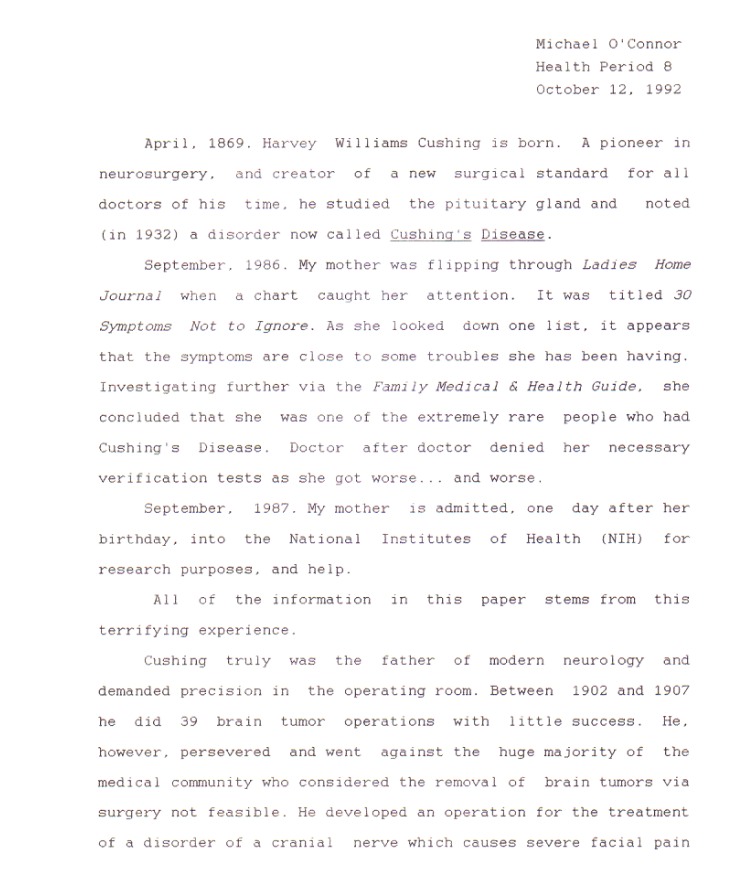
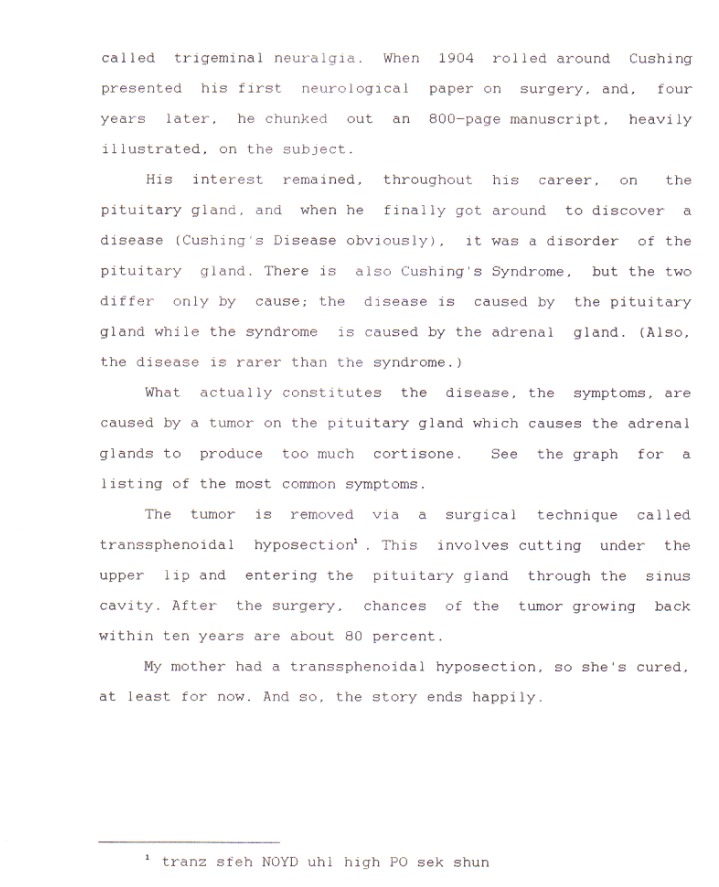
Michael wrote this paper on Cushing’s when he was in the 7th grade. From the quality of the pages, he typed this on typing paper – no computers yet!

Click on each page to enlarge.

When Michael started having headache issues in middle school, I had him tested for Cushings.  I had no idea yet if it could be familial but I wasn’t taking any chances.  It turned out that my father had also had some unnamed endocrine issues.  Hmmm…

I survived my time and surgery at NIH and Michael grew up to be a wonderful young man, if an only child.  🙂

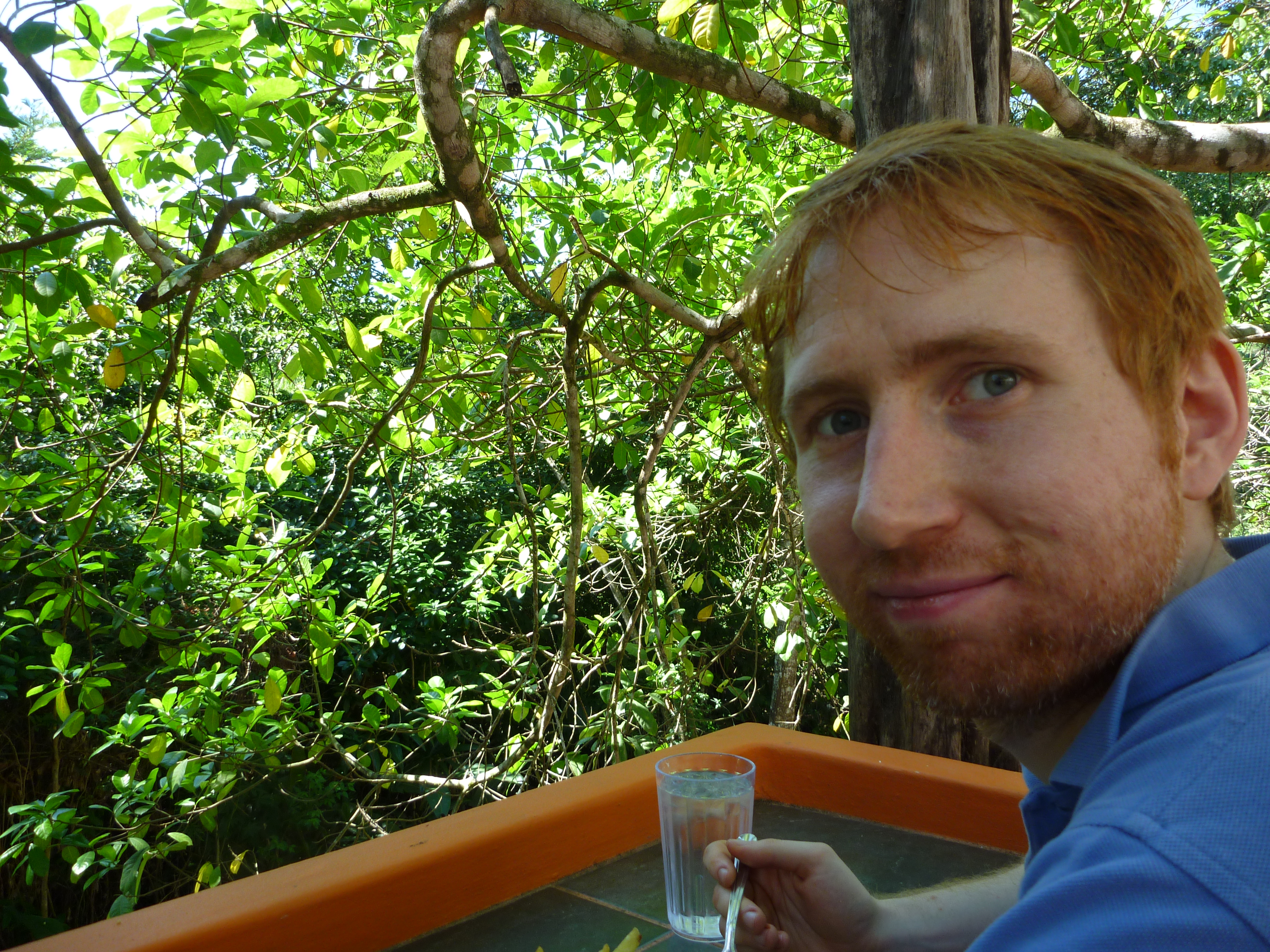
After I survived kidney cancer (see the post from April 12) Michael and I went zip-lining – a goal of mine after surviving that surgery.  This was taken in a treetop restaurant in Belize.

For the mathematically inclined, this is his blog.  Xor’s Hammer.  I understand none of it.