Case Report Shows Rare Adrenal Tumors Associated with Cushing’s Disease

Pituitary tumors that produce too much adrenocorticotropic hormone (ACTH) have been associated with the development of rare tumors on the adrenal glands, called adrenal myelolipomas, for the first time in a case report.

The study, “Case report of a bilateral adrenal myelolipoma associated with Cushing disease,” was published in the journal Medicine.

Myelolipomas, composed of mature fat cells and blood-forming cells, are usually asymptomatic and do not produce hormones. In many cases, these tumors are detected by accident when patients undergo imaging scans for other conditions.

The cause of these tumors is unknown, but due to their benign nature, they do not spread to other parts of the body. However, they can grow up to 34 centimeters (about 13 inches), leading to tissue death and hemorrhage.

Researchers at Soon Chun Hyang University College of Medicine in Seoul, Korea, described the case of a 52-year-old man with myelolipoma possibly caused by an ACTH-secreting pituitary tumor.

During a routine checkup, researchers detected a mass in the patient’s spleen. Further abdominal evaluations identified tissue lesions in both adrenal glands consistent with myelolipoma. Besides the masses, the patient did not show any other Cushing-associated physical characteristics.

However, the patient’s ACTH levels were two times higher than the normal upper limit. Cortisol levels were also increased and unresponsive to low-dose dexamethasone treatment.

No additional lesions were found that could help explain the high ACTH and cortisol levels. But analysis of blood samples collected from the veins draining the pituitary glands revealed the right gland was producing too much ACTH, strongly suggesting Cushing’s disease.

Both the left adrenal gland and pituitary tumor were surgically removed. The samples collected during surgery confirmed the benign nature of the adrenal tumors, and the diagnosis of abnormal, ACTH-positive pituitary gland tissue.

Three days after the surgeries, hormone levels were back to normal. But a follow-up evaluation five months later again showed increased ACTH levels. Cortisol levels, however, were normal.

For the next seven years, the patient was evaluated every six months. During a five-year period, the size of the right adrenal gland was found to have grown. Imaging analysis confirmed the existence of small, new lesions in both pituitary glands.

“This case confers valuable information about the clinical course of adrenal myelolipoma associated with Cushing disease,” the researchers said. It also “supports the notion that ACTH can be associated with the development of bilateral adrenal myelolipomas.”

From https://cushingsdiseasenews.com/2018/03/08/bilateral-adrenal-myelolipoma-associated-with-cushing-disease-case-report/

Dr. Charles Wilson, One of the world’s greatest neurosurgeons and pioneer of transsphenoidal pituitary surgery died at 88


The UCSF website in an obituary from Kate Vidinsky reads “He took a particular interest in pituitary disorders, those affecting the pea-sized ‘master gland’ at the base of the brain responsible for controlling the body’s hormone levels. He was a pioneer of transsphenoidal surgery – the endonasal approach for removing pituitary tumors – and performed more than 3,300 of these procedures at UCSF Medical Center.”

The New York Times in an obituary published yesterday described him as “a pioneering and virtuosic San Francisco neurosurgeon”.

Dr. Wilson died February 28, 2018.

Cushing’s Patients at Risk for Autoimmune Diseases After Condition Is Resolved

Children with Cushing’s syndrome are at risk of developing new autoimmune and related disorders after being cured of the disease, a new study shows.

The study, “Incidence of Autoimmune and Related Disorders After Resolution of Endogenous Cushing Syndrome in Children,” was published in Hormone and Metabolic Research.

Patients with Cushing’s syndrome have excess levels of the hormone cortisol, a corticosteroid that inhibits the effects of the immune system. As a result, these patients are protected from autoimmune and related diseases. But it is not known if the risk rises after their disease is resolved.

To address this, researchers at the Eunice Kennedy Shriver National Institute of Child Health and Human Development (NICHD) examined 127 children with Cushing’s syndrome at the National Institutes of Health from 1997 until 2017.

Among the participants, 77.5 percent had a pituitary tumor causing the disease, 21.7 percent had ACTH-independent disease, and one patient had ectopic Cushing’s syndrome. All patients underwent surgery to treat their symptoms.

After a mean follow-up of 31.2 months, 7.8 percent of patients developed a new autoimmune or related disorder.

Researchers found no significant differences in age at diagnosis, gender, cortisol levels, and urinary-free cortisol at diagnosis, when comparing those who developed autoimmune disorders with those who didn’t. However, those who developed an immune disorder had a significantly shorter symptom duration of Cushing’s syndrome.

This suggests that increased cortisol levels, even for a short period of time, may contribute to more reactivity of the immune system after treatment.

The new disorder was diagnosed, on average, 9.8 months after Cushing’s treatment. The disorders reported were celiac disease, psoriasis, Hashimoto thyroiditis, Graves disease, optic nerve inflammation, skin hypopigmentation/vitiligo, allergic rhinitis/asthma, and nerve cell damage of unknown origin responsive to glucocorticoids.

“Although the size of our cohort did not allow for comparison of the frequency with the general population, it seems that there was a higher frequency of optic neuritis than expected,” the researchers stated.

It is still unclear why autoimmune disorders tend to develop after Cushing’s resolution, but the researchers hypothesized it could be a consequence of the impact of glucocorticoids on the immune system.

Overall, the study shows that children with Cushing’s syndrome are at risk for autoimmune and related disorders after their condition is managed. “The presentation of new autoimmune diseases or recurrence of previously known autoimmune conditions should be considered when concerning symptoms arise,” the researchers stated.

Additional studies are warranted to further explore this link and improve care of this specific population.

From https://cushingsdiseasenews.com/2018/03/06/after-cushings-cured-autoimmune-disease-risk-looms-study/

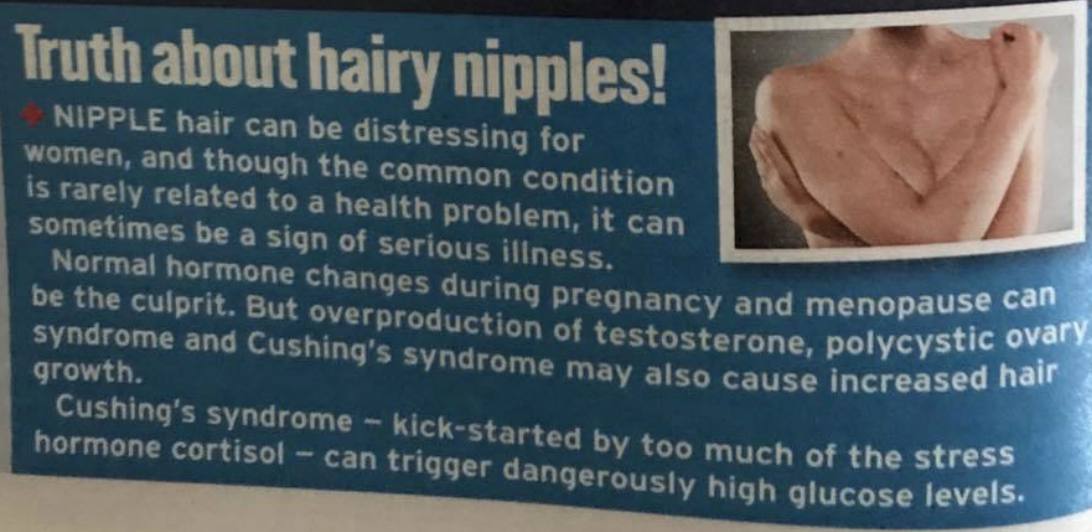
Cushing’s and Hairy Nipples

Hairy nipples are a common condition in women. The amount of hair on the nipples varies, but some women find that the hair becomes long, coarse, and dark, which can be distressing.

Hairy nipples are rarely a cause for concern and are usually not a sign of any underlying health issues. However, occasionally they can signify something more serious, in which case, it is essential to consult a doctor.

Almost every part of a person’s skin is covered in hair and hair follicles. On certain parts of the body, such as the top of the head, the hair usually grows longer and thicker, while on other parts, it is thin and transparent.

Fast facts on hairy nipples:

  • It is not known how common hairy nipples are or how many women have them.
  • Many women do not report the condition and instead manage it themselves.
  • It is possible for hair that used to be fine and light to turn coarse and dark with age.

Causes of hairy nipples in women

There are several underlying reasons that might cause nipple hairs to grow. These are:

Cushing’s syndrome

Cushing’s syndrome is another condition caused by hormonal imbalance. When it occurs, there is an excess of cortisol in the body. In this case, a person may experience several symptoms, such as:

  • increased hair growth
  • abnormal menstrual periods
  • high blood pressure
  • a buildup of fat on the chest and tummy, while arms and legs remain slim
  • a buildup of fat on the back of the neck and shoulders
  • a rounded and red, puffy face
  • bruising easily
  • big purple stretch marks
  • weakness in the upper arms and thighs
  • low libido
  • problems with fertility
  • mood swings
  • depression
  • high blood glucose level

Cushing’s syndrome is fairly rare, and the cause is usually associated with taking glucocorticosteroid medicine, rather than the body overproducing the hormone on its own.

It is possible, however, that a tumor in the lung, pituitary gland, or adrenal gland is the cause.

Also:

Hormonal changes and fluctuations

Hormonal changes in women can cause many different symptoms, one of which is changes in nipple hair growth and color.

Some common hormonal changes happen during pregnancy and menopause.

However, hormonal changes can also occur when a woman is in her 20s and 30s, which may cause nipple hair to change appearance or become noticeable for the first time.

Overproduction of male hormones

It is possible for hormonal imbalances to cause hairy nipples. Overproduction of male hormones, including testosterone, can cause hair growth, while other symptoms include:

  • oily skin that can lead to breakouts and acne
  • menstrual periods stopping
  • increase in skeletal muscle mass
  • male pattern baldness, leading to a woman losing hair on her head

If overproduction of male hormones is suspected, it is a good idea to make an appointment with a doctor who can confirm this with a simple test.

Polycystic ovary syndrome

Polycystic ovary syndrome (PCOS) occurs because of a hormonal imbalance. PCOS is a condition that affects the way the ovaries work.

Common symptoms of PCOS are:

  • infertility
  • irregular menstrual periods
  • ovarian cysts
  • excessive hair growth in unusual places, such as the nipples

PCOS is believed to affect around 1 in 5 women.

Medication

The side effects of particular medicines can cause unusual hair growth.

Medicines, such as testosterone, glucocorticosteroids, and certain other immunotherapy drugs may cause hairy nipples.

What are the treatment options?

Treatment for hairy nipples is not usually necessary for health reasons.

However, many women with the condition prefer to try and reduce or get rid of the appearance of hair on their nipples for cosmetic purposes.

There are several methods by which they can try and do this:

Trimming the nipple hair

Trimming the nipple hair may be enough to reduce its appearance. Small nail scissors are ideal, and hair can be cut close to the skin. It is essential to do this carefully and avoid catching the skin.

Trimming will need to be carried out regularly when the hair grows back.

Tweezing the nipple hair

Tweezing nipple hair is an effective way to get rid of unwanted nipple hair. However, this option can be painful as the skin around the nipple area is particularly soft and sensitive.

It is also important to bear in mind that the hair will return, and tweezing the hair increases the risk of infection and ingrown hairs.

Shaving the nipple hair

Shaving is another option to reduce the appearance of nipple hair. However, it is advisable to do so with caution to avoid nicking the sensitive skin.

This option also carries an increased risk of developing ingrown hairs and infection.

Waxing

Sugaring or waxing is a good hair removal option, though either one is likely to be painful. A salon is the best place to get this treatment type, as doing this at home may cause damage to the skin. Infection and ingrown hairs are again a risk.

Laser hair removal

These popular treatments can help to reduce the hair growth and slow or even prevent regrowth for a while. However, they can be painful, too.

Laser treatment is by far the most expensive option, as it will need to be performed by a plastic surgeon or cosmetic dermatologist.

Hormonal treatment

If a hormonal imbalance is the cause of hairy nipples, a doctor may prescribe or adjust a woman’s medication therapy to restore a healthy hormonal balance.

Other treatments and how to choose

The above treatments are all commonly used to remove and reduce nipple hair and usually have minimal side effects.

Bleaching or using hair removal cream to treat the condition, however, is not advised as these methods are usually too harsh for this sensitive area and may cause irritation and damage.

At what point should you see a doctor?

Hairy nipples in women are quite common, and there is usually no need to see a doctor. However, if they are accompanied by any other unusual symptoms, it is a good idea to make an appointment.

A doctor will be able to perform tests to determine whether an underlying cause, such as PCOS, is causing the growth of nipple hair. If so, they will give advice and medication therapy to help manage the condition.

A doctor will also be able to advise how to remove nipple hair safely.

Takeaway

For the majority of women, nipple hair may seem unsightly, but it is not a cause for any concerns about their health.

However, because some medical conditions can cause nipple hair to darken and grow, it is important to see a doctor if any other symptoms are experienced.

Nipple hair can usually be easily treated and managed, should a woman choose to try to remove the hair for cosmetic reasons.

Adapted from https://www.medicalnewstoday.com/articles/320835.php


High Levels of MMP-9 Enzyme May Predict Tumor Recurrence in Cushing’s Patients

Measuring the levels of a specific enzyme in pituitary tumors producing excess adrenocorticotrophic hormone (ACTH) may help predict the recurrence of Cushing’s disease in patients, a study shows.

The study, “Expression of MMP-9, PTTG, HMGA2, and Ki-67 in ACTH-secreting pituitary tumors and their association with tumor recurrence,” was published in the journal World Neurosurgery.

Cushing’s syndrome is characterized by excess cortisol levels in the blood. In 70 percent of cases, this is caused by pituitary tumors making too much ACTH, a hormone that regulates cortisol production. This condition is called Cushing’s disease.

While transsphenoidal adenomectomy, a surgery to remove a pituitary gland tumor, is the first treatment choice, tumor recurrence rates can be as high as 45 percent.

Only a few studies have investigated the association between biomarkers and the risk of ACTH-secreting pituitary tumors recurring, leaving physicians with limited methods to predict which patients will have a recurrence.

Identifying biomarkers that can effectively predict the potential recurrence of Cushing’s disease would allow clinicians to look for early signs in patients and start appropriate follow-up and therapeutic protocols, avoiding long-term mortality.

Many studies have suggested that matrix metalloproteinase-9 (MMP-9) enzymes, the pituitary tumor transforming gene (PTTG), and high mobility group A 2 proteins (HMGA2) all play vital roles in the development of pituitary tumors.

Metalloproteinases (MMPs) are enzymes that work to degrade the cell’s extracellular matrix, which anchors the cell, thus enabling tumor invasion. PTTG is highly expressed in pituitary tumors, and is a marker of malignancy in many types of tumors. HMGA2 is overexpressed in various tumors, and is also associated with high malignancy.

However, whether levels of MMP-9, PTTG, and HMGA2 are related to ACTH-secreting tumor recurrence has not been investigated.

Researchers set out to determine the expression levels of MMP-9, PTTG, HMGA2, and Ki-67 (a marker of cell growth) in ACTH-secreting pituitary tumors, and evaluate their association with tumor behavior and recurrence.

They conducted a retrospective study that included 55 patients with sporadic Cushing’s disease with long-term remission after a transsphenoidal adenomectomy. Their tumor specimens were collected and examined.

Patients were divided into two groups based on whether or not they had tumor recurrence. There were 28 patients in the non-recurrent group, and 27 in the recurrent.

Results showed there was significantly increased expression of MMP-9 in tumor samples of recurrent patients, compared with the non-recurrent group. Levels of MMP-9 were also strongly associated with a shorter time period to recurrence (recurrence-free interval).

On the other hand, PTTG, HMGA2, and Ki-67 expression was not significantly different between the recurrent group and the non-recurrent group.

“ACTH-secreting pituitary tumors with higher levels of MMP-9 were associated with a higher recurrence rate and a shorter recurrence-free interval. MMP-9 could be a valuable tool for predicting recurrence of ACTH-secreting pituitary tumors,” the researchers concluded.

From https://cushingsdiseasenews.com/2018/03/02/mmp-9-enzyme-levels-may-predict-tumor-recurrence-in-cushings-study/