Day 5: Cushing’s Awareness Challenge 2015

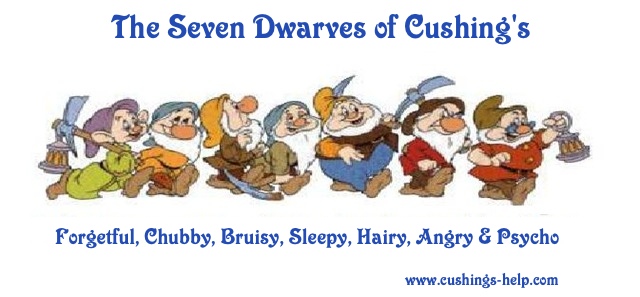
The Seven Dwarves of Cushing's

So, these are only seven of the many, many symptoms of Cushing’s.  I had those above – and I often felt like I looked like one of those little bearded dwarves.

Cushing’s affects every part of the body.  It’s not like when I had kidney cancer and only the kidney was affected.

Here are some of the many areas affected.

  • Progressive obesity and skin changes
  • Weight gain and fatty tissue deposits, particularly around the midsection and upper back, in the face (moon face) and between the shoulders (buffalo hump). Some symptoms such as sudden weight gain, are caused by excess cortisol. The excess cortisol in the body does not increase protein and carbohydrate metabolism. It slows or nearly disables metabolism function, which can cause weight gain (fat accumulation) in the buttocks, abdomen, cheeks, neck, or upper back.
  • Loss of muscle mass. Some areas of the body, such as the arms and legs, will remain thin.
  • Pink or purple stretch marks (striae) on the skin of the abdomen, thighs, breasts and arms
  • Thinning, fragile skin that bruises easily
  • Slow healing of cuts, insect bites and infections
  • Acne

Women with Cushing’s syndrome may experience:

  • Thicker or more visible body and facial hair (hirsutism)
  • Irregular or absent menstrual periods

Men with Cushing’s syndrome may experience:

  • Decreased libido
  • Decreased fertility
  • Erectile dysfunction

Other signs and symptoms include:

  • Fatigue
  • Muscle weakness
  • Depression, anxiety and irritability
  • Loss of emotional control
  • Cognitive difficulties
  • New or worsened high blood pressure
  • Glucose intolerance that may lead to diabetes
  • Headache
  • Bone loss, leading to fractures over time
  • Hyperlipidemia (elevated lipids – cholesterol – in the blood stream)
  • Recurrent opportunistic or bacterial infections
Think you have Cushing’s?  Get to a doctor and don’t give up!

MaryO
         MaryO

Day 3 Coverage of ENDO 2015

ENDO_2015


OR24-Adrenal Tumors: Clinical Implications of the Recent Molecular and Genetic Findings

Long term follow-up of a pivotal phase 2 study of Ultratrace® Iobenguane I-131 (AZEDRA) in patients with malignant relapsed/refractory pheochromocytoma/paraganglioma
C Jimenez, DA Pryma, DC Sullivan, JK Schwarz, RB Noto, N Stambler, T Armor, JD Jensen, RJ Israel


OR27-Hyperandrogenic Ovarian Dysfunction — Winner: Outstanding Abstract Award

The neurokinin B receptor antagonist AZD4901 decreases LH and testosterone secretion in women with PCOS: A randomized, double-blind, placebo-controlled clinical trial
JT George, R Kakkar, J Marshall, ML Scott, R Finkelman, T Ho, S McIntosh, JD Veldhuis, RA Anderson, L Webber


OR28-Lipids – Liver, Muscle, and Patient Bench to Bedside

Diagnosing familial hypercholesterolemia (FH) in the United States: Results from the CASCADE FH patient registry
Z Ahmad, C Newman, E O’Brien, P Shrader, EM deGoma, CD Ahmed, PM Moriarty, MRF Linton, MD Shapiro, PB Due, CM Ballantyne, WA Neal, D Duffy, L Hudgins, LC Hemphill, JA Underberg, KE Watson, SS Gidding, S Baum, K Wilemon, D Pickhardt, I Kindt, DJ Rader, M Roe, JW Knowles


OR30-Neuroendocrinology

Assessment of primary cancers in growth hormone-treated pediatric patients compared to population databases: An epidemiological analysis of a large, multinational, prospective observational study
CJ Child, AG Zimmermann, N Jia, LL Robison, JH Bramswig, WF Blum


Hypophysitis in the age of cancer immunotherapy: Experience in a large cancer center
MJoelle Pitteloud, R Dadu, ME Cabanillas, K Shah, MI-N Hu, MA Habra, SG Waguespack


OR34-Testosterone Replacement Therapy: Risks and Benefits

The association between testosterone use and major adverse cardiovascular events (MACE): An exploratory retrospective cohort analysis of two large, contemporary, coronary heart disease clinical trials
S Janmohamed, G Cicconetti, CE Koro, RV Clark, E Tarka


Oral Presentations in Reproductive Science–Winner: Oral Abstract Award in Reproductive Science

Effects of androgens and estrogens on cardiometabolic parameters in young adult men
EW Yu, H Lee, S-AM Burnett-Bowie, SC Hirsch, G Abrishamian-Garcia, LF Borges, DW Goldstein, AP Taylor, KE Wulczyn, AF Moore, JS Finkelstein


PP27-Hyperandrogenic Ovarian Dysfunction

Role of insulin resistance and hyperandrogenemia in early vascular dysfunction in adolescents with PCOS
SK Bartz, MC Caldas, R Krishnamurthy, R Krishnamurthy, FF Bacha


SAT 379-412-Cushing’s Syndrome

Does a normal urine free cortisol result rule out Cushing’s syndrome?
ST Sharma, LK Nieman


SAT 418-443-Biochemical, Genetic and Pharmacological Studies of the Pituitary and Hypothalamus

Clinical and molecular differences between invasive and non-invasive pituitary adenomas
DA Cano, M Mendez-Muros, E Venegas, N Gros, E Dios, N Garcia-Hernandez, A Madrazo-Atutxa, I Martin-Scheffer, E Cardenas, A Kaen, F Roldan, A Soto-Moreno

Other Diseases

forums

Many of the people who post on the message boards suffer from other diseases, as well as Cushing’s. These links help to provide some information about these diseases.

~A ~

Acanthosis nigricans
This Topic on the Message Boards.

Acromegaly
This Topic on the Message Boards.

Addison’s Disease
This Topic on the Message Boards.

Adrenoleukodystrophy
This Topic on the Message Boards.


~B ~

Barrett’s esophagus


~C ~

Carney Complex
This Topic on the Message Boards.
New Support Group for Carney Complex.

Central Serous Retinopathy
This Topic on the Message Boards.

Congenital Adrenal Hyperplasia (CAH)
This Topic on the Message Boards.

Conn’s Syndrome
This Topic on the Message Boards.

Craniopharyngioma
This Topic on the Message Boards.


~D ~

Diabetes insipidus
This Topic on the Message Boards.


~E ~

Ectopic ACTH Syndrome
This Topic on the Message Boards.

Empty Sella
This Topic on the Message Boards.


~F ~

Fibromyalgia
This Topic on the Message Boards.


~G ~

Gigantism
This Topic on the Message Boards.


~H ~

Hirsuitism
This Topic on the Message Boards.

Hyperprolactinemia
This Topic on the Message Boards.

Hyperthyroidism
This Topic on the Message Boards.

Hypoalderostonism
This Topic on the Message Boards.

Hypocalcemia
This Topic on the Message Boards

Hypopituitarism
This Topic on the Message Boards.

Hypothyroidism
This Topic on the Message Boards.


~I ~

Insulin Resistance
This Topic on the Message Boards.


~K ~

Kidney Disease
This Topic on the Message Boards.


~L ~

Lyme Disease
This Topic on the Message Boards.


~M ~

Madelung’s Disease
This Topic on the Message Boards.

Menopause
This Topic on the Message Boards.

MEN Type 1
This Topic on the Message Boards.

Myasthenia Gravis
This Topic on the Message Boards.


~N ~

Nelson’s Syndrome
This Topic on the Message Boards.


~O ~

Osteopenia
This Topic on the Message Boards.

Osteoporosis
This Topic on the Message Boards.


~P ~

Panhypopituitarism
This Topic on the Message Boards.

PCOS
This Topic on the Message Boards.

Perimenopause
This Topic on the Message Boards.

Pheochromocytoma
This Topic on the Message Boards.

Pituitary dwarfism
This Topic on the Message Boards.

Premature menopause
This Topic on the Message Boards.

Primary pigmented nodular adrenocortical disease (PPNAD)
This topic on the Message Boards

Prolactinoma
This Topic on the Message Boards.

Pseudo Cushing’s
This Topic on the Message Boards


~R ~

Rathke’s cleft cyst
This Topic on the Message Boards.

ROHHAD (Rapid-Onset Obesity With Hypothalamic Dysfunction, Hypoventilation, and Autonomic Dysregulation Presenting in Childhood)
This Topic on the Message Boards


~S ~

Sheehan’s Syndrome
This Topic on the Message Boards.

Stein-Leventhal Syndrome
This Topic on the Message Boards.


~T ~

Thymoma
This Topic on the Message Boards.

Thyroid Gland Disorders
This Topic on the Message Boards.

Turner’s Syndrome
This Topic on the Message Boards.


~V ~

Von Hippel-Lindau disease
This Topic on the Message Boards.


~Z ~

Zollinger-Ellison Syndrome

Depressed? Anxious? It Could Be An Early Symptom Of These Illnesses

In the January 2015 edition of Psychotherapy and Psychsomatics, a group of Italian researchers explored whether depression, anxiety, and other psychiatric mood disorders might be early symptoms of medical disorders, as opposed to being “just” psychological symptoms.

Their research showed that depression in particular can be a strong indicator of other forms of illness, finding it “to be the most common affective prodrome [early symptom] of medical disorders and was consistently reported in Cushing’s syndrome, hypothyroidism, hyperparathyroidism, pancreatic and lung cancer, myocardial infarction, Wilson’s disease, and AIDS.”

Read the entire article here: Depressed? Anxious? It Could Be An Early Symptom Of These Illnesses.

Cushing’s Syndrome – Epidemiology Forecast to 2023

It’s NOT as rare as they thought…

Epidemiologists forecast an increase in the diagnosed prevalent cases of CS in the 6MM, from 32,634 diagnosed prevalent cases in 2013 to 34,573 diagnosed prevalent cases in 2023, with an annual growth rate of 0.59% in the forecast period. In 2023, the US will have the highest number of diagnosed prevalent cases of CS, with 17,162 diagnosed prevalent cases.

For this analysis, The publisher epidemiologists used data available from Orphanet to construct the 10-year epidemiological forecast for the diagnosed prevalent cases of CS, Cushing’s disease, ectopic ACTH CS, adrenal adenoma CS, and adrenal carcinoma CS in the 6MM. The forecast provides the age- and sex-specific diagnosed prevalent cases of CS subtypes in the six markets, providing a comprehensive view of CS. In addition, this analysis provided detailed, clinically relevant segmentations for Cushing’s disease in order to improve the management of the disease.

Scope

  • The Cushing’s syndrome (CS) EpiCast Report provides an overview of the risk factors, comorbidities, and the global and historical epidemiological trends for CS in the six major markets (6MM) (US, France, Germany, Italy, Spain, and UK). The report also includes a 10-year epidemiological forecast for the diagnosed prevalent cases of CS, Cushing’s disease, ectopic- adrenocorticotropic hormone (ACTH) CS, adrenal adenoma CS, and adrenal carcinoma CS segmented by age (18 to =85 years) and sex in these markets.
  • The CS epidemiology report is written and developed by Masters- and PhD-level epidemiologists.
  • The EpiCast Report is in-depth, high-quality, transparent and market-driven, providing expert analysis of disease trends in the 6MM.

Read the article here: http://www.businesswire.com/news/home/20141103006612/en/Research-Markets-EpiCast-Report-Cushings-Syndrome–#.VFgvl5PF9HA