Increase in Glucose Uptake by Cushing’s Disease-associated Tumors Could Improve Early Detection

An increase in glucose uptake by Cushing’s disease-associated pituitary tumors could improve their detection, new research shows.

The study, “Corticotropin releasing hormone can selectively stimulate glucose uptake in corticotropinoma via glucose transporter 1,” appeared in the journal Molecular and Cellular Endocrinology.

The study’s senior author was Dr. Prashant Chittiboina, MD, from the Department of Neurosurgery, Wexner Medical Center, The Ohio State University, in Columbus, Ohio.

Microadenomas – tumors in the pituitary gland measuring less than 10 mm in diameter – that release corticotropin, or corticotropinomas, can lead to Cushing’s disease. The presurgical detection of these microadenomas could improve surgical outcomes in patients with Cushing’s.

But current tumor visualization methodologies – magnetic resonance imaging (MRI) and 18F-fluorodeoxyglucose (18F-FDG) positron emission tomography (PET) – failed to detect a significant percentage of pituitary microadenomas.

Stimulation with corticotropin-releasing hormone (CRH), which increases glucose uptake, has been suggested as a method of increasing the detection of adenomas with 18F-FDG PET, by augmenting the uptake of 18F-FDG – a glucose analog.

However, previous studies aiming to validate this idea have failed, leading the research team to hypothesize that it may be due to a delayed elevation in glucose uptake in corticotropinomas.

The scientists used clinical data to determine the effectiveness of CRH in improving the detection of corticotropinomas with 18F-FDG PET in Cushing’s disease.

They found that CRH increased glucose uptake in human and mouse tumor cells, but not in healthy mouse or human pituitary cells that produce the adrenocorticotropic hormone (ACTH). Exposure to CRH increased glucose uptake in mouse tumor cells, with a maximal effect at four hours after stimulation.

Similarly, the glucose transporter GLUT1, which is located at the cell membrane, was increased two hours after stimulation, as was GLUT1-mediated glucose transport.

These findings indicate a potential mechanism linking CRH exposure to augmented glucose uptake through GLUT1. Expectedly, the inhibition of glucose transport with fasentin suppressed glucose uptake.

The researchers consistently observed exaggerated evidence of GLUT1 in human corticotropinomas. In addition, human corticotroph tumor cells showed an increased breakdown of glucose, which indicates that, unlike healthy cells, pituitary adenomas use glucose as their primary source of energy.

Overall, the study shows that corticotropin-releasing hormone (CRH) leads to a specific and delayed increase in glucose uptake in tumor corticotrophs.

“Taken together, these novel findings support the potential use of delayed 18F-FDG PET imaging following CRH stimulation to improve microadenoma detection in [Cushing’s disease],” researchers wrote. The scientists are now conducting a clinical trial to further explore this promising finding.

From https://cushingsdiseasenews.com/2017/10/12/glucose-uptake-in-cushings-disease-could-improve-presurgical-tumor-detection/

Cortisol Modulator Shows Early Signs of Safety, Efficacy in Healthy Volunteers

The glucocorticoid receptor antagonist CORT125134 is safe and has shown preliminary signs of efficacy in healthy volunteers participating in a Phase 1 trial, say researchers in England.

Their study, “Assessment of Safety, Tolerability, Pharmacokinetics, and Pharmacological Effect of Orally Administered CORT125134: An Adaptive, Double-Blind, Randomized, Placebo-Controlled Phase 1 Clinical Study,” appeared in the journal Clinical Pharmacology in Drug Development.”

Cortisol signaling is indirectly controlled by the glucocorticoid receptor (GR). When cortisol binds the GR, the receptor becomes activated and migrates to the nucleus, where it regulates the expression of many genes. This influences a myriad of processes, including inflammation, immune response and brain function.

CORT125134, also known as relacorilant, is being developed by Corcept Therapeutics of Menlo Park, California, for Cushing’s disease patients and others who may benefit from it. The drug is a GR antagonist, blocking the receptor’s activity.

In order to evaluate the safety and tolerability of CORT125134, and learn how it behaves in the body, Corcept researchers conduced a Phase 1 trial in healthy subjects.

The British study, conducted at the Quotient Clinical in Nottingham, included 81 adults who received a single ascending-dose of CORT125134 or placebo, and 48 subjects who received multiple-ascending doses of the drug versus placebo.

Single doses were tested in nine distinct groups. Six tested six different doses of CORT125134, one tested a 150 mg dose in subjects receiving a high-fat meal, and two groups included patients receiving prednisone (a well-known GR activator), prednisone plus Korlym (mifepristone), or prednisone plus CORT125134.

Korlym is a medicine approved for Cushing’s  patients with high blood sugar levels due to high cortisol in circulation. But the drug targets the progesterone receptor and is associated with side effects like pregnancy termination and irregular vaginal bleeding.

Multiple doses, given for up to 14 days, were tested in four additional cohorts. Researchers observed that CORT125134 was rapidly absorbed and eliminated, presenting a suitable profile for once-daily dosing.

Efficacy was determined by CORT125134’s ability to counteract the effects of prednisone. In addition, a single dose of 500 mg or multiple dosing with 250 mg had similar effects as those seen with 600 mg of Korlym — the therapeutic dose used for Cushing’s treatments.

Most common treatment-related adverse events reported in the single-ascending dose part of the study were nausea, vomiting and thirst; most were mild. In those given multiple-ascending doses, adverse events included mild musculoskeletal and connective tissue disorders, as well as gastrointestinal system disorders.

Multiple 500 mg doses exceeded the maximum tolerated dose, as it led to musculoskeletal symptoms that forced researchers to stop treatment.

“This first-in-human study has demonstrated that CORT125134 is well tolerated following single doses up to 500 mg and repeated doses up to 250 mg once daily for 14 days,” researchers wrote. “Pharmacological activity was confirmed following the administration of a single 500-mg dose and daily administration of 250 mg.”

Corcept is now enrolling participants into a Phase 2 open-label trial (NCT02804750) to evaluate CORT125134 in patients with Cushing’s syndrome. This trial is being conducted in the United States and Europe and will include 80 participants. Top-line results are expected in the first quarter of 2018.

From https://cushingsdiseasenews.com/2017/10/10/phase-1-data-demonstrates-efficacy-safety-of-cort125134-in-healthy-volunteers/

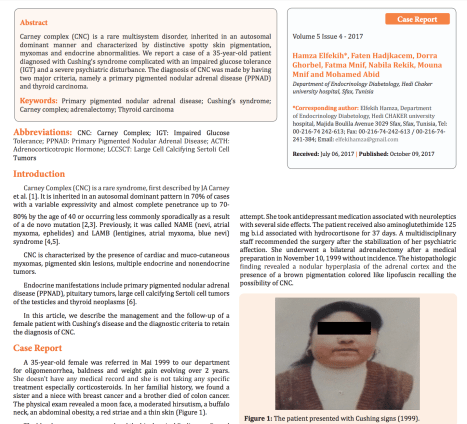
Cushing’s Syndrome Revealing Carney Complex: A Case Report


Carney complex (CNC) is a rare multisystem disorder, inherited in an autosomal dominant manner and characterized by distinctive spotty skin pigmentation, myxomas and endocrine abnormalities.

We report a case of a 35-year-old patient diagnosed with Cushing’s syndrome complicated with an impaired glucose tolerance (IGT) and a severe psychiatric disturbance. The diagnosis of CNC was made by having two major criteria, namely a primary pigmented nodular adrenal disease (PPNAD) and thyroid carcinoma.

Read the entire report here: Cushing’s Syndrome Revealing Carney Complex: A Case
Report

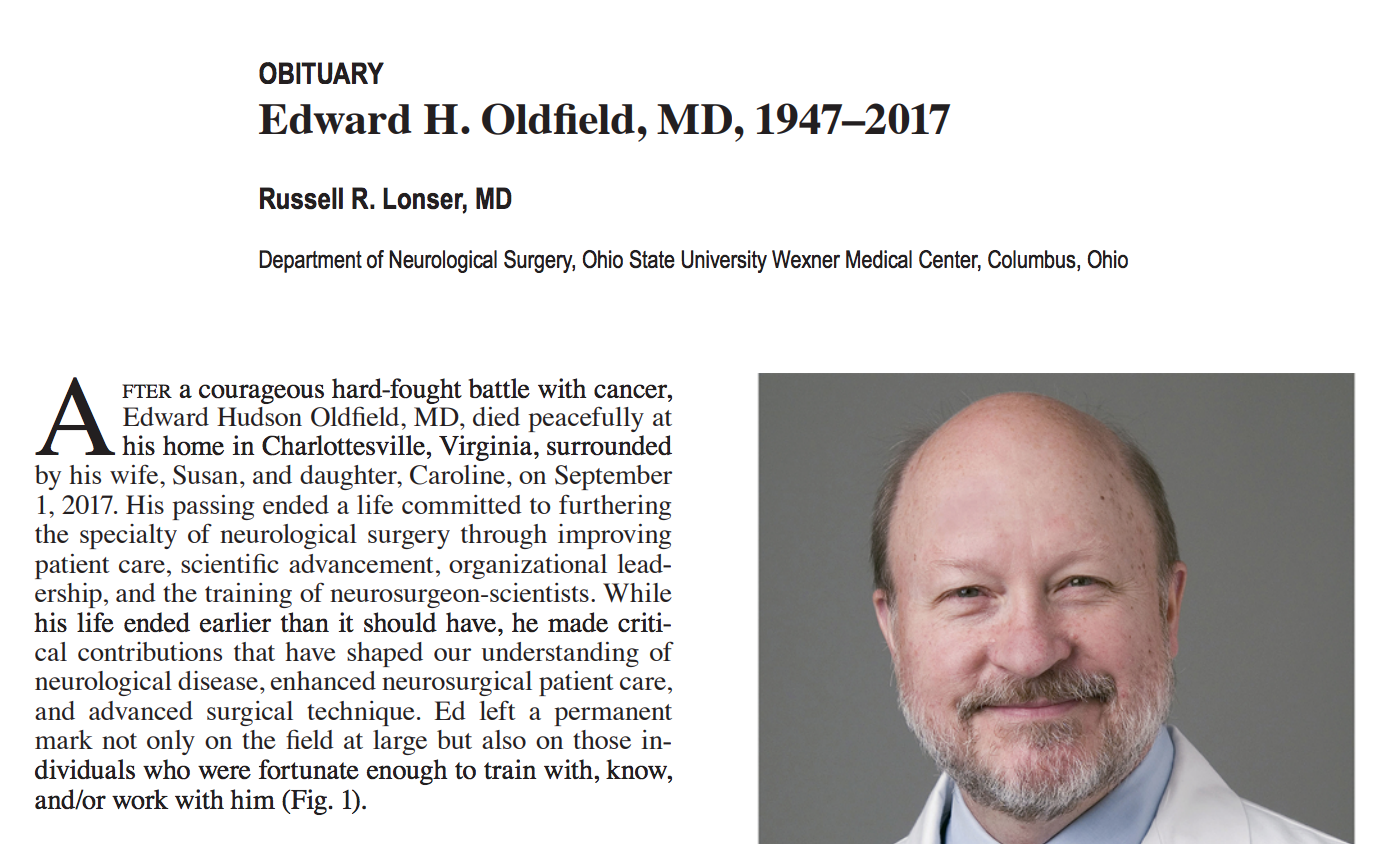
In Memory: Edward H. Oldfield, MD, 1947–2017

Dr. Oldfield was my pituitary surgeon at NIH back in 1987.  This was back in the olden days of transsphenoidal surgery.  I honestly expected to die but this man saved my life.


Ed started as Senior Staff Fellow in the Surgical Neurology Branch at the NIH (1981). After 5 years, Ed would become the Chief of the Surgical Neurology Branch. He would stay on as Branch Chief and lead the neurosurgical effort at the NIH for the next 21 years. During his tenure, he developed clinical, research, and training programs in epilepsy, congenital malformations, syringomyelia, nervous system neoplasia, drug delivery, and vascular malformations. The strength of these programs was his leadership and their multidisciplinary nature, which incorporated physicians and scientists across the basic, translational, and clinical arenas. Research investigation was always targeted at defined clinical problems. Under his direction, these programs shaped understanding of the studied neurological disorders, as well as improving patient care.

Read the entire obituary here: Edward H. Oldfield, MD, 1947–2017

Massachusetts Hospital Opens New Neurosurgery Program

Please let us know your experiences with this new program!


Hallmark Health and Tufts Medical Center have established a new neurosurgery program at Melrose-Wakefield Hospital to bring advanced care and services to the community. Fellowship-trained neurosurgeon Mina G. Safain, MD, has been jointly hired by Hallmark Health and Tufts Medical Center to lead the new program. He will provide care at both Melrose-Wakefield Hospital and Tufts Medical Center.

The neurosurgery program is an example of clinical integration of services between Hallmark Health and Tufts Medical Center since Hallmark Health joined Wellforce as a third founding member this past January. At that time, leaders from the organizations discussed finding ways to bring specialized care traditionally performed at academic medical centers into the community hospital setting for the benefit and convenience of patients.

“Offering neurosurgery provides a service for our patients that few community hospitals can offer,” said Steven Sbardella, MD, chief medical officer at Hallmark Health. “Our clinical relationship with Tufts Medical Center enables us to bring more highly specialized care options to our patients.”

“We are extremely excited to work with the physicians at Melrose-Wakefield Hospital and look forward to increasing the services available to care for patients with neurologic diseases,” said Carl Heilman, MD, neurosurgeon-in-chief at Tufts Medical Center. “Dr. Safain is an exceptionally talented and compassionate neurosurgeon and the perfect person to spearhead the launch of this new program.”

Dr. Safain’s clinical interests include all diseases affecting the brain, spine and peripheral nervous system.  He has specific interests in minimal access procedures for degenerative, infectious and oncologic spine disorders, as well as minimally invasive treatments for brain tumors, including neuro-endoscopy.

“The opportunity to practice in the community is very important to me,” said Dr. Safain. “I look forward to working with the esteemed staff and providers at Melrose-Wakefield Hospital and Lawrence Memorial Hospital and treating the patients in the surrounding communities.”

“Welcoming such a highly-respected neurosurgeon as Mina Safain to our team is a tremendous benefit for our communities and patients across our system including Lawrence Memorial Hospital in Medford and Melrose-Wakefield Hospital,” said Dr. Sbardella.

Dr. Safain, together with Ran Ku, PA, a neurosurgery physician assistant with more than 12 years of experience, will provide neurosurgery coverage and expertise five days a week.

Dr. Safain received his medical degree from Yale University School of Medicine.  He completed his neurosurgery residency at Tufts Medical Center serving as chief resident during his final year.  Dr. Safain also completed fellowship training in pituitary and neuro-endoscopic surgery at Brigham and Women’s Hospital.

Dr. Safain has published and presented nationally on a range of topics related to neurosurgical diseases and minimally invasive treatments for brain tumors.

From https://www.hallmarkhealth.org/Neurosurgery-program-established-at-Melrose-Wakefield-Hospital.html