Share this info with your endo in case he/she missed it!
This activity is intended for endocrinologists, primary care physicians, nurses, nurse practitioners, and pharmacists.
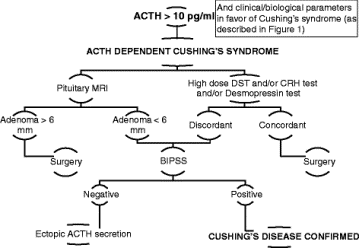
The goal of this activity is to review the diagnosis and treatment of Cushing disease from a multidisciplinary perspective.
Upon completion of this activity, participants will be able to:
- Outline the rationale for a multidisciplinary approach to the diagnosis and treatment of patients with Cushing disease
- Review the safety and efficacy of current management strategies for patients with Cushing disease
- Describe the diagnostic workup for Cushing disease and the reasons why timely diagnosis and treatment are important
Faculty and Disclosures
As an organization accredited by the ACCME, Medscape, LLC, requires everyone who is in a position to control the content of an education activity to disclose all relevant financial relationships with any commercial interest. The ACCME defines “relevant financial relationships” as financial relationships in any amount, occurring within the past 12 months, including financial relationships of a spouse or life partner, that could create a conflict of interest.
Medscape, LLC, encourages Authors to identify investigational products or off-label uses of products regulated by the US Food and Drug Administration, at first mention and where appropriate in the content.
Laurence Katznelson, MD
 Professor of Medicine and Neurosurgery, Stanford University; Medical Director, Pituitary Center, Stanford Hospital and Clinics, Stanford, California
Disclosure: Laurence Katznelson, MD, has disclosed the following relevant financial relationships:
Received grants for clinical research from: Corcept Therapeutics Inc.; Novartis Pharmaceuticals Corporation
Dr Katznelson does not intend to discuss off-label uses of drugs, mechanical devices, biologics, or diagnostics approved by the FDA for use in the United States.
Dr Katznelson does not intend to discuss investigational drugs, mechanical devices, biologics, or diagnostics not approved by the FDA for use in the United States.
Brooke Swearingen, MD
 Associate Professor of Neurosurgery, Harvard Medical School; Associate Visiting Neurosurgeon, Massachusetts General Hospital, Boston, Massachusetts
Disclosure: Brooke Swearingen, MD, has disclosed the following relevant financial relationships: Served as an advisor or consultant for: Novartis Pharmaceuticals Corporation
Owns stock, stock options or bonds from: Novartis Pharmaceuticals Corporation; Pfizer Inc; Amgen Inc; Roche
Dr Swearingen does not intend to discuss off-label uses of drugs, mechanical devices, biologics, or diagnostics approved by the FDA for use in the United States.
Dr Swearingen does not intend to discuss investigational drugs, mechanical devices, biologics, or diagnostics not approved by the FDA for use in the United States.
Nicholas Tritos, MD
 Assistant Professor of Medicine, Harvard Medical School; Staff, Neuroendocrine Unit, Massachusetts General Hospital, Boston, Massachusetts
Disclosure: Nicholas Tritos, MD, has disclosed the following relevant financial relationships:
Served as an advisor or consultant for: Corcept Therapeutics Inc; Pfizer Inc
Received grants for clinical research from: Pfizer Inc; Ipsen
Dr Tritos does intend to discuss off-label uses of drugs, mechanical devices, biologics, or diagnostics approved by the FDA for use in the United States.
Dr Tritos does not intend to discuss investigational drugs, mechanical devices, biologics, or diagnostics not approved by the FDA for use in the United States.
Susan Cornell, PharmD, CDE
 Associate Professor, Pharmacy Practice, Midwestern University-Chicago, Downers Grove, Illinois; Clinical Pharmacist/Certified Diabetes Educator, DuPage Community Clinic, Wheaton, Illinois
Disclosure: Susan Cornell, PharmD, CDE, has disclosed the following relevant relationships:
Served as a speaker or member of a speakers bureau for: Johnson & Johnson Diabetes Institute
Dr Cornell does intend to discuss off-label uses of drugs, mechanical devices, biologics, or diagnostics approved by the FDA for use in the United States.
Dr Cornell does not intend to discuss investigational drugs, mechanical devices, biologics, or diagnostics not approved by the FDA for use in the United States.
Rita Pach, RN, MSN
 Nurse, Johns Hopkins Pituitary Center, Baltimore, Maryland
Participation by Mrs Pach in the development of this product does not constitute or imply endorsement by the Johns Hopkins University or the Johns Hopkins Hospital and Health System.
Disclosure: Rita Pach, RN, has disclosed no relevant financial relationships.
Mrs Pach does not intend to discuss off-label uses of drugs, mechanical devices, biologics, or diagnostics approved by the FDA for use in the United States.
Mrs Pach does not intend to discuss investigational drugs, mechanical devices, biologics, or diagnostics not approved by the FDA for use in the United States.
Kristin M. Richardson
Group Scientific Director, Medscape, LLC
Disclosure: Kristin M. Richardson has disclosed no relevant financial relationships.
David Modrak, PhD
Freelance editor, Montville, New Jersey
Disclosure: David Modrak, PhD, has disclosed no relevant financial relationships.
Nafeez Zawahir, MD
CME Clinical Director, Medscape, LLC
Disclosure: Nafeez Zawahir, MD, has disclosed no relevant financial relationships.
Laurie E. Scudder, DNP, NP
Nurse Planner, Continuing Professional Education Department, Medscape, LLC; Clinical Assistant Professor, School of Nursing and Allied Health, George Washington University, Washington, DC
Disclosure: Laurie E. Scudder, DNP, NP, has disclosed no relevant financial relationships.
Instructions for Participation and Credit
There are no fees for participating in or receiving credit for this online educational activity. For information on applicability and acceptance of continuing education credit for this activity, please consult your professional licensing board.
This activity is designed to be completed within the time designated on the title page; physicians should claim only those credits that reflect the time actually spent in the activity. To successfully earn credit, participants must complete the activity online during the valid credit period that is noted on the title page. To receive AMA PRA Category 1 Credit™, you must receive a minimum score of 70% on the post-test.
Follow these steps to earn CME/CE credit*:
- Read the target audience, learning objectives, and author disclosures.
- Study the educational content online or printed out.
- Online, choose the best answer to each test question. To receive a certificate, you must receive a passing score as designated at the top of the test. We encourage you to complete the Activity Evaluation to provide feedback for future programming.
You may now view or print the certificate from your CME/CE Tracker. You may print the certificate but you cannot alter it. Credits will be tallied in your CME/CE Tracker and archived for 6 years; at any point within this time period you can print out the tally as well as the certificates from the CME/CE Tracker.
*The credit that you receive is based on your user profile.
Continue to activity: http://www.medscape.org/viewarticle/806559
Filed under: Cushing's, pituitary, Treatments | Tagged: Cushing, Cushing Syndrome, Dr. Brooke Swearingen, Dr. Laurence Katznelson, Dr. Nicholas Tritos, Food and Drug Administration, Harvard, Harvard Medical School, Johns Hopkins, Mass General, Medscape, Neurosurgery, Novartis, Pfizer, Rita Pach, Stanford University, Susan Cornell, United States | Leave a comment »


 CushieBlog