A Case Report of Cushing’s Disease Presenting With Psychosis and Muscle Weakness Postpartum

Abstract

Cushing’s syndrome is a condition leading to overproducing of cortisol by the adrenal glands. If the pituitary gland overproduces cortisol, it is called Cushing’s disease. Cushing’s syndrome and even Cushing’s disease during and after pregnancy are rare events. There is not enough literature and guidance for managing and treating these patients. The diagnosis of Cushing’s syndrome in pregnancy is often delayed because the symptoms overlap. We presented a thin 31-year-old woman, admitted 2 months after a normal-term delivery, with an atypical presentation of Cushing’s disease, unusual clinical features, and a challenging clinical course. She had no clinical discriminatory features of Cushing’s syndrome. Given that the patient only presented with psychosis and proximal myopathy and had an uncomplicated pregnancy, our case was considered unusual. The patients also had hyperpigmentation and severe muscle weakness which are among the less common presentations of Cushing’s syndrome. Our findings suggest that an early diagnosis of Cushing’s disease is important in pregnancy period for its prevalent fetal and maternal complications, and it should be treated early to optimize fetal and maternal outcomes as there is an increasing trend toward live births in treated participants.

Introduction

Cushing’s syndrome is a condition that originates from excessive production of glucocorticoids. The condition is most common in women of childbearing age and is characterized by altered distribution of the adipose tissue to the central and upper regions of the trunk (central obesity and buffalo hump), face (moon face), capillary wall integrity (easy bruising), hyperglycemia, hypertension, mental status changes and psychiatric symptoms, muscle weakness, signs associated with hyperandrogenism (acne and hirsutism), and violaceous striae among other signs. Hypercortisolism and hyperandrogenism suppress the production of the pituitary gonadotropins, which in turn leads to menstrual irregularities and infertility.13 Moreover, the main common cause of developing Cushing’s syndrome is the use of exogenic steroid.3
Cushing’s disease is a form of Cushing’s syndrome with overproduction of adrenocorticotropic hormone (ACTH) due to pituitary adenoma. The diagnosis is made using clinical features and paraclinical tests including urinary free cortisol (UFC), serum ACTH, dexamethasone suppression tests (DSTs), pituitary magnetic resonance imaging (MRI), and sometimes by inferior petrosal sinus sampling (IPSS).4 Although women with Cushing’s disease are less likely to become pregnant, timely diagnosis and appropriate management are especially important during possible pregnancy, preventing neonatal and maternal complications and death. The diagnosis is challenging due to the overlap of the disease symptoms with the changes associated with a normal pregnancy. Moreover, the hormonal milieu during pregnancy has recently been proposed as a potential trigger for Cushing’s disease in some cases; hence, the term “pregnancy-associated Cushing’s disease” has been used for the disease in the recent literature. In this study, we presented a thin 31-year-old woman who was referred to our clinic 2 months after a normal delivery, with an atypical presentation of Cushing’s disease, unusual clinical features, and a challenging clinical course.

Case Presentation

Our patient was a 31-year-old woman who presented 2 months after the delivery of her second child. She had a history of type 2 diabetes mellitus and hypertension in the past 2 years prior to her presentation. She had been admitted to another center following an episode of falling and muscle weakness. Two weeks later, she was admitted to our center with an impression of pulmonary thromboembolism due to tachypnea, tachycardia, and dyspnea. During follow-up, she was found to have leukocytosis, hyperglycemia (random blood sugar: 415 mg/d; normal level: up to 180 mg/dL) and hypokalemic metabolic alkalosis (PH: 7.5, HCO3 [bicarbonate]: 44.7 mEq/L, paO2 [partial pressure of oxygen]: 73 mm Hg, pCO2: 51.7 mm Hg, potassium: 2.7 mEq/L [normal range: 3.5-5.1 mEq/L]), which was refractory to the treatment; therefore, an endocrinology consultation was first requested. On physical examination, the patient was agitated, confused, and psychotic. Her vital signs were: blood pressure 155/100 mm Hg, heart rate: 130 bpm, and respiratory rate: 22 bpm, temperature: 39°C. As it has shown in Figure 1A, her face is not typical for moon face of Cushing’s syndrome, but facial hirsutism (Figure 1A) and generalized hyperpigmentation is obvious (Figure 1A-C). She was a thin lady and had a normal weight and distribution of adiposity (Body Mass Index [BMI] = 16.4 kg/m2; weight: 40 kg, and height: 156 cm). Aside from thinness of skin, she did not have the cutaneous features of Cushing’s syndrome (e.g. purpura, acne, and violaceous striae) and did not have supraclavicular and dorsocervical fat pad (buffalo hump), or plethora. In other words, she had no clinical discriminatory features of Cushing’s syndrome despite the high levels of cortisol, as confirmed by severely elevated UFC (5000 μg/24 h and 8000 μg/24 h; normal level: 4-40 μg/24 h). In addition, as will be mentioned later, the patient had axonal neuropathy which is a very rare finding in Cushing’s syndrome.
Figure 1. Clinical finding of our case with Cushing’s disease. (A) Hirsutism, (B) muscle atrophy seen in proximal portion of lower limbs, and (C) hyperpigmentation specially on the skin of the abdominal region.

OPEN IN VIEWER

She had a markedly diminished proximal muscle force of 1 out of 5 across all extremities; the rest of the physical examinations revealed no significant abnormalities (Figure 1B). On the contrary, based on her muscle weakness, hirsutism, psychosis and hyperpigmentation and refractory hypokalemic alkalosis, hyperglycemia, and hypertension, Cushing’s syndrome was suspected; therefore, 24-hour UFC level was checked that the results showed a severely elevated urinary cortisol (5000 μg/24 h and 8000 μg/24 h; normal level: 4-40 μg/24 h). Serum ACTH level was also inappropriately elevated (45 pg/mL; normal range: 10-60 pg/mL). High-dose dexamethasone failed to suppress plasma cortisol level and 24-hour urine cortisol level. A subsequent pituitary MRI showed an 8-mm pituitary mass, making a diagnosis of Cushing’s disease more probable. Meanwhile, the patient was suffering from severe muscle weakness that did not improve after the correction of hypokalemia. Then, a neurology consultation was requested. The neurology team evaluated laboratory data as well as EMG (Electromyography) and NCV (Nerve Conduction Velocity) of the patient, and based on their findings, “axonal neuropathy” was diagnosed for her weakness; so they ruled out the other neuromuscular diseases. A 5-day course of intravenous immunoglobulin (IVIG) was started for her neuropathy; however, the treatment did not improve her symptoms and the patient developed fungal sepsis and septic shock. Therefore, she was processed with broad-spectrum antibiotics and antifungal agents and recovered from the infection.
Mitotane was started for the patient before definitive surgical treatment to suppress hormonal production due to her poor general condition. Despite the 8-mm size of the pituitary mass which is likely to be a source of ACTH, our patient was underweight and showed the atypical clinical presentation of Cushing’s disease, making us suspect an ectopic source for the ACTH. Therefore, a Gallium dotatate scan was performed to find any probable ectopic sources; however, the results were unremarkable. The patient underwent Trans-Sphenoidal Surgery (TSS) to resect the pituitary adenoma because it was not possible to perform IPSS in our center. Finally, the patient’s condition including electrolyte imbalance, muscle weakness, blood pressure, and hyperglycemia started to improve significantly. The pathologist confirmed the diagnosis of a corticotropic adenoma. Nevertheless, the patient suddenly died while having her meal a week after her surgery; most likely due to a thromboembolic event causing a cardiac accident.

Discussion

Our patient was significantly different from other patients with Cushing’s disease because of her atypical phenotype. She was unexpectedly thin and had psychosis, hyperpigmentation, proximal myopathy, axonal neuropathy and no clinical discriminatory features of Cushing’s syndrome such as central adiposity, dorsocervical or supraclavicular fat pad, plethora or striae. She had also a history of type 2 diabetes and hypertension 2 years before her admission. The patient was diagnosed with Cushing’s later. From what was presented, the patient did not know she had Cushing’s until after her delivery and despite the highly elevated UFC, and she completed a normal-term delivery. Given that she only presented with psychosis and proximal myopathy, her pregnancy was considered unusual. Her clinical features such as hyperpigmentation and severe muscle weakness are among less common presentations.5
11β-hydroxysteroid dehydrogenase type 1 (11-βHSD1) is an enzyme responsible for converting cortisone (inactive glucocorticoid) into cortisol (active). It is speculated that this enzyme has a role in obesity (Figure 2).6,7
Figure 2. The enzymatic actions of 11β-hydroxysteroid dehydrogenase on its substrate interconverting inactive and active glucocorticoid.

OPEN IN VIEWER

In a case reported by Tomlinson, a 20-year-old female was diagnosed with Cushing’s disease despite not having the classical features of the disease. It has been suggested that the mechanism is a partial defect in 11β-HSD1 activity and concomitant increase in cortisol clearance rate. Thus, the patient did not have a classic phenotype; the defect in the conversion of cortisone to cortisol rises cortisol clearance and protects the patient from the effects of cortisol excess. This observation may help explain individual susceptibility to the side effects of glucocorticoids.6
Further studies of Tomlinson et al showed that a deficit in the function of (and not a mutation related to) 11β-HSD2 might have been responsible for the absence of typical Cushing’s symptoms. 11-HSD2 keeps safe the mineralocorticoid receptor from excess cortisol. Mutation in the HSD11B2 gene explains an inherited form of hypertension, apparent mineralocorticoid excess syndrome, in which Cushing’s disease results in cortisol-mediated mineralocorticoid excess affecting the kidney and leads to both hypokalemia and hypertension.8
It is frequent in Cushing’s syndrome that the patients usually have no mineralocorticoid hypertension; however, it is still proposed that a defect in 11β-HSD1 can be responsible for the presence of mineralocorticoid hypertension in a subgroup of patients. In fact, 11β-HSD1 is expressed in several tissues like the liver, kidneys, placenta, fatty tissues and gonads,9 meaning that this enzyme may potentially affect the results of cortisol excess in Cushing’s syndrome/disease. Abnormality in the function of this enzyme could explain the absence of the symptoms like central obesity, easy bruising, and typical striae during Cushing’s disease. Several factors affect the action of glucocorticoids. In this regard, the impact of the different types and levels of impairment in glucocorticoid receptors have been highlighted in some studies, as it can lead to different levels of response to glucocorticoids10 as well as a variety in the symptoms observed in Cushing’s disease.
The predominant reaction of the NADP(H)-dependent enzyme 11-Tukey’s honestly significant difference (HSD)1 happens through the catalysis of the conversion of inactive cortisol into receptor-active cortisol. The reverse reaction is mediated through the unidirectional NAD-dependent 11-HSD type 2 (Figure 2).11
In another case reported by Ved V. Gossein, a 41-year-old female was evaluated for hirsutism and irregular menstrual cycles. Her BMI was 22.6 kg/m2. The patient had no signs or symptoms of overnight recurrent Cushing’s syndrome, the 48-hour DST failed to suppress cortisol levels, and 24-hour urinary cortisol levels were persistently elevated on multiple occasions. Adrenocorticotropic hormone levels were unreasonably normal, suggesting ACTH-dependent hypercortisolism. Despite these disorders, she had 2 children. Magnetic resonance imaging (MRI) of the pituitary did not show any abnormalities. Moreover, abdominal MRI did not show adrenal mass or enlargement. Genetic testing to determine glucocorticoid resistance syndrome showed no mutation.12
Primary generalized glucocorticoid resistance is a rare genetic disorder characterized by generalized or partial insensitivity of target tissues to glucocorticoids.1317 There is a compensatory increase in hypothalamic-pituitary activity due to decreased sensitivity of peripheral tissues to glucocorticoids systems.1317 Excessive ACTH secretion leads to high secretion of cortisol and mineralocorticoids and/or androgens. However, the clinical features of Cushing’s syndrome do not develop after resistance to the effects of cortisol. Generalized glucocorticoid resistance is a rare condition characterized by high cortisol levels but no scarring of Cushing’s syndrome.18
An important aspect of our case was her pregnancy. Our patient had a history of hypertension and diabetes type 2, 2 years before her presentation to our center that could be because of an undiagnosed Cushing’s disease. The patient’s pregnancy terminated 2 months prior the admission and she had a normal vaginal delivery. So, we suspect that she become pregnant while involved with the disease. Aside from focusing on how this can happen in a patient with such high levels of glucocorticoids, more attention should be paid to occurring pregnancy in the background of Cushing’s disease. In fact, up to 250 patients were reported, of which less than 100 were actively treated.1922
Cushing’s disease is associated with serious complications in up to 70% of the cases coinciding with pregnancy.21 The most frequent maternal complications reported in the literature are hypertension and impaired glucose tolerance, followed by preeclampsia, osteoporosis, severe psychiatric complications, and maternal death (in about 2% of the cases). Prematurity and intrauterine growth retardation account for the most prevalent fetal complications. Stillbirth, intrauterine deaths, intrauterine hemorrhage, and hypoadrenalism have also been reported.23 Early diagnosis is especially challenging during pregnancy because of many clinical and biochemical shared features of the 2 conditions.23,24 These features include an increase in ACTH production, corticosteroid-binding globulin (CBG) 1 level, level of cortisol (urinary, plasma and free), hyperglycemia, weight gain, and an increased chance for occurrence of bruising, hypertension (mistaken with preeclampsia), gestational diabetes mellitus, weight gain, and mood swings.3 There are some suggestions proposed in the studies that help in screening and differentiation of Cushing’s from the normal and abnormal effects of pregnancy and Cushing’s disease from Cushing’s syndrome in suspected pregnant patients. Contrary to Cushing’s syndrome, the nocturnal minimum level of cortisol is preserved in pregnancy.23,25 There is not yet a diagnostic cut-off determined on mentioned level; however, a few studies elucidate the evaluation of hypercortisolemia in a pregnant patient.2628
Urinary free cortisol, a measure that reflects the amount of free cortisol in circulation, normally increases during pregnancy, and it can increase up to 8 times the normal level with Cushing’s disease during the second and the third trimesters,23,29 which is a useful tool to evaluate cortisol levels in a suspected pregnant woman. Because the suppression of both UFC and plasma cortisol is decreased in pregnancy,23,30 a low-dose DST is not very helpful for screening Cushing’s disease in pregnant patients. However, a high-dose DST with a <80% cortisol suppression might only indicate Cushing’s disease.3,31 Thus, it helps differentiating between ectopic ACTH syndrome and Cushing’s disease.32 The use of high-dose DST can distinguish between adrenal and pituitary sources of CS in pregnancy. Owing to the limited evidence available and the lack of data on normal pregnancies, the use of corticotropin-releasing hormone (CRH), desmopressin, and high-dose DST in pregnancy is not recommended yet.33 More timely diagnosis as well as timely intervention may have saved the life of our patient.
To differentiate between ectopic ACTH syndrome and Cushing’s disease, adrenal imaging should be considered. For higher plasma levels, combined employment of CRH stimulation test and an 8-mg DST can be helpful.3 Bilateral inferior petrosal sinus sampling (B-IPSS) might be needed when the findings are not in accordance with other results, but it is recommended to perform B-IPSS only if the noninvasive studies are inconclusive and only if there is enough expertise, experience, and technique for its performance.3
Although axonal neuropathy has been reported as a rare syndrome associated with paraneoplastic ectopic Cushing’s syndrome and exogenous Cushing’s syndrome, its association with Cushing’s disease has not been reported.5,32 Our patient had severe muscle weakness that we initially attributed it to myopathy and hypokalemia associated with Cushing’s syndrome. In our study, the diagnosis of axonal neuropathy was made based on electrophysiological studies by a neurology consultant and then IVIG was administered; however, the patient’s weakness did not improve after this treatment. The co-occurrence of Guillain-Barré syndrome which may also be classified as axonal neuropathy has also been reported in a pregnant woman with ectopic Cushing’s syndrome.34,35 Whether this finding is coincidental or the result of complex immune reactions driven by Cushing’s disease, or the direct effect of steroids, these results cannot be deduced from current data.36 Some data suggest that the fluctuations and inferior petrosal sinus sampling may trigger the flare of autoimmune processes, specifically when the cortisol levels start to decline during the course of Cushing’s syndrome.35,8 Also, due to COVID-19 pandemic affecting vital organs like kidney, paying attention to COVID-19 is suggested.3740

Conclusions

We presented a thin young female with psychosis, proximal myopathy, and axonal neuropathy with Cushing’s disease who had a recent pregnancy that was terminated without any fetal or maternal complications despite the repeated elevated serum cortisol and 24-hour UFC; therefore, we suggest that she might have glucocorticoid resistance. Glucocorticoid resistance is a rare disease in which the majority, but not all, of patients have a genetic mutation in the hGR-NR3C1 gene. As we did not perform genetic testing for our patient, the data are lacking.
Another clue to the absence of the classic Cushing’s disease phenotype in our case is the role of isoenzymes of 11-HSD1 and 11-HSD2. Other mechanisms, such as the defect somewhere in the glucocorticoid pathway of action such as a decreased number of receptors, a reduction in ligand affinity, or a postreceptor defect, play an important role in nonclassical clinical manifestations of Cushing’s syndrome.

Acknowledgments

The authors thank the patient for allowing us to publish this case report. The authors show their gratitude to the of the staff of the Rasool Akram Medical Complex Clinical Research Development Center (RCRDC) specially Mrs. Farahnaz Nikkhah for its technical and editorial assists.

Ethics Approval

Our institution does not require ethical approval for reporting individual cases or case series.

Informed Consent

Written informed consent was obtained from the patient and for her anonymized information to be published in this article.

Declaration of Conflicting Interests

The author(s) declared no potential conflicts of interest with respect to the research, authorship, and/or publication of this article.

Funding

The author(s) received no financial support for the research, authorship, and/or publication of this article.

References

1. Guilhaume B, Sanson ML, Billaud L, Bertagna X, Laudat MH, Luton JP. Cushing’s syndrome and pregnancy: aetiologies and prognosis in twenty-two patients. Eur J Med. 1992; 1(2):83-89.
2. Lin W, Huang HB, Wen JP, et al. Approach to Cushing’s syndrome in pregnancy: two cases of Cushing’s syndrome in pregnancy and a review of the literature. Ann Transl Med. 2019; 7(18):490.
3. Vilar L, Freitas MdC, Lima LHC, Lyra R, Kater CE. Cushing’s syndrome in pregnancy: an overview. Arq Bras Endocrinol Metabol. 2007;51(8):1293-1302.
4. Pecori Giraldi F, Cavallo LM, P, et al. The role of inferior petrosal sinus sampling in ACTH-dependent Cushing’s syndrome: review and joint opinion statement by members of the Italian Society for Endocrinology, Italian Society for Neurosurgery, and Italian Society for Neuroradiology. Neurosurg Focus. 2015;38(2):E5.
5. Molina Garrido MJ, Guillén Ponce C, Maciá Escalante S, Pons Sanz V, Carrato Mena A. Cushing’s paraneoplastic syndrome as first manifestation of an adenocarcinoma of unknown origin. Clin Transl Oncol. 2006;8(8):621-623.
6. Tomlinson JW, Draper N, Mackie J, et al. Absence of Cushingoid phenotype in a patient with Cushing’s disease due to defective cortisone to cortisol conversion. J Clin Endocrinol Metab. 2002;87(1):57-62.
7. Kobayashi T, Matsumoto T, Kamata K. IGF-I-induced enhancement of contractile response in organ-cultured aortae from diabetic rats is mediated by sustained thromboxane A2 release from endothelial cells. J Endocrinol. 2005;186(2): 367-376.
8. Stewart PM. Tissue-specific Cushing’s syndrome, 11β-hydroxysteroid dehydrogenases and the redefinition of corticosteroid hormone action. Eur J Endocrinol. 2003;149:163-168.
9. Ricketts ML, Verhaeg JM, Bujalska I, et al. Immunohistochemical localization of type 1 11β-hydroxysteroid dehydrogenase in human tissues. J Clinl Endocrinol Metabol. 1998;83:1325-1335.
10. Huizenga NA, Koper JW, De Lange P, et al. A polymorphism in the glucocorticoid receptor gene may be associated with and increased sensitivity to glucocorticoids in vivo. J Clin Endocrinol Metab. 1998;83(1):144-151.
11. Hintzpeter J, Stapelfeld C, Loerz C, Martin HJ, Maser E. Green tea and one of its constituents, Epigallocatechine-3-gallate, are potent inhibitors of human 11β-hydroxysteroid dehydrogenase type 1. PLoS ONE. 2014;9(1):e84468.
12. Gossain VV, El-Rifai M, Krishnan P, Bhavsar B. Cushing’s syndrome with no clinical stigmata—a variant of glucocorticoid resistance syndrome. Clin Diabetes Endocrinol. 2018;4:23-25.
13. Charmandari E, Kino T, Ichijo T, Chrousos GP. Generalized glucocorticoid resistance: clinical aspects, molecular mechanisms, and implications of a rare genetic disorder. J Clin Endocrinol Metab. 2008;93(5):1563-1572.
14. Cidlowski JA, Malchoff CD, Malchoff DM. Glucocorticoid receptors, their mechanism of action, and glucocorticoid resistance. In: Jameson JL, De Groot LJ, eds. Endocrinology: Adult and Pediatric. Saunders; 2016:1717-1726.
15. Charmandari E, Kino T. Chrousos syndrome: a seminal report, a phylogenetic enigma and the clinical implications of glucocorticoid signaling changes. Eur J Clin Investig. 2010;40: 932-942.
16. Nicolaides NC, Charmandari E. Chrousos syndrome: from molecular pathogenesis to therapeutic management. Eur J Clin Invest. 2015;45(5):504-514.
17. Nicolaides N, Lamprokostopoulou A, Sertedaki A, Charmandari E. Recent advances in the molecular mechanisms causing primary generalized glucocorticoid resistance. Hormones. 2016;15(1): 23-34.
18. Huizenga NATM De Lange P, Koper JW, et al. Five patients with biochemical and/or clinical generalized glucocorticoid resistance without alterations in the glucocorticoid receptor gene. J Clin Endocrinol Metab. 2000;85:2076-2081.
19. Luger A, Broersen LHA, Biermasz NR, et al. ESE clinical practice guideline on functioning and nonfunctioning pituitary adenomas in pregnancy. Eur J Endocrinol. 2021;185: G1-G33.
20. Sridharan K, Sahoo J, Palui R, et al. Diagnosis and treatment outcomes of Cushing’s disease during pregnancy. Pituitary. 2021;24(5):670-680.
21. Caimari F, Valassi E, Garbayo P, et al. Cushing’s syndrome and pregnancy outcomes: a systematic review of published cases. Endocrine. 2017;55(2):555-563.
22. Lindsay JR, Jonklaas J, Oldfield EH, Nieman LK. Cushing’s syndrome during pregnancy: personal experience and review of the literature. J Clin Endocrinol Metab. 2005;90(5):3077-3083.
23. Lindsay JR, Nieman LK. The hypothalamic-pituitary-adrenal axis in pregnancy: challenges in disease detection and treatment. Endocr Rev. 2005;26(6):775-799.
24. Buescher MA, McClamrock HD, Adashi EY. Cushing syndrome in pregnancy. Obstetr Gynecol. 1992;79:130-137.
25. Carr BR, Parker CR Jr, Madden JD, et al. Maternal plasma adrenocorticotropin and cortisol relationships throughout human pregnancy. Am J Obstetr Gynecol. 1981;139:416-422.
26. Mellor A, Harvey RD, Pobereskin LH, Sneyd JR. Cushing’s disease treated by trans-sphenoidal selective adenomectomy in mid-pregnancy. Br J Anaesth. 1998;80(6):850-852.
27. Doshi S, Bhat A, Lim K. Cushing’s syndrome in pregnancy. J Obstetr Gynaecol. 2003;23:568-569.
28. Wood PJ, Barth JH, Freedman DB, Perry L, Sheridan B. Evidence for the low dose dexamethasone suppression test to screen for Cushing’s syndrome—recommendations for a protocol for biochemistry laboratories. Ann Clin Biochem. 1997;34(pt 3):222-229.
29. Lindsay JR, Jonklaas J, Oldfield EH, Nieman LK. Cushing’s syndrome during pregnancy: personal experience and review of the literature. J Clin Endocrinol Metab. 2005;90(5): 3077-3083.
30. Wallace C, Toth EL, Lewanczuk RZ, Siminoski K. Pregnancy-induced Cushing’s syndrome in multiple pregnancies. J Clin Endocrinol Metab. 1996;81(1):15-21.
31. Invitti C, Pecori Giraldi F, de Martin M, Cavagnini F. Diagnosis and management of Cushing’s syndrome: results of an Italian multicentre study. Study Group of the Italian Society of Endocrinology on the Pathophysiology of the Hypothalamic-Pituitary-Adrenal Axis. J Clin Endocrinol Metab. 1999;84(2):440-448.
32. Vilar L, Naves LA, Freitas MdC, et al. Endogenous Cushing’s syndrome: clinical and laboratorial features in 73 cases. Arq Bras Endocrinol Metabol. 2007;51(4):566-574.
33. Hamblin R, Coulden A, Fountas A, Karavitaki N. The diagnosis and management of Cushing’s syndrome in pregnancy. J Neuroendocrinol. 2022;34(8):e13118.
34. Bressler R, Johnson CT. Cushing’s syndrome and the Guillain-Barré syndrome. Ann Intern Med. 1959;50:1298-1303.
35. Moeindarbary S, Abbasi dalooei M, Ghahremani S, et al. Guillain-Barré syndrome following Cushing’s syndrome in a pregnant woman: a case report. Int J Pediatr. 2019;7:10651-10657.
36. Hasenmajer V, Sbardella E, Sciarra F, Minnetti M, Isidori AM, Venneri MA. The immune system in Cushing’s syndrome. Trends Endocrinol Metab. 2020;31(9):655-669.
37. Besharat S, Alamda NM, Dadashzadeh N, et al. Clinical and demographic characteristics of patients with COVID-19 who died in Modarres Hospital. Open Access Maced J Med Sci. 2020;8:144-149.
38. Lotfi B, Farshid S, Dadashzadeh N, Valizadeh R, Rahimi MM. Is Coronavirus Disease 2019 (COVID-19) associated with renal involvement? A review of century infection. Jundishapur J Microbiol. 2020;13:e102899.
39. Dadashzadeh N, Farshid S, Valizadeh R, Nanbakhsh M, Rahimi MM. Acute respiratory distress syndrome in COVId-19 disease. Immunopathol Persa. 2020;6:e16.
40. Petramala L, Olmati F, Conforti MG, et al. Autoimmune diseases in patients with Cushing’s syndrome after resolution of hypercortisolism: case reports and literature review. Int J Endocrinol. 2018;2018:1464967.


How AI Could Help Make Brain Surgery Safer

I’m not sure I like this!

STORY: Could artificial intelligence be used to make brain surgery safer?

At this university in London, trainee surgeon Danyal Khan is taking part in a mock operation during which he’s assisted by a real-time video feed, as is typical in brain surgery.

But what’s new here is that the footage is being analyzed by AI to help Khan better understand what he’s seeing.

The AI system, which is under development at University College London (UCL), highlights sensitive or critical structures in the brain.

Neurosurgeon Hani Marcus believes it has the potential to make brain surgery safer and more effective:

“So I’m very bullish that in the medium to long term, the A.I. will be helping lots of surgeons do lots of operations better than they otherwise can.”

Marcus says the AI system analyzed video of more than 200 pituitary gland tumor operations, and gained around 10 years-worth of experience in a fraction of the time.

That knowledge means the AI can now not only help navigate to the correct area of the brain, but also know what should be happening at any stage of the procedure, making it a valuable training aid.

“So, what we’re really trying to do is apply AI or artificial intelligence to support surgeons doing brain tumor surgery at the base of the brain. And what this practically entails is us training the AI with hundreds of videos, telling it, if you like, what structures are what and then at some point over that period, the AI becomes really good itself at recognising things, and able to support other surgeons who’re perhaps less experienced in advising them what to do next.”

Assistant Professor of Robotics and A.I. Sophia Bano explains how that might look in a real operation:

“There can be scenarios where clinicians, unintentionally, are very close to a very critical structure such as the optic nerve. This can have, any damage or a slight more pressure on the optic nerve, can have long term complications on the patient side. So, this whole tool will alert the surgeon during the procedure if there is any risk of potential complication so they can recalibrate themselves during the procedure.”

Khan, who was also involved in developing the software that is now helping him learn, says the A.I. system has been a valuable tool in his training.

It could also provide him with step-by-step guidance during a procedure, similar to having a senior surgeon standing over your shoulder.

“I think as I progress as a surgeon, there might be stages where I wonder, you know, have I done enough of a particular part of the procedure and should I move on? And actually having that sort of assistant in the background as a reassurance to look at and say, ‘well, yeah, actually, at this stage, out of the hundreds of videos of experts that this algorithm has watched, the experts would probably start moving on to the next phase’. It’s a useful double check.”

According to UCL, the system could be ready to be used in operating theaters within two years.

From https://news.yahoo.com/ai-could-help-brain-surgery-080156167.html

Hormones and High Blood Pressure: Study Reveals Endocrine Culprits and Targeted Treatments

In a recent study published in Hypertension Research, scientists examine the endocrine causes of hypertension (HTN) and investigate the efficacy of treatments to alleviate HTN.


What is HTN?

About 30% of the global population is affected by HTN. HTN is a modifiable cardiovascular (CV) risk factor that is associated with a significant number of deaths worldwide.

There are two types of HTN known as primary and secondary HTN. As compared to primary HTN, secondary HTN causes greater morbidity and mortality.

The most common endocrine causes of HTN include primary aldosteronism (PA), paragangliomas and pheochromocytomas (PGL), Cushing’s syndrome (CS), and acromegaly. Other causes include congenital adrenal hyperplasia, mineralocorticoid excess, cortisol resistance, Liddle syndrome, Gordon syndrome, and thyroid and parathyroid dysfunction.

What is PA?

PA is the most common endocrine cause of hypertension, which is associated with excessive aldosterone secretion by the adrenal gland and low renin secretion. It is difficult to estimate the true prevalence of PA due to the complexity of its diagnosis.

Typically, the plasma aldosterone-to-renin ratio (ARR) is measured to diagnose PA. The diagnosis of PA can also be confirmed using other diagnostic tools like chemiluminescent enzyme immunoassays (CLEIAs) and radio immune assay (RIA).

Continuous aldosterone secretion is associated with organ damage due to chronic activation of the mineralocorticoid (MR) receptor in many organs, including fibroblasts and cardiomyocytes. An elevated level of aldosterone causes diastolic dysfunction, endothelial dysfunction, left ventricular hypertrophy, and arterial stiffness.

Increased aldosterone secretion also leads to obstructive sleep apnea and increases the risk of osteoporosis. This is why individuals with PA are at a higher risk of cardiovascular events (CVDs), including heart failure, myocardial infarction, coronary artery disease, and atrial fibrillation.

PA is treated by focusing on normalizing potassium and optimizing HTN and aldosterone secretion. Unilateral adrenalectomy is a surgical procedure proposed to treat PA.

Young patients who are willing to stop medication are recommended surgical treatment. The most common pharmaceutical treatment for PA includes mineralocorticoid receptor antagonists such as spironolactone and eplerenone.

Pheochromocytomas and paragangliomas

PGL are tumors that develop at the thoracic-abdominal-pelvic sympathetic ganglia, which are present along the spine, as well as in the parasympathetic ganglia located at the base of the skull. The incidence rate of PGL is about 0.6 for every 100,000 individuals each year. PGL tumors synthesize excessive catecholamines (CTN), which induce HTN.

Some of the common symptoms linked to HTN associated with PGL are palpitations, sweating, and headache. PGL can be diagnosed by determining metanephrines (MN) levels, which are degraded products of CTN. Bio-imaging tools also play an important role in confirming the diagnosis of PGL.

Excessive secretion of CTN increases the risk of CVDs, including Takotsubo adrenergic heart disease, ventricular or supraventricular rhythm disorders, hypertrophic obstructive or ischaemic cardiomyopathy, myocarditis, and hemorrhagic stroke. Excessive CTN secretion also causes left ventricular systolic and diastolic dysfunction.

Typically, PGL treatment is associated with surgical procedures. Two weeks before the surgery, patients are treated with alpha-blockers. For these patients, beta-blockers are not used as the first line of treatment without prior use of alpha-adrenergic receptors.

Patients with high CTN secretion are treated with metyrosine, as this can inhibit tyrosine hydroxylase. Hydroxylase converts tyrosine into dihydroxyphenylalanine, which is related to CTN synthesis.

What is CS?

CS, which arises due to persistent exposure to glucocorticoids, is a rare disease with an incidence rate of one in five million individuals each year. The most common symptoms of CS include weight gain, purple stretch marks, muscle weakness, acne, and hirsutism. A high cortisol level causes cardiovascular complications such as HTN, hypercholesterolemia, and diabetes.

CS is diagnosed based on the presence of two or more biomarkers that can be identified through pathological tests, such as salivary nocturnal cortisol, 24-hour urinary-free cortisol, and dexamethasone suppression tests.

CS is treated through surgical procedures based on the detected lesions. Patients with severe CS are treated with steroidogenic inhibitors, such as metyrapone, ketoconazole, osilodrostat, and mitotane. Pituitary radiotherapy and bilateral adrenalectomy are performed when other treatments are not effective.

Acromegaly

Acromegaly arises due to chronic exposure to growth hormone (GH), leading to excessive insulin-like growth factor 1 (IGF1) synthesis. This condition has a relatively higher incidence rate of 3.8 million person-years. Clinical symptoms of acromegaly include thickened lips, widened nose, a rectangular face, prominent cheekbones, soft tissue overgrowth, or skeletal deformities.

Prolonged exposure to GH leads to increased water and sodium retention, insulin resistance, reduced glucose uptake, and increased systemic vascular resistance. These conditions increase the risk of HTN and diabetes in patients with acromegaly. Acromegalic patients are also at a higher risk of cancer, particularly those affecting the thyroid and colon.

Acromegaly is diagnosed using the IGF1 assay, which determines IGF1 levels in serum. After confirming the presence of high IGF1 levels, a GH suppression test must be performed to confirm the diagnosis. Bioimaging is also conducted to locate adenoma.

Acromegaly is commonly treated through surgical procedures. Patients who refuse this line of treatment are treated with somatostatin receptor ligands, growth hormone receptor antagonists, dopaminergic agonists, or radiotherapy.

Journal reference:
  • De Freminville, J., Amar, L., & Azizi, M. (2023) Endocrine causes of hypertension: Literature review and practical approach. Hypertension Research; 1-14. doi:10.1038/s41440-023-01461-1

From https://www.news-medical.net/news/20231015/Hormones-and-high-blood-pressure-Study-reveals-endocrine-culprits-and-targeted-treatments.aspx

Crooke Cell Adenoma Confers Poorer Endocrinological Outcomes Compared with Corticotroph Adenoma

Abstract

Background and Objectives

Crooke cell adenomas (CCA) are a rare, aggressive subset of adrenocorticotrophin secreting pituitary corticotroph adenomas (sCTA) found in 5–10% of patients with Cushing’s disease. Multiple studies support worse outcomes in CCA but are limited by small sample size and single-institution databases. We compared outcomes in CCA and sCTA using a multicenter, international retrospective database of high-volume skull base centers.

Methods

Patients surgically treated for pituitary adenoma from January 2017 through December 2020 were included.

Results

2826 patients from 12 international centers were compared (n=20 CCA and n=480 sCTA). No difference in baseline demographics, tumor characteristics or postoperative complications was seen. Microsurgical approaches (60% CCA vs. 62.3% sCTA) were most common. Gross total resection (GTR) was higher in CCA patients (100% vs. 83%, p=0.05). Among patients that had GTR according to intraoperative findings, fewer CCA patients had postoperative hormone normalization of pituitary function (50% vs. 77.8%, p<0.01) and remission of hypersecretion by 3-6 months (75% vs. 84.3%, p<0.01). This was present despite CCA having better local control rates (100% vs. 96%, p<0.01) and fewer patients with remnant on MRI (0% vs. 7.2%, p<0.01). A systematic literature review of 35 studies reporting on various treatment strategies reiterated the high rate of residual tumor, persistent hypercortisolism, and tumor-related mortality in CCA patients.

Conclusion

This modern, multicenter series of patients with CCA reflects their poor prognosis and reduced post-surgical hormonal normalization. Further work is necessary to better understand the pathophysiology of CCA to devise more targeted treatment approaches.

References (0)

Cited by (0)

Previous presentations: none

Previous publications: none

Disclosures

No relevant disclosures to report

CREDIT statement

Matthew Finlay: conceptualization, writing – review and editing

Richard Drexler: conceptualization, writing – review and editing

All: data curation, writing – review and editing

Michael Karsy: conceptualization, data curation, methodology, writing – original draft, writing – review and editing, supervision

Funding and Disclosures: none

View full text

From https://www.sciencedirect.com/science/article/abs/pii/S187887502301344X

Intensity-Modulated Radiotherapy for Cushing’s Disease: Single-Center Experience in 70 Patients

Context: Intensity-modulated radiotherapy (IMRT) is a modern precision radiotherapy technique for the treatment of the pituitary adenoma.

Objective: Aim to investigate the efficacy and toxicity of IMRT in treating Cushing’s Disease (CD).

Methods: 70 of 115 patients with CD treated with IMRT at our institute from April 2012 to August 2021 were included in the study. The radiation doses were usually 45-50 Gy in 25 fractions. After IMRT, endocrine evaluations were performed every 6 months and magnetic resonance imaging (MRI) annually. Endocrine remission was defined as suppression of 1 mg dexamethasone test (DST) or normal 24-hour urinary free cortisol level (24hUFC). The outcome of endocrine remission, endocrine recurrence, tumor control and complications were retrieved from medical record.

Results: At a median follow-up time of 36.8 months, the endocrine remission rate at 1, 2, 3 and 5 years were 28.5%, 50.2%, 62.5% and 74.0%, respectively. The median time to remission was 24 months (95%CI: 14.0-34.0). Endocrine recurrence was found in 5 patients (13.5%) till the last follow-up. The recurrence-free rate at 1, 2, 3 and 5 years after endocrine remission was 98.2%, 93.9%, 88.7% and 88.7%, respectively. The tumor control rate was 98%. The overall incidence of new onset hypopituitarism was 22.9%, with hypothyroidism serving as the most common individual axis deficiency. Univariate analysis indicated that only higher Ki-67 index (P=0.044) was significant favorable factors for endocrine remission.

Conclusion: IMRT was a highly effective second-line therapy with low side effect profile for CD patients. Endocrine remission, tumor control and recurrence rates were comparable to previous reports on FRT and SRS.

Introduction

Cushing’s disease (CD) is characterized by hypersecretion of adrenocorticotropic hormone (ACTH) from pituitary adenoma. As the state of hypercortisolemia considerably increases morbidity and mortality, normalizing cortisol levels is regarded as the major treatment goal in patients with CD (1). Transsphenoidal selective adenomectomy (TSS) is now established as the first-line treatment of CD. Despite the satisfactory remission rate that can be achieved with TSS (ranging from 59-97%), delayed recurrences have also been reported in up to 50% of patients (2).

The Endocrine Society guidelines suggest a shared decision-making approach in patients who underwent a noncurative surgery or for whom surgery was not possible (3). Second-line therapeutic options include repeat transsphenoidal surgery, medical therapy, radiotherapy and bilateral adrenalectomy. Radiotherapy (RT) is generally used in patients who have failed TSS or have recurrent CD, as well as in progressively growing or invasive corticotroph tumors (34).

Both stereotactic radiosurgery(SRS)and fractionated radiotherapy (FRT) have been used in the treatment of CD. Conventional radiotherapy as one of the technique for FRT has been used with a long experience, but its benefits were hindered by high risk of toxicity, mainly attributed to the harm to healthy surrounding structures (4). Previous studies on conventional RT in treating CD showed high efficacy (tumor control rate of 92-100% and hormonal control rate of 46-89%), but RT-induced hypopituitarism (30-58%) and recurrence (16-21%) were also commonly reported (147). Modern precise radiotherapy, especially intensity-modulated radiotherapy (IMRT), can spare the surrounding normal structure better by a more conformal and precise dose distribution (8). However, a large cohort study on long-term efficacy and toxicity of IMRT for CD is still lacking. Therefore, in the current study, we aim to analyze the efficacy and toxicity of intensity-modulated radiotherapy (IMRT) in treating CD. We also investigated the predictors of endocrine remission in aid of further management.

Methods

Patient

We collected 115 cases of Cushing’s disease treated at our center from April 2012 to August 2021. Patients were excluded under the following conditions: (1) follow-up time less than 3 months, (2) lacking evaluation of serum cortisol (F), adrenocorticotropic hormone (ACTH) or 24-hour urinary free cortisol (24hUFC) before or after RT, (3) underwent uni or bilateral adrenalectomy, (4) having received RT at other institutes before admitted to our center. At last, a total of 70 cases were included in this study.

Radiotherapy parameters

RT was administrated by a linear accelerator (6 MV X-ray). Intensity-modulated radiation therapy was applied for all patients. Including fix-filde IMRT (FF-IMRT), volumetric modulated arc therapy (VMAT) or Tomotherapy. We immobilized the patient with an individualized thermoplastic head mask and then conducted a computed tomography (CT) simulation scan at 2- to 3-mm intervals. The target volume and organs at risks (OARs) were delined with a contrast enhanced T1-weighted image (T1WI) magnetic resonance imaging (MRI) fusing with planning CT. The gross tumor volume (GTV) was defined with the lesion visible on MRI or CT. The clinical target volume (CTV) included microscopic disease, especially when the tumor invaded cavernous sinus and surrounding bones. The planning target volume (PTV) was defined as CTV plus a margin of 2- to 3-mm in three dimensions. The prescription dose was defined at 100% isodoseline to cover at least 95% PTV. The maximum dose was limited to less than 54 Gy for the brain stem and optic pathway structures. Radiotherapy was performed once a day and five fractions a week during five to six weeks. The total dose was 45-60 Gy, delivered in 25-30 fractions, with most patients (78.6%) receiving 45-50 Gy in 25 fractions. The fractionated dose was 1.8-2.0 Gy.

Data collection and clinical evaluation

Baseline characteristics were collected at the last outpatient visit before RT, including demographic characteristics, biochemical data, tumor characteristics and details of previous treatments. After RT, endocrine evaluations were performed every 6 months. Endocrine remission was considered when 1 mg dexamethasone suppression test (DST)<1.8 mg/dl. If 1mg DST results were lacking, then 24hUFC within the normal range was used as a remission criterion. Patients who regained elevated hormone levels after achieving remission were considered to have endocrine recurrence. For patients receiving medications that could interfere with the metabolism of cortisol, hormonal evaluation was performed at least 3 months after the cessation of the therapy.

Tumor size was measured on magnetic resonance imaging (MRI) before RT and annually after the completion of RT. Any reduction in or stabilization of tumor size was considered as tumor control. Tumor recurrence was defined as an increase of 2 millimeters in 2 dimensions comparing to MRI before RT, or from invisible tumor to a visible tumor on MRI (9).

Anterior pituitary function was assessed before RT and every 6 months during the follow-up after RT. RT-induced hypopituitarism was defined as the development of new onset hormone deficiency after RT. The diagnostic criteria for growth hormone deficiency (GHD), central hypothyroidism and hypogonadotropic hypogonadism (HH) refer to previous literature (1012). Panhypopituitarism referred to three or more anterior pituitary hormone deficiencies (13).

Statistical analysis

Statistical analysis was performed with SPSS version 25.0. Longitudinal analysis was performed with Kaplan-Meier method. For time-dependent variable, Log rank test was used for univariate analysis and Cox regression for multivariate analysis. The cut-off of F, ACTH and 24hUFC were defined as their median value. All variants in the univariate analysis were included in the model of multivariate analysis. P value < 0.05 was considered statistically significant. Plot was created with GraphPad Prism version 9.4.

Results

Patient characteristics

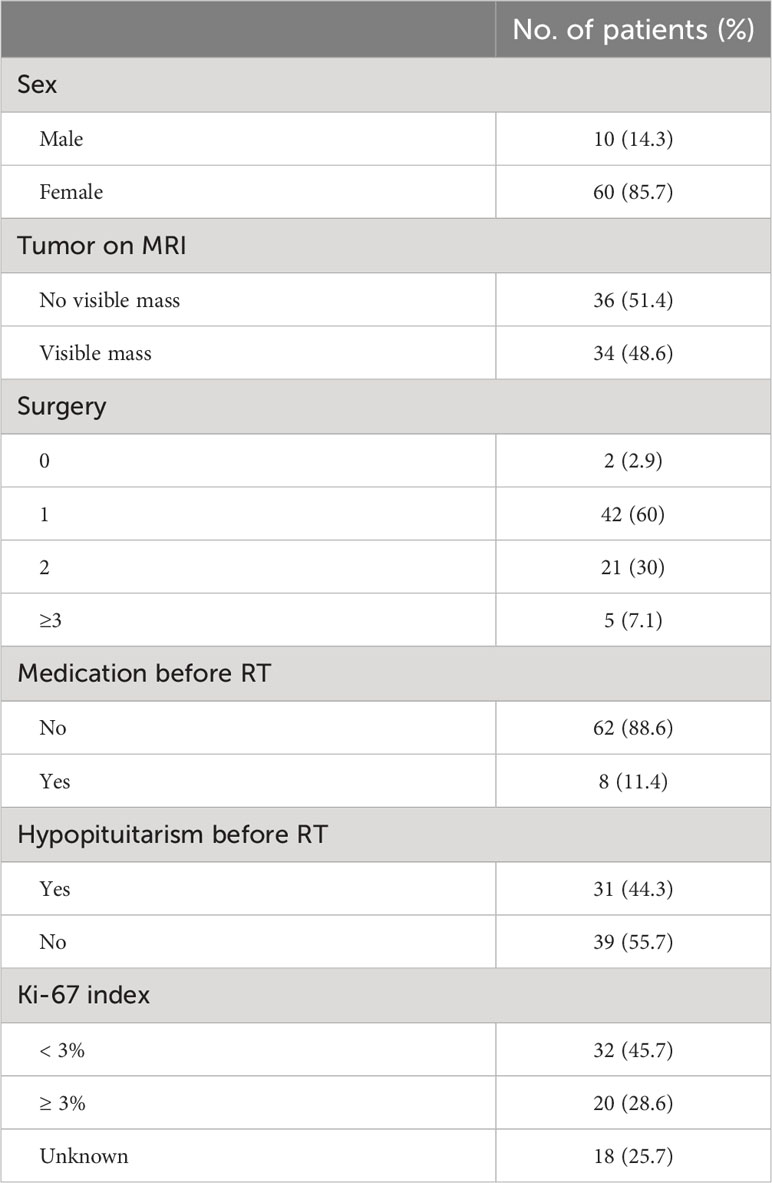
Of 70 cases included in the study, the median age was 32 years (range, 11-66 years). 60 (85.7%) were female and 10 (14.3%) were male (F:M= 6:1). The median follow-up time was 36.8 months (range, 3.0-111.0 months). 68 patients received RT as a second-line treatment because of incomplete tumor resection, failure to achieve complete endocrine remission or recurrence postoperative, and 2 were treated with RT alone because of contraindication of surgery. The frequency of surgical treatment was 1 for 42 patients, 2 for 21 and more than 3 for 5. A total of 8 patients received medical treatment before RT. 5 of them used pasireotide, 2 used ketoconazole and 1 used mifepristone. The median ACTH level was 58.7 pg/ml (range 14.9-265 pg/ml), F, 26.2μg/dl (range 11.8-72.6 μg/dl) and 24hUFC, 355.7 μg/24hr (range 53.5-3065 μg/24hr) before RT. Tumor size evaluation was performed in all 70 patients before RT. Among them, 36 patients showed no visible residual tumor identified on MRI and only 5 patients showed tumor size more than 1 cm. Hypopituitarism was found in 31 patients (38.8%) before RT. HH was the most common (21 patients, 26.3%), followed by central hypothyroidism (13 patients, 16.3%) and GHD (9 patients, 11.3%). Panhypopituitarism was found in 4 patients (5.0%). (Table 1).

Table 1
www.frontiersin.orgTable 1 Patient characteristics.

Endocrine remission

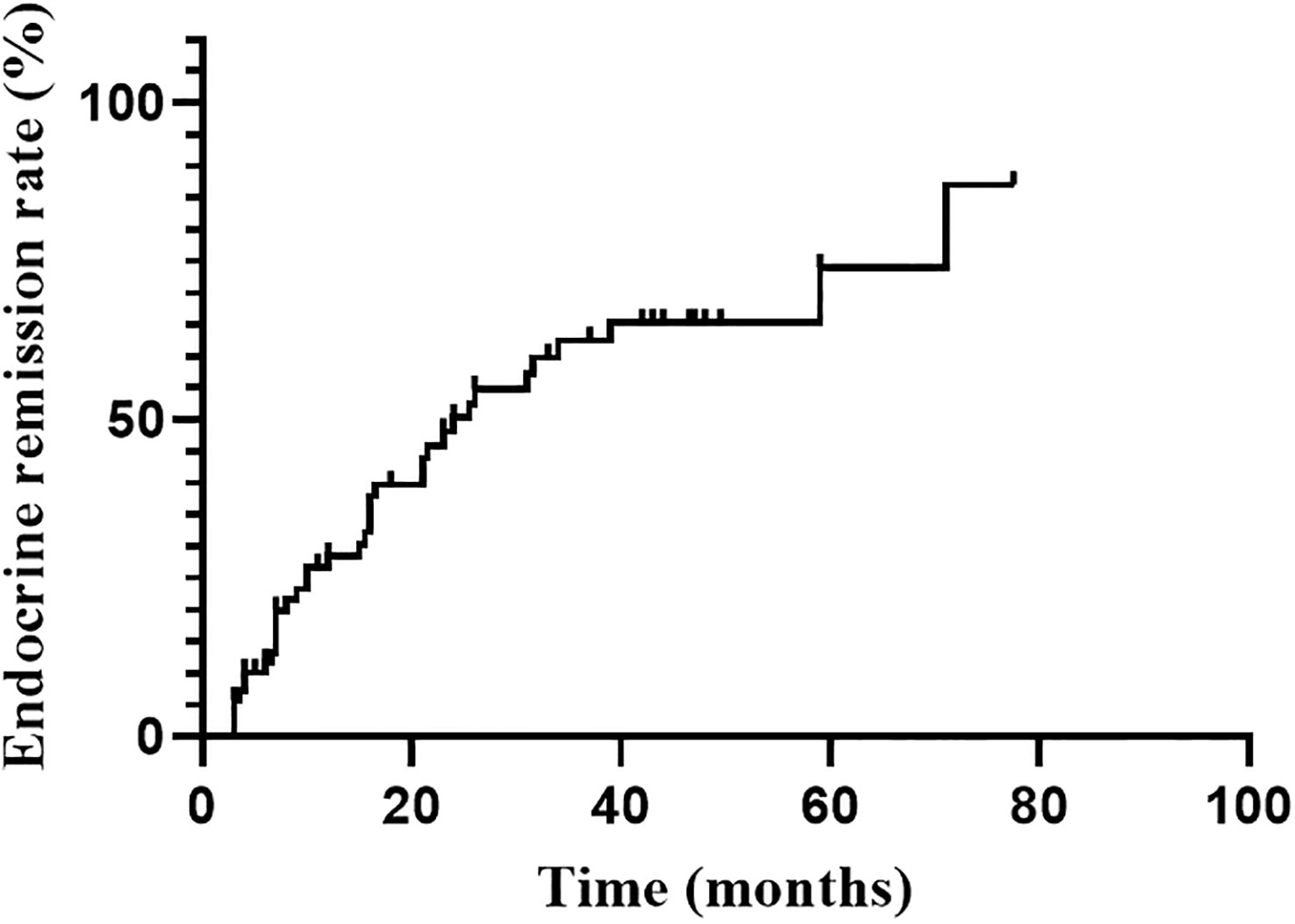
Endocrine remission was achieved in 37 of 70 patients during the follow-up. Six of them were evaluated by 1mg DST. The hormonal remission rate at 1, 2, 3 and 5 years were 28.5%, 50.2%, 62.5% and 74.0%, respectively, gradually increasing with follow-up time (Figure 1). The median time to remission was 24.0 months (95%CI: 14.0-34.0 months). Univariate analysis indicated that only higher Ki-67 index (P=0.044) was significant favorable factors for endocrine remission. There was no significant correlation between remission and age, sex, tumor size, the frequency of surgery, medication prior RT. The hormone levels (F, ACTH and 24hUFC prior RT) were divided into high and low groups by the median value, and were also not found to be associated with endocrine remission (Table 2). Since only Ki-67 was significant in the univariate analysis and all other parameters were far from significant, a multivariate analysis was no longer performed.

Figure 1
www.frontiersin.orgFigure 1 Endocrine remission rate during the follow-up after RT.

Table 2
www.frontiersin.orgTable 2 Univariate predictors of endocrine remission.

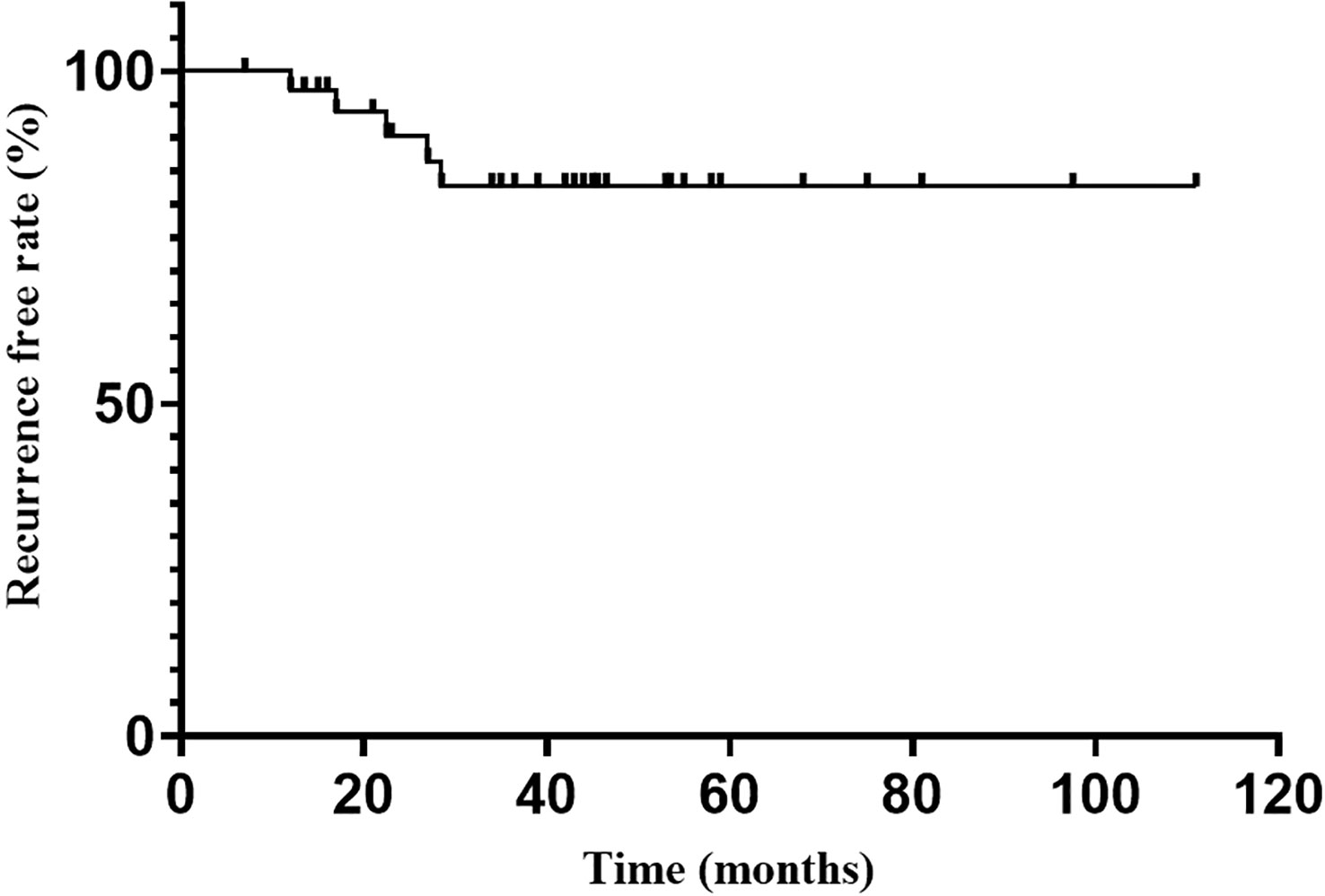
Endocrine recurrence was found in 5 patients till the last follow-up, with an overall recurrence rate of 13.5% (5/37). The median time to recurrence after reaching endocrine remission was 22.5 months. The recurrence-free rate at 1, 2, 3 and 5 years after endocrine remission was 98.2%, 93.9%, 88.7% and 88.7%, respectively (Figure 2).

Figure 2
www.frontiersin.orgFigure 2 Recurrence free rate after endocrine emission.

Tumor control

A total of 51 patients had repeated MRI examinations before and after treatment. During the follow-up, 20 patients showed reduction and 30 patoents remained stable in tumor size, with a tumor control rate of 98%. Only 1 patient showed enlargement tumor 1 year after RT, with F, ACTH and 24hUFC increase continuously.

Complications

At the last follow-up, 16 patients developed new onset hypopituitarism after RT. The overall incidence of RT-induced hypopituitarism was 22.9%. Hypothyroidism was the most common of hypopituitarism (8 patients), followed by HH (7 patients), adrenal insufficiency (4 patients) and GHD (3 patients). Only 1 patient (1.3%) with systemic lupus erythematosus (SLE) comorbidity complained of progressively worsening visual impairment during the follow up. No cerebrovascular event or radiation associated intracranial malignancy was found in our cohort.

Discussion

Efficacy and radiotherapy techniques

RT has been emerged as an effective second-line treatment for CD for many years. Although conventional fractionated RT has been used for a long experience in patients with CD, study on the modern precise radiotherapy, particularly IMRT, is rare and reports limited evidence on its long-term treatment outcome. IMRT can be implemented in many different techniques, such as fixed-field intensity-modulated radiotherapy (FF-IMRT), volumetric-modulated arc therapy (VMAT) and tomotherapy. Compared with conventional RT, IMRT allows a better target volume conformity while preserves adequate coverage to the target (1415). Our study reported that IMRT for CD has an endocrine remission rate of 74.0% at 5 years, with a median time to remission of 24.0 months (95%CI: 14.0-34.0 months). The endocrine remission rate at 5 years was comparable to those reported in previous series of FRT, with a median time to remission within the reported range (4.5-44 months) (91618) (Table 3). Compared with SRS in treating CD, the endocrine remission rate and median time to remission were also similar. Pivonello et al (19) summarized 36 studies of SRS for CD between 1986 to 2014, the mean endocrine remission rate was 60.8% and the median time to remission was 24.5 months. Tumor control rate was 98% in our cohort, only one patient showed enlargement tumor with elevating hormones. This local control rate was also comparable to that reported in a series of pituitary adenoma treated with FRT (93-100%) and SRS(92-96%) (916182021). Indeed, despite the lack of controlled studies about SRS and FRT in treating CD, many reviews that summarize the biochemical control and tumor contral of both are similar (2619).

Table 3
www.frontiersin.orgTable 3 Literature review of FRT and SRS in patients with CD published in recent years.

The overall endocrine recurrence rate in our study was 13.5%, with a median time to recurrence of 22.5 months. We, for the first time, reported the actuarial recurrence free rate at 1, 2, 3 and 5 years in CD patients treated with IMRT. The recurrence free rate at 3 and 5 years was 88.7% in our study. Outcomes were comparable to those reported in patients treated with conventional RT or SRS, with a mean recurrence rate and a median recurrence time of 15.9% (range, 0-62.5%) and 28.1 months, or 12.3% (range, 0-100%) and 33.5 months, according to a review conducted by Pivonello et al (19).

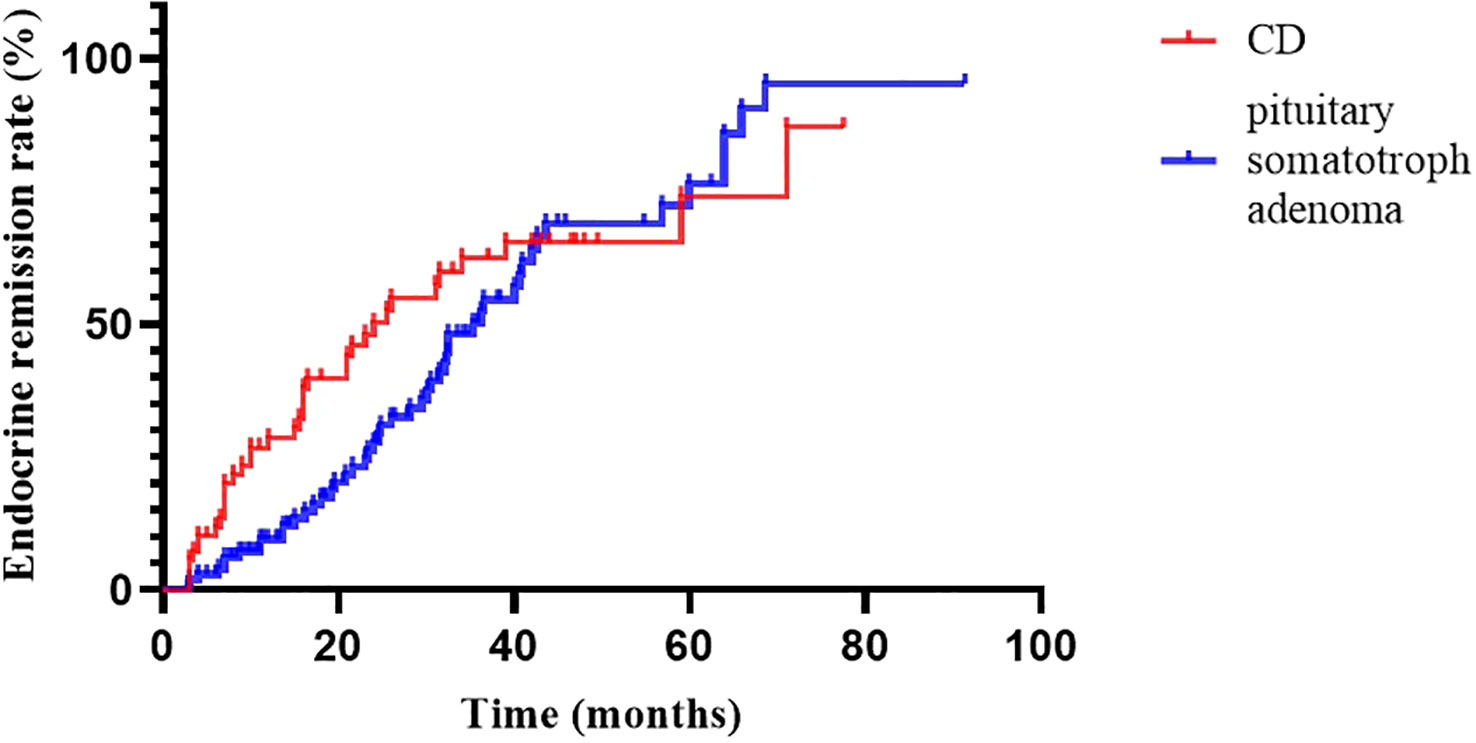
At 2020, we reported the outcomes of pituitary somatotroph adenomas treated with IMRT at our institution (20). Compared with pituitary somatotroph adenomas, CD has a similar 5-year remission rate (74.0% vs 74.3%) but a shorter median time to remission (24.0m vs 36.2m) (Figure 3). The tumor contral rates were similar, at 98% and 99%, respectively. The endocrine recurrence rate was significantly different, with CD being about one-fold higher than the pituitary somatotroph adenoma (13.8% vs 6.1%). This may be due to the majority of microadenomas in CD and that of macroadenomas in pituitary somatotroph adenomas.

Figure 3
www.frontiersin.orgFigure 3 Endocrine remission rate of CD and pituitary somatotroph adenoma.

Predictors of endocrine remission

In the univariate analysis, we found that only Ki-67 index ≥ 3% was correlated with better endocrine remission (p=0.044). Cortisol levels before RT and tumor size were not predictors of endocrine remission. For surgery in treating CD, higher preoperative ACTH level was considered as unfavorable prognostic factor for endocrine remission in a few studies (2223). For radiotherapy, some previous studies also have reported a faster endocrine remission in patients with lower serum cortisol level. Minniti et al. reported that hormone level was normalized faster in patients with lower urinary and plasma cortisol level at the time of RT (16). Apaydin also reported that low postoperative cortisol and 1mg DST was a favorable factors for faster remission in patients treated with gamma knife surgery (GKS) and hypofractionated radiotherapy (HFRT), although no significant relationship was found between remission rate and plasma cortisol level prior RT in both studies (916). Castinetti et al. found that initial 24hUFC was a predicative factor of endocrine remission in patients treated with GKS, which was not reported in our cohort treated with IMRT (24). However, the discrepancy between the results can be attributed to various factors, including selection bias of retrospective study, duration of follow-up, endocrine remission criteria and cut-off value.

Tumor size before RT was considered as a significant predictor for endocrine remission in some published series of patients treated with SRS. Jagannathan et al. reported a significant relationship between preoperative tumor volume and endocrine remission in patients with CD treated with GKS (25). However no significant correlation between tumor size and endocrine remission was found in series of patients treated with FRT (591617). But our study found no significant correlation between tumor size (visible or no-visible residual tumor on MRI) before RT and endocrine remission. The frequency of surgery before RT was also not found to be associated with endocrine remission in our study, which reached a similar conclusion with some previous studies (9171826). Abu Dabrh et al. reported a higher remission rate in patients receiving TSS prior RT in their meta-analysis (5). Similar result was also reported in a review on the treatment outcome of GKS in patients with CD, that postoperative GKS was more effective than primary GK (19). However, analysis on this parameter was difficult in our cohort considering the low number of patients who received IMRT as the first-line treatment.

Reports on the effect of medical treatment on endocrine remission have been controversial. Some studies reported a negative effect of medical treatment at the time of SRS on endocrine remission in patients with CD. Castinetti et al. showed a significant higher rate of endocrine remission in patients who were not receiving ketoconazole at the time of GKS, compared to those who were (27). Sheehan et al. also found a significantly shorter time to remission in patients who discontinued ketoconazole at the time of GKS (28). However, no such correlation was found in patients treated with FRT (917). Like previous studies on FRT, we also noted no significant relationship between preradiation use of medication and endocrine remission, but our statistical analysis may be hindered by the low proportion of patients undergoing medical treatment before RT. Moreover, the anticortisolic drugs used in previous studies were mainly ketoconazole or cabergoline, while most of our patient have received pasireotide, whose effect have not been well-studied yet. Further studies are necessary to understand the effect of somatostatin receptor ligands on the outcome of radiotherapy in patients with CD.

Complications

Hypopituitarism is the most common complication secondary to radiotherapy, with the rate of new-onset hypopituitarism ranging widely in previous report. Pivonello et al. reviewed series of CD patients who were treated with conventional RT with a follow-up of at least 5 years (19). The reported mean and median rates of hypopituitarism were 50% and 48.3%, respectively (range, 0-100%). As regards FRT, the overall rate of new-onset hypopituitarism was 22.2-40% at a median follow-up ranging from 29-108 months, with both incidence and severity increasing with longer follow-up (91619). The incidence of hypopituitarism in our series was 22.9%, which was within the reported range of new onset hypopituitarism after FRT. Lower rate of hypopituitarism after SRS compared to conventional RT has been recognized in previous reviews (26). Our study showed that new onset hypopituitarism was less prevalent after IMRT than after conventional RT. This can be attributed to a higher precision in contouring the target volume and OARs, allowing these modern radiotherapy techniques to provide a better protection to hypothalamus-pituitary axes. In previous studies, potential risk factors for new onset hypopituitarism included suprasellar extension, higher radiation dose to the tumor margin and lower isodose line prescribed (2930). Sensitivity of individual hormonal axes to RT varies in different series. In our study, central hypothyroidism was the most common individual axis deficiency, followed by HH, adrenal insufficiency and GHD. This sequence was similar to that reported by Sheehan et al., whose series included 64 CD patients treated with SRS, as well as some other series (2931). It is noted in some studies that GHD is the most vulnerable axes (193233). Limited number of patients undergoing stimulation test may underestimate the prevalence of GHD in our study and some previous series, and longer follow-up is needed to generate a more accurate, time-dependent rate of new onset hypopituitarism.

In our study, only one patient complained of mild visual impairment, which was comparable to the rate ranging from 0-4.5% in previous series of FRT treating pituitary adenoma (9161826323435). This patient had concomitant SLE and the associated microangiopathy may render the optic nerve intolerant to radiotherapy. Cranial nerve damage was acknowledged as an uncommon complication, with an estimated risk of vision deterioration below 1% if single radiation dose was no more than 2.0 Gy and total dose no more than 45-50 Gy (236). The actuarial rate of optic neuropathy at 10 years was 0.8% in a series containing 385 patients with pituitary adenoma (37). No patient in our cohort developed cerebrovascular accident or secondary brain tumor. This finding was consistent with the low actuarial prevalence of these complications reported in other published series of FRT. Secondary brain tumor was extremely rare after SRS, with an overall incidence of 6.80 per patients-year, or a cumulative incidence of 0.00045% over 10 years in a multicenter cohort study containing 4905 patients treated with GKS (38). Ecemis et al. reviewed cohort studies of conventional RT in treating pituitary adenoma from 1990 to 2013 and found that 1.42% of patients developed secondary brain tumor, with a latency period of 19.6 years for meningioma, 11 years for glioma and 9 years for astrocytoma (39). As for cerebrovascular accident, Minniti et al. reported two patients (in a total of 40 patients) who had stroke 6 and 8 years after FRT (16). Data was still limited for FRT. Considering the low incidence and long latency period, large, controlled cohort study with long follow-up of FRT is still needed to accurately evaluate these complications.

Limitations

Our study has several limitations. First, not all patients rigorously followed regular follow-up time points, making time-dependent statistical analysis less accurate. In addition, the excessively low number of cases with 1mg DST as the endocrine remission criterion may affect the accuracy of the remission rate.Moreover, a median follow-up time of about 3 years hampered evaluation on some late complications, including cerebrovascular events and secondary brain tumor.

In conclusion, our study revealed that IMRT was a highly effective second-line therapy with low side effect profile for CD patients, and it’s endocrine remission, tumor control and recurrence rates were comparable to previous reports on FRT and SRS.

Data availability statement

The original contributions presented in the study are included in the article/supplementary material. Further inquiries can be directed to the corresponding author.

Author contributions

1. Conceptualization: FZ and HZ 2. Data curation: XL and ZX. 3. Funding acquisition: FZ. 4. Investigation: XL and ZX 5. Methodology: WW 6. Resources: XL, SS and XH 7. Validation: LL and HZ. 8. Writing – original draft: ZX 9. Writing – review and editing: XL. All authors contributed to the article and approved the submitted version.

Funding

Supported by grants National High Level Hospital Clinical Research Funding (No.2022-PUMCH-B-052) and National Key R&D Program of China, Ministry of Science and Technology of the People’s Republic of China.(Grant No. 2022YFC2407100, 2022YFC2407101).

Conflict of interest

The authors declare that the research was conducted in the absence of any commercial or financial relationships that could be construed as a potential conflict of interest.

Publisher’s note

All claims expressed in this article are solely those of the authors and do not necessarily represent those of their affiliated organizations, or those of the publisher, the editors and the reviewers. Any product that may be evaluated in this article, or claim that may be made by its manufacturer, is not guaranteed or endorsed by the publisher.

References

1. Katznelson L. Role of radiation in the treatment of Cushing disease. Pituitary (2022) 25(5):740–2. doi: 10.1007/s11102-022-01234-y

PubMed Abstract | CrossRef Full Text | Google Scholar

2. Ironside N, Chen CJ, Lee CC, Trifiletti DM, Vance ML, Sheehan JP. Outcomes of pituitary radiation for Cushing’s disease. Endocrinol Metab Clin North Am (2018) 47(2):349–65. doi: 10.1016/j.ecl.2018.01.002

PubMed Abstract | CrossRef Full Text | Google Scholar

3. Nieman LK, Biller BM, Findling JW, Murad MH, Newell-Price J, Savage MO, et al. Treatment of Cushing’s syndrome: an endocrine society clinical practice guideline. J Clin Endocrinol Metab (2015) 100(8):2807–31. doi: 10.1210/jc.2015-1818

PubMed Abstract | CrossRef Full Text | Google Scholar

4. Gheorghiu ML, Fleseriu M. Stereotactic radiation therapy in pituitary adenomas, is it better than conventional radiation therapy? Acta Endocrinol (Buchar) (2017) 13(4):476–90. doi: 10.4183/aeb.2017.476

PubMed Abstract | CrossRef Full Text | Google Scholar

5. Abu Dabrh AM, Singh Ospina NM, Al Nofal A, Farah WH, Barrionuevo P, Sarigianni M, et al. Predictors of biochemical remission and recurrence after surgical and radiation treatments of cushing disease: A systematic review and meta-analysis. Endocr Pract (2016) 22(4):466–75. doi: 10.4158/EP15922.RA

PubMed Abstract | CrossRef Full Text | Google Scholar

6. Gheorghiu ML. Updates in the outcomes of radiation therapy for Cushing’s disease. Best Pract Res Clin Endocrinol Metab (2021) 35(2):101514. doi: 10.1016/j.beem.2021.101514

PubMed Abstract | CrossRef Full Text | Google Scholar

7. Minniti G, Brada M. Radiotherapy and radiosurgery for Cushing’s disease. Arq Bras Endocrinol Metabol (2007) 51(8):1373–80. doi: 10.1590/s0004-27302007000800024

PubMed Abstract | CrossRef Full Text | Google Scholar

8. Castinetti F, Brue T, Ragnarsson O. Radiotherapy as a tool for the treatment of Cushing’s disease. Eur J Endocrinol/European Fed Endocr Societies (2019) 180(5):D9–D18. doi: 10.1530/EJE-19-0092

CrossRef Full Text | Google Scholar

9. Apaydin T, Ozkaya HM, Durmaz SM, Meral R, Kadioglu P. Efficacy and safety of stereotactic radiotherapy in Cushing’s disease: A single center experience. Exp Clin Endocrinol Diabetes (2021) 129(7):482–91. doi: 10.1055/a-1217-7365

PubMed Abstract | CrossRef Full Text | Google Scholar

10. Fleseriu M, Hashim IA, Karavitaki N, Melmed S, Murad MH, Salvatori R, et al. Hormonal replacement in hypopituitarism in adults: an endocrine society clinical practice guideline. J Clin Endocrinol Metab (2016) 101(11):3888–921. doi: 10.1210/jc.2016-2118

PubMed Abstract | CrossRef Full Text | Google Scholar

11. Higham CE, Johannsson G, Shalet SM. Hypopituitarism. Lancet (2016) 388(10058):2403–15. doi: 10.1016/S0140-6736(16)30053-8

PubMed Abstract | CrossRef Full Text | Google Scholar

12. Bhasin S, Cunningham GR, Hayes FJ, Matsumoto AM, Snyder PJ, Swerdloff RS, et al. Testosterone therapy in men with androgen deficiency syndromes: an Endocrine Society clinical practice guideline. J Clin Endocrinol Metab (2010) 95(6):2536–59. doi: 10.1210/jc.2009-2354

PubMed Abstract | CrossRef Full Text | Google Scholar

13. Jazbinsek S, Kolenc D, Bosnjak R, Faganel Kotnik B, Zaletel Zadravec L, et al. Prevalence of endocrine and metabolic comorbidities in a national cohort of patients with craniopharyngioma. Horm Res Paediatr (2020) 93(1):46–57. doi: 10.1159/000507702

PubMed Abstract | CrossRef Full Text | Google Scholar

14. Ramos-Prudencio R, Perez-Alvarez SI, Flores-Balcazar CH, de Leon-Alfaro MA, Herrera-Gonzalez JA, Elizalde-Cabrera J, et al. Radiotherapy for the treatment of pituitary adenomas: A dosimetric comparison of three planning techniques. Rep Pract Oncol Radiother (2020) 25(4):586–93. doi: 10.1016/j.rpor.2020.04.020

PubMed Abstract | CrossRef Full Text | Google Scholar

15. Bortfeld T. IMRT: a review and preview. Phys Med Biol (2006) 51(13):R363–79. doi: 10.1088/0031-9155/51/13/R21

PubMed Abstract | CrossRef Full Text | Google Scholar

16. Minniti G, Osti M, Jaffrain-Rea ML, Esposito V, Cantore G, Maurizi Enrici R. Long-term follow-up results of postoperative radiation therapy for Cushing’s disease. J Neurooncol (2007) 84(1):79–84. doi: 10.1007/s11060-007-9344-0

PubMed Abstract | CrossRef Full Text | Google Scholar

17. Budyal S, Lila AR, Jalali R, Gupta T, Kasliwal R, Jagtap VS, et al. Encouraging efficacy of modern conformal fractionated radiotherapy in patients with uncured Cushing’s disease. Pituitary (2014) 17(1):60–7. doi: 10.1007/s11102-013-0466-4

PubMed Abstract | CrossRef Full Text | Google Scholar

18. Sherry AD, Khattab MH, Xu MC, Kelly P, Anderson JL, Luo G, et al. Outcomes of stereotactic radiosurgery and hypofractionated stereotactic radiotherapy for refractory Cushing’s disease. Pituitary (2019) 22(6):607–13. doi: 10.1007/s11102-019-00992-6

PubMed Abstract | CrossRef Full Text | Google Scholar

19. Pivonello R, De Leo M, Cozzolino A, Colao A. The treatment of Cushing’s disease. Endocr Rev (2015) 36(4):385–486. doi: 10.1210/er.2013-1048

PubMed Abstract | CrossRef Full Text | Google Scholar

20. Lian X, Shen J, Gu Z, Yan J, Sun S, Hou X, et al. Intensity-modulated radiotherapy for pituitary somatotroph adenomas. J Clin Endocrinol Metab (2020) 105(12):4712–e4721. doi: 10.1210/clinem/dgaa651

CrossRef Full Text | Google Scholar

21. Mackley HB, Reddy CA, Lee SY, Harnisch GA, Mayberg MR, Hamrahian AH, et al. Intensity-modulated radiotherapy for pituitary adenomas: the preliminary report of the Cleveland Clinic experience. Int J Radiat Oncol Biol Phys (2007) 67(1):232–9. doi: 10.1016/j.ijrobp.2006.08.039

PubMed Abstract | CrossRef Full Text | Google Scholar

22. Dai C, Fan Y, Liu X, Bao X, Yao Y, Wang R, et al. Predictors of immediate remission after surgery in Cushing’s disease patients: A large retrospective study from a single center. Neuroendocrinol (2021) 111(11):1141–50. doi: 10.1159/000509221

CrossRef Full Text | Google Scholar

23. Cannavo S, Almoto B, Dall’Asta C, Corsello S, Lovicu RM, De Menis E, et al. Long-term results of treatment in patients with ACTH-secreting pituitary macroadenomas. Eur J Endocrinol/European Fed Endocr Societies (2003) 149(3):195–200. doi: 10.1530/eje.0.1490195

CrossRef Full Text | Google Scholar

24. Castinetti F, Nagai M, Morange I, Dufour H, Caron P, Chanson P, et al. Long-term results of stereotactic radiosurgery in secretory pituitary adenomas. J Clin Endocrinol Metab (2009) 94(9):3400–7. doi: 10.1210/jc.2008-2772

PubMed Abstract | CrossRef Full Text | Google Scholar

25. Jagannathan J, Sheehan JP, Pouratian N, Laws ER, Steiner L, Vance ML. Gamma Knife surgery for Cushing’s disease. J Neurosurg (2007) 106(6):980–7. doi: 10.3171/jns.2007.106.6.980

PubMed Abstract | CrossRef Full Text | Google Scholar

26. Colin P, Jovenin N, Delemer B, Caron J, Grulet H, Hecart AC, et al. Treatment of pituitary adenomas by fractionated stereotactic radiotherapy: a prospective study of 110 patients. Int J Radiat Oncol Biol Phys (2005) 62(2):333–41. doi: 10.1016/j.ijrobp.2004.09.058

PubMed Abstract | CrossRef Full Text | Google Scholar

27. Castinetti F, Nagai M, Dufour H, Kuhn JM, Morange I, Jaquet P, et al. Gamma knife radiosurgery is a successful adjunctive treatment in Cushing’s disease. Eur J Endocrinol/European Fed Endocr Societies (2007) 156(1):91–8. doi: 10.1530/eje.1.02323

CrossRef Full Text | Google Scholar

28. Sheehan JP, Xu Z, Salvetti DJ, Schmitt PJ, Vance ML. Results of gamma knife surgery for Cushing’s disease. J Neurosurg (2013) 119(6):1486–92. doi: 10.3171/2013.7.JNS13217

PubMed Abstract | CrossRef Full Text | Google Scholar

29. Xu Z, Lee Vance M, Schlesinger D, Sheehan JP. Hypopituitarism after stereotactic radiosurgery for pituitary adenomas. Neurosurgery (2013) 72(4):630–7. doi: 10.1227/NEU.0b013e3182846e44

PubMed Abstract | CrossRef Full Text | Google Scholar

30. Cordeiro D, Xu Z, Mehta GU, Ding D, Vance ML, Kano H, et al. Hypopituitarism after Gamma Knife radiosurgery for pituitary adenomas: a multicenter, international study. J Neurosurg (2018), 1188–96. doi: 10.3171/2018.5.Jns18509

CrossRef Full Text | Google Scholar

31. Scheick S, Amdur RJ, Kirwan JM, Morris CG, Mendenhall WM, Roper S, et al. Long-term outcome after fractionated radiotherapy for pituitary adenoma: the curse of the secretory tumor. Am J Clin Oncol (2016) 39(1):49–54. doi: 10.1097/COC.0000000000000014

PubMed Abstract | CrossRef Full Text | Google Scholar

32. Minniti G, Traish D, Ashley S, Gonsalves A, Brada M. Fractionated stereotactic conformal radiotherapy for secreting and nonsecreting pituitary adenomas. Clin Endocrinol (Oxf) (2006) 64(5):542–8. doi: 10.1111/j.1365-2265.2006.02506.x

PubMed Abstract | CrossRef Full Text | Google Scholar

33. Degerblad M, Brismar K, Rahn T, Thoren M. The hypothalamus-pituitary function after pituitary stereotactic radiosurgery: evaluation of growth hormone deficiency. J Intern Med (2003) 253(4):454–62. doi: 10.1046/j.1365-2796.2003.01125.x

PubMed Abstract | CrossRef Full Text | Google Scholar

34. Plitt AR, El Ahmadieh TY, Aoun SG, Wardak Z, Barnett SL. Fractionated cyberKnife stereotactic radiotherapy for perioptic pituitary adenomas. World Neurosurg (2019) 126:e1359–64. doi: 10.1016/j.wneu.2019.03.102

PubMed Abstract | CrossRef Full Text | Google Scholar

35. Kong DS, Lee JI, Lim DH, Kim KW, Shin HJ, Nam DH, et al. The efficacy of fractionated radiotherapy and stereotactic radiosurgery for pituitary adenomas: long-term results of 125 consecutive patients treated in a single institution. Cancer (2007) 110(4):854–60. doi: 10.1002/cncr.22860

PubMed Abstract | CrossRef Full Text | Google Scholar

36. Becker G, Kocher M, Kortmann RD, Paulsen F, Jeremic B, Muller RP, et al. Radiation therapy in the multimodal treatment approach of pituitary adenoma. Strahlenther Onkol (2002) 178(4):173–86. doi: 10.1007/s00066-002-0826-x

PubMed Abstract | CrossRef Full Text | Google Scholar

37. Erridge SC, Conkey DS, Stockton D, Strachan MW, Statham PF, Whittle IR, et al. Radiotherapy for pituitary adenomas: long-term efficacy and toxicity. Radiother Oncol (2009) 93(3):597–601. doi: 10.1016/j.radonc.2009.09.011

PubMed Abstract | CrossRef Full Text | Google Scholar

38. Wolf A, Naylor K, Tam M, Habibi A, Novotny J, Liscak R, et al. Risk of radiation-associated intracranial Malignancy after stereotactic radiosurgery: a retrospective, multicentre, cohort study. Lancet Oncol (2019) 20(1):159–64. doi: 10.1016/S1470-2045(18)30659-4

PubMed Abstract | CrossRef Full Text | Google Scholar

39. Ecemis GC, Atmaca A, Meydan D. Radiation-associated secondary brain tumors after conventional radiotherapy and radiosurgery. Expert Rev Neurother (2013) 13(5):557–65. doi: 10.1586/ern.13.37

PubMed Abstract | CrossRef Full Text | Google Scholar

Keywords: cushing’s disease, intensity-modulated radiotherapy, radiotherapy, pituitary adenoma, ACTH

Citation: Lian X, Xu Z, Sun S, Wang W, Zhu H, Lu L, Hou X and Zhang F (2023) Intensity-modulated radiotherapy for cushing’s disease: single-center experience in 70 patients. Front. Endocrinol. 14:1241669. doi: 10.3389/fendo.2023.1241669

Received: 17 June 2023; Accepted: 31 August 2023;
Published: 26 September 2023.

Edited by:

Luiz Augusto Casulari, University of Brasilia, Brazil

Reviewed by:

Luiz Eduardo Armondi Wildemberg, Instituto Estadual do Cérebro Paulo Niemeyer (IECPN), Brazil
Carolina Leães Rech, Federal University of Health Sciences of Porto Alegre, Brazil

Copyright © 2023 Lian, Xu, Sun, Wang, Zhu, Lu, Hou and Zhang. This is an open-access article distributed under the terms of the Creative Commons Attribution License (CC BY). The use, distribution or reproduction in other forums is permitted, provided the original author(s) and the copyright owner(s) are credited and that the original publication in this journal is cited, in accordance with accepted academic practice. No use, distribution or reproduction is permitted which does not comply with these terms.

*Correspondence: Fuquan Zhang, zhangfq@pumch.cn

These authors have contributed equally to this work

Disclaimer: All claims expressed in this article are solely those of the authors and do not necessarily represent those of their affiliated organizations, or those of the publisher, the editors and the reviewers. Any product that may be evaluated in this article or claim that may be made by its manufacturer is not guaranteed or endorsed by the publisher.

From https://www.frontiersin.org/articles/10.3389/fendo.2023.1241669/full