Tiruchi surgeons treat Pakistan national for pituitary tumour

0276f-pituitary-gland


The patient had discovered his condition by chance in Quetta last year.

A team of city-based surgeons has performed a sophisticated surgery on a young Pakistani national to remove a pituitary tumour.

Bakhtiyar Khan, a 30-year-old Pakistani national from the Talli village in Sibi, Balochistan, underwent the surgery here a few days ago.

The surgery was performed by Dr. T.N. Janakiraman, skull base surgeon and managing director, Royal Pearl Hospital and Research Institute, Dr. Uday Chanukya, Dr. Prayatna Kumar, skull base surgeons, and Dr. Balamurugan, anaesthesiologist.

The tumour, in the cavernous sinus — a large collection of thin-walled veins creating a cavity bordered by the temporal bone of the skull and the sphenoid bone in the head, was removed through endoscopic surgery.

“Normally surgeons go through the skull and brain to excise the tumour with the help of surgical microscopic glasses. But this doesn’t ensure the removal of the entire tumour, which is why radiation is recommended after the operation,” Dr. Janakiraman told The Hindu .

“In Bakhtiyar’s case, the tumour had gone into the cavernous sinus. We used his nasal cavity as the entry point, and brought the tumour out through the nose as well. This is a scar-less keyhole surgery that ensures complete excision and doesn’t require us to make a new opening in the skull,” he added.

Dr. Janakiraman, who was trained in the procedure by internationally renowned neurosurgeon Dr. Amin Kassam in the U.S. 10 years ago, has been doing the procedure for the past nine years in Tiruchi.

For the patient’s elder brother, Sardar Khan, the experience has been both exhausting yet exhilarating. A file clerk at the local health centre in Sibi, the Khan brothers had taken their father, who is paralysed, to a doctor in Quetta last year, when the physician there suggested that it was Mr. Bakhtiyar who needed medical attention urgently. “None of us knew that he was unwell,” recounted Mr. Sardar. “We were advised by neurosurgeon Dr. Asghar Khan to seek help in India immediately. I couldn’t believe that I, who had never left my village to see even Lahore or Karachi, had to go to India.”

In a process that took three to six months, Mr. Sardar convinced Mr. Bakhtiyar and his other siblings (they are eight brothers and two sisters) to get ready to meet Dr. Janakiraman, besides applying for passports and organising visas.

The brothers took the Samjhauta Express from Wagah to Delhi on January 31. The Tamil Nadu Sampark Kranti Express brought them to Tiruchi after a 46-hour journey. As a humanitarian gesture, the hospital has waived all fees (in the range of Rs. 1 to 3 lakhs), except the cost of medicines.

“I’m feeling much better now, and my eyesight has improved,” said Mr. Bakhtiyar Khan. After a few days of observation and a final MRI scan, he will be free to travel back home with his brother.

Said a gratified Mr. Sardar: “I haven’t seen much of India, or even of Tiruchi, but to me, Dr. Janakiraman and his team are India. I’d like to thank all my new friends in India for taking such good care of me and my brother.”

From http://www.thehindu.com/news/national/tamil-nadu/tiruchi-surgeons-treat-pakistan-national-for-pituitary-tumour/article8231567.ece

Medic Alert Bracelets

This was posted today on Facebook from Jeannie Middlebrooks, an EMS provider.  She says “Anyone can message me with questions too!”
I have seen alot of people recently asking for advice as to what to put on their Medic Alert Bracelets, What Kind to buy, etc.
The most common things I see are that bracelets are being bought that look like “normal jewelry” because they don’t want it to stick out.
The other thing is that they are putting the IMPORTANT information on the BACK of the bracelet
Guys I have been in EMS 16 years, and recently Diagnosed SAI this past april. so I have a few things to say on this subject. You can take it for what it’s worth, but please understand this is coming from someone who lives in the heat of the moment taking care of people like us when that moment counts.. When we find an unconscious patient we have several things that we are attempting to do to save that patient, granted looking for a medic alert tag is important, but it is not more important that keeping a compromised airway open, checking vitals, getting an IV, asking family for a history, etc. Looking for a medic alert is usually done en route to the hospital if it is not blatantly obvious upon arrival.
#1 Anything that looks pictures I have posted below, I can 100% promise you, will be looked over in the heat of the moment if you are unconscious. Your family will more than likely be on edge and forget to tell us, or you will be by yourself and no one will know to tell us to look. It looks like standard jewelry.. so I’m not going to look at it.. therefore missing your life threatening emergency.. and if I am one of MILLIONS of first responders that are unfamiliar with Adrenal Insufficiency, I will NOT recognize the signs and symptoms, and you will NOT get the care you need pre-hospital.. leaving your body without the necessary cortisol for that much longer.
#2- If you place your Pertinent information on the back of your bracelet, PLEASE make sure that the medic alert symbol is on the front of the bracelet, BIG AND RED… don’t make it small and pink, or the same color as the bracelet.. yet again. we will overlook it in the moment..
#3- Necklaces are a bad idea.. They almost always get tucked into a shirt, and we almost NEVER see them. they are easily moved.
#4- Your medic alert tag should have your name. What you Suffer From, That you are Steroid Dependant. Where your Injection Kit is location (if applicable), Instructions to give the meds or you will die.. (This alerts bystanders to give you the injection as well.. I can say this because I had a bystander do it based solely on my Medic Alert tag.. she found it, drew it up, and gave it to me), and an emergency contact who can give responders information they need. If you have more than one Critical condition. List the most life threatening in order.
Please Please Please don’t take this post the wrong way. I am saying all of this coming from someone who lives in these moments every day. I know how many first responders are not familiar with the disease that can so easily kill us, and if you are willing to risk your life for the sake of a “pretty” bracelet, then I can’t stop you.. nor can anyone here.. Just know that it is a HUGE risk…

Annual Holiday Hoolpa

pituitary-meeting


It’s that time of year again.

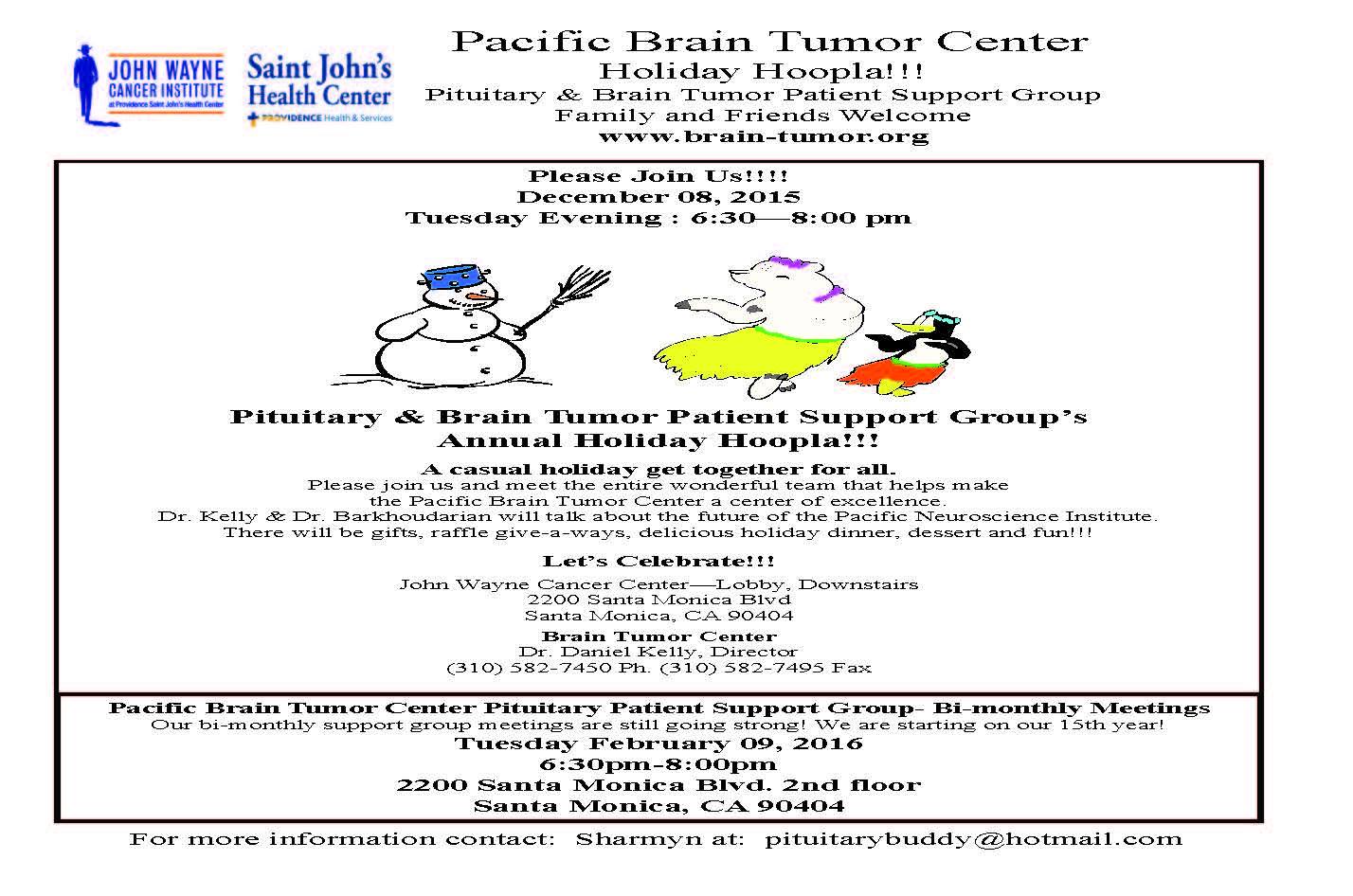
It’s time for the  Pituitary Patient Annual Holiday Party at the Pacific Brain Tumor Center.
John Wayne Cancer Institute Lobby, Santa Monica, CA.

December 08, 2015, 6:30-8:00pm

Family and Friends are Welcome!

View the flyer.

COR-003 Clinical Trial for Cushing’s Syndrome

CureClick_Trial_Card_CushingsBLU2


This trial is testing the safety and effectiveness of an investigational drug for the treatment of Cushing’s Syndrome. Under the supervision of qualified physicians, cortisol levels and symptoms of Cushing’s Syndrome will be closely followed along with any signs of side effects.

More about the study:

The study drug (COR-003) is administered by tablets.

  • There will be 90 participants in this trial
  • There is no placebo used in the trial

If you are interested, please find the full study details and eligibility criteria listed here.

Eligibility Criteria:

Participants must:

  • be at least 18 years old
  • have been diagnosed with endogenous Cushing’s Syndrome by a medical professional (not caused by the use of steroid medications)

Participants must not:

  • have been treated with radiation for Cushing’s Syndrome in the past 4 years
  • be currently using weight loss medication
  • have been diagnosed with uncontrolled hypertension, some forms of cancer, adrenal carcinoma, Hepatitis B / C, or HIV

Please complete the online questionnaire to check if you’re eligible for the trial.

If you’re not familiar with clinical trials, here are some FAQs:

What are clinical trials?

Clinical trials are research studies to determine whether investigational drugs or treatments are safe and effective for humans. All new investigational medications and devices must undergo several clinical trials, often involving thousands of people.

Why participate in a clinical trial?

You will have access to investigational treatments that would be available to the general public only upon approval. You will also receive study-related medical care and attention from clinical trial staff at research facilities. Clinical trials offer hope for many people and an opportunity to help researchers find better treatments for others in the future.

Learn why I’m posting about this Clinical Trial

Osilodrostat for Cushing’s

The study looked at a drug to treat Cushing’s disease. The article, in the journal Pituitary, is called Osilodrostat, a potent oral 11β-hydroxylase inhibitor: 22-week, prospective, Phase II study in Cushing’s disease.
Fleseriu M, Pivonello R, Young J, Hamrahian AH, Molitch ME, Shimizu C, Tanaka T, Shimatsu A, White T, Hilliard A, Tian C, Sauter N, Biller BM, Bertagna X.
Pituitary. 2015 Nov 5. [Epub ahead of print]

Abstract

PURPOSE:
In a 10-week proof-of-concept study (LINC 1), the potent oral 11β-hydroxylase inhibitor osilodrostat (LCI699) normalized urinary free cortisol (UFC) in 11/12 patients with Cushing’s disease. The current 22-week study (LINC 2; NCT01331239) further evaluated osilodrostat in patients with Cushing’s disease.

METHODS:
Phase II, open-label, prospective study of two patient cohorts. Follow-up cohort: 4/12 patients previously enrolled in LINC 1, offered re-enrollment if baseline mean UFC was above ULN. Expansion cohort: 15 newly enrolled patients with baseline UFC > 1.5 × ULN. In the follow-up cohort, patients initiated osilodrostat twice daily at the penultimate efficacious/tolerable dose in LINC 1; dose was adjusted as needed. In the expansion cohort, osilodrostat was initiated at 4 mg/day (10 mg/day if baseline UFC > 3 × ULN), with dose escalated every 2 weeks to 10, 20, 40, and 60 mg/day until UFC ≤ ULN. Main efficacy endpoint was the proportion of responders (UFC ≤ ULN or ≥50 % decrease from baseline) at weeks 10 and 22.

RESULTS:
Overall response rate was 89.5 % (n/N = 17/19) at 10 weeks and 78.9 % (n/N = 15/19) at 22 weeks; at week 22, all responding patients had UFC ≤ ULN. The most common AEs observed during osilodrostat treatment were nausea, diarrhea, asthenia, and adrenal insufficiency (n = 6 for each). New or worsening hirsutism (n = 2) and/or acne (n = 3) were reported among four female patients, all of whom had increased testosterone levels.

CONCLUSIONS:
Osilodrostat treatment reduced UFC in all patients; 78.9 % (n/N = 15/19) had normal UFC at week 22. Treatment with osilodrostat was generally well tolerated.

KEYWORDS:
11β-hydroxylase; Cortisol; Cushing’s; LCI699; Osilodrostat