Cushing’s Syndrome is Hazardous to Your Health

morbidity

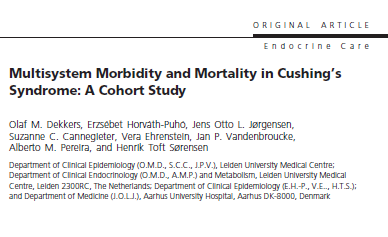
People with Cushing’s syndrome, even when treated, have higher morbidity and mortality rates that comparable controls. That is the conclusion of a new study published in the June issue of the Journal of Clinical Endocrinology Metabolism. The study by Olaf Dekkers et al, examined data records from the Danish National Registry of Patients and the Danish Civil Registration System of 343 patients with benign Cushing’s syndrome of adrenal or pituitary origin (i.e., Cushing’s disease) and a matched population comparison cohort (n=34,300).  Due to the lengthy delay of many patients being diagnosed with Cushing’s syndrome, morbidity was investigated in the 3 years before diagnosis while  morbidity and mortality were assessed during complete follow-up after diagnosis and treatment.

The study found that mortality was twice as high in Cushing’s syndrome patients (HR 2.3, 95% CI 1.8-2.9) compared with controls over a mean follow-up period of 12.1 years. Furthermore, patients with Cushing’s syndrome were at increased risk for:

  • venous thromboembolism (HR 2.6, 95% CI 1.5-4.7)
  • myocardial infarction (HR 3.7, 95% CI 2.4-5.5)
  • stroke (HR 2.0, 95% CI 1.3-3.2)
  • peptic ulcers (HR 2.0, 95% CI 1.1-3.6)
  • fractures (HR 1.4, 95% CI 1.0-1.9)
  • infections (HR 4.9, 95% CI 3.7-6.4).

The study also found that this increased multimorbidity risk was present before diagnosis indicating that it was due to cortisol overproduction rather than treatment.

Many of the Cushing’s syndrome patients underwent surgery to remove the benign tumor. For this group, the investigators performed a sensitivity analysis of the  long-term mortality and cardiovascular risk in this  subgroup (n=186)  considered to be cured after operation (adrenal surgery and patients with pituitary surgery in combination with a diagnosis of hypopituitarism in the first 6 months after operation).  The risk estimates for mortality (HR 2.31, 95% CI 1.62-3.28), venous thromboembolism (HR 2.03, 95% CI 0.75-5.48), stroke (HR 1.91, 95% CI 0.90-4.05), and acute myocardial infarction (HR 4.38, 95% CI 2.31-8.28) were also increased in this subgroup one year after the operation.

The standard treatment for endogenous Cushing’s syndrome is surgery. This past year, Signifor (pasireotide) was approved for treatment of adults patients with Cushing’s disease for whom pituitary surgery is not an option or has not been curative.  Cushing’s disease, which accounts for the majority of Cushing’s syndrome patients, is defined as the presence of an ACTH producing tumor on the pituitary grand. In the study by Dekker’s et al, the percentage of patients with Cushing’s disease is not known. We look forward to reexamination of this dataset in a few years following the introduction of more treatment options for Cushing’s disease as well as an analysis that explores the differences in mortality/morbidity rates in the different subsets of patients that make of Cushing’s syndrome (Cushing’s disease, ectopic Cushing’s syndrome, Exogenous Cyshing’s syndrome).

References

Dekkers OM, Horvath-Pujo, Jorgensen JOL, et al, Multisystem morbidity and mortality in Cushing’s syndrome: a cohort study. J Clin Endocrinol Metab 2013 98(6): 2277–2284. doi: 10.1210/jc.2012-3582

– See more at: http://www.raredr.com/medicine/articles/cushing%E2%80%99s-syndrome-hazardous-your-health-0

Aggressive pituitary tumors

In this lecture from Clínica Medellín an overview of aggressive pituitary tumores is presented.

Cushing Disease: A Multidisciplinary Treatment Update

Share this info with your endo in case he/she missed it!

This activity is intended for endocrinologists, primary care physicians, nurses, nurse practitioners, and pharmacists.

The goal of this activity is to review the diagnosis and treatment of Cushing disease from a multidisciplinary perspective.

Upon completion of this activity, participants will be able to:

  1. Outline the rationale for a multidisciplinary approach to the diagnosis and treatment of patients with Cushing disease
  2. Review the safety and efficacy of current management strategies for patients with Cushing disease
  3. Describe the diagnostic workup for Cushing disease and the reasons why timely diagnosis and treatment are important

Faculty and Disclosures

As an organization accredited by the ACCME, Medscape, LLC, requires everyone who is in a position to control the content of an education activity to disclose all relevant financial relationships with any commercial interest. The ACCME defines “relevant financial relationships” as financial relationships in any amount, occurring within the past 12 months, including financial relationships of a spouse or life partner, that could create a conflict of interest.

Medscape, LLC, encourages Authors to identify investigational products or off-label uses of products regulated by the US Food and Drug Administration, at first mention and where appropriate in the content.

Laurence Katznelson, MD

Professor of Medicine and Neurosurgery, Stanford University; Medical Director, Pituitary Center, Stanford Hospital and Clinics, Stanford, California

Disclosure: Laurence Katznelson, MD, has disclosed the following relevant financial relationships:
Received grants for clinical research from: Corcept Therapeutics Inc.; Novartis Pharmaceuticals Corporation

Dr Katznelson does not intend to discuss off-label uses of drugs, mechanical devices, biologics, or diagnostics approved by the FDA for use in the United States.

Dr Katznelson does not intend to discuss investigational drugs, mechanical devices, biologics, or diagnostics not approved by the FDA for use in the United States.

Brooke Swearingen, MD

Associate Professor of Neurosurgery, Harvard Medical School; Associate Visiting Neurosurgeon, Massachusetts General Hospital, Boston, Massachusetts

Disclosure: Brooke Swearingen, MD, has disclosed the following relevant financial relationships: Served as an advisor or consultant for: Novartis Pharmaceuticals Corporation
Owns stock, stock options or bonds from: Novartis Pharmaceuticals Corporation; Pfizer Inc; Amgen Inc; Roche

Dr Swearingen does not intend to discuss off-label uses of drugs, mechanical devices, biologics, or diagnostics approved by the FDA for use in the United States.

Dr Swearingen does not intend to discuss investigational drugs, mechanical devices, biologics, or diagnostics not approved by the FDA for use in the United States.

Nicholas Tritos, MD

Assistant Professor of Medicine, Harvard Medical School; Staff, Neuroendocrine Unit, Massachusetts General Hospital, Boston, Massachusetts

Disclosure: Nicholas Tritos, MD, has disclosed the following relevant financial relationships:
Served as an advisor or consultant for: Corcept Therapeutics Inc; Pfizer Inc
Received grants for clinical research from: Pfizer Inc; Ipsen

Dr Tritos does intend to discuss off-label uses of drugs, mechanical devices, biologics, or diagnostics approved by the FDA for use in the United States.

Dr Tritos does not intend to discuss investigational drugs, mechanical devices, biologics, or diagnostics not approved by the FDA for use in the United States.

Susan Cornell, PharmD, CDE

Associate Professor, Pharmacy Practice, Midwestern University-Chicago, Downers Grove, Illinois; Clinical Pharmacist/Certified Diabetes Educator, DuPage Community Clinic, Wheaton, Illinois

Disclosure: Susan Cornell, PharmD, CDE, has disclosed the following relevant relationships:
Served as a speaker or member of a speakers bureau for: Johnson & Johnson Diabetes Institute

Dr Cornell does intend to discuss off-label uses of drugs, mechanical devices, biologics, or diagnostics approved by the FDA for use in the United States.

Dr Cornell does not intend to discuss investigational drugs, mechanical devices, biologics, or diagnostics not approved by the FDA for use in the United States.

Rita Pach, RN, MSN

Nurse, Johns Hopkins Pituitary Center, Baltimore, Maryland

Participation by Mrs Pach in the development of this product does not constitute or imply endorsement by the Johns Hopkins University or the Johns Hopkins Hospital and Health System.
Disclosure: Rita Pach, RN, has disclosed no relevant financial relationships.

Mrs Pach does not intend to discuss off-label uses of drugs, mechanical devices, biologics, or diagnostics approved by the FDA for use in the United States.

Mrs Pach does not intend to discuss investigational drugs, mechanical devices, biologics, or diagnostics not approved by the FDA for use in the United States.

Kristin M. Richardson

Group Scientific Director, Medscape, LLC

Disclosure: Kristin M. Richardson has disclosed no relevant financial relationships.

David Modrak, PhD

Freelance editor, Montville, New Jersey

Disclosure: David Modrak, PhD, has disclosed no relevant financial relationships.

Nafeez Zawahir, MD

CME Clinical Director, Medscape, LLC

Disclosure: Nafeez Zawahir, MD, has disclosed no relevant financial relationships.

Laurie E. Scudder, DNP, NP

Nurse Planner, Continuing Professional Education Department, Medscape, LLC; Clinical Assistant Professor, School of Nursing and Allied Health, George Washington University, Washington, DC

Disclosure: Laurie E. Scudder, DNP, NP, has disclosed no relevant financial relationships.

Instructions for Participation and Credit

There are no fees for participating in or receiving credit for this online educational activity. For information on applicability and acceptance of continuing education credit for this activity, please consult your professional licensing board.

This activity is designed to be completed within the time designated on the title page; physicians should claim only those credits that reflect the time actually spent in the activity. To successfully earn credit, participants must complete the activity online during the valid credit period that is noted on the title page. To receive AMA PRA Category 1 Credit™, you must receive a minimum score of 70% on the post-test.

Follow these steps to earn CME/CE credit*:

  1. Read the target audience, learning objectives, and author disclosures.
  2. Study the educational content online or printed out.
  3. Online, choose the best answer to each test question. To receive a certificate, you must receive a passing score as designated at the top of the test. We encourage you to complete the Activity Evaluation to provide feedback for future programming.

You may now view or print the certificate from your CME/CE Tracker. You may print the certificate but you cannot alter it. Credits will be tallied in your CME/CE Tracker and archived for 6 years; at any point within this time period you can print out the tally as well as the certificates from the CME/CE Tracker.

*The credit that you receive is based on your user profile.

Continue to activity: http://www.medscape.org/viewarticle/806559

Pregnancy and pituitary disorders

Pituitary and pineal glands

Pituitary and pineal glands (Photo credit: Wikipedia)

Z Karaca, F Tanriverdi, K Unluhizarci and F Kelestimur
+ Author Affiliations

Department of Endocrinology,
Erciyes University Medical School, 38039 Kayseri, Turkey
(Correspondence should be addressed to F Kelestimur; Email: fktimur@erciyes.edu.tr)

Abstract

Major hormonal changes emerge during pregnancy. The pituitary gland is one of the most affected organs with altered anatomy and physiology. The pituitary gland is enlarged as a result of lactotroph hyperplasia. Due to physiological changes in the pituitary and target hormone levels, binding globulins, and placental hormones, hormonal evaluation becomes more complex in pregnant women. As a consequence of physiological hormonal changes, the evaluation of pituitary functions in pregnant women is quite different from that done in the prepregnant state. Pituitary adenomas may cause problems by their hormone secretion that affects the mother and the fetus besides causing an increased risk of tumor growth.

Furthermore, diagnosis, course, and treatment of pituitary diseases point out differences. The changes in anatomy and physiology of the pituitary gland during pregnancy are reviewed.

Pituitary disorders namely Cushing’s disease; acromegaly; prolactinoma; TSH-secreting, gonadotropin-producing, and clinically nonfunctioning adenomas; craniopharyngioma; and Sheehan’s syndrome, which is one of the most common causes of hypopituitarism, lymphocytic hypophysitis, and hypopituitarism, in relation to pregnancy are discussed. Being aware of all this information will prevent any serious problems which mother and child will be exposed to.

Read the entire article here: http://www.eje-online.org/content/162/3/453.full

From Bangladesh ~ Pituitary Adenoma: When headache is a headache

Location of the pituitary gland in the human brain

Location of the pituitary gland in the human brain (Photo credit: Wikipedia)

“Got headache? Take a paracetamol and get relieved in a short while.”

This is common practice in our country. Almost everyone has had a headache, but rarely headache becomes a headache in our lives. Not all headaches require doctor’s attention but sometimes it represent the tip of a huge iceberg.

Mr Shafiul Islam, 38 years of age, an active male developed a gradual onset of headache, which worsened at the morning, followed by vomiting. He visited a general practitioner and took prescribed medicines, but that failed to cure the symptoms. Rather he was gradually experiencing loss of outer side vision of both eyes.

When he revisited a doctor and was advised for MRI of brain he was diagnosed with a core of “Pituitary Macrodenoma,” a tumor of a hormone producing gland of brain. Then Shafiul was referred to Neurosurgeon of Comfort Nursing home Assistant Professor Dr Moshiur Rahman, who decided to perform operation for removal of the tumor after the initial evaluation.

The pituitary gland is an endocrine gland about the size of a pea and weighing 5 grams (0.18 oz) in humans. It is a protrusion off the bottom of the hypothalamus at the base of the brain, and rests in a small, bony cavity (sella turcica). The pituitary gland secretes nine hormones. A pituitary adenoma is a slow growing and less harmful tumor arising from cells in the pituitary gland. Because they originate from cells in the pituitary gland, which is the master hormone gland, they often cause problems related to hormonal dysfunction.

Some pituitary tumors result in excessive production and over-secretion of hormones, which can result in a variety of syndromes. A large proportion of these tumors, however, do not produce any functional hormones, but instead grow to a size where they cause symptoms because they compress surrounding structures. For these reasons, larger pituitary tumors (called macroadenomas) often present with headache, visual loss and pituitary gland dysfunction.

The specific cause of pituitary adenoma development is unknown, although they are likely to be caused in part by random mutations in cells of the pituitary gland. Surgery is the first line of treatment for many symptomatic pituitary tumors in patients that are good surgical candidates, especially in patients with nonfunctioning macroadenomas.

Dr Moshiur approached the tumor by entering through nasal opening with the help of ENT specialist Associate Professor Dr Sajol Ashfaq, under general aenesthesia (fully unconscious) done by Aenesthesiologist Associate Professor Dr Shamsul Alam. After elevation of a thin membrane over the nasal partition and breaking a bone in the base of the skull they got a vision of the tumor through endoscope. After that, the tumor was removed through the nose. After three days of post-operative care, the patient was discharged. All his symptoms, headache, vomiting and poor vision improved dramatically and he got back to his normal life.

Dr Moshiur Rahman said: “The surgical approach for removing pituitary tumours is usually an endonasal (through the nostril) transsphenoidal (through the sphenoid sinus) approach. This procedure is Endoscopic Transnasal Transphenoidal Pituitary Adenomectomy, which is a safe, minimally invasive but effective, modern treatment option for Pituitary Adenoma, with few side effects and short post-operative hospital stay. This latest technology is being practiced in some centres of the capital for last few years.”

He also said, he performed three operations before successfully with no long term adverse effect. He also paid gratefulness to Associate Professor Dr Sajol Ashfaq and Associate Professor Dr Shamsul Alam for their sincere and great effort.

Once, people had to go outside of the country for this operation. Nowadays, this operation is often performed by many neurosurgeons of the capital. A few centres have also developed to provide these facilities of operation. People can take this oppurtunity confidently by choosing a competent surgical team.