Interview May 13 with Michelle B (MichelleB), Cyclic Cushing’s Patient

Hello all, I’m Michelle mother of 3 beautiful children, I work part-time, 33yrs young, non-smoker, non-drinker, overall health is good for the most part…..Where do I even begin.

I just recently received the diagnosis of cyclic Cushing’s. I’m not really sure how long I have actually had Cushing’s because I have had a diagnosis of PCOS since I was 17 yrs. old ( I’m now the ripe young age of 33). However looking back through labs with my endocrinologist who I see every 6 months, my ACTH levels have been elevated for a bit over 1 yr. It was not until recently January of 2015- things were going terribly wrong.

Starting in January I started to feel genuinely unwell, on a regular basis. I cant really explain all my symptoms there were so many different sensations and feelings that were seemingly different daily. However the red flag was I was having blood pressure spikes from really high, to very low back to back. I never had any blood pressure issues so this was a concern that led me to see a cardiologist. Upon tons of testing the cardio MD felt that something was telling my otherwise very healthy heart to do this and I should see a endocrinologist. (thank goodness for him) I contacted my endo and let him know…. the testing began.

I did every test: the midnightcortisol saliva test, dex suppression, 24 hr urine test, CRH stimulation testing. And I did them more than once. Each time it was a different response either, inconclusive, normal high, or high. I was then referred to the head of the Cleveland clinics pituitary department Dr. Kennedy. He said he is having a hard time believing when he looks at me that its Cushing’s. However all my labs say it is. I will say I do fit the mold of PCOS to a tee- which symptoms of that do coincide with Cushing’s but he still said we have to be sure its Cushing’s. To add to the mix I did have a normal MRI as well.

Dr. Kennedy started me on a 2 week midnight cortisol saliva test- Upon completion we noted levels of cortisol all over the place, some Normal, normal on high range, high, and really high. He confirmed with all the other tests this is Cushing’s. Now we are trying to figure out what is next…. and where is this damn little tumor at. he feels that it is most likely in the pituitary from my test results, but we still are not ruling out else where. He is thinking that the next step would be exploratory neurosurgery or the IPSS. I’m not sure what to think of all this, except I want to hope for the best like everyone- and just be cured!!

On a side note during all of this I also had episodes of severe pain in my chest and nausea. I went to see a GI who did an upper endo scope. They found I had eosinpphilic esophagitis. I also have never had any GI problems until now; and they came on suddenly. Im also having pain in my pancreas area- not sure if any of the two are related at all to Cushing’s. But once again I was fine until recently with all these issues at once it seems.

wish me luck on further testing, treatment, and ultimately a CURE!!

interview

Michelle was our guest in an interview on BlogTalk Radio  Wednesday, May 13, 2015.

The archived interview is available now through iTunes Podcasts (Cushie Chats) or BlogTalkRadio. There are currently 83 other past interviews for your listening pleasure!

HOME | Sitemap | Adrenal Crisis! | Abbreviations | Glossary | Forums | Donate | Bios | Add Your Bio

Day Ten, Cushing’s Awareness Challenge 2015

In March of 1987, after the endo finally  confirmed that I had Cushing’s, I was sent to a local hospital where they repeated all those same tests for another week and decided that it was not my adrenal gland (Cushing’s Syndrome) creating the problem. The doctors and nurses had no idea what to do with me, so they put me on the brain cancer ward.

When I left this hospital after a week, we didn’t know any more than we had before.

As luck would have it, NIH (National Institutes of Health, Bethesda, Maryland) was doing a clinical trial of Cushing’s. I live in the same area as NIH so it was not too inconvenient but very scary at first to think of being tested there. At that time I only had a choice of NIH, Mayo Clinic and a place in Quebec to do this then-rare pituitary surgery called a Transsphenoidal Resection.

My husband asked my endo if it were his wife, if he would recommend this surgery.  The endo responded that he was divorcing his wife – he didn’t care what happened to her.  Oh, my!

I chose NIH – closest and free. After I was interviewed by the doctors there, I got a letter that I had been accepted into the clinical trial.

The night before I was admitted, I signed my will.  I was sure I was going to die there.  If not during testing, as a result of surgery.

The first time I was there was for 6 weeks as an inpatient. More of the same tests.

There were about 12 of us there and it was nice not to be alone with this mystery disease. Many of these Cushies (mostly women) were getting bald, couldn’t walk, having strokes, had diabetes. One was blind, one had a heart attack while I was there. Several were from Greece.

My first roommate was a nurse.  She spent the entire first night screaming in pain.  I was very glad when they moved me to a new room!

Towards the end of my testing period, I was looking forward to the surgery just to get this whole mess over with – either a cure or dying. While I was at NIH, I was gaining about a pound a day!

During the time I was home the weekend  before surgery, a college classmate of mine (I didn’t know her) DID die at NIH of a Cushing’s-related problem. I’m so glad I didn’t find out until reading the alumnae magazine a couple months later!  She was the same class, same major, same home-town, same disease…

We have a Scottish doctor named James Lind to thank for the clinical trial.  He  conducted the first ever clinical trial in 1747 and developed the theory that citrus fruits cured scurvy.  Lind  compared the effects of various different acidic substances, ranging from vinegar to cider, on groups of afflicted sailors, and found that the group who were given oranges and lemons had largely recovered from scurvy after 6 days.

I’d like to think that I advanced the knowledge of Cushing’s at least a little bit by being a guinea  pig in 1987-1989.

From the NIH: http://endocrine.niddk.nih.gov/pubs/cushings/cushings.aspx

Hope through Research

Several components of the National Institutes of Health (NIH) conduct and support research on Cushing’s syndrome and other disorders of the endocrine system, including the National Institute of Diabetes and Digestive and Kidney Diseases, the National Institute of Child Health and Human Development (NICHD), the National Institute of Neurological Disorders and Stroke, the National Cancer Institute, and the National Center for Research Resources.

NIH-supported scientists are conducting intensive research into the normal and abnormal function of the major endocrine glands and the many hormones of the endocrine system. Researchers continue to study the effects of excess cortisol, including its effect on brain structure and function. To refine the diagnostic process, studies are under way to assess the accuracy of existing screening tests and the effectiveness of new imaging techniques to evaluate patients with ectopic ACTH syndrome. Researchers are also investigating jugular vein sampling as a less invasive alternative to petrosal sinus sampling. Research into treatment options includes study of a new drug to treat the symptoms of Cushing’s syndrome caused by ectopic ACTH secretion.

Studies are under way to understand the causes of benign endocrine tumor formation, such as those that cause most cases of Cushing’s syndrome. In a few pituitary adenomas, specific gene defects have been identified and may provide important clues to understanding tumor formation. Endocrine factors may also play a role. Increasing evidence suggests that tumor formation is a multistep process. Understanding the basis of Cushing’s syndrome will yield new approaches to therapy.

The NIH supports research related to Cushing’s syndrome at medical centers throughout the United States. Scientists are also treating patients with Cushing’s syndrome at the NIH Clinical Center in Bethesda, MD. Physicians who are interested in referring an adult patient may contact Lynnette Nieman, M.D., at NICHD, 10 Center Drive, Room 1-3140, Bethesda, MD 20892-1109, or by phone at 301-496-8935. Physicians interested in referring a child or adolescent may contact Constantine Stratakis, M.D., D.Sc., at NICHD, 10 Center Drive, Room 1-3330, Bethesda, MD 20892-1103, or by phone at 301-402-1998.

What Causes Cushing’s Disease?

0276f-pituitary-gland


A condition in which the body produces too much cortisol, Cushing’s disease occurs when a tumor on the pituitary gland makes the gland create too much ACTH, the hormone that stimulates the production and release of cortisol (also known as “the stress hormone”). It may also occur with excess growth of the pituitary gland, known as hyperplasia. For most patients, Cushing’s disease will show itself through symptoms like red lines on the abdomen, abdominal weight gain and roundness to the face. And while the condition only affects 10 to 15 people per million per year, patients who suffer with it understandably wonder why. What are the causes? Where would a pituitary gland tumor come from? What leads to excess growth of that gland? To help answer these questions, here’s a look at Cushing’s disease causes:

Causes of Cushing’s Disease

The most common cause for Cushing’s disease is adenoma, a usually benign tumor on the pituitary gland. Because the tumors are normally pretty small, they can be hard to diagnose. For this reason, many patients who have Cushing’s disease don’t find out right away. Meeting with an endocrinologist can help the diagnosis process, improving your chances for a fast, successful recognition of the disease.

Risk Factors for Cushing’s Disease

Even though it’s a rare condition, Cushing’s disease occurs more commonly in women, particularly those between the ages of 20 and 50. Other factors that may increase the risk of Cushing’s disease include obesity, type 2 diabetes, poorly controlled blood sugar levels and high blood pressure. While none of these factors are a direct cause of the condition, they are associated with higher prevalence of it.

Cushing’s Disease vs. Cushing’s Syndrome

Often mistaken for one another, Cushing’s disease and Cushing’s syndrome are actually not the same condition. What they have in common is that they both involve the body’s producing too much cortisol. Cushing’s disease is a medical condition, however, while Cushing’s syndrome is a symptom of it. Cushing’s syndrome will often occur when a patient is taking corticosteroid medication.

Why You Should See an Endocrinologist

If you believe you or someone you love may have Cushing’s disease, it is best to see a specialist. Symptoms develop slowly and sometimes in cycles, so without proper testing it can be hard to identify what’s happening. A skilled endocrinologist can conduct hormone blood tests to measure blood cortisol levels at different times. He or she can also schedule an MRI for an individual who is not taking cortisol medications, in order to isolate the location of any tumors.

Have you been dealing with the symptoms of elevated cortisol levels, such as unexplained weight gain, particularly in the abdominal area and/or back of the neck? Is your skin or vision changing? These symptoms could be indicating a deeper problem in your body — so schedule an appointment to have your condition evaluated by a professional as soon as you can. Through proper treatment, you may be able to reduce or even eliminate your symptoms and be restored to full health again.

From http://www.hormone.org/diseases-and-conditions/pituitary/secretory-tumors/cushings-disease/cushings-disease-causes

Does a normal urine free cortisol result rule out Cushing’s syndrome?

ENDO_2015


March 07, 2015

SAT 379-412-Cushing’s Syndrome

Does a normal urine free cortisol result rule out Cushing’s syndrome?

ST Sharma, LK Nieman

Summary: Researchers conducted this study to assess the diagnostic accuarcy of urine free cortisol (UFC) and 24-hour urine 17-hydroxycorticosteroids (170HCS) in patients with Cushing’s syndrome, concluding that in patients with mild CS, UFC can be falsely normal or only minimally elevated. Further, they found that to help in making a diagnosis and prevent treatment delays, clinicians may consider incorporating multiple collections and use of complimentary screening tests including 24-hour urine 17OHCS and late night salivary cortisol (LNSC) testing.

Methods:

  • For this retrospective study, researchers included all CS patients evaluated at the National Institutes of Health (NIH) from 2009 to 2014.
  • The screening tests used for CS included UFC, 17OHCS, midnight serum cortisol and low dose (1 mg overnight or 2-day 2 mg/day) dexamethasone suppression test (DST).
  • They defined abnormal as values above reference range for UFC, 17OHCS and LNSC, a midnight serum cortisol ≥7.5 mcg/dL, and post-dexamethasone cortisol values ≥1.8 mcg/dL.
  • Hourly 24-hour sampling for cortisol was performed in a few cases with a mild clinical phenotype and equivocal test results.
  • Researchers measured UFC using liquid chromatography/tandem mass spectrometry (LC-MS/MS), and 17OHCS was measured using colorimetric methodology with Porter-Silber reaction (reported as mg/g of creatinine).
  • For this study, they used the mean of the first two UFC and 17OHCS values (appropriate collection by urine volume and creatinine) obtained within 30 days of initial NIH presentation.

Results:

  • In all, 72 patients were diagnosed with CS (aged 18-77 years, 51 females), 51 of whom had CD, 10 had ectopic CS, and 2 had an adrenal source of Cushing’s based on pathology.
  • Biochemical tests such as inferior petrosal sinus sampling (IPSS) suggested ectopic CS, but no tumor was found (occult) in 6 patients.
  • In 2 patients with failed transsphenoidal surgery, IPSS was indicative of a pituitary source, and one patient did not complete evaluation for ACTH-dependent CS.
  • UFC results were available in all patients, 17OHCS in 70, LNSC in 21, midnight serum cortisol in 68, and DST results in 37 patients.
  • UFC was falsely normal in 6 patients and only minimally elevated (<2 x ULN) in 13 patients (normal renal function, no history of cyclicity, all had CD); of these 19 patients, 24-hour 17OHCS was abnormal in all, LNSC was abnormal in 12, midnight serum cortisol was abnormal in 18, and DST was abnormal in 12 patients.
  • Hourly 24-hour sampling for cortisol performed in 3 of these patients revealed abnormal nadir (>7.5 mcg/dL) and mean daily serum cortisol (>9 mcg/dL) levels.

From http://www.mdlinx.com/endocrinology/conference-abstract.cfm/ZZ5BA369FDE9DE4CED82CB6A7CD5BFD1BE/42581/?utm_source=confcoveragenl&utm_medium=newsletter&utm_content=abstract-list&utm_campaign=abstract-ENDO2015&nonus=0

Scientists Find Potential Therapeutic Target for Cushing’s Disease

Scientists at the Salk Institute for Biological Studies have identified a protein that drives the formation of pituitary tumors in Cushing’s disease, a development that may give clinicians a therapeutic target to treat this potentially life-threatening disorder.

The protein, called TR4 (testicular orphan nuclear receptor 4), is one of the human body’s 48 nuclear receptors, a class of proteins found in cells that are responsible for sensing hormones and, in response, regulating the expression of specific genes. Using a genome scan, the Salk team discovered that TR4 regulates a gene that produces adrenocorticotropic hormone (ACTH), which is overproduced by pituitary tumors in Cushing’s disease (CD). The findings were published in the May 6, 2013 early online edition of Proceedings of the National Academy of Sciences.

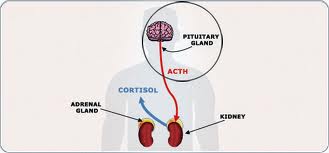
The diagram shows how adrenocorticotropin hormone is secreted in Cushing's disease.

“We were surprised by the scan, as TR4 and ACTH were not known to be functionally linked,” says senior author Ronald M. Evans, a professor in Salk’s Gene Expression Laboratory and a lead researcher in the Institute’s Helmsley Center for Genomic Medicine. “TR4 is driving the growth and overexpression of ACTH. Targeting this pathway could therapeutically benefit treatment of CD.”

In their study, Evans and his colleagues discovered that forced overexpression of TR4 in both human and mouse cells increased production of ACTH, cellular proliferation and tumor invasion rates. All of these events were reversed when TR4 expression was reduced.

First described more than 80 years ago, Cushing’s disease is a rare disorder that is caused by pituitary tumors or excess growth of the pituitary gland located at the base of the brain. People with CD have too much ACTH, which stimulates the production and release of cortisol, a hormone that is normally produced during stressful situations.

While these pituitary tumors are almost always benign, they result in excess ACTH and cortisol secretion, which can result in various disabling symptoms, including diabetes, hypertension, osteoporosis, obesity and psychological disturbances. Surgical removal of the tumors is the first-line therapy, with remission rates of approximately 80 percent; however, the disease recurs in up to 25 percent of cases.

Drugs such as cabergoline, which is used to treat certain pituitary tumors, alone or in combination with ketoconazole, a drug normally used to treat fungal infections, have been shown to be effective in some patients with Cushing’s disease. More recently, mefipristone-best known as the abortion pill RU-486-was approved by the FDA to treat CD. Despite these advances in medical therapy, the Salk scientists say additional therapeutic approaches are needed for CD.

“Pituitary tumors are extremely difficult to control,” says Michael Downes, a senior staff scientist in the Gene Expression Laboratory and a co-author of the study. “To control them, you have to kill cells in the pituitary gland that are proliferating, which could prevent the production of a vital hormone.”

Previous studies have found that, by itself, TR4 is a natural target for other signaling molecules in the pituitary. Small-molecule inhibitors that have been developed for other cancers could be potentially applied to disrupt this signaling cascade. “Our discovery,” says Evans, a Howard Hughes Medical Institute investigator and holder of the March of Dimes Chair in Molecular and Developmental Biology, “might lead clinicians to an existing drug that could be used to treat Cushing’s disease.

Notes about this neurogenetics and Cushing’s disease research

Other researchers on the study were Li Du, Marvin Bergsneider, Leili Mirsadraei, Stephen H. Young, William H. Yong and Anthony P. Heaney of the David A. Geffen School of Medicine at the University of California, Los Angeles, and Johan W. Jonker of the University of Groningen.

The study was supported by the National Institutes of Health, the Leona M. and Harry B. Helmsley Charitable Trust, the Samuel Waxman Cancer Research Foundation, the Jonsson Comprehensive Cancer Center at UCLA, and Ipsen/Biomeasure.

Contact: Andy Hoang – Salk Institute
Source: Salk Institute press release
Image Source: The ACTH Cushing’s disease diagram is credited to NIDDK/NIH and is available in the public domain.
Original Research: Abstract for “Evidence for orphan nuclear receptor TR4 in the etiology of Cushing disease” by Li Du, Marvin Bergsneider, Leili Mirsadraei, Steven H. Young, Johan W. Jonker, Michael Downes, William H. Yong, Ronald M. Evans, and Anthony P. Heaney in Proceedings of the National Academy of Sciences. Published May 6 2013 doi: 10.1073/pnas.1306182110

From http://neurosciencenews.com/tr4-cushings-disease-acth-neurogenetics-120/