Cushing’s disease best treated by endocrinologist

Dear Dr. Roach: I was told that I have Cushing’s disease, which has caused diabetes, high blood pressure, hunger, weight gain and muscle loss. I was never sick before this, and I did not have any of those things. I am told I have a tumor on my right adrenal gland. I have been to numerous doctors, but most have not been too helpful. They seem to try to treat the diabetes or blood pressure, but nothing else. They seem not to be familiar with Cushing’s. I tell them which medication works, but they still give me new medication. I have an endocrinologist and am scheduled to meet a urologist.

I have managed to go to physical therapy, exercise every day and lose over 50 pounds. I am not happy with the advice I’m getting. I was told that surgery to remove the tumor will fix everything, but that I would need to take steroids for either a short term or for life. My body is already making too much cortisol. I have 50 more pounds to lose. I work hard to keep the weight down. I feel like a science experiment. Within a week, I have had three different medications. I could not tell which was causing the side effects and making me dehydrated. I am not sure surgery is right for me, because they said it can be done laparoscopically, but if they can’t do it that way, they will have to cut me all the way across, which may take a long time to heal and may get infected.

Do you know what tests will confirm the diagnosis? Would surgery fix all these problems? I had the 24-hour urine test, the saliva test and blood tests. I want to know if it may be something else instead of Cushing’s. I’m not on anything for the high cortisol levels.

– A.L.

A: It sounds very much like you have Cushing’s syndrome, which is caused by excess cortisone, a hormone that has many effects. It is called Cushing’s disease when the underlying cause is a pituitary tumor that causes the adrenal gland to make excess cortisone. (Cortisone and cortisol are different names for the same chemical, also called a glucocorticoid.) Cushing’s syndrome also may be caused by an adenoma (benign tumor) of the adrenal gland, which sounds like the case in you.

The high amounts of cortisone produced by the adrenal tumor cause high blood pressure, glucose intolerance or frank diabetes, increased hunger, obesity (especially of the abdomen – large bellies and skinny limbs are classic), dark-colored striae (stretch marks), easy bruising, a reddish face and often weakness of arm and leg muscles. When full-blown, the syndrome is easy to spot, but many people don’t have all the characteristics, especially early in the course of the disease.

Your endocrinologist is the expert in diagnosis and management, and has done most of the tests. I am somewhat surprised that you haven’t yet seen a surgeon to have the tumor removed. Once it is removed, the body quickly starts to return to normal, although losing the weight can be a problem for many.

I have seen cases in my training where, despite many tests, the diagnosis was still uncertain. The endocrinologist orders a test where the blood is sampled from both adrenal veins (which contain the blood that leaves the adrenal glands on top of the kidneys). If the adrenal vein on the side of the tumor has much more cortisone than the opposite side, the diagnosis is certain.

By DR. KEITH ROACH For the Herald & Review at http://herald-review.com/news/opinion/editorial/columnists/roach/dr-roach-cushing-s-disease-best-treated-by-endocrinologist/article_38e71835-464d-5946-aa9c-4cb1366bcee3.html

Resolution of the physical features of Cushing’s syndrome in a patient with a cortisol secreting adrenocortical adenoma after unilateral adrenalectomy

A 37-year-old woman developed clinical manifestations of Cushing’s syndrome over a span of 2 years. Physical examination revealed features that best describe Cushing’s syndrome, such as wide purple striae (>1 cm) over the abdomen, facial plethora and easy bruisability.1  Other features observed were hypertension, moon facies, acne, a dorsocervical fat pad, central obesity and dyslipidaemia.

The diagnosis of hypercortisolism was confirmed using a 1 mg overnight dexamethasone suppression test (19.7 ng/dL, N: <1.8) and 24 h urine free cortisol (185.9 μg/24 h, N: 3.5–45). A suppressed adrenocorticotropic hormone (ACTH) level (4 pg/mL, N: 5–20) and a lack of hyperpigmentation suggested ACTH-independent Cushing’s syndrome. Further work up using CT with contrast of the adrenals showed a 2.4×2.3×2.4 cm right adrenal mass. The patient then underwent laparoscopic adrenalectomy of the right adrenal gland. Steroids was started postoperatively and tapered over time. Histopathology results were consistent with an adrenocortical adenoma (2.5 cm widest dimension). Six months after surgery, there was resolution of the physical features, weight loss and improvement in blood pressure.

Figure 1 is a serial photograph of the physical features seen in Cushing’s syndrome, such as moon facies, a dorsocervical fat pad and wide purple striae, taken preoperatively, and at 3 and 6 months after surgery. With treatment, physical and biochemical changes of Cushing’s syndrome both resolve through time.2 The time course of the resolution of these changes, however, is varied.2 ,3 We observed that the physical features were ameliorated at 3 months and resolved at 6 months.

Learning points

  • Physicians as well as patients should be aware that improvement of the features of Cushing’s syndrome after treatment does not occur immediately.

  • Dramatic resolution of the physical features of Cushing’s syndrome, however, can be observed as early as 6 months after surgery.

Figure 1

Physical features of Cushing’s syndrome (top to bottom: moon facies, a dorsocervical fat pad and wide purple striae (>1 cm) over the abdomen) documented before surgery, and at 3 and 6 months after surgery.

Footnotes

  • Twitter Follow John Paul Quisumbing at @jpquisumbingmd

  • Contributors JPMQ worked up the case and wrote the case report. MASS reviewed the case report and critically appraised it. JPMQ incorporated his suggestions.

  • Competing interests None declared.

  • Patient consent Obtained.

  • Provenance and peer review Not commissioned; externally peer reviewed.

References

From http://casereports.bmj.com/content/2016/bcr-2016-215693.short?rss=1

Hospital Staff Didn’t Give Emergency Cortisol to Teenager with Complex Special Needs

solu-cortef


A TEENAGER with complex special needs who died in hospital suffered a failure in basic medical communication, an inquest heard today.

Robin Brett, 18, of Blackmore Close, died in June 2014 in the Great Western Hospital after being admitted with chronic constipation and vomiting.

After a blood test indicated a raised white blood cell count, Robin went into cardiac arrest and died.

He had congenital adrenal hyperplasia (CAH) a metabolic disease and genetic defect of the adrenal gland and learning difficulties. He required daily care and medications.

Robin’s parents listed a string of errors they believe contributed to his death including failure to give him his regular medications, infrequent observations and the lack of regular and vital cortisol injections.

His heartbroken mother, Teresa, told the inquest in Salisbury that she had told hospital staff to give Robin an emergency dose of cortisol, which was not topped up after the recommended four hours.

She said: “I asked them to give him cortisol after I noticed he was becoming clammy and had a headache which is a sign of adrenal distress, I was just about to with the syringe in my hand when it was done and he instantly perked up.

 “But this wasn’t done again after four hours and I don’t know why.”

GWH staff nurse Hannah Porte who cared for Robin on his admission said she had concerns about his “alarmingly” high pulse rate when she did observations.

“I spoke with a doctor who assured me that because he had a pre-existing condition it wasn’t of great concern. That is our protocol and I felt comforted and reassured when they said that,” she said.

Robin was described as “rocking backwards and forwards and retching “ shortly before his cardiac arrest.

Mum Teresa broke down as she recalled her “sociable and friendly” son’s decline.

“He asked me to turn his DVD player off which was out of character in itself and he was clammy. All of a sudden he wasn’t breathing,” she said,

Registrar Fahreyer Alam, who examined Robin upon admission, said he could not provide an explanation as to why steroidal drugs were prescribed but not administered to Robin.

“They was nothing about his condition on examination which would link to adrenal crisis,” he said,

“The drugs were written on the drug chart and I cannot say why they were not given to him.”

Dr Alam said he had set an observation schedule of every two hours which he had articulated to nurses, and was not observed.

“All I can is there is an element of trust in the nurses and in a busy department we do have to relay things verbally and that is what you do,” he said.

When questioned by assistant coroner Dr Claire Balysz, Dr Alam said the effect of the seven week constipation may have put pressure on Robin’s vital organs.

“His heart and lungs were smaller than average and slightly underdeveloped. The faecal impaction made his colon stretch, it may have impacted his lungs and his heart and that is something the post mortem found,” he said.

Dr Alam and nurse Porte agreed that more was being done within the trust to improve the accuracy and accessibility of patient records, including a new observation system and the use of electronic prescribing and administration (EPMA) system.

Adapted from http://www.thisiswiltshire.co.uk/news/13843924.Robin_Brett__18__died_in_GWH_after_medics_failed_to_communicate__inquest_hears/

Hair Analysis Provides a Historical Record of Cortisol Levels in Cushing’s Syndrome

Exp Clin Endocrinol Diabetes. Author manuscript; available in PMC 2010 Sep 24.
Published in final edited form as:
PMCID: PMC2945912
NIHMSID: NIHMS235640
Hair Analysis Provides a Historical Record of Cortisol Levels in Cushing’s Syndrome

Abstract

The severity of Cushing’s Syndrome (CS) depends on the duration and extent of the exposure to excess glucocorticoids. Current measurements of cortisol in serum, saliva and urine reflect systemic cortisol levels at the time of sample collection, but cannot assess past cortisol levels. Hair cortisol levels may be increased in patients with CS, and, as hair grows about 1 cm/month, measurement of hair cortisol may provide historical information on the development of hypercortisolism.

We attempted to measure cortisol in hair in relation to clinical course in six female patients with CS and in 32 healthy volunteers in 1 cm hair sections. Hair cortisol content was measured using a commercially available salivary cortisol immune assay with a protocol modified for use with hair.

Hair cortisol levels were higher in patients with CS than in controls, the medians (ranges) were 679 (279–2500) and 116 (26–204) ng/g respectively (P <0.001). Segmental hair analysis provided information for up to 18 months before time of sampling. Hair cortisol concentrations appeared to vary in accordance with the clinical course.

Based on these data, we suggest that hair cortisol measurement is a novel method for assessing dynamic systemic cortisol exposure and provides unique historical information on variation in cortisol, and that more research is required to fully understand the utility and limits of this technique.

Keywords: glucocorticoids, pituitary adenoma, cancer, adrenal gland, hormones, cushing hair

Today in Lab History

Jokichi Takamine was a Japanese-American biochemist and industrialist, born Nov. 3, 1854, who isolated the hormone produced in the adrenal gland that causes the body to respond to emergencies. This chemical was adrenalin — now called epinephrine — from the suprarenal gland. It was the first pure hormone to be isolated from natural sources.

He applied for and received a U.S. patent on the substance, and went on to make a fortune with his marketing of Adrenalin. In fact, the product that he marketed was not pure epinephrine, but a mixture of the hormone and its sibling compound, norepinephrine, or noradrenaline. It is now made synthetically. He also found takadastase, and played a key role in the introduction of phosphate fertilizer along with various other manufacturing and chemical industries to Japan.

~~~~~

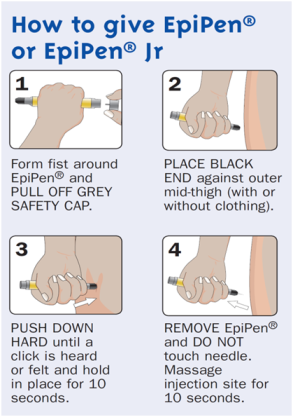
How_to_give_EpiPen

Epinephrine, an EpiPen or Auvi-Q/Allerject injection, should be given in the mid-anterior lateral thigh (not the outer thigh). We call this the EpiCenter of the thigh, and this video segment from the EpiCenter Medical (http://www.epicentermedical.com) online anaphylaxis first aid course has a thigh location graphic to help you pinpoint the most effective location for the injection.

http://youtu.be/C87K9MI946M