Participating in Life

I think that this is so important, especially with our health.  Had I not been an active participant and followed several doctors’ advice 25 years ago, I’d most likely not been here to write this.

I see this all the time, though.  Whatever the doctor says is true.  People will say that the doctor gave me this or that med but they don’t know what it is for.

I just don’t get how people can take meds and not have a clue what they are, how they work, how they might interact with other drugs they may be taking.  But it happens because people blindly follow whatever a doctor may give them.

Participation is so important – you have to know how YOU’RE feeling, what YOUR symptom are.  Do your own research.  Your doctor doesn’t know what it feels like to live in your body no matter how much you try to tell him/her.

Ultimately, you are the one who cares most about yourself and the only one who can make a difference through your research, thoughts and actions.

Just because a doctor gives you something, you don’t have to take it.  24 years ago a locally well-known neurologist “gave me” Xanax. Since he couldn’t see my tumor with his Magnetic Resonance Imaging (MRI) machine there was “no possibility” that it existed.  Had I followed his advice, taken the Xanax and stopped pursuing a Cushing’s diagnosis I would most have likely died by now.

The doctor was going by the odds.  The odds were that I really didn’t have a pituitary tumor.  But I’m not a statistic and neither are you.  Follow your instincts and take care of YOU.  This is the only life you’ll ever have.

The most healing thing we can do for ourselves is to participate in the process of our lives as fully as we can-even when the unexpected and the fearful happen.

~Today’s Page-a-Day calendar

What do YOU do to keep participating in your health care and daily life?

FDA Declines to Approve Relacorilant for Hypertension Linked to Hypercortisolism

Key takeaways:

  • The FDA issued a complete response letter for relacorilant to treat hypertension tied to hypercortisolism.
  • The investigational drug induced BP reductions for adults with hypertension in the phase 3 GRACE trial.

The FDA has issued a complete response letter for an oral selective glucocorticoid receptor antagonist under investigation for the treatment of hypertension secondary to hypercortisolism, according to an industry press release.

Corcept Therapeutics announced the FDA issued a complete response letter for relacorilant (Corcept Therapeutics). The drug is under investigation for the treatment of endogenous hypercortisolism, ovarian cancer and other disorders, according to the company.

As Healio previously reported, the phase 3 GRACE trial enrolled 152 adults with Cushing’s syndrome plus hypertension, hyperglycemia or both conditions. Participants received relacorilant for 22 weeks during an open-label phase. At 22 weeks, adults who met criteria for hypertension or hyperglycemia control entered a withdrawal phase where they were randomly assigned, 1:1, to continue relacorilant or switch to placebo for 12 weeks.

In the GRACE trial, adults with hypertension had a 7.9 mm Hg decrease in systolic blood pressure and a 5.1 mm Hg decline in diastolic BP at 22 weeks. During the randomized withdrawal phase, adults who remained on relacorilant had no change in systolic and diastolic BP, whereas those receiving placebo had a BP increase from the start of the phase to week 12.

In a press release from Corcept Therapeutics from 2024, the company announced results from the phase 3 GRADIENT trial, a randomized, double-blind, placebo-controlled trial where adults with Cushing’s syndrome caused by an adrenal adenoma or adrenal hyperplasia were randomly assigned, 1:1, to relacorilant or placebo for 22 weeks. According to the press release, the relacorilant group had a 6.6 mm Hg decline in mean systolic BP compared with baseline at 22 weeks. However, there was no significant difference in mean systolic BP change between the relacorilant and placebo groups.

As Healio previously reported, relacorilant was also assessed in a long-term extension study that enrolled adults who completed the GRACE and GRADIENT trials as well as a phase 2 hypercortisolism study. In that trial, relacorilant conferred a 10 mm Hg drop in 24-hour ambulatory systolic BP and a 7.3 mm Hg reduction in 24-hour ambulatory diastolic BP at 24 months.

In the company’s press release announcing receipt of the complete response letter, Corcept Therapeutics said the FDA acknowledged that the GRACE trial met its primary endpoint and that the GRADIENT trial provided “confirmatory evidence.” However, the FDA said it did not view relacorilant offered “a favorable benefit-risk assessment” without more data of its effectiveness, according to the press release.

“We are surprised and disappointed by this outcome,” Joseph K. Belanoff, MD, CEO of Corcept Therapeutics, said in a press release. “Our commitment to patients suffering from the effects of hypercortisolism is unwavering. I am confident we will find a way to get relacorilant to the patients it could help. We will meet with the FDA as soon as possible to discuss the best path forward.”

https://www.healio.com/news/endocrinology/20251231/fda-declines-to-approve-relacorilant-for-hypertension-linked-to-hypercortisolism?utm_source=selligent&utm_medium=email&utm_campaign=20251231ENDO&utm_content=20251231ENDO

On Becoming Empowered

This is kind of a “cheat” post since it’s a compilation of other posts, web pages, message board posts and some original thoughts.  

For all of my early life, I was the good, compliant, patient.  I took whatever pills the doctor prescribed, did whatever tests h/she (most always a he) wrote for.  Believed that whatever he said was the absolute truth.  He had been to med school.  He knew what was wrong with me even though he didn’t live in my body 24/7 and experience what I did.

I know a lot of people are still like this.  Their doctor is like a god to them.  He can do no wrong – even if they don’t feel any better after treatment, even if they feel worse.  “But the doctor said…”

Anyway, I digress.

All this changed for me in 1983.

At first I noticed I’d stopped having my periods and, of course, I thought I was pregnant. I went to my Gynecologist who had no explanation. Lots of women lose their periods for a variety of reasons so no one thought that this was really significant.

Then I got really tired, overly tired. I would take my son to a half hour Choir rehearsal and could not stay awake for the whole time. I would lie down in the back of the van, set an alarm and sleep for the 30 minutes.

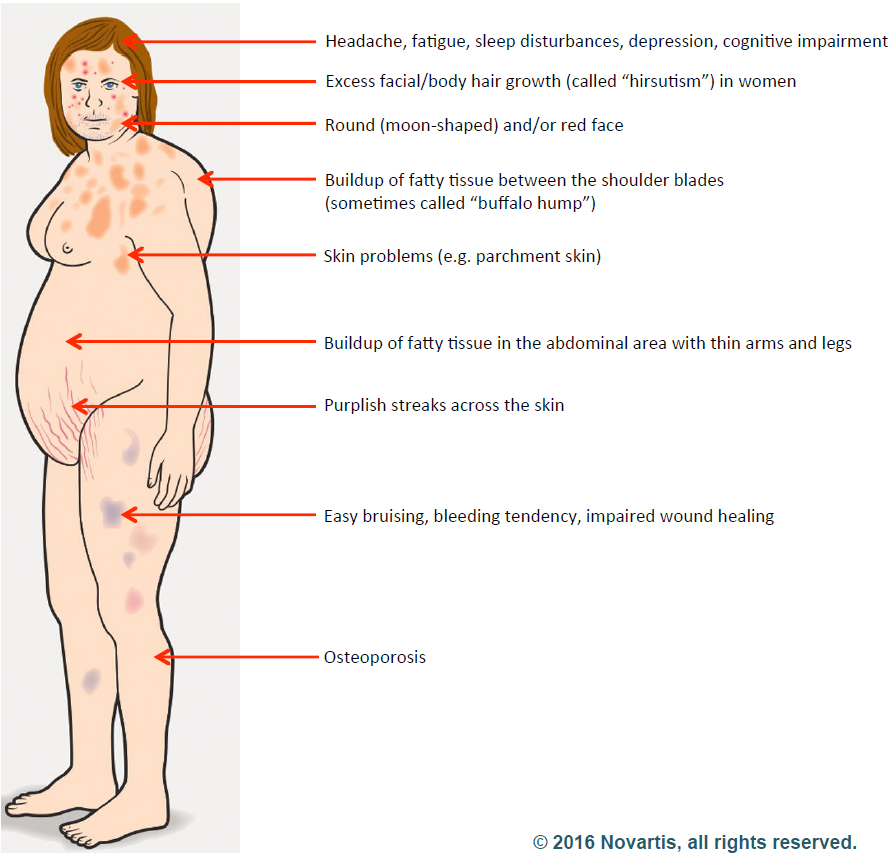
A whole raft of other symptoms started appearing – I grew a beard (Hirsuitism), gained weight even though I was on Weight Watchers and working out at the gym nearly every day, lost my period, everything hurt, got what is called a “moon face” and a “buffalo hump” on the back of my neck. I also got stretch marks. I was very depressed but it’s hard to say if that was because of the hormone imbalance or because I felt so bad and no one would listen to me.

I came across a little article in the Ladies Home Journal magazine which said “If you have these symptoms…ask your doctor about Cushing’s”. After that, I started reading everything I could on Cushing’s and asking my doctors. Due to all my reading at the library and medical books I bought, I was sure I had Cushing’s but no one would believe me. Doctors would say that Cushing’s Disease is too rare, that I was making this up and that I couldn’t have it.

I asked doctors for three years – PCP, gynecologist, neurologist, podiatrist – all said the now-famous refrain.  It’s too rare.  You couldn’t have Cushing’s.  I kept persisting in my reading, making copies of library texts even when I didn’t understand them, keeping notes.  I just knew that someone, somewhere would “discover” that I had Cushing’s.

My husband was on the doctors’ sides.  He was sure it was all in my mind (as opposed to all in my head!) and he told me to just think “happy thoughts” and it would all go away.

A Neurologist gave me Xanax. Since he couldn’t see my tumor with his Magnetic Resonance Imaging (MRI) machine there was “no possibility” that it existed. Boy was he wrong!

Later in 1986 I started bruising incredibly easily. I could touch my skin and get a bruise. On New Year’s Day of 1987 I started bleeding under the skin. My husband made circles around the outside perimeter each hour with a marker, like the rings of a tree. When I went to my Internist the next day he was shocked at the size. He now thought I had a blood disorder so he sent me to a Hematologist/Oncologist.

Fortunately, the Hematologist/Oncologist ran a twenty-four hour urine test and really looked at me. Both he and his partner recognized that I had Cushing’s. Of course, he was sure that he did the diagnosis.  No matter that I had been pursuing this with other doctors for 3 years.

It was not yet determined if it was Cushing’s Disease (Pituitary) or Syndrome (Adrenal). However, he couldn’t help me any further so the Hematologist referred me to an Endocrinologist.

The Endocrinologist, of course, didn’t trust the other tests I had had done so I was back to square one. He ran his own multitude of tests. He had to draw blood at certain times like 9 AM. and 5 PM. There was a dexamethasone suppression test where I took a pill at 10 p.m. and gave blood at 9 am the next day. I collected gallons of urine in BIG boxes (Fun in the fridge!). Those were from 6 a.m. to 6 a.m. to be delivered to his office by 9 a.m. same day. I was always worried that I’d be stopped in rush hour and the police would ask about what was in that big container. I think I did those for a week. He also did standard neurological tests and asked lots of questions.

When the endo confirmed that I had Cushing’s in 1987 he sent me to a local hospital where they repeated all those same tests for another week and decided that it was not my adrenal gland (Cushing’s Syndrome) creating the problem. The doctors and nurses had no idea what to do with me, so they put me on the brain cancer ward.

When I left this hospital after a week, we didn’t know any more than we had before.

As luck would have it, NIH (National Institutes of Health, Bethesda, Maryland) was doing a clinical trial of Cushing’s. I live in the same area as NIH so it was not too inconvenient but very scary at first to think of being tested there. At that time I only had a choice of NIH, Mayo Clinic and a place in Quebec to do this then-rare pituitary surgery called a Transsphenoidal Resection. I chose NIH – closest and free. After I was interviewed by the Doctors there, I got a letter that I had been accepted into the clinical trial. The first time I was there was for 6 weeks as an inpatient. More of the same tests.

There were about 12 of us there and it was nice not to be alone with this mystery disease. Many of these Cushies (mostly women) were getting bald, couldn’t walk, having strokes, had diabetes. One was blind, one had a heart attack while I was there. Towards the end of my testing period, I was looking forward to the surgery just to get this whole mess over with. While I was at NIH, I was gaining about a pound a day!

The MRI still showed nothing, so they did a Petrosal Sinus Sampling Test. That scared me more than the prospect of surgery. (This test carries the risk of stroke and uncontrollable bleeding from the incision points.) Catheters were fed from my groin area to my pituitary gland and dye was injected. I could watch the whole procedure on monitors. I could not move during this test or for several hours afterwards to prevent uncontrolable bleeding from a major artery. The test did show where the tumor probably was located. Also done were more sophisticated dexamethasone suppression tests where drugs were administered by IV and blood was drawn every hour (they put a heplock in my arm so they don’t have to keep sticking me). I got to go home for a weekend and then went back for the surgery – the Transsphenoidal Resection. I fully expected to die during surgery (and didn’t care if I did) so I signed my will and wrote last letters to those I wanted to say goodbye to. During the time I was home just before surgery, a college classmate of mine (I didn’t know her) did die at NIH of a Cushing’s-related problem. I’m so glad I didn’t find out until a couple months later!

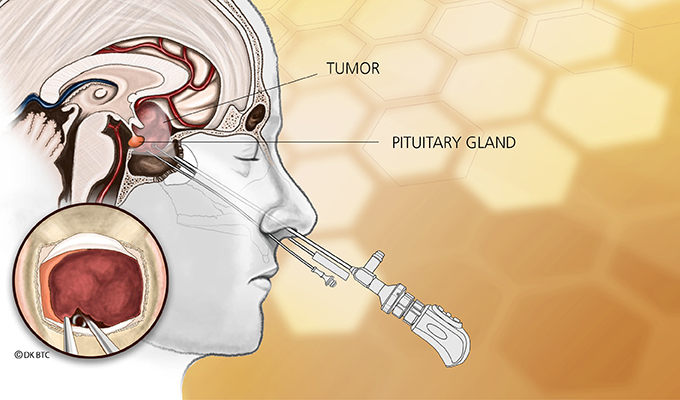
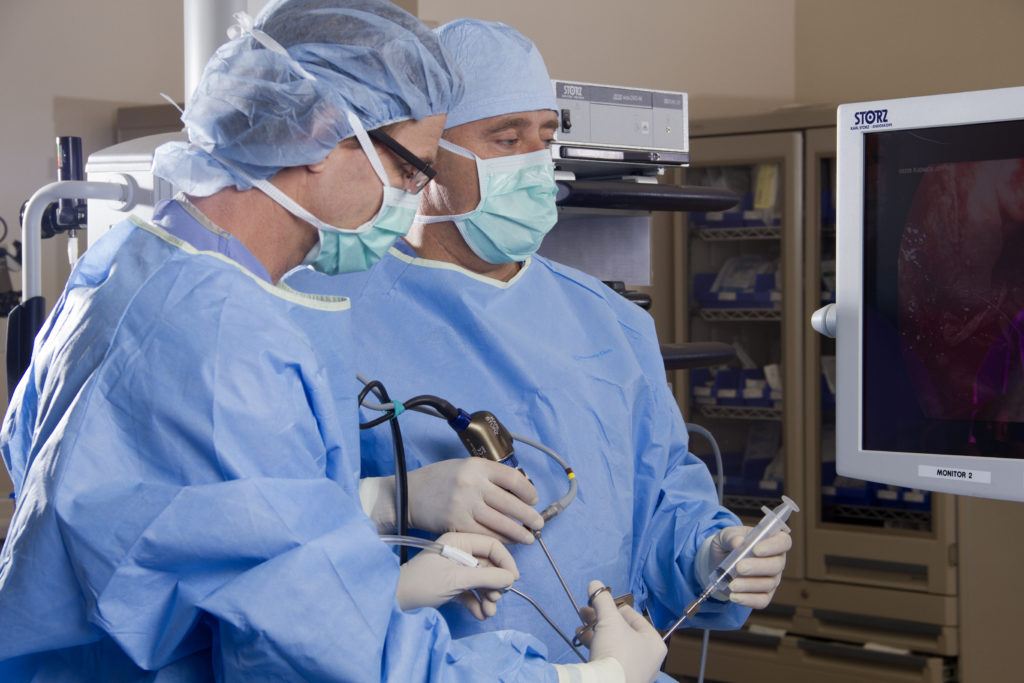
November 3, 1987, the surgeon, Dr. Ed Oldfield, cut the gum above my front teeth under my upper lip so there is no scar. He used tiny tools and microscopes. My tumor was removed successfully. In some cases (not mine) the surgeon uses a plug of fat from the abdomen to help seal the cut. Afterwards, I was in intensive care overnight and went to a neurology ward for a few days until I could walk without being dizzy. I had some major headaches for a day or two but they gave me drugs (morphine) for those. Also, I had cotton plugs in my nostrils. It was a big day when they came out. I had diabetes insipidus (DI) for a little while, but that went away by itself – thank goodness!

I had to use a foam product called “Toothies” to brush my teeth without hitting the incision. Before they let me go home, I had to learn to give myself an injection in my thigh. They sent me home with a supply of injectible cortisone in case my level ever fell too low (it didn’t). I was weaned gradually off cortisone pills (scary). I now take no medications. I had to get a Medic Alert bracelet. I will always need to tell medical staff when I have any kind of procedure – the effects of my excess cortisone will remain forever.

I went back to the NIH for several follow-up visits of a week each where they did all the blood and urine testing again. After a few years NIH set me free. Now I go to my “outside” endocrinologist every year for the dexamethasone suppression test, 24-hour urine and regular blood testing.

As I get further away from my surgery, I have less and less chance that my tumor will grow back. I have never lost all the weight I gained and I still have the hair on my chin but most of my other symptoms are gone. I am still and always tired and need a nap most days. I do not, however, still need to take whole days off just to sleep.

I consider myself very lucky that I was treated before I got as bad as some of the others on my floor at NIH but think it is crazy that these symptoms are not taken seriously by doctors.

My story goes on and if you’re interested some is on this blog and some is here:

Forbes Magazine | MaryO’s bio | Cushing’s and Cancer Blog | Cushing’s Awareness Day Testimonial Archive |

Because of this experience in getting a Cushing’s diagnosis – and later, a prescription for growth hormone – I was concerned that there were probably other people not being diagnosed with Cushing’s. When I searched online for Cushing’s, all the sites that came up were for dogs and horses with Cushing’s.  Not what I was looking for!

In July of 2000, I was talking with my dear friend Alice, who ran a wonderful menopause site, Power Surge, wondering why there weren’t many support groups online (OR off!) for Cushing’s.  This thought percolated through my mind for a few hours and I realized that maybe this was my calling.  Maybe I should be the one to start a network of support for other “Cushies” to help them empower themselves.

I wanted to educate others about the awful disease that took doctors years of my life to diagnose and treat – even after I gave them the information to diagnose me.  I didn’t want anyone else to suffer for years like I did.  I wanted doctors to pay more attention to Cushing’s disease.

The first website (http://www.cushings-help.com) went “live” July 21, 2000.  It was just a single page of information. The message boards began September 30, 2000 with a simple message board which then led to a larger one, and a larger.  Today, in 2010, we have over 7 thousand members.  Some “rare disease”!

The message boards are stillactive and we have weekly online text chats, weekly live interviews, local meetings, conferences, email newsletters, a clothing exchange, a Cushing’s Awareness Day Forum, podcasts, phone support and much more. Because I wanted to spread the word to others not on “the boards” we have extended out to social networking sites – twitter groups, facebook groups, twines, friendfeeds, newsletters, websites, chat groups, multiply.com, and much, much more.

People are becoming more empowered and participating in their own diagnoses, testing and treatment.  This have changed a lot since 1983!

When I had my Cushing’s over 40 years ago (AARRGGHH!), I never thought that I would meet another Cushing’s patient in real life or online. Back then, I’d never even been aware that there was anything like an “online”. I’m so glad that people struggling with Cushing’s today don’t have to suffer anymore thinking that they’re the only one who deals with this.

Because of my work on the websites – and, believe me it is a ton of work! – I have had the honor of meeting over a hundred other Cushies personally at local meetings, conferences, at NIH (the National Institutes of Health in Bethesda, MD where I had my final diagnosis and surgery). It occurred to me once that this is probably more than most endocrinologists will ever see in their entire career. I’ve also talked to countless others on the phone. Amazing for a “rare” disease!

I don’t know what pushed me in 1983, how I got the confidence and self-empowerment to challenge these doctors and their non-diagnoses over the years.  I’m glad that I didn’t suffer any longer than I did and I’m glad that I have a role in helping others to find the medical help that they need.

What do *YOU* think?  How are you becoming empowered?

Welcome!

This site is provided at no charge by the Cushings Help Organization, Inc. for Cushing’s patients, friends and family – or anyone who wants to learn more about Cushing’s.

What is Cushing’s?

Cushing’s syndrome, also known as hypercortisolism or hyperadrenocorticism, is an endocrine disorder caused by prolonged exposure of the body’s tissues to high levels of the hormone cortisol (in the blood) from a variety of causes, including primary pituitary adenoma (known as Cushing’s disease), primary adrenal hyperplasia or neoplasia, ectopic ACTH production (e.g., from a small cell lung cancer), and iatrogenic (steroid use). It is relatively rare and most commonly affects adults aged 20 to 50. An estimated 10 to 15 of every million people are affected each year. Cushing’s was discovered by American physician, surgeon and endocrinologist Harvey Cushing (1869-1939) and reported by him in 1932.

Normally, cortisol is released from the adrenal glands in response to ACTH being released from the pituitary gland. Both Cushing’s syndrome and Cushing’s disease are characterized by elevated levels of cortisol in the blood, but the cause of elevated cortisol differs between the two.

  • Cushing’s disease specifically refers to a tumor in the pituitary gland that stimulates excessive release of cortisol from the adrenal glands by releasing large amounts of ACTH.
  • In Cushing’s syndrome, ACTH levels will normally drop due to negative feedback from the high levels of cortisol. All forms of Cushing’s are correctly called Cushing’s Syndrome.

Cushing’s syndrome occurs when the body’s tissues are exposed to excessive levels of cortisol for long periods of time. Cortisol helps maintain blood pressure and cardiovascular function and is responsible for helping the body respond to stress. Many people suffer the symptoms of Cushing’s syndrome because they take steroids such as prednisone for asthma, rheumatoid arthritis, lupus and other inflammatory diseases, or for immunosuppression after transplantation. Prednisone is well-known for a “bloating” look that it gives people who take it.

Others develop Cushing’s syndrome because of overproduction of cortisol by the body due to a tumor on the pituitary (usually an adenoma or benign tumor of the pituitary glands) or adrenal glands, or elsewhere in the body Adrenal cancers, or other adrenal abnormalities may be the cause of Cushing’s Syndrome as well.

People who have been diagnosed with depression, alcoholism, malnutrition and panic attacks tend to have higher cortisol levels as well. These types of Cushing’s may be called Pseudo-Cushing’s.

Symptoms vary, but most people have upper body obesity (central obesity), rounded face (“moon face”), increased fat around the neck and on the back of the neck (buffalo hump), and thinning arms and legs. Children tend to be obese with slowed growth rates.

Other symptoms appear in the skin, which becomes fragile and thin. It bruises easily and heals poorly. Purplish pink stretch marks (straie) may appear on the abdomen, thighs, buttocks, arms and breasts. The bones are weakened, and routine activities such as bending, lifting or rising from a chair may lead to backaches, rib and spinal column fractures.

Most people have severe fatigue, weak muscles, persistent hypertension (due to the aldosterone-like effects) and insulin resistance, leading to hyperglycemia (high blood sugars) which can lead to diabetes mellitus. Patients frequently suffer various psychological disturbances, ranging from euphoria to frank psychosis. Depression and anxiety, including panic attacks, are common.

Women usually have excess hair growth (hirsutism) on their faces, necks, chests, abdomens, and thighs. Their menstrual periods may become irregular or stop (amenorrhoea). Men have decreased fertility with diminished or absent desire for sex.

Other symptoms include excess sweating, telangiectasia (dilation of capillaries, spider veins), atrophy of the skin (which gets thin and bruises easily) and other mucous membranes, proximal muscle weakness (hips, shoulders).

The excess cortisol may also affect other endocrine systems and cause, for example, reduced libido, impotence and infertility.

Untreated Cushing’s syndrome can lead to heart disease and increased mortality. Excess ACTH may also result in hyperpigmentation of the skin.

For a more complete list of Cushing’s Symptoms, see the Cushing’s Checklist. Many tests are done to determine if a person has Cushing’s. You can find a listing of them here.

The message boards are very active and we have weekly online chats, local meetings, email newsletters, a clothing exchange, a Cushing’s Awareness Day Forum in honor of Dr. Harvey Cushing’s birthday April 8, phone support and much more. Whenever one of the members of the boards gets into NIH, we try to go to visit them there. Other board members participate in the “Cushie Helper” program where they support others with one-on-one support, doctor/hospital visits, transportation issues and more.

Who Gets Cushing’s?

People just like you!

Environmental Issues and Cushing’s

We’ve had quite a bit of discussion on this topic on the Cushing’s Help message boards.  A few samples:

We live in a part of Ontario known as “the Chemical Valley”. We are surrounded by Dow Chemical, Imperial Oil, Dupont, British Petroleum, Shell Oil and about 12 other chemical plants.
There has been many people complaining about the high rate of cancer in our area and the government was forced to do a health study in our area but as of yet they haven’t figured out how to do the testing. My guess is they don’t want us to know how sick we really are.
We are part of the Goiter Belt which I think extends to PA. There are very few people here who do not have thyroid problems.
My 2 brothers and 2 sisters are suffering the same as I am and so are all our children! Both my parents died in their 50’s from untreated hypothyroid disease. Probably had adrenal/pituitary damage too when I think about their symptoms.
I see hypothyroid people everywhere I look and have since started checking for the hump and cushing signs.
Holy endocrine system Batman, I think we are all suffering at the hands of the Big Oil Companies. My husband works for British Petroleum!!!!

I hate to even think about it. Growing up in Buffalo – erie county new york, which is nestled between lake ontario & lake erie, I don’t believe the water is safe to drink. There are several epa areas of concern around lake ontario & lake erie. AOC’s (areas of concern) are highly polluted areas. Specificlly erie canal & buffalo river are awful. I found out some years ago that a playground that I frequented as a child was a landfill for hazardous chemicals. Now I have a pituitary tumor, coincidence? Probably not

I live near Green Bay WI, which is part of Lake Michigan. I believe our drinking water comes from the Bay. The water is polluted from the papermills (PCPs). I also did play on a heavily fertilized and treated lawn from a chemical company for at least 5 years when I was little. I had a thyroid nodule removed, hypothyroidism, and I am still in the testing phase to see if I have a pituitary tumor. My father also has hopothyroid, and seems to have kind of a hump. He has had cancer as well.
I remember the nuclear accident in the 80’s. It was really scary. I remember them saying something like it was worse than what they reported.

This is one of my future quests, I live in a town on 10,000 people and there are many cases of brain and pituitary tumors, I hear it all the time, I know of at least 3 definite pituitary cushing’s cases in my small town. My future goal when I am feeling better is to put my story in the paper, have people call me if they or someone they know has a funtioning pituitary tumor, also brain tumors and brain cancer has some large numbers too. The state sent me a letter I had to fill out when I first found out about my tumor, it was manditory, if I did not fill it out they where going to have my doctor fill it out so I did. So somewhere someone is keeping track of brain tumors in my town. I want to find out the numbers, if it is as bad as I think it is I am going to calll CDC to find out why. I also want to start a support group. But I need to feel better first because this is going to be a big undertaking.

There are many more postings on this topic.

From Wennersten: There’s something in the water

Scientists now tell us there is something in our waters that we least expected.

That “something” is a class of chemicals called endocrine disruptors, and Dr. Vicki Blazer, a fisheries biologist at the United States Geological Survey, thinks the chemicals are responsible for the high concentrations of intersex fish found in the Potomac, and other rivers in the mid-Atlantic.

The chemicals also prove a threat to human health, but a bit of explanation, first.

Our body’s endocrine system is a complex network of glands and hormones that regulate growth, development, and the operation of various organs. The endocrine glands (for example the thyroid, adrenal, pancreas, testes, ovaries and pituitary glands) release hormones that act as chemical messengers and regulate many life functions.

Endocrine disrupters are chemicals that interfere with this system, by either acting like a hormone, or blocking a hormone’s function. They can be natural, but many are man-made such as PCBs, dioxin, DDT and other pesticides, pharmaceuticals and plasticizers. They are found in many products, including plastic bottles, metal food cans, detergents, flame retardants, food, toys, cosmetics and pesticides. They enter the environment and are now commonly found in our streams, rivers, bays and oceans, where scientists are observing problems.

Then Great Lakes Area of Concerns shows a map of problem areas

Forty-three AOCs have been identified: 26 located entirely within the United States; 12 located wholly within Canada; and five that are shared by both countries. Two Canadian AOCs have been delisted and one U.S. AOC has been delisted leaving 30 AOCs remaining on the U.S. side of the border.

RAPs are being developed for each of these AOCs to address impairments to any one of 14 beneficial uses (e.g., restrictions on fish and wildlife consumption, dredging activities, or drinking water consumption) associated with these areas.  USEPA has assigned RAP Liaisons for AOCs.  Sediments have been identified as serious problems in many AOCs. AOC Principles and Guidelines have been finalized for formally delisting these areas as beneficial uses are restored.

What do YOU think?  Are you in one of these areas?