Cushing’s Patients at Risk for Autoimmune Diseases After Condition Is Resolved

Children with Cushing’s syndrome are at risk of developing new autoimmune and related disorders after being cured of the disease, a new study shows.

The study, “Incidence of Autoimmune and Related Disorders After Resolution of Endogenous Cushing Syndrome in Children,” was published in Hormone and Metabolic Research.

Patients with Cushing’s syndrome have excess levels of the hormone cortisol, a corticosteroid that inhibits the effects of the immune system. As a result, these patients are protected from autoimmune and related diseases. But it is not known if the risk rises after their disease is resolved.

To address this, researchers at the Eunice Kennedy Shriver National Institute of Child Health and Human Development (NICHD) examined 127 children with Cushing’s syndrome at the National Institutes of Health from 1997 until 2017.

Among the participants, 77.5 percent had a pituitary tumor causing the disease, 21.7 percent had ACTH-independent disease, and one patient had ectopic Cushing’s syndrome. All patients underwent surgery to treat their symptoms.

After a mean follow-up of 31.2 months, 7.8 percent of patients developed a new autoimmune or related disorder.

Researchers found no significant differences in age at diagnosis, gender, cortisol levels, and urinary-free cortisol at diagnosis, when comparing those who developed autoimmune disorders with those who didn’t. However, those who developed an immune disorder had a significantly shorter symptom duration of Cushing’s syndrome.

This suggests that increased cortisol levels, even for a short period of time, may contribute to more reactivity of the immune system after treatment.

The new disorder was diagnosed, on average, 9.8 months after Cushing’s treatment. The disorders reported were celiac disease, psoriasis, Hashimoto thyroiditis, Graves disease, optic nerve inflammation, skin hypopigmentation/vitiligo, allergic rhinitis/asthma, and nerve cell damage of unknown origin responsive to glucocorticoids.

“Although the size of our cohort did not allow for comparison of the frequency with the general population, it seems that there was a higher frequency of optic neuritis than expected,” the researchers stated.

It is still unclear why autoimmune disorders tend to develop after Cushing’s resolution, but the researchers hypothesized it could be a consequence of the impact of glucocorticoids on the immune system.

Overall, the study shows that children with Cushing’s syndrome are at risk for autoimmune and related disorders after their condition is managed. “The presentation of new autoimmune diseases or recurrence of previously known autoimmune conditions should be considered when concerning symptoms arise,” the researchers stated.

Additional studies are warranted to further explore this link and improve care of this specific population.

From https://cushingsdiseasenews.com/2018/03/06/after-cushings-cured-autoimmune-disease-risk-looms-study/

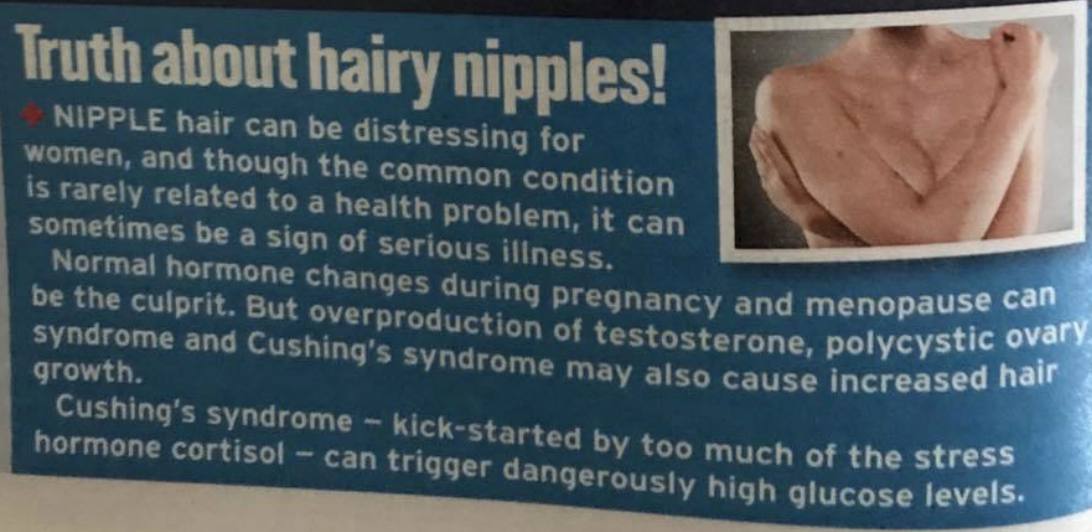
Cushing’s and Hairy Nipples

Hairy nipples are a common condition in women. The amount of hair on the nipples varies, but some women find that the hair becomes long, coarse, and dark, which can be distressing.

Hairy nipples are rarely a cause for concern and are usually not a sign of any underlying health issues. However, occasionally they can signify something more serious, in which case, it is essential to consult a doctor.

Almost every part of a person’s skin is covered in hair and hair follicles. On certain parts of the body, such as the top of the head, the hair usually grows longer and thicker, while on other parts, it is thin and transparent.

Fast facts on hairy nipples:

  • It is not known how common hairy nipples are or how many women have them.
  • Many women do not report the condition and instead manage it themselves.
  • It is possible for hair that used to be fine and light to turn coarse and dark with age.

Causes of hairy nipples in women

There are several underlying reasons that might cause nipple hairs to grow. These are:

Cushing’s syndrome

Cushing’s syndrome is another condition caused by hormonal imbalance. When it occurs, there is an excess of cortisol in the body. In this case, a person may experience several symptoms, such as:

  • increased hair growth
  • abnormal menstrual periods
  • high blood pressure
  • a buildup of fat on the chest and tummy, while arms and legs remain slim
  • a buildup of fat on the back of the neck and shoulders
  • a rounded and red, puffy face
  • bruising easily
  • big purple stretch marks
  • weakness in the upper arms and thighs
  • low libido
  • problems with fertility
  • mood swings
  • depression
  • high blood glucose level

Cushing’s syndrome is fairly rare, and the cause is usually associated with taking glucocorticosteroid medicine, rather than the body overproducing the hormone on its own.

It is possible, however, that a tumor in the lung, pituitary gland, or adrenal gland is the cause.

Also:

Hormonal changes and fluctuations

Hormonal changes in women can cause many different symptoms, one of which is changes in nipple hair growth and color.

Some common hormonal changes happen during pregnancy and menopause.

However, hormonal changes can also occur when a woman is in her 20s and 30s, which may cause nipple hair to change appearance or become noticeable for the first time.

Overproduction of male hormones

It is possible for hormonal imbalances to cause hairy nipples. Overproduction of male hormones, including testosterone, can cause hair growth, while other symptoms include:

  • oily skin that can lead to breakouts and acne
  • menstrual periods stopping
  • increase in skeletal muscle mass
  • male pattern baldness, leading to a woman losing hair on her head

If overproduction of male hormones is suspected, it is a good idea to make an appointment with a doctor who can confirm this with a simple test.

Polycystic ovary syndrome

Polycystic ovary syndrome (PCOS) occurs because of a hormonal imbalance. PCOS is a condition that affects the way the ovaries work.

Common symptoms of PCOS are:

  • infertility
  • irregular menstrual periods
  • ovarian cysts
  • excessive hair growth in unusual places, such as the nipples

PCOS is believed to affect around 1 in 5 women.

Medication

The side effects of particular medicines can cause unusual hair growth.

Medicines, such as testosterone, glucocorticosteroids, and certain other immunotherapy drugs may cause hairy nipples.

What are the treatment options?

Treatment for hairy nipples is not usually necessary for health reasons.

However, many women with the condition prefer to try and reduce or get rid of the appearance of hair on their nipples for cosmetic purposes.

There are several methods by which they can try and do this:

Trimming the nipple hair

Trimming the nipple hair may be enough to reduce its appearance. Small nail scissors are ideal, and hair can be cut close to the skin. It is essential to do this carefully and avoid catching the skin.

Trimming will need to be carried out regularly when the hair grows back.

Tweezing the nipple hair

Tweezing nipple hair is an effective way to get rid of unwanted nipple hair. However, this option can be painful as the skin around the nipple area is particularly soft and sensitive.

It is also important to bear in mind that the hair will return, and tweezing the hair increases the risk of infection and ingrown hairs.

Shaving the nipple hair

Shaving is another option to reduce the appearance of nipple hair. However, it is advisable to do so with caution to avoid nicking the sensitive skin.

This option also carries an increased risk of developing ingrown hairs and infection.

Waxing

Sugaring or waxing is a good hair removal option, though either one is likely to be painful. A salon is the best place to get this treatment type, as doing this at home may cause damage to the skin. Infection and ingrown hairs are again a risk.

Laser hair removal

These popular treatments can help to reduce the hair growth and slow or even prevent regrowth for a while. However, they can be painful, too.

Laser treatment is by far the most expensive option, as it will need to be performed by a plastic surgeon or cosmetic dermatologist.

Hormonal treatment

If a hormonal imbalance is the cause of hairy nipples, a doctor may prescribe or adjust a woman’s medication therapy to restore a healthy hormonal balance.

Other treatments and how to choose

The above treatments are all commonly used to remove and reduce nipple hair and usually have minimal side effects.

Bleaching or using hair removal cream to treat the condition, however, is not advised as these methods are usually too harsh for this sensitive area and may cause irritation and damage.

At what point should you see a doctor?

Hairy nipples in women are quite common, and there is usually no need to see a doctor. However, if they are accompanied by any other unusual symptoms, it is a good idea to make an appointment.

A doctor will be able to perform tests to determine whether an underlying cause, such as PCOS, is causing the growth of nipple hair. If so, they will give advice and medication therapy to help manage the condition.

A doctor will also be able to advise how to remove nipple hair safely.

Takeaway

For the majority of women, nipple hair may seem unsightly, but it is not a cause for any concerns about their health.

However, because some medical conditions can cause nipple hair to darken and grow, it is important to see a doctor if any other symptoms are experienced.

Nipple hair can usually be easily treated and managed, should a woman choose to try to remove the hair for cosmetic reasons.

Adapted from https://www.medicalnewstoday.com/articles/320835.php


Benefits of Medication Before Surgery for Cushing’s Syndrome Still Unclear

In Europe, nearly 20 percent of patients with Cushing’s syndrome receive some sort of medication for the disease before undergoing surgery, a new study shows.

Six months after surgery, these patients had remission and mortality rates similar to those who received surgery as a first-line treatment, despite having worse disease manifestations when the study began. However, preoperative medication may limit doctors’ ability to determine the immediate success of surgery, researchers said.

A randomized clinical trial is needed to conclusively address if preoperative medication is a good option for Cushing’s patients waiting for surgery, they stated.

The study, “Preoperative medical treatment in Cushing’s syndrome. Frequency of use and its impact on postoperative assessment. Data from ERCUSYN,” was published in the European Journal of Endocrinology. 

Surgery usually is the first-line treatment in patients with Cushing’s syndrome. But patients also may receive preoperative medication to improve cortisol excess and correct severe diseases occurring simultaneously with Cushing’s.

Multiple studies have hypothesized that preoperative medication can have a beneficial effect on patients who undergo surgery. However, data on the beneficial impact of medication on morbidity, and the immediate surgical and long-term outcomes in patients with Cushing’s syndrome, are limited and inconclusive.

So, researchers made use of the European Registry on Cushing’s Syndrome (ERCUSYN), the largest database that collects information on diagnosis, management, and long-term follow-up in Cushing’s patients.

The team set out to collect information of the prevalence of preoperative medication in Cushing’s patients throughout Europe, and whether it influences patients’ outcomes after surgery. It also aimed to determine the differences between patients who receive preoperative medication versus those who undergo surgery directly.

Researchers analyzed 1,143 patients in the ERCUSYN database from 57 centers in 26 countries. Depending on what was causing the disease, patients were included in four major groups: pituitary-dependent Cushing’s syndrome (68%), adrenal-dependent Cushing’s syndrome (25%), Cushing’s syndrome from an ectopic source (5%), and Cushing’s syndrome from other causes (1%).

Overall, 20 percent of patients received medication – ketoconazole, metyrapone, or a combination of both – before surgery. Patients with ectopic and pituitary disease were more likely to receive medication compared to patients whose disease stemmed from the adrenal glands. Preoperative treatment lasted for a median of 109 days.

Patients in the pituitary group who were prescribed preoperative medication had more severe clinical features at diagnosis and poorer quality of life compared to those who received surgery as first-line treatment. No differences were found in the other groups.

But patients with pituitary-dependent disease receiving medication were more likely to have normal cortisol within seven days of surgery, or the immediate postoperative period, compared to patients who had surgery without prior medication. These patients also had a lower remission rate.

Within six months of surgery, however, there were no differences in morbidity or remission rates observed between each group. Also, no differences were seen in perioperative mortality rates – within one month of surgery.

Interestingly, researchers noted that patients who took medication prior to surgery were less likely to be in remission immediately after surgery. The reason, they suggest, might be because the medication already had begun to improve the clinical and biochemical signs of the disease, “so changes that take place in the first week after surgery may be less dramatic.”

“A randomized trial assessing simple endpoints, such as length of hospital stay, surgical impression and adverse effects of surgery, is needed to conclusively demonstrate that [preoperative medication] is a valid option in patients waiting for surgical correction of hypercortisolism,” the team concluded.

From https://cushingsdiseasenews.com/2018/02/22/benefits-cushings-syndrome-pre-surgery-medication-unclear-study/

Repeat Checks of Cortisol Levels in Saliva May Improve Use of Metopirone as Cushing’s Treatment

Measuring cortisol levels in saliva multiple times a day is a convenient and useful way to determine the best course of treatment for patients with Cushing’s syndrome, a preliminary study shows.

The research, “Multiple Salivary Cortisol Measurements Are a Useful Tool to Optimize Metyrapone Treatment in Patients with Cushing’s Syndromes Treatment: Case Presentations,” appeared in the journal Frontiers of Endocrinology.

Prompt and effective treatment for hypercortisolism — the excessive amount of cortisol in the blood — is essential to lowering the risk of Cushing’s-associated conditions, including infections, cardiovascular disease, and stroke.

Steroid hormone inhibitors, such as HRA Pharma’s Metopirone (metyrapone), have been used significantly in Cushing’s syndrome patients.

These therapies not only suppress cortisol levels, but also avoid adrenal insufficiency (where not enough cortisol is produced) and restore the circadian rhythm, which is disrupted in Cushing’s patients. However, effective medical treatment requires monitoring cortisol activity throughout the day.

Salivary measurements of cortisol are a well-known method for diagnosing and predicting the risk of recurrence of Cushing’s syndrome. The method is convenient for patients and can be done in outpatient clinics. However, the medical field lacks data on whether measuring cortisol in saliva works for regulating treatment.

Researchers analyzed the effectiveness of salivary cortisol measurements for determining the best dosage and treatment timing of Cushing’s patients with Metopirone.

The study included six patients, three with cortisol-secreting masses in the adrenal glands and and three with ACTH (or adrenocorticotropin)-secreting adenomas in the pituitary glands, taking Metopirone. Investigators collected samples before and during treatment to assess morning serum cortisol and urinary free cortisol (UFC). Patients also had salivary cortisol assessments five times throughout the day.

Saliva samples were collected at 6 a.m. (wake-up time), 8 a.m. (before breakfast), noon (before lunch), 6 p.m. (before dinner), and 10 p.m. (before sleep).

Other studies have used UFC assessments to monitor treatment. However, the inability of this parameter to reflect changes in diurnal cortisol requires alternative approaches.

Results showed that although UFC was normalized in five out of six patients, multiple salivary cortisol measurements showed an impaired diurnal cortisol rhythm in these patients.

Whereas patients with cortisol-secreting adrenocortical adenoma showed elevated cortisol levels throughout the day, those with ACTH-secreting pituitary adenoma revealed increased levels mainly in the morning. This finding indicates that “the significance of elevated morning cortisol levels is different depending on the disease etiology,” the researchers wrote.

In a prospective case study to better assess the effectiveness of performing multiple salivary cortisol assessments, the research team analyzed one of the participants who had excessive cortisol production that was not controlled with four daily doses of Metoripone (a daily total of 2,250 mg).

Results revealed that cortisol levels increased before each dosage. After the patient’s treatment regimen was changed to a 2,500 mg dose divided into five daily administrations, researchers observed a significant improvement in the diurnal cortisol pattern, as well as in UFC levels.

Subsequent analysis revealed that performing multiple salivary cortisol measurements helps with a more precise assessment of excess cortisol than analyzing UFC levels, or performing a unique midnight salivary cortisol collection, the researchers said.

Although more studies are required, the results “suggest that multiple salivary cortisol measurements can be a useful tool to visualize the diurnal cortisol rhythm and to determine the dose and timing of metyrapone [Metopirone] during the treatment in patients with [Cushing’s syndrome],” the researchers wrote.

Future studies should include a larger sample size, evaluate changes over a longer term, use a standardized protocol for treatment dosing and timing, and evaluate changes in a patient’s quality of life, the investigators said.

From https://cushingsdiseasenews.com/2018/02/15/multiple-saliva-cortisol-checks-cushings-metyrapone-study/

Preoperative medical treatment in Cushing’s syndrome.

European Journal of Endocrinology — | February 14, 2018

Valassi E, et al. – This study was performed to assess how frequently preoperative medical treatment (PMT) was given to Cushing’s syndrome (CS) patients across Europe and to investigate differences in preoperative characteristics of patients who receive PMT and those who undergo primary surgery. In addition, the physicians determined if PMT influenced the postoperative outcome in pituitary-dependent CS (PIT-CS). In contrast with adrenal-dependent CS (ADR-CS), CS from an ectopic source (ECT-CS) and PIT-CS exhibited greater likelihood of receiving PMT. Data reported more severe clinical features at the diagnosis and poorer quality of life in PIT-CS patients treated with PMT. The interpretation of immediate postoperative outcome could be confounded with PMT. They recommended follow-up to definitely evaluate surgical results.

Methods

  • A total of 1,143 CS patients entered into the ERCUSYN database from 57 centres in 26 countries.
  • During this study, 69% patients presented with PIT-CS, 25% adrenal-dependent CS (ADR-CS), 5% CS from an ectopic source (ECT-CS), and 1% were classified as having CS from other causes (OTH-CS).

Results

  • In this study, 20% of patients took PMT.
  • PMT was offered more frequently in ECT-CS and PIT-CS compared to ADR-CS (p < 0.001).
  • Ketoconazole (62%), metyrapone (16%), and a combination of both (12%) were the most commonly used drugs.
  • The median (interquartile range) duration of PMT was 109 (98) days.
  • More severe clinical features at diagnosis and poorer quality of life were noted in PIT-CS patients treated with PMT compared to those undergoing primary surgery (SX) (p < 0.05).
  • PIT-CS patients treated with PMT were more likely to have normal cortisol (p < 0.01) and a lower remission rate (p < 0.01) within 7 days of surgery.
  • Between SX and PMT groups, no differences in morbidity or remission rates were observed within 6 months of surgery.

Read the full article on European Journal of Endocrinology