Exophthalmos and Cushing’s Syndrome

A woman experienced red, irritated and bulging eyes. She saw an ophthalmologist who strongly suspected Graves’ ophthalmopathy. However, the patient did not have and never had hyperthyroidism.

Indeed, she had primary hypothyroidism optimally treated with levothyroxine. Her thyroid stimulating hormone level was 1.197 uIU/mL.

An MRI of the orbits showed normal extraocular muscles without thickening, but there was mild proptosis and somewhat increased intraorbital fat content. Both thyroid-stimulating immunoglobulins as well as thyrotropin receptor antibodies were negative.

The patient presented to her primary care physician a few months later. She had experienced a 40-lb weight gain over only a few months and also had difficult-to-control blood pressure.

After failing to respond to several antihypertensive medications, her primary care physician astutely decided to evaluate for secondary causes of hypertension. A renal ultrasound was ordered to evaluate for renal artery stenosis, and the imaging identified an incidental right-sided adrenal mass. A CT confirmed a 3.4-cm right-sided adrenal mass. Her morning cortisol was slightly high at 24.7 ug/dL (4.3 – 22.4) and her adrenocorticotropic hormone was slightly low at 5 pg/mL (10-60).

At this point I saw the patient in consultation. She definitely had many of the expected clinical exam findings of Cushing’s syndrome, including increased fat deposition to her abdomen, neck, and supraclavicular areas, as well as striae. Her 24-hour urine cortisol was markedly elevated at 358 mcg/24hrs (< 45) confirming our suspicions.

She asked me, “Do you think that my eye problem could be related to this?”

“I’ve not heard of it before,” I replied, “but that doesn’t mean there can’t be a connection. Wouldn’t it be wonderful if your eyes got better after surgery?”

The patient underwent surgery to remove what fortunately turned out to be a benign adrenal adenoma.

When we saw her in follow-up 2 weeks later, her blood pressures were normal off medication and her eye symptoms had improved. I had a medical student rotating with me, so I suggested that we do a PubMed literature search.

The first article to come up was a case report titled “Exophthalmos: A Forgotten Clinical Sign of Cushing’s Syndrome.” Indeed, not only did Harvey Cushing describe this clinical finding in his original case series in 1932, but others have reported that up to 45% of patients with active Cushing’s syndrome have exophthalmos.

The cause is uncertain but is theorized to be due to increased intraorbital fat deposition. Unlike exophthalmos due to thyroid disease, the orbital muscles are relatively normal — just as they were with our patient.

Some of you may have seen exophthalmos in your Cushing’s patients; however, this was the first time I had seen it. Just because one has not heard of something, does not mean it could never happen; no one knows everything. “When in doubt, look it up” is a good habit for both attending physicians and their students.

For more information:

Giugni AS, et al. Case Rep Endocrinol. 2013; 2013: 205208.

From http://www.healio.com/endocrinology/adrenal/news/blogs/%7B779bf3e5-e1da-459e-af27-955c9b4274a5%7D/thomas-b-repas-do-facp-face-cde/exophthalmos-and-cushings-syndrome

Genetics Research Demystifies Fatal Glandular Disease (Cushing’s)

Researchers at Tokyo Institute of Technology have identified genetic mutations responsible for Cushing’s disease, a potentially fatal glandular condition.

Symptoms of Cushing’s disease include weight gain, muscular weakness, mood and reproductive problems, and if untreated patients can die from the resulting infections and cardiovascular problems. Although first described by Harvey Cushing back in 1932, as Martin Reincke and colleagues in Germany and Japan point out in their latest Nature Genetics report, the mechanism causing the disease “has remained obscure since its first description”. Now by sequencing the tissues responsible the researchers have identified clusters of mutations that cause Cushing’s disease as well as how these mutations bring the disease into effect.

The disease arises from benign tumours on glandular pituitary tissue – corticotroph adenomas – which excessively secrete the hormone adrenocorticotropin (ACTH). Previous studies sought to identify mutations that might cause the disease through sequencing candidate genes and microarray studies, but these made little progress. Instead, the researchers applied a particular type of DNA sequencing known as ‘exome sequencing’ to the pituitary corticotroph adenoma.

The collaboration included researchers from Ludwig-Maximilians-Universität Munich, the University of Würzburg, the Max Planck Institute, the Helmholtz-Center Munich, Universität Hamburg , Universität Erlangen in Germany and Tokyo Institute of Technology in Japan. The research team exome-sequenced samples from 10 patients with Cushing’s disease and noticed a small number of protein altering mutations in the adenoma tissue. The researchers further identified the gene harbouring the mutations as ubiquitin-specific protease 8 (USP8), and were able to pinpoint the region of USP8 prone to mutation in Cushing’s disease.

Previous research observations of Cushing’s disease have highlighted strong expression of another gene, epidermal growth factor receptor (EGFR). By examining EGFR in HeLa cells expressing USP8, the researchers behind this latest research demonstrated that this was the result of USP8 mutations inhibiting downregulation of EGFR.

The researchers conclude that their results “not only identify the first of so far enigmatic driver mutations in corticotroph adenomas but also elucidate a novel mechanism by which the EGFR pathway is constitutively activated in human tumours.” Further research will be required for a more detailed understanding of genetic onset of the disease.

Reference

Martin Reincke etal, Nature Genetics, Advance Online Publication 9 December 2014

Background

Cushing’s disease adenomas

The adenomas that cause Cushing’s disease are benign tumours of epithelial tissue that grow on the pituitary gland. The tumours comprise corticotroph cells, a hormone producing cell that secretes asdrenocorticotropin (ACTH). While the pathological role of ACTH hypersecretion was already known, previous studies had been unable to identify the molecular mechanisms behind these hormone processes that lead to Cushing’s disease.

Exome sequencing

When RNA is processed by splicing, parts of the RNA – the introns – are removed. The remaining RNA, the exons, are collectively referred to as the exome.

While DNA sequencing finds the sequence of proteins for the whole DNA, by focusing on the exons, exome sequencing provides information specifically on the protein-coding genes. Changes to these genes are more likely to have significant ramifications on the organism.

Ubiquitination and USP8

Ubiquitination is a reversible protein modification process that occurs by means of a small protein called ubitquitin, which is found in all eukaryotic cells (cells containing a nucleus and other structures enclosed within a membrane). Ubiquitination regulates the fate and function of proteins.

USP8 is a ubiquitin-specific protease enzyme that can remove ubitquitin molecules from target proteins. The discovery of a high number of mutations in the USP8 gene in Cushing’s disease prompted the researchers to make further investigations on the mutant USP8 enzymes at biochemical and cellular levels. From these studies they could identify the mechanisms behind the mutations and the effect on epidermal growth factor receptor (EGFR), a gene that mediates the synthesis of an ACTH precursor.

Figure (click to view larger)
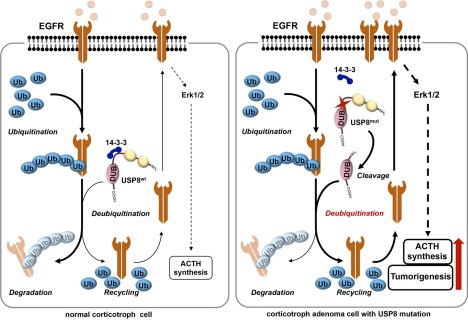
corticotroph

Figure caption: Schematic representation showing the proposed mechanisms how USP8 mutations lead to increased ACTH secretion and tumorigenesis in corticotroph.

Further information

Yukiko Tokida, Asuka Suzuki

Center for Public Affairs and Communications, Tokyo Institute of Technology

2-12-1, Ookayama, Meguro-ku, Tokyo 152-8550, Japan

E-mail: media@jim.titech.ac.jp

URL: http://www.titech.ac.jp/english/

Tel: +81-3-5734-2975     Fax: +81-3-5734-3661

About Tokyo Institute of Technology

As one of Japan’s top universities, Tokyo Institute of Technology seeks to contribute to civilization, peace and prosperity in the world, and aims at developing global human capabilities par excellence through pioneering research and education in science and technology, including industrial and social management. To achieve this mission, we have an eye on educating highly moral students to acquire not only scientific expertise but also expertise in the liberal arts, and a balanced knowledge of the social sciences and humanities, all while researching deeply from basics to practice with academic mastery. Through these activities, we wish to contribute to global sustainability of the natural world and the support of human life.


Source: Tokyo Institute of Technology, Center for Public Affairs and Communications: http://www.healthcanal.com/genetics-birth-defects/58155-tokyo-institute-of-technology-research-genetics-research-demystifies-fatal-glandular-disease.html

Brains in jars at the Cushing Center in the Yale Medical Library

harvey-cushing-memorial

Sitting quietly in jars in a custom-built room at Yale’s medical library are 550 human brains. The collection once belonged to pioneering neurosurgeon Harvey Cushing, who preserved the brains from 1903 to 1932 as part of his tumor registry. When Cushing died in 1939, his undergraduate alma mater Yale inherited the brains.

Cushing was among a handful of doctors operating on the brain during the early 20th century. At the time, about a third of patients who underwent brain tumor surgery did not survive the operation. Cushing introduced practices that dramatically lowered the mortality rate, such as monitoring blood pressure during surgery and operating with a local anesthesic instead of ether. He was also the first to use x-rays to diagnose brain tumors.


Read the entire article here: Brains in jars at the Cushing Center in the Yale Medical Library.

Cushing’s Awareness Challenge, Day Eight

It’s Here!


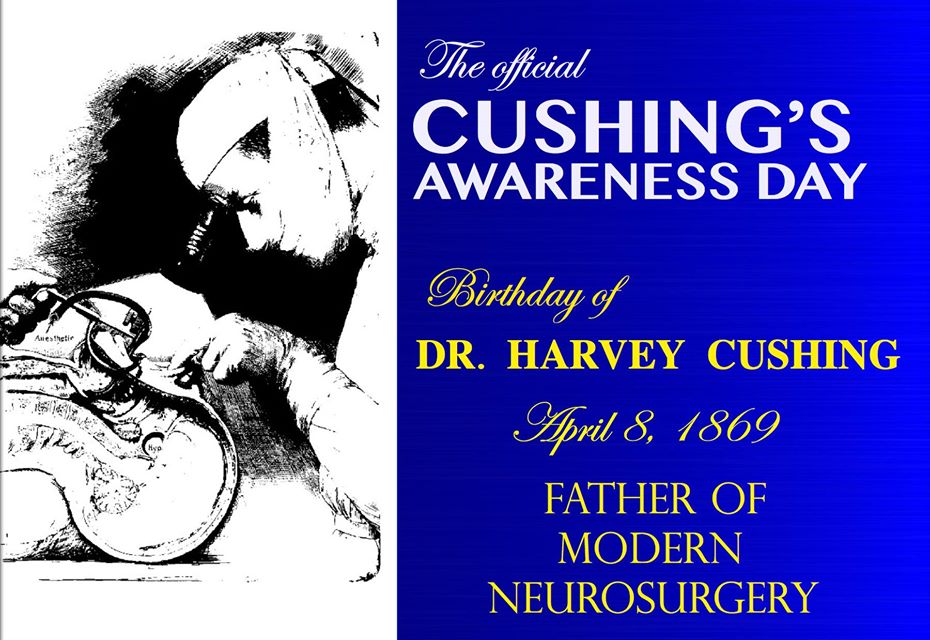
Dr. Cushing was born in Cleveland Ohio. The fourth generation in his family to become a physician, he showed great promise at Harvard Medical School and in his residency at Johns Hopkins Hospital (1896 to 1900), where he learned cerebral surgery under William S. Halsted

After studying a year in Europe, he introduced the blood pressure sphygmomanometer to the U.S.A. He began a surgical practice in Baltimore while teaching at Johns Hopkins Hospital (1901 to 1911), and gained a national reputation for operations such as the removal of brain tumors. From 1912 until 1932 he was a professor of surgery at Harvard Medical School and surgeon in chief at Peter Bent Brigham Hospital in Boston, with time off during World War I to perform surgery for the U.S. forces in France; out of this experience came his major paper on wartime brain injuries (1918). In addition to his pioneering work in performing and teaching brain surgery, he was the reigning expert on the pituitary gland since his 1912 publication on the subject; later he discovered the condition of the pituitary now known as “Cushing’s disease“.

Read more about Dr. Cushing

Today, April 8th, is Cushing’s Awareness Day. Please wear your Cushing’s ribbons, t-shirts, awareness bracelets or Cushing’s colors (blue and yellow) and hand out Robin’s wonderful Awareness Cards to get a discussion going with anyone who will listen.

And don’t just raise awareness on April 8.  Any day is a good day to raise awareness.


robin-harvey


MaryO

What would Harvey Cushing say about Cushing’s disease today?

harvey-book

(BPT) – More than 80 years ago renowned neurosurgeon, Dr. Harvey Cushing, discovered a tumor on the pituitary gland as the cause of a serious, hormone disorder that leads to dramatic physical changes in the body in addition to life-threatening health concerns. The discovery was so profound it came to be known as Cushing’s disease. While much has been learned about Cushing’s disease since the 1930s, awareness of this rare pituitary condition is still low and people often struggle for years before finding the right diagnosis.

Read on to meet the man behind the discovery and get his perspective on the present state of Cushing’s disease.

* What would Harvey Cushing say about the time it takes for people with Cushing’s disease to receive an accurate diagnosis?

Cushing’s disease still takes too long to diagnose!

Despite advances in modern technology, the time to diagnosis for a person with Cushing’s disease is on average six years. This is partly due to the fact that symptoms, which may include facial rounding, thin skin and easy bruising, excess body and facial hair and central obesity, can be easily mistaken for other conditions. Further awareness of the disease is needed as early diagnosis has the potential to lead to a more favorable outcome for people with the condition.

* What would Harvey Cushing say about the advances made in how the disease is diagnosed?

Significant progress has been made as several options are now available for physicians to use in diagnosing Cushing’s disease.

In addition to routine blood work and urine testing, health care professionals are now also able to test for biochemical markers – molecules that are found in certain parts of the body including blood and urine and can help to identify the presence of a disease or condition.

* What would Harvey Cushing say about disease management for those with Cushing’s disease today?

Patients now have choices but more research is still needed.

There are a variety of disease management options for those living with Cushing’s disease today. The first line and most common management approach for Cushing’s disease is the surgical removal of the tumor. However, there are other management options, such as medication and radiation that may be considered for patients when surgery is not appropriate or effective.

* What would Harvey Cushing say about the importance of ongoing monitoring in patients with Cushing’s disease?

Routine check-ups and ongoing monitoring are key to successfully managing Cushing’s disease.

The same tests used in diagnosing Cushing’s disease, along with imaging tests and clinical suspicion, are used to assess patients’ hormone levels and monitor for signs and symptoms of a relapse. Unfortunately, more than a third of patients experience a relapse in the condition so even patients who have been surgically treated require careful long-term follow up.

* What would Harvey Cushing say about Cushing’s disease patient care?

Cushing’s disease is complex and the best approach for patients is a multidisciplinary team of health care professionals working together guiding patient care.

Whereas years ago patients may have only worked with a neurosurgeon, today patients are typically treated by a variety of health care professionals including endocrinologists, neurologists, radiologists, mental health professionals and nurses. We are much more aware of the psychosocial impact of Cushing’s disease and patients now have access to mental health professionals, literature, patient advocacy groups and support groups to help them manage the emotional aspects of the disease.

Learn More

Novartis is committed to helping transform the care of rare pituitary conditions and bringing meaningful solutions to people living with Cushing’s disease. Recognizing the need for increased awareness, Novartis developed the “What Would Harvey Cushing Say?” educational initiative that provides hypothetical responses from Dr. Cushing about various aspects of Cushing’s disease management based on the Endocrine Society’s Clinical Guidelines.

For more information about Cushing’s disease, visit www.CushingsDisease.com or watch educational Cushing’s disease videos on the Novartis YouTube channel at www.youtube.com/Novartis.


From http://www.jsonline.com/sponsoredarticles/health-wellness/what-would-harvey-cushing-say-about-cushings-disease-today8087390508-253383751.html