Irreversible Effects of Previous Cortisol Excess on Cognitive Functions in Cushing’s Disease | Laika’s MedLibLog

Irreversible Effects of Previous Cortisol Excess on Cognitive Functions in Cushing’s Disease | Laika’s MedLibLog.

If we listen to Cushing patients, who are “cured” and have traded Cushing’s disease for Addison’s disease, we notice that they feel better after their high levels of cortisol have normalized, but not fully cured (see two examples of ex-Cushing patients with longlasting if not irreversible health) problems in my previous post here. [added 2010-04-17)

To realize how this affects daily life, I recommend to read the photo-blog 365 days with Cushing by Robin (also author of Survive the Journey). Quite a few of her posts deal with the continuous weakness (tag muscle atrophy), tiredness (tag fatigue), problems with (short-term) memory (see tag memory)  or both (like here and here).

Scientifically the question is to which extent ex-Cushing patients score worse than other healthy individuals or chronically ill people and, if so, whether this can be attributed to the previous high levels of glucocorticoids….

via Irreversible Effects of Previous Cortisol Excess on Cognitive Functions in Cushing’s Disease | Laika’s MedLibLog.

Cushing’s Awareness Challenge: Day 13

robin-complications

What can I say?  Robin’s images area always right on!

My only addition to this list would be the ongoing daily fatigue.  Maybe that’s not really a complication but more of an annoyance.

My bone loss has stopped  (or  slowed down some) over  the years since my pituitary surgery in 1987 but I doubt that I’ll ever gain back any height!

Luckily, I haven’t had a stroke – knock on wood!

Cushing’s – the “gift” that keeps on giving!

maryo colorful zebra


Cushing’s Awareness Challenge, Day 6

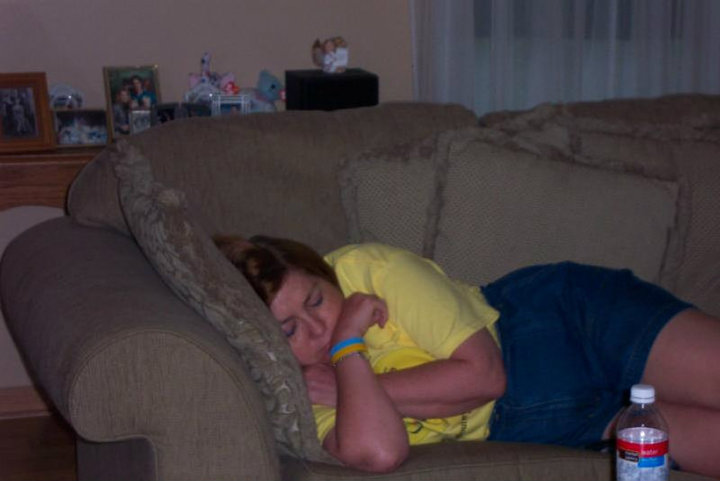
This seems to be nostalgia time.  Yesterday, I posted a picture from 2007.  This one is from Rockford, IL, Cushing’s Weekend, 2006:

asleep-in-rockford


Yes, that’s me asleep.

I flew out to Chicago, drove up to Rockford, IL.  The next day, we all drove up to Wisconsin to have lunch with some other Cushies.  I missed most of that meeting because I fell asleep on the sofa. 😦

Tired, fatigued, missing the main event because I can’t stay awake.

Something similar happened today.  I ring handbells at my church.  I got up and rang at the first service just fine.  I brought my mom home at 9:30.   I needed to leave at 10:30 for the other service we were playing.  Checked my email.  Next thing I knew, it was just after 11.  AACK!

After a quick note apologizing to the director, I fell asleep again and here it is, nearly 6:30pm.  Another day, gone.

I hate this, sleeping all day, missing things, missing beautiful weather.

But that’s life, post-Cushing’s.

sleep


Cushing’s Awareness Challenge, Day 4

Another idea I borrowed from Robin – using a Wordle as inspiration for today’s post.
Even though I’m “in remission” since 1987, I’m still way too fatigued, napping every afternoon for several hours.  People think I should be normal since my pituitary surgery was so long ago.  Well, no.
me-tired
Just a few days ago, I posted this abstract on Severe fatigue in patients with adrenal insufficiency.  I don’t think that they needed to do this study at all.  Just ask any Cushie!

Abstract

BACKGROUND:

Fatigue is a frequently experienced complaint in patients with adrenal insufficiency (AI) and may be influenced by cortisol levels.

AIM:

The objective of this study was to determine the prevalence of severe fatigue in adrenal insufficiency (AI) patients, to assess which dimensions contribute to fatigue severity and to determine the association between salivary cortisol levels and momentary fatigue.

SUBJECTS AND METHODS:

We performed a cross-sectional study in the outpatient department of a university hospital. Included were 27 patients with congenital adrenal hyperplasia (CAH), 26 patients with primary AI (PAI), 24 patients with secondary AI (SAI) and 31 patients with adrenal insufficiency after treatment for Cushing’s syndrome (Cush-AI). Measurements included computerised questionnaires to determine fatigue severity and physical and psychosocial contributors. Patients took four saliva samples at home, in which cortisol levels were measured.

RESULTS:

Severe fatigue was experienced by 41 % of the CAH patients, 42 % of the PAI patients, 50 % of the SAI patients and 42 % of the Cush-AI patients. Psychological distress, functional impairment, sleep disturbance, physical activity, concentration problems and social functioning contributed to the subjective experience of fatigue. Salivary cortisol levels were not correlated with momentary fatigue.

CONCLUSIONS:

A considerable proportion of AI patients experience severe fatigue. Salivary cortisol level is not a significant predictor for momentary fatigue in AI patients.

PMID:
24615365
[PubMed – in process]

From http://www.ncbi.nlm.nih.gov/pubmed/24615365


Back to my nap now…

maryo colorful zebra

Severe fatigue in patients with adrenal insufficiency: physical, psychosocial and endocrine determinants

Abstract

BACKGROUND:

Fatigue is a frequently experienced complaint in patients with adrenal insufficiency (AI) and may be influenced by cortisol levels.

AIM:

The objective of this study was to determine the prevalence of severe fatigue in adrenal insufficiency (AI) patients, to assess which dimensions contribute to fatigue severity and to determine the association between salivary cortisol levels and momentary fatigue.

SUBJECTS AND METHODS:

We performed a cross-sectional study in the outpatient department of a university hospital. Included were 27 patients with congenital adrenal hyperplasia (CAH), 26 patients with primary AI (PAI), 24 patients with secondary AI (SAI) and 31 patients with adrenal insufficiency after treatment for Cushing’s syndrome (Cush-AI). Measurements included computerised questionnaires to determine fatigue severity and physical and psychosocial contributors. Patients took four saliva samples at home, in which cortisol levels were measured.

RESULTS:

Severe fatigue was experienced by 41 % of the CAH patients, 42 % of the PAI patients, 50 % of the SAI patients and 42 % of the Cush-AI patients. Psychological distress, functional impairment, sleep disturbance, physical activity, concentration problems and social functioning contributed to the subjective experience of fatigue. Salivary cortisol levels were not correlated with momentary fatigue.

CONCLUSIONS:

A considerable proportion of AI patients experience severe fatigue. Salivary cortisol level is not a significant predictor for momentary fatigue in AI patients.

PMID:
24615365
[PubMed – in process]

From http://www.ncbi.nlm.nih.gov/pubmed/24615365