Pituitary Incidentaloma Treatment Guideline

0276f-pituitary-gland


It is unclear how many people have pituitary incidentaloma, but imaging and autopsy studies indicate they are quite common and occur in up to one-third of patients. Fortunately, the vast majority of these serendipitously discovered tumors are clinically insignificant.

A management guideline in the Annals of Endocrinology brings endocrinologists up to date on current thinking about pituitary incidentaloma management.   Endocrinologists classify these tumors as micro- or macro-. Microincidentalomas are discovered in around 10% of patients, often upon CT after a fall, and are less than 1 cm in diameter. They may grow, but only 5% proceed to macroincidentaloma.

Currently, experts recommend assessing nonfunctioning (NF) microincidentaloma clinically for signs of hypersecretion (hyperprolactinemia, acromegaly or Cushing’s syndrome), with subsequent systematic prolactin and IGF-1 assay.   Pituitary incidentalomas that are larger than 1 cm at discovery—macroincidentalomas—are more likely to grow, with 25% and 24%-40% of patients having larger tumors at 4 and 8 years after diagnosis respectively.

Concerns escalate and closer surveillance is needed if a macroadenoma is in contact with the optic chiasm. With any NF macroincidentaloma, experts recommend assessing patients for signs of hormonal hypersecretion or hypopituitarism. Then, laboratory screening for hypersecretion or hormonal deficiency is needed, as is ophthalmologic assessment (visual acuity and visual field) if the lesion is near the optic chiasm (OC).   Surveillance differs by tumor size, with 5 mm the cutoff for NF microincidentaloma.

Tumors smaller than that require no surveillance, and those larger need to be monitored with MRI at 6 months and then 2 years. Endocrinologists should revisit macroincidentaloma distant from the optic chiasm with MRI at 1 year and conduct hormonal exploration (for anterior pituitary deficiency), then monitor every 2 years.   Proximity to the optic chiasm often creates a need for surgery or increased vigilance. MRI is recommended at 6 months, with hormonal and visual assessment, then annual MRI and hormonal and visual assessment every 6 months.

Specific types of pituitary incidentaloma call for surgery: evolutive NF microincidentaloma, NF macroincidentaloma associated with hypopituitarism or showing progression, incidentaloma compressing the optic chiasm, possible malignancy, non-compliant patient, pregnancy desired in the short-term, or context at risk of apoplexy.

Few guidelines are published for pituitary incidentaloma, and this one is enhanced with a decision tree that walks endocrinologist through the recommendations. –

See more at: http://www.hcplive.com/medical-news/pituitary-incidentaloma-treatment-guideline#sthash.0DqxeTru.dpuf

Reduced mortality in patients with GH replacement therapy – a Swedish study based on more than 4,000 patient-years

ENDO_2015


March 06, 2015

OR20-Pituitary Tumors-New Clinical Considerations

Reduced mortality in patients with GH replacement therapy – a Swedish study based on more than 4,000 patient-years

DS Olsson, AG Nilsson, P Trimpou, B-A Bengtsson, E Andersson, G Johannsson

Summary: In this study, researchers assessed mortality in patients with hypopituitarism with and without long-term growth hormone (GH) replacement therapy (GHRT). Theirs is the first study to report a reduced mortality in non-functioning pituitary adenoma (NFPA) patients with long-term GHRT compared with both the general population and NFPA patients who have not received GHRT, despite a more severe hypopituitarism. Further, researchers found that mortality due to circulatory diseases was not increased in NFPA patients regardless of GHRT. Finally, they found that death due to malignant tumors was decreased in the GHRT-group.

Methods:

  • To eliminate the influence of the etiology of hypopituitarism on mortality, researchers included only  patients with NFPA were studied.
  • Using the Swedish National Patient Registry, researchers identified NFPA patients within the Sahlgrenska University Hospital’s catchment-area (1.5 million inhabitants), and retrospectively reviewed records of all identified NFPA patients from 1987 to 2011.
  • Standardized mortality ratios (SMRs) with 95% confidence intervals (reference: Swedish population) were calculated and cox-regression analyses were used to identify predictors for mortality.

Results:

  • Researchers identified 437 patients with NFPA, of whom 435 (99%) had complete records and were included in the study.
  • They observed that GHRT had been used for at least 1 year by 188 patients (132 men, 56 women), while 247 patients had not been treated with GHRT (148 men, 99 women).
  • Mean (±SD) age at diagnosis was lower (P<0.001) in the GHRT-group (54.2±11.7) compared to the non-GHRT-group (63.8±15.6).
  • Mean duration of GHRT was 10.9 (6.7) years, and mean follow-up time in the non-GHRT-group was 7.0 (5.4) years.
  • In the GHRT-group, ACTH deficiency, gonadotropic deficiency and thyrotrophic deficiency were more frequent (71%, 74% and 93%, respectively) compared with the non-GHRT-group (38%, 34% and 50%).
  • The total number of events/deaths in the study was 83.
  • In the GHRT group, SMR was 0.49 (0.27-0.80, P=0.002) compared with 0.98 (0.76-1.24;P=0.94) in the non-GHRT-group; SMR was lower in the GHRT-group compared to the non-GHRT-group (P=0.02).
  • Researchers found that Cox-regression analyses identified GHRT (P=0.01) and younger age at diagnosis (P<0.0001) as predictors of decreased mortality.
  • They also found that cause-specific mortality due to circulatory diseases was not increased (GHRT-group, SMR 0.62; 0.25-1.28; Non-GHRT-group, SMR 0.96; 0.65-1.36).
  • SMR for malignant tumors was reduced in the GHRT-group (SMR 0.19; 0.02-0.68; P=0.003), and as expected in the non-GHRT-group (SMR 0.74; 0.37-1.31; P=0.37).

From http://www.mdlinx.com/endocrinology/conference-abstract.cfm/ZZ5BA369FDE9DE4CED82CB6A7CD5BFD1BE/42341/?utm_source=confcoveragenl&utm_medium=newsletter&utm_content=abstract-list&utm_campaign=abstract-ENDO2015&nonus=0

Long-term remission and recurrence rate in a cohort of Cushing’s disease: the need for long-term follow-up

Pituitary. 2014 Apr 19. [Epub ahead of print]

Author information

 Abstract

OBJECTIVE:

Transsphenoidal surgery is the procedure of choice in Cushing disease (CD), with immediate post-operative remission rates ranging between 59 and 94 % and recurrence rates between 3 and 46 %, both depending upon the definition criteria and the duration of the follow-up. Our aim was to assess the rate of remission, recurrence and persistence of the disease after the first treatment and to identify predictors of remission in the CD population of our center.

METHODS:

Retrospective cohort study of the patients diagnosed of CD and with follow-up in our center between 1974 and 2011. We analyzed 41 patients (35 women and 6 men) with a mean age at diagnosis of 34 ± 13 years. The mean follow-up was 14 ± 10 years (range 1-37 years) and the median of follow-up period was 6.68 years.

RESULTS:

Thirty-five (85.4 %) patients underwent transsphenoidal surgery as first treatment option. Histopathological evidence of a pituitary adenoma was registered in 17 (48.5 %) patients. Thirty-two (78 %) patients achieved disease remission after the first treatment, 21 (65.6 %) of them presented disease recurrence. Persistent disease was observed in 9 (22 %) patients. Twelve (29.3 %) subjects developed post-surgical adrenal insufficiency, 7 of which (70 %) achieved stable remission. Two parameters were found to be significant predictors of remission after the first treatment: age at disease diagnosis and the development of adrenal insufficiency (cortisol ❤ μg/dl) in the immediate post-operative state.

CONCLUSIONS:

We report a high recurrence rate, at least partially attributable to the long follow-up time. Early post-surgery adrenal insufficiency predicts remission. Hypopituitarism was also very prevalent, and strongly associated with radiotherapy. These results lead us to the conclusion that CD needs a life-long strict follow-up.

PMID:


24748528


[PubMed – as supplied by publisher]

Cushing’s Syndrome is Hazardous to Your Health

morbidity

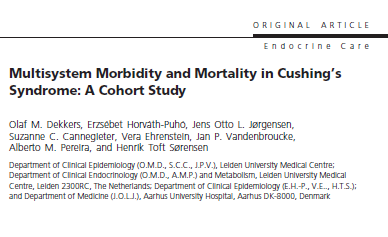
People with Cushing’s syndrome, even when treated, have higher morbidity and mortality rates that comparable controls. That is the conclusion of a new study published in the June issue of the Journal of Clinical Endocrinology Metabolism. The study by Olaf Dekkers et al, examined data records from the Danish National Registry of Patients and the Danish Civil Registration System of 343 patients with benign Cushing’s syndrome of adrenal or pituitary origin (i.e., Cushing’s disease) and a matched population comparison cohort (n=34,300).  Due to the lengthy delay of many patients being diagnosed with Cushing’s syndrome, morbidity was investigated in the 3 years before diagnosis while  morbidity and mortality were assessed during complete follow-up after diagnosis and treatment.

The study found that mortality was twice as high in Cushing’s syndrome patients (HR 2.3, 95% CI 1.8-2.9) compared with controls over a mean follow-up period of 12.1 years. Furthermore, patients with Cushing’s syndrome were at increased risk for:

  • venous thromboembolism (HR 2.6, 95% CI 1.5-4.7)
  • myocardial infarction (HR 3.7, 95% CI 2.4-5.5)
  • stroke (HR 2.0, 95% CI 1.3-3.2)
  • peptic ulcers (HR 2.0, 95% CI 1.1-3.6)
  • fractures (HR 1.4, 95% CI 1.0-1.9)
  • infections (HR 4.9, 95% CI 3.7-6.4).

The study also found that this increased multimorbidity risk was present before diagnosis indicating that it was due to cortisol overproduction rather than treatment.

Many of the Cushing’s syndrome patients underwent surgery to remove the benign tumor. For this group, the investigators performed a sensitivity analysis of the  long-term mortality and cardiovascular risk in this  subgroup (n=186)  considered to be cured after operation (adrenal surgery and patients with pituitary surgery in combination with a diagnosis of hypopituitarism in the first 6 months after operation).  The risk estimates for mortality (HR 2.31, 95% CI 1.62-3.28), venous thromboembolism (HR 2.03, 95% CI 0.75-5.48), stroke (HR 1.91, 95% CI 0.90-4.05), and acute myocardial infarction (HR 4.38, 95% CI 2.31-8.28) were also increased in this subgroup one year after the operation.

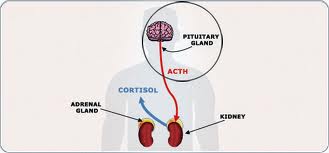
The standard treatment for endogenous Cushing’s syndrome is surgery. This past year, Signifor (pasireotide) was approved for treatment of adults patients with Cushing’s disease for whom pituitary surgery is not an option or has not been curative.  Cushing’s disease, which accounts for the majority of Cushing’s syndrome patients, is defined as the presence of an ACTH producing tumor on the pituitary grand. In the study by Dekker’s et al, the percentage of patients with Cushing’s disease is not known. We look forward to reexamination of this dataset in a few years following the introduction of more treatment options for Cushing’s disease as well as an analysis that explores the differences in mortality/morbidity rates in the different subsets of patients that make of Cushing’s syndrome (Cushing’s disease, ectopic Cushing’s syndrome, Exogenous Cyshing’s syndrome).

References

Dekkers OM, Horvath-Pujo, Jorgensen JOL, et al, Multisystem morbidity and mortality in Cushing’s syndrome: a cohort study. J Clin Endocrinol Metab 2013 98(6): 2277–2284. doi: 10.1210/jc.2012-3582

– See more at: http://www.raredr.com/medicine/articles/cushing%E2%80%99s-syndrome-hazardous-your-health-0

Pregnancy and pituitary disorders

Pituitary and pineal glands

Pituitary and pineal glands (Photo credit: Wikipedia)

Z Karaca, F Tanriverdi, K Unluhizarci and F Kelestimur
+ Author Affiliations

Department of Endocrinology,
Erciyes University Medical School, 38039 Kayseri, Turkey
(Correspondence should be addressed to F Kelestimur; Email: fktimur@erciyes.edu.tr)

Abstract

Major hormonal changes emerge during pregnancy. The pituitary gland is one of the most affected organs with altered anatomy and physiology. The pituitary gland is enlarged as a result of lactotroph hyperplasia. Due to physiological changes in the pituitary and target hormone levels, binding globulins, and placental hormones, hormonal evaluation becomes more complex in pregnant women. As a consequence of physiological hormonal changes, the evaluation of pituitary functions in pregnant women is quite different from that done in the prepregnant state. Pituitary adenomas may cause problems by their hormone secretion that affects the mother and the fetus besides causing an increased risk of tumor growth.

Furthermore, diagnosis, course, and treatment of pituitary diseases point out differences. The changes in anatomy and physiology of the pituitary gland during pregnancy are reviewed.

Pituitary disorders namely Cushing’s disease; acromegaly; prolactinoma; TSH-secreting, gonadotropin-producing, and clinically nonfunctioning adenomas; craniopharyngioma; and Sheehan’s syndrome, which is one of the most common causes of hypopituitarism, lymphocytic hypophysitis, and hypopituitarism, in relation to pregnancy are discussed. Being aware of all this information will prevent any serious problems which mother and child will be exposed to.

Read the entire article here: http://www.eje-online.org/content/162/3/453.full