Through The Art Of Makeup, People With Rare Pituitary Disorders Now Have Unique Resources To Help Address Common Physical And Emotional Changes

Did you know that applying contour powder on certain areas of your face, like the outer rim of the jaw, along the hairline or along the hollows of the cheek, can help make enlarged features less noticeable? Seems like a basic makeup tip, right? Well, to a person with a pituitary disorder that dramatically changes one’s facial features, this type of information may make a major difference – not only physically, but also psychologically.

This is why Novartis has teamed up with Kevyn Aucoin Beauty (KAB) to bring The Highlights Project to those living with acromegaly and Cushing’s disease. The program offers a variety of virtual tools such as makeup suggestions from professional artists and video demonstrations. These resources address common concerns expressed by patients while also educating about these rare, but serious pituitary disorders.

Kevyn Aucoin, founder of KAB and famed Hollywood makeup legend, was diagnosed with acromegaly in 2001 at the age of 40 and passed away less than 12 months later. Aucoin believed in the transformative nature of makeup and saw it as a reflection of both inner and outer beauty. In this spirit, The Highlights Project features a series of makeup tutorials, tips and inspirations designed to help enhance the self-image of pituitary patients. The program also includes the perspective of a psychotherapist who specializes in helping patients with acromegaly and Cushing’s disease.

Like so many other people with acromegaly and Cushing’s disease, Kevyn went undiagnosed for years and faced both emotional and physical challenges as a result of his condition. “Through Kevyn Aucoin Beauty’s partnership with Novartis on The Highlights Project, we hope that we can inspire others living with these pituitary disorders to see their own beauty and view makeup as Kevyn did, not as a mask, but as a tool for discovery,” said Desiree Tordecilla, Executive Vice President, Kevyn Aucoin Beauty.

Acromegaly and Cushing’s disease are pituitary disorders caused by the presence of a noncancerous tumor on the pituitary gland. The symptoms often include highly visual physical changes in the body. For people with acromegaly, enlarged facial features, jaw and brow protrusions, thickening of the skin and skin tags are common. People with Cushing’s disease frequently experience uncontrollable weight gain, facial fullness and redness, a buffalo hump, acne and oily skin. Beyond the external physical changes, these conditions often also cause serious health complications such as cardiovascular issues, fatigue, muscle weakness and cognitive changes. Those living with uncontrolled acromegaly and Cushing’s disease are also at an increased risk of death. Due to the rare nature of these diseases, receiving an accurate diagnosis can be difficult and may take several years – therefore, education and awareness is critical.

The Highlights Project aims to provide support and help those with acromegaly and Cushing’s disease manage the physical manifestations and psychosocial challenges often associated with these conditions.

“As someone who was self-conscious about how unfeminine my facial features appeared, I was amazed by the impact the simple makeup tricks I picked up from The Highlights Project had on my self-esteem,” said Shannon Goodson, who was diagnosed with acromegaly in 2008. “Staying positive, educating yourself about the condition and monitoring hormone levels to ensure the disease is under control are the first steps to empowering yourself and understanding that you are so much more than your diagnosis.”

The mission of The Highlights Project is to help put a face to the challenges those with acromegaly and Cushing’s disease may encounter and serve as a vessel for learning. Novartis is committed to helping to transform the care of rare pituitary conditions and bringing meaningful solutions to patients. To help support acromegaly and Cushing’s disease patients, and learn more about The Highlights Project, visit TheHighlightsProject.com. For more information about these diseases, visit AcromegalyInfo.com and CushingsDisease.com.
Read more from Journal Sentinel: http://www.jsonline.com/sponsoredarticles/health-wellness/through-the-art-of-makeup-people-with-rare-pituitary-disorders-now-have-unique-resources-to-help-address-common-physical-and-emotional-changes8087390808-251841151.html#ixzz2wtDUV9iF


Polycystic ovarian syndrome and Cushing’s syndrome: A persistent diagnostic quandary

European Journal of Obstetrics & Gynecology and Reproductive Biology, 02/10/2014  Clinical Article

Brzana J, et al. – This study aims to retrospectively review institutional records of female patients of reproductive age with Cushing’s disease (CD) and determine if and how many had been previously diagnosed as having solely PCOS. To determine whether clinical patterns might be useful in identifying appropriate candidates for hypercortisolism screening in women suspected of PCOS. Prolonged exposure to hypercortisolism has been linked with increased mortality and morbidity. Tests for hypercortisolism in all the PCOS cases authors report led to an appropriate CD diagnosis. Future research should focus on when and which (if not all) women with suspected PCOS should be tested for hypercortisolism.

Methods

  • The study included 50 patients with pathologically proven CD at Oregon Health & Science University, Northwest Pituitary Center between 2006 and 2011.
  • Physical, clinical, and biochemical features for hypercortisolism were compared.

Results

  • Of 50 patients with pathologically proven CD, 26 were women of reproductive age.
  • Of these, half had previously been diagnosed with and treated initially solely for PCOS.
  • Hirsutism and menstrual abnormalities were more common in the group with an initial PCOS diagnosis than in the group with an initial CD diagnosis.

From http://www.mdlinx.com/endocrinology/newsl-article.cfm/5055779/ZZ4747461521296427210947/?news_id=2364&newsdt=021014&subspec_id=1509&utm_source=Focus-On&utm_medium=newsletter&utm_content=Top-New-Article&utm_campaign=article-section

Outcome of Bilateral Adrenalectomy in Cushing’s Syndrome: A Systematic Review

  1. Katrin Ritzel,
  2. Felix Beuschlein,
  3. Anne Mickisch,
  4. Andrea Osswald,
  5. Harald J. Schneider,
  6. Jochen Schopohl and
  7. Martin Reincke

Author Affiliations


  1. Medizinische Klinik und Poliklinik IV, Klinikum der Universität München, D-80336 München, Germany
  1. Address all correspondence and requests for reprints to: Martin Reincke, M.D., Medizinische Klinik und Poliklinik IV, Klinikum der Universität München, Ziemssenstrasse 1, D-80336 München, Germany. E-mail:Martin.Reincke@med.uni-muenchen.de.

Abstract

Background: The outcome of bilateral adrenalectomy (BADx) in patients with Cushing’s syndrome (CS) is not well characterized.

Methods: A literature search was performed with the search terms “bilateral adrenalectomy” or “total adrenalectomy” and “Cushing’s” or “Cushing.” Immediate and long-term outcomes after BADx in CS were analyzed using descriptive statistics (median [range]).

Results: From 549 screened publications, 37 studies met inclusion criteria (1320 patients, 82% having Cushing’s disease [CD], 13% having ectopic CS, and 5% having primary adrenal hyperplasia).

Surgical morbidity and mortality of BADx (23 studies, 739 patients) were 18% (6–31) and 3% (0–15), respectively. In patients with CD, surgical mortality was below 1%. Although residual cortisol secretion due to accessory adrenal tissue or adrenal remnants was found in 3–34% (5 studies, 236 patients), less than 2% had a relapse of CS.

Symptoms of hypercortisolism (eg, hypertension, obesity, or depression) improved in the majority of the patients after BADx (7 studies, 195 patients). The number of adrenal crises per 100 patient-years was 9.3 (6 studies, 203 patients).

Nelson’s syndrome occurred in 21% (0–47) of the patients (24 studies, 768 patients). Mortality (23 studies, 690 patients) was 17% (0–88) at a follow-up of 41 months (14–294). Remarkably, 46% of the patients died in the first year after surgery. The median ages at death were 62 years (CD) and 53 years (ectopic CS).

Conclusion: BADx is relatively safe and provides adequate success. Excess mortality within the first year after surgery suggests that intensive clinical care for patients after BADx is warranted.

Footnotes

  • For editorial see page 3974

  • Abbreviations:

    BADx
    bilateral adrenalectomy
    BAH
    bilateral adrenal hypercortisolism
    CD
    Cushing’s disease
    CS
    Cushing’s syndrome
    ECS
    ectopic CS
    NS
    Nelson’s syndrome
    QOL
    quality of life
    TSS
    transsphenoidal surgery.


From http://jcem.endojournals.org/content/98/10/3939.abstract

Mortality in Cushing’s syndrome: data from 386 patients from a single tertiary referral center

Source

M Yaneva, Endocrinology, Medical University, Sofia, 1341, Bulgaria.

European Journal of Endocrinology, 08/16/2013  Review Article

Yaneva MK et al. – Data on the incidence, mortality and causes of death in patients with Cushing’s syndrome (CS) are scarce, due to the rarity of CS. The aim of the study was to analyze mortality rates in CS in a large cohort of patients of all etiologies and to determine the cause of death. Patients with CS have increased mortality due to vascular events and infections.

Abstract

OBJECTIVE:

Data on the incidence, mortality and causes of death in patients with Cushing’s syndrome (CS) are scarce, due to the rarity of CS. The aim of the study was to analyze mortality rates in CS in a large cohort of patients of all etiologies and to determine the cause of death.

DESIGN:

This was a retrospective study of patients with CS, treated over a period of 45 years in the main tertiary referral center in Bulgaria.

METHODS:

386 patients with CS of all etiologies were included. The main outcome measures were the standardized mortality ratio (SMR) and the cause of death.

RESULTS:

Mean (± SD) age at diagnosis was 38±13 years; 84% of patients were women; mean follow up was 85 months (range: 0-494 months). The SMR in the CS cohort was 4.05 (95% confidence interval (CI) 2.50-5.80) (p<0.0001). The following subgroups did not have a significantly increased SMR: patients with Cushing’s disease SMR – 1.88 (95%CI 0.69-4.08), adrenal adenomas 1.67 (95%CI 0.20-6.02) and ACTH-independent bilateral adrenal hyperplasia 1.14 (95 %CI 0.21-6.34). Patients with adrenal carcinomas, ectopic CS and those with CS of undetermined etiology had significantly increased SMR: 48.00 (95%CI 30.75-71.42), 13.33 (95%CI 0.00-24.59) and 4.00 (95%CI 0.48-14.45), respectively (p<0.0001). The significant predictors for mortality were active disease at death, age, male sex, etiology of the disease, the overall duration of active disease. The major causes of death were vascular events (40%) -cardiovascular 29% and cerebrovascular 11%, followed by infections (12%).

CONCLUSIONS:

Patients with CS have increased mortality due to vascular events and infections.

Read more at MDLinx

Cushing’s Syndrome is Hazardous to Your Health

morbidity

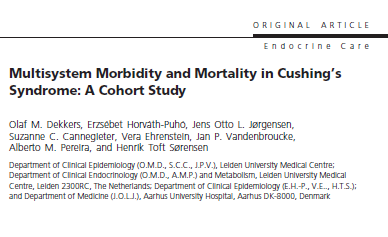
People with Cushing’s syndrome, even when treated, have higher morbidity and mortality rates that comparable controls. That is the conclusion of a new study published in the June issue of the Journal of Clinical Endocrinology Metabolism. The study by Olaf Dekkers et al, examined data records from the Danish National Registry of Patients and the Danish Civil Registration System of 343 patients with benign Cushing’s syndrome of adrenal or pituitary origin (i.e., Cushing’s disease) and a matched population comparison cohort (n=34,300).  Due to the lengthy delay of many patients being diagnosed with Cushing’s syndrome, morbidity was investigated in the 3 years before diagnosis while  morbidity and mortality were assessed during complete follow-up after diagnosis and treatment.

The study found that mortality was twice as high in Cushing’s syndrome patients (HR 2.3, 95% CI 1.8-2.9) compared with controls over a mean follow-up period of 12.1 years. Furthermore, patients with Cushing’s syndrome were at increased risk for:

  • venous thromboembolism (HR 2.6, 95% CI 1.5-4.7)
  • myocardial infarction (HR 3.7, 95% CI 2.4-5.5)
  • stroke (HR 2.0, 95% CI 1.3-3.2)
  • peptic ulcers (HR 2.0, 95% CI 1.1-3.6)
  • fractures (HR 1.4, 95% CI 1.0-1.9)
  • infections (HR 4.9, 95% CI 3.7-6.4).

The study also found that this increased multimorbidity risk was present before diagnosis indicating that it was due to cortisol overproduction rather than treatment.

Many of the Cushing’s syndrome patients underwent surgery to remove the benign tumor. For this group, the investigators performed a sensitivity analysis of the  long-term mortality and cardiovascular risk in this  subgroup (n=186)  considered to be cured after operation (adrenal surgery and patients with pituitary surgery in combination with a diagnosis of hypopituitarism in the first 6 months after operation).  The risk estimates for mortality (HR 2.31, 95% CI 1.62-3.28), venous thromboembolism (HR 2.03, 95% CI 0.75-5.48), stroke (HR 1.91, 95% CI 0.90-4.05), and acute myocardial infarction (HR 4.38, 95% CI 2.31-8.28) were also increased in this subgroup one year after the operation.

The standard treatment for endogenous Cushing’s syndrome is surgery. This past year, Signifor (pasireotide) was approved for treatment of adults patients with Cushing’s disease for whom pituitary surgery is not an option or has not been curative.  Cushing’s disease, which accounts for the majority of Cushing’s syndrome patients, is defined as the presence of an ACTH producing tumor on the pituitary grand. In the study by Dekker’s et al, the percentage of patients with Cushing’s disease is not known. We look forward to reexamination of this dataset in a few years following the introduction of more treatment options for Cushing’s disease as well as an analysis that explores the differences in mortality/morbidity rates in the different subsets of patients that make of Cushing’s syndrome (Cushing’s disease, ectopic Cushing’s syndrome, Exogenous Cyshing’s syndrome).

References

Dekkers OM, Horvath-Pujo, Jorgensen JOL, et al, Multisystem morbidity and mortality in Cushing’s syndrome: a cohort study. J Clin Endocrinol Metab 2013 98(6): 2277–2284. doi: 10.1210/jc.2012-3582

– See more at: http://www.raredr.com/medicine/articles/cushing%E2%80%99s-syndrome-hazardous-your-health-0