Cushing’s Awareness Challenge: Day 10

robin-tests

Gee, I’m an underachiever. LOL I only had one IPSS and one pituitary surgery.

While I was at NIH, my MRIs still showed nothing, so they did an Inferior Petrosal Sinus Sampling Test. That scared me more than the prospect of surgery. (This test carries the risk of stroke and uncontrollable bleeding from the incision points.) Catheters were fed from my groin area to my pituitary gland and dye was injected. I could watch the whole procedure on monitors.

I could not move during this test or for several hours afterwards to prevent uncontrollable bleeding from a major artery. The test did show where the tumor probably was located.

Also done were more sophisticated dexamethasone suppression tests where drugs were administered by IV and blood was drawn every hour (they put a heplock in my arm so they didn’t have to keep sticking me). I got to go home for a weekend and then went back for the surgery – the Transsphenoidal Resection. I fully expected to die during surgery (and didn’t care if I did) so I signed my will and wrote last letters to those I wanted to say goodbye to.

During the time I was home just before surgery, a college classmate of mine (I didn’t know her) did die at NIH of a Cushing’s-related problem. I’m so glad I didn’t find out until a couple months later!

maryo colorful zebra

Cushing’s Awareness Challenge: Day 9

cushings-women

Another of Robin’s fine awareness graphics.  I had all these symptoms except Type 2 Diabetes.

After my pituitary surgery, I had diabetes mellitus for a while but that went away.

It was the easy bruising that finally got me diagnosed.

In 1986 I started bruising incredibly easily. I could touch my skin and get a bruise.

On New Year’s Day of 1987 I started bleeding under the skin. My husband made circles around the outside perimeter each hour with a marker, like the rings of a tree. When I went to my Internist the next day he was shocked at the size. He now thought I had a blood disorder so he sent me to a Hematologist/Oncologist.

Fortunately, the Hematologist/Oncologist ran a twenty-four hour urine test and really looked at me. Both he and his partner recognized that I had Cushing’s. Of course, he was sure that he did the diagnosis. No matter that I had been pursuing this with other doctors for 3 years.

However, he couldn’t help me any further so the Hematologist referred me to an Endocrinologist and I was finally on the way to my diagnosis.


maryo colorful zebra


Cushing’s Awareness Challenge, Day 4

Another idea I borrowed from Robin – using a Wordle as inspiration for today’s post.
Even though I’m “in remission” since 1987, I’m still way too fatigued, napping every afternoon for several hours.  People think I should be normal since my pituitary surgery was so long ago.  Well, no.
me-tired
Just a few days ago, I posted this abstract on Severe fatigue in patients with adrenal insufficiency.  I don’t think that they needed to do this study at all.  Just ask any Cushie!

Abstract

BACKGROUND:

Fatigue is a frequently experienced complaint in patients with adrenal insufficiency (AI) and may be influenced by cortisol levels.

AIM:

The objective of this study was to determine the prevalence of severe fatigue in adrenal insufficiency (AI) patients, to assess which dimensions contribute to fatigue severity and to determine the association between salivary cortisol levels and momentary fatigue.

SUBJECTS AND METHODS:

We performed a cross-sectional study in the outpatient department of a university hospital. Included were 27 patients with congenital adrenal hyperplasia (CAH), 26 patients with primary AI (PAI), 24 patients with secondary AI (SAI) and 31 patients with adrenal insufficiency after treatment for Cushing’s syndrome (Cush-AI). Measurements included computerised questionnaires to determine fatigue severity and physical and psychosocial contributors. Patients took four saliva samples at home, in which cortisol levels were measured.

RESULTS:

Severe fatigue was experienced by 41 % of the CAH patients, 42 % of the PAI patients, 50 % of the SAI patients and 42 % of the Cush-AI patients. Psychological distress, functional impairment, sleep disturbance, physical activity, concentration problems and social functioning contributed to the subjective experience of fatigue. Salivary cortisol levels were not correlated with momentary fatigue.

CONCLUSIONS:

A considerable proportion of AI patients experience severe fatigue. Salivary cortisol level is not a significant predictor for momentary fatigue in AI patients.

PMID:
24615365
[PubMed – in process]

From http://www.ncbi.nlm.nih.gov/pubmed/24615365


Back to my nap now…

maryo colorful zebra

Cushing’s Syndrome is Hazardous to Your Health

morbidity

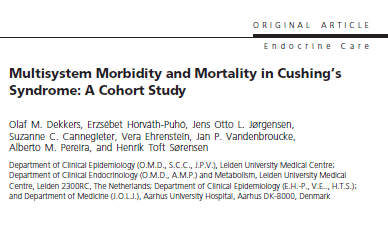
People with Cushing’s syndrome, even when treated, have higher morbidity and mortality rates that comparable controls. That is the conclusion of a new study published in the June issue of the Journal of Clinical Endocrinology Metabolism. The study by Olaf Dekkers et al, examined data records from the Danish National Registry of Patients and the Danish Civil Registration System of 343 patients with benign Cushing’s syndrome of adrenal or pituitary origin (i.e., Cushing’s disease) and a matched population comparison cohort (n=34,300).  Due to the lengthy delay of many patients being diagnosed with Cushing’s syndrome, morbidity was investigated in the 3 years before diagnosis while  morbidity and mortality were assessed during complete follow-up after diagnosis and treatment.

The study found that mortality was twice as high in Cushing’s syndrome patients (HR 2.3, 95% CI 1.8-2.9) compared with controls over a mean follow-up period of 12.1 years. Furthermore, patients with Cushing’s syndrome were at increased risk for:

  • venous thromboembolism (HR 2.6, 95% CI 1.5-4.7)
  • myocardial infarction (HR 3.7, 95% CI 2.4-5.5)
  • stroke (HR 2.0, 95% CI 1.3-3.2)
  • peptic ulcers (HR 2.0, 95% CI 1.1-3.6)
  • fractures (HR 1.4, 95% CI 1.0-1.9)
  • infections (HR 4.9, 95% CI 3.7-6.4).

The study also found that this increased multimorbidity risk was present before diagnosis indicating that it was due to cortisol overproduction rather than treatment.

Many of the Cushing’s syndrome patients underwent surgery to remove the benign tumor. For this group, the investigators performed a sensitivity analysis of the  long-term mortality and cardiovascular risk in this  subgroup (n=186)  considered to be cured after operation (adrenal surgery and patients with pituitary surgery in combination with a diagnosis of hypopituitarism in the first 6 months after operation).  The risk estimates for mortality (HR 2.31, 95% CI 1.62-3.28), venous thromboembolism (HR 2.03, 95% CI 0.75-5.48), stroke (HR 1.91, 95% CI 0.90-4.05), and acute myocardial infarction (HR 4.38, 95% CI 2.31-8.28) were also increased in this subgroup one year after the operation.

The standard treatment for endogenous Cushing’s syndrome is surgery. This past year, Signifor (pasireotide) was approved for treatment of adults patients with Cushing’s disease for whom pituitary surgery is not an option or has not been curative.  Cushing’s disease, which accounts for the majority of Cushing’s syndrome patients, is defined as the presence of an ACTH producing tumor on the pituitary grand. In the study by Dekker’s et al, the percentage of patients with Cushing’s disease is not known. We look forward to reexamination of this dataset in a few years following the introduction of more treatment options for Cushing’s disease as well as an analysis that explores the differences in mortality/morbidity rates in the different subsets of patients that make of Cushing’s syndrome (Cushing’s disease, ectopic Cushing’s syndrome, Exogenous Cyshing’s syndrome).

References

Dekkers OM, Horvath-Pujo, Jorgensen JOL, et al, Multisystem morbidity and mortality in Cushing’s syndrome: a cohort study. J Clin Endocrinol Metab 2013 98(6): 2277–2284. doi: 10.1210/jc.2012-3582

– See more at: http://www.raredr.com/medicine/articles/cushing%E2%80%99s-syndrome-hazardous-your-health-0

Endoscopic transsphenoidal pituitary surgery: a good and safe primary treatment option for Cushings disease, even in case of macroadenomas or invasive adenomas.

Abstract – European Journal of Endocrinology, 06/24/2013  Clinical Article

Wagenmakers MA et al. – This study aims to gain insight in the role of endoscopic TS as a primary treatment option for CD, especially in patients with MRI negative CD and (invasive) macroadenomas.

The data suggest that in patients with non–invasive and invasive macroadenomas the endoscopic technique of TS should be the technique of choice as remission rates seem to be higher than remission rates reported for microscopic TS, although no comparative study has been performed.

Get this article here.