Cushing’s Disease – Rare Disease Quick Facts

cushings-diagnosis


Cushing’s disease is a rare condition due to excess cortisol levels that result from a pituitary tumor secreting adrenocorticotropic hormone (ACTH), which stimulates cortisol secretion.  Cushing’s disease should not be confused with Cushing’s syndrome which is increased cortisol levels but that increase can be due to any number of factors. However, Cushing’s disease is the most common form of Cushing’s syndrome.

Symptoms

The symptoms related to Cushing’s disease and Cushing’s syndrome are the same, since both are related to an excess of cortisol. Also, symptoms vary extensively among patients and that, with the inherent fluctuation in hormone levels make it difficult to diagnosis both conditions.

Changes in physical characteristics of the body

  • Fullness and rounding of the face
  • Added fat on back of neck (so-called “buffalo hump”)
  • Easy bruising
  • Purplish stretch marks on the abdomen (abdominal striae)
  • Excessive weight gain, especially in abdominal region
  • Red cheeks
  • Excess hair growth on the face, neck, chest, abdomen and thighs

Changes in physiology/psychology

  • Generalized weakness and fatigue
  • Menstrual disorder
  • Decreased fertility and/or sex drive
  • High blood pressure that is often difficult to treat
  • Diabetes mellitus
  • Mood and behavior disorders

Diagnosis

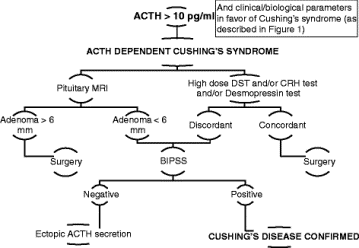
The early stages of Cushing’s disease may be difficult to recognize. However, if it is suspected, diagnosis is generally a 2 stage process. First to determine if cortisol levels are high, and if so, why they are high.

Tests to confirm high cortisol levels:

  • 24-hour urine cortisol
  • Dexamethasone suppression test (low dose)

Tests to determine cause:

  • Blood ACTH level
  • Brain MRI
  • Corticotropin-releasing hormone test
  • Dexamethasone suppression test (high dose)
  • Petrosal sinus sampling

Treatment

Surgery

  • Most patients with Cushing’s disease undergo surgery to remove the pituitary adenoma offers.
  • If the tumor is isolated to the pituitary, cure rates of 80-85% are common.
  • If the tumor has spread to nearby organs, cure rates of 50-55% are common.

Medicine (approved orphan drugs)

Signifor (pasireotide)

  • Approved for patients with Cushing’s disease for whom pituitary is not an option or surgery has been ineffective.
  • Signifor is a somatostatin receptor agonist that leads to inhibition of ACTY secretion (and subsequently decreased cortisol levels).

Korlym (mifepristone)

  • Approved for patients with Cushing’s syndrome who have type 2 diabetes or glucose intolerance and have failed surgery (or not candidates for surgery).
  • Korlym is a glucocorticoid receptor antagonist which in turn blocks the effects of the high levels of cortisol in the body. Korlym is used to treat high glucose levels due to elevated cortisol.

Medicines used but not indicated for Cushing’s disease include

Mitoden

ketoconazole

Metyrapone

Etomidate

Radiation

  • Radiation therapy may be used in some patients and can be very effective in controlling the growth of these tumors.

Prognosis

In most cases, treatment can cure Cushing’s disease. If not treated properly, the chronic hypercortisolism can lead to excess morbidity and mortality due to increased cardiovascular and other risk factors.

For more information

National Library of Medicine, National Institute of Health

Cushing’s Disease Information (provided by Novartis Pharmaceuticals)


Images courtesy of the open access journal Orhanet Journal for Rare Diseases.  Castinetti et al. Orphanet J Rare Dis. 2012 7:41   doi:10.1186/1750-1172-7-41

– See more at: http://www.raredr.com/front-page-medicine/articles/cushings-disease-rare-disease-quick-facts-0

Pasireotide for the treatment of Cushing’s disease

Posted online on June 17, 2013. (doi:10.1517/21678707.2013.807731)

Annamaria Colao Chiara Simeoli Monica De Leo Alessia Cozzolino Rosario Pivonello

Department of Clinical Medicine and Surgery, Section of Endocrinology, Federico II University, Via Sergio Pansini 5,

80131 Naples

, Italy +39 0817462132; +39 0815465443; colao@unina.it

Author for correspondence

Introduction: Pasireotide, a novel multireceptor targeted somatostatin analog is the first drug approved for treatment of adult patients with Cushing’s disease (CD) for whom pituitary surgery is not an option or has not been curative.

Areas covered: The review describes published data on efficacy and safety of pasireotide in CD patients. In particular, the review focuses on a Phase III study (CSOM230B2305) evaluating the outcomes of treatment with pasireotide at the doses of 600 and 900 µg twice daily for 12 months in 162 CD patients. This clinical trial reported a decrease in urinary free cortisol levels in the majority of patients, with a substantial reduction in nearly half and a normalization in > 25% of patients included in the study, accompanied by an improvement in clinical picture as well as a significant reduction in pituitary tumor size. Hyperglycemia appears as the most important side effect, requiring a careful monitoring and a prompt administration of glucose-lowering medications.

Expert opinion: Pasireotide seems to have a promising role as medical option for CD patients who experienced a failure or not candidate for neurosurgery; its employment will probably induce in the near future significant changes in the therapeutic approach to CD.

Read More: http://informahealthcare.com/doi/abs/10.1517/21678707.2013.807731

Salk scientists find potential therapeutic target for Cushing’s disease

LA JOLLA, CA—Scientists at the Salk Institute for Biological Studies have identified a protein that drives the formation of pituitary tumors in Cushing’s disease, a development that may give clinicians a therapeutic target to treat this potentially life-threatening disorder.

The protein, called TR4 (testicular orphan nuclear receptor 4), is one of the human body’s 48 nuclear receptors, a class of proteins found in cells that are responsible for sensing hormones and, in response, regulating the expression of specific genes. Using a genome scan, the Salk team discovered that TR4 regulates a gene that produces adrenocorticotropic hormone (ACTH), which is overproduced by pituitary tumors in Cushing’s disease (CD). The findings were published in the May 6 early online edition of Proceedings of the National Academy of Sciences.

“We were surprised by the scan, as TR4 and ACTH were not known to be functionally linked,” says senior author Ronald M. Evans, a professor in Salk’s Gene Expression Laboratory and a lead researcher in the Institute’s Helmsley Center for Genomic Medicine. “TR4 is driving the growth and overexpression of ACTH. Targeting this pathway could therapeutically benefit treatment of CD.”

In their study, Evans and his colleagues discovered that forced overexpression of TR4 in both human and mouse cells increased production of ACTH, cellular proliferation and tumor invasion rates. All of these events were reversed when TR4 expression was reduced.

First described more than 80 years ago, Cushing’s disease is a rare disorder that is caused by pituitary tumors or excess growth of the pituitary gland located at the base of the brain. People with CD have too much ACTH, which stimulates the production and release of cortisol, a hormone that is normally produced during stressful situations.

While these pituitary tumors are almost always benign, they result in excess ACTH and cortisol secretion, which can result in various disabling symptoms, including diabetes, hypertension, osteoporosis, obesity and psychological disturbances. Surgical removal of the tumors is the first-line therapy, with remission rates of approximately 80 percent; however, the disease recurs in up to 25 percent of cases.

Drugs such as cabergoline, which is used to treat certain pituitary tumors, alone or in combination with ketoconazole, a drug normally used to treat fungal infections, have been shown to be effective in some patients with Cushing’s disease. More recently, mefipristone-best known as the abortion pill RU-486-was approved by the FDA to treat CD. Despite these advances in medical therapy, the Salk scientists say additional therapeutic approaches are needed for CD.

“Pituitary tumors are extremely difficult to control,” says Michael Downes, a senior staff scientist in the Gene Expression Laboratory and a co-author of the study. “To control them, you have to kill cells in the pituitary gland that are proliferating, which could prevent the production of a vital hormone.”

Previous studies have found that, by itself, TR4 is a natural target for other signaling molecules in the pituitary. Small-molecule inhibitors that have been developed for other cancers could be potentially applied to disrupt this signaling cascade. “Our discovery,” says Evans, a Howard Hughes Medical Institute investigator and holder of the March of Dimes Chair in Molecular and Developmental Biology, “might lead clinicians to an existing drug that could be used to treat Cushing’s disease.”