Rare Disease Week

The House & Senate Congressional Calendars came out this week!

Congress is in session during Rare Disease Week – SaveTheDate!

Feb. 25th – Feb. 28th, 2013

4 Days of Rare Disease Events in Washington DC!

More info coming soon.

2nd Annual Patient Advocacy Summit

RARE

Come join us for our 2nd Annual “RARE Patient Advocacy Summit
to be held on Friday, September 20, 2013
at The Balboa Bay Club & Resort in Newport Beach, CA.

Register today!

Seating is limited for in-person participation.

Webcast registration available for those unable to attend in person.

divider

From Symptom to Cure:  The Journey of a Rare Disease Advocate ~ Equipping Patients to Make a Difference

Join Global Genes | RARE Project for a unique and interactive educational experience at our 2nd Annual Patient Advocacy Summit on Friday, September 20, 2013.   There is no charge to participate in this event.

A rare diagnosis changes everything. It crashes plans and dreams, knocks you off your feet, and requires a continual investment of time and money as you try to determine what should be your next step.  The purpose of the RARE Patient Advocacy Summit is to help patient ADVOCATES become successful ACTIVISTS and to provide the discussion, insights and tools to move down this advocacy path, equipped and prepared.

The summit will offer practical advice, case studies and networking opportunities as we learn from one another.  The goal is to have patient advocates walk away with a better understanding of the challenges they will face and where they can be most effective in helping advocate for their disease/disorder.

Attendees will:
  • Learn how to get started: obtain 501c3 status, write grants, leverage PR effectively and utilize social media to spread your message.

  • Collaboration: Understand how to successfully work with other rare disease stakeholders, patient advocates, the FDA and other government entities.

  • Learn the importance of patient registries, the different types of registries and how advocates can support them.

  • Explore the role of foundations and advocates related to scientific discovery and drug development.

  • Gain a broad understanding of the scientific process, including diagnostic and research methodologies and collaborations with academia and industry.

At the end of this day-long event, each participant will gain perspective on the complexities and questions that need to be considered in order to become effective advocates for the rare disease patients and help advance therapies in the rare diseases we represent.

Who Should Attend:
  • Rare disease patients, caregivers, family members and friends
  • Patient advocates

Whether you are new to this rare disease journey or an experienced traveler, an individual advocate or part of an existing rare disease organization, you will gain value from this event.

Register today!

divider

Hotel and Travel Information

divider

Sponsor Information

To become a sponsor or for more information, please contact Nicole Boice.  We look forward to seeing you at this year’s summit.

 View videos from our 2012 event.

Cushing’s Disease – Rare Disease Quick Facts

cushings-diagnosis


Cushing’s disease is a rare condition due to excess cortisol levels that result from a pituitary tumor secreting adrenocorticotropic hormone (ACTH), which stimulates cortisol secretion.  Cushing’s disease should not be confused with Cushing’s syndrome which is increased cortisol levels but that increase can be due to any number of factors. However, Cushing’s disease is the most common form of Cushing’s syndrome.

Symptoms

The symptoms related to Cushing’s disease and Cushing’s syndrome are the same, since both are related to an excess of cortisol. Also, symptoms vary extensively among patients and that, with the inherent fluctuation in hormone levels make it difficult to diagnosis both conditions.

Changes in physical characteristics of the body

  • Fullness and rounding of the face
  • Added fat on back of neck (so-called “buffalo hump”)
  • Easy bruising
  • Purplish stretch marks on the abdomen (abdominal striae)
  • Excessive weight gain, especially in abdominal region
  • Red cheeks
  • Excess hair growth on the face, neck, chest, abdomen and thighs

Changes in physiology/psychology

  • Generalized weakness and fatigue
  • Menstrual disorder
  • Decreased fertility and/or sex drive
  • High blood pressure that is often difficult to treat
  • Diabetes mellitus
  • Mood and behavior disorders

Diagnosis

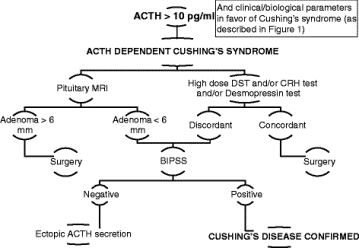
The early stages of Cushing’s disease may be difficult to recognize. However, if it is suspected, diagnosis is generally a 2 stage process. First to determine if cortisol levels are high, and if so, why they are high.

Tests to confirm high cortisol levels:

  • 24-hour urine cortisol
  • Dexamethasone suppression test (low dose)

Tests to determine cause:

  • Blood ACTH level
  • Brain MRI
  • Corticotropin-releasing hormone test
  • Dexamethasone suppression test (high dose)
  • Petrosal sinus sampling

Treatment

Surgery

  • Most patients with Cushing’s disease undergo surgery to remove the pituitary adenoma offers.
  • If the tumor is isolated to the pituitary, cure rates of 80-85% are common.
  • If the tumor has spread to nearby organs, cure rates of 50-55% are common.

Medicine (approved orphan drugs)

Signifor (pasireotide)

  • Approved for patients with Cushing’s disease for whom pituitary is not an option or surgery has been ineffective.
  • Signifor is a somatostatin receptor agonist that leads to inhibition of ACTY secretion (and subsequently decreased cortisol levels).

Korlym (mifepristone)

  • Approved for patients with Cushing’s syndrome who have type 2 diabetes or glucose intolerance and have failed surgery (or not candidates for surgery).
  • Korlym is a glucocorticoid receptor antagonist which in turn blocks the effects of the high levels of cortisol in the body. Korlym is used to treat high glucose levels due to elevated cortisol.

Medicines used but not indicated for Cushing’s disease include

Mitoden

ketoconazole

Metyrapone

Etomidate

Radiation

  • Radiation therapy may be used in some patients and can be very effective in controlling the growth of these tumors.

Prognosis

In most cases, treatment can cure Cushing’s disease. If not treated properly, the chronic hypercortisolism can lead to excess morbidity and mortality due to increased cardiovascular and other risk factors.

For more information

National Library of Medicine, National Institute of Health

Cushing’s Disease Information (provided by Novartis Pharmaceuticals)


Images courtesy of the open access journal Orhanet Journal for Rare Diseases.  Castinetti et al. Orphanet J Rare Dis. 2012 7:41   doi:10.1186/1750-1172-7-41

– See more at: http://www.raredr.com/front-page-medicine/articles/cushings-disease-rare-disease-quick-facts-0

The Rare Disease Search Engine That Outperforms Google

A powerful new search engine designed to help diagnose rare diseases could prove a boon for both medics and the public.

In the late 1940s, a professor at the University of Maryland School of Medicine coined an unusual phrase to describe unexpected diagnoses. “When you hear hoofbeats behind you, don’t expect to see a zebra,” he said. The phrase stuck and today, medics commonly use the term “zebra” to describe a rare disease, usually defined as one that occurs in less than 1 in 2000 of the population.

Rare diseases are inherently hard to diagnose. According to the European Organisation for Rare Disease, 25 per cent of diagnoses are delayed by between 5 and 30 years.

So it’s no surprise that medics are looking for more effective ways to do the job. An increasingly common aid in this process is the search engine, typically Google.  This forms part of an iterative process in which a medic enter symptoms into a search engine, examines lists of potential diseases and then looks for further evidence of symptoms in the patient.

The problem, of course, is that  common-or-garden search engines are not optimised for this process. Google, for example, considers pages important if they are linked to by other important pages, the basis of its famous PageRank algorithm. However, rare diseases by definition are unlikely to have a high profile on the web. What’s more, searches are likely to be plagued with returns from all sorts of irrelevant sources.

Today, Radu Dragusin at the Technical University of Denmark and a few pals unveil an alternative. These guys have set up a bespoke search engine dedicated to the diagnosis of rare diseases called FindZebra, a name based on the common medical slang for a rare disease. After comparing the results from this engine against the same searches on Google, they show that it is significantly better at returning relevant results.

The magic sauce in FindZebra is the index it uses to hunt for results. These guys have created this index by crawling a specially selected set of curated  databases on rare diseases. These include the Online Mendelian Inheritance in Man database, the Genetic and Rare Diseases Information Center and Orphanet

They then use the open source information retrieval tool Indri  to search this index via a website with a conventional search engine interface. The result is FindZebra.

Finally, they compared the results of  searches on FindZebra against the same search on Google applied to the same limited dataset, a feature that is possible with advanced Google searches.  Dragusin and co say that the Google results are significantly worse than their own.

For example, on FindZebra the search query “Boy, normal birth, deformity of both big toes (missing joint), quick development of bone tumor near spine and osteogenesis at biopsy” returns the correct diagnosis “Fibrodysplasia ossificans progressiva” as the first result. However, this diagnosis does not appear at all in the results from any type of Google search.

This indicates that the PageRank algorithm, or at least the way Google has tweaked it, is not suited to this kind of search. “Our finding, that FindZebra outperforms Google overall for this task and especially when restricted to the sites of our collection (Google Restricted), suggests that Google ranking algorithm is suboptimal for the task at hand,” they conclude.

Although still a research project, Dragusin and co have made their rare disease search engine publicly available at www.findzebra.com. This could clearly become a valuable tool for the medical community.

What is less clear, however, is how this tool will be used by the general public. The site comes with the forlorn message: “Warning! FindZebra is a research project and it is to be used only by medical professionals” .

FindZebra could obviously be a hypochondriac’s charter. On the other hand, that’s true of any medical dictionary.

The informed public are increasingly visiting their doctors armed with detailed information downloaded form the internet.  Any move to improve the quality of this information must surely be of significant value.

Ref: arxiv.org/abs/1303.3229: FindZebra: A Search Engine For Rare Diseases

From TechnologyReview.com

The Deadline is Friday for Helping Grow the Rare Disease Congressional Caucus

caucus1

Friday, May 17 at 8PM eastern is the deadline for this.

We want to have Caucus Members from all 50 States.

We have 28 to go: AL, AK, AZ, CO, CT, DE, HI, ID, KS, KY, LA, ME, MD, MS, MO, MT, NV, NH, NM, ND, OK, RI, SC, SD, UT, VT, WI, & WY If you live in one of these states or know someone who does – Please take ACTION today!


http://bit.ly/RareAlert

Original post:

Help us strengthen the rare disease community’s voice on Capitol Hill!  Please take 3 minutes to ask your Member of Congress to join the Rare Disease Caucus at http://bit.ly/RareAlert.
It’s easy – the Action Center has a draft letter that will automatically be sent to your Member of Congress – just put in your name and address & click send.  We also encourage you to personalize the letter to share information about your specific disease.  If your Congress Member is already on the Caucus, the letter will automatically populate as a thank you letter instead – these are just as important to send!
It can take up to 10 letters from constituents for a Member to respond so please share this Action Alert with your friends, family & colleagues.  Join our Facebook event & invite your friends:   http://on.fb.me/17Mlpjg
The Rare Disease Congressional Caucus will help bring public and Congressional awareness to the unique needs of the rare disease community – patients, physicians, scientists, and industry, and create opportunities to address roadblocks in access to and development of crucial treatments.  The Caucus will give a permanent voice to the rare disease community on Capitol Hill.  Working together, we can find solutions that turn hope into treatments.