Cushing’s Disease – Rare Disease Quick Facts

cushings-diagnosis


Cushing’s disease is a rare condition due to excess cortisol levels that result from a pituitary tumor secreting adrenocorticotropic hormone (ACTH), which stimulates cortisol secretion.  Cushing’s disease should not be confused with Cushing’s syndrome which is increased cortisol levels but that increase can be due to any number of factors. However, Cushing’s disease is the most common form of Cushing’s syndrome.

Symptoms

The symptoms related to Cushing’s disease and Cushing’s syndrome are the same, since both are related to an excess of cortisol. Also, symptoms vary extensively among patients and that, with the inherent fluctuation in hormone levels make it difficult to diagnosis both conditions.

Changes in physical characteristics of the body

  • Fullness and rounding of the face
  • Added fat on back of neck (so-called “buffalo hump”)
  • Easy bruising
  • Purplish stretch marks on the abdomen (abdominal striae)
  • Excessive weight gain, especially in abdominal region
  • Red cheeks
  • Excess hair growth on the face, neck, chest, abdomen and thighs

Changes in physiology/psychology

  • Generalized weakness and fatigue
  • Menstrual disorder
  • Decreased fertility and/or sex drive
  • High blood pressure that is often difficult to treat
  • Diabetes mellitus
  • Mood and behavior disorders

Diagnosis

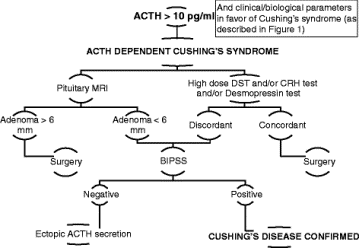
The early stages of Cushing’s disease may be difficult to recognize. However, if it is suspected, diagnosis is generally a 2 stage process. First to determine if cortisol levels are high, and if so, why they are high.

Tests to confirm high cortisol levels:

  • 24-hour urine cortisol
  • Dexamethasone suppression test (low dose)

Tests to determine cause:

  • Blood ACTH level
  • Brain MRI
  • Corticotropin-releasing hormone test
  • Dexamethasone suppression test (high dose)
  • Petrosal sinus sampling

Treatment

Surgery

  • Most patients with Cushing’s disease undergo surgery to remove the pituitary adenoma offers.
  • If the tumor is isolated to the pituitary, cure rates of 80-85% are common.
  • If the tumor has spread to nearby organs, cure rates of 50-55% are common.

Medicine (approved orphan drugs)

Signifor (pasireotide)

  • Approved for patients with Cushing’s disease for whom pituitary is not an option or surgery has been ineffective.
  • Signifor is a somatostatin receptor agonist that leads to inhibition of ACTY secretion (and subsequently decreased cortisol levels).

Korlym (mifepristone)

  • Approved for patients with Cushing’s syndrome who have type 2 diabetes or glucose intolerance and have failed surgery (or not candidates for surgery).
  • Korlym is a glucocorticoid receptor antagonist which in turn blocks the effects of the high levels of cortisol in the body. Korlym is used to treat high glucose levels due to elevated cortisol.

Medicines used but not indicated for Cushing’s disease include

Mitoden

ketoconazole

Metyrapone

Etomidate

Radiation

  • Radiation therapy may be used in some patients and can be very effective in controlling the growth of these tumors.

Prognosis

In most cases, treatment can cure Cushing’s disease. If not treated properly, the chronic hypercortisolism can lead to excess morbidity and mortality due to increased cardiovascular and other risk factors.

For more information

National Library of Medicine, National Institute of Health

Cushing’s Disease Information (provided by Novartis Pharmaceuticals)


Images courtesy of the open access journal Orhanet Journal for Rare Diseases.  Castinetti et al. Orphanet J Rare Dis. 2012 7:41   doi:10.1186/1750-1172-7-41

– See more at: http://www.raredr.com/front-page-medicine/articles/cushings-disease-rare-disease-quick-facts-0

A Subtle Case of Cushing’s

English: "Dr. Harvey Cushing," oil o...

English: “Dr. Harvey Cushing,” oil on canvas, by the American artist Edmund Tarbell. Courtesy of the Dittrick Medical History Center. (Photo credit: Wikipedia)

Synopsis: 36 year old male who presented with weight gain, proximal muscle weakness, and excessive sweating. Among multiple 24-hour urine free cortisol and midnight salivary tests, a minority were minimally elevated.

The diagnosis of Cushing’s disease was questioned over an eight month evaluation period.

The challenges of diagnosing Cushing’s disease are discussed.

Clinical History

Pre-Operative Imaging

Operative Findings

Surgical Pathology

Post-Operative Course

Discussion, Part 1

Discussion, Part 2


References

Nieman LK, Biller BM, Findling JW, Newell-Price J, Savage MO, Stewart PM, Montori VM. The diagnosis of Cushing’s syndrome: an Endocrine Society Clinical Practice Guideline. J Clin Endocrinol Metab. 2008 May;93(5):1526-40.

Mantero F, Terzolo M, Arnaldi G, Osella G, Masini AM, Alì A, Giovagnetti M, Opocher G, Angeli A. A survey on adrenal incidentaloma in Italy. Study Group on Adrenal Tumors of the Italian Society of Endocrinology. J Clin Endocrinol Metab. 2000 Feb;85(2):637-44.

Catargi B, Rigalleau V, Poussin A, Ronci-Chaix N, Bex V, Vergnot V, Gin H, Roger P, Tabarin A. Occult Cushing’s syndrome in type-2 diabetes. J Clin Endocrinol Metab. 2003 Dec;88(12):5808- 13.

Reimondo G, Pia A, Allasino B, Tassone F, Bovio S, Borretta G, Angeli A, Terzolo M. Screening of Cushing’s syndrome in adult patients with newly diagnosed diabetes mellitus. Clin Endocrinol (Oxf). 2007 Aug;67(2):225-9.

Omura M, Saito J, Yamaguchi K, Kakuta Y, Nishikawa T. Prospective study on the prevalence of secondary hypertension among hypertensive patients visiting a general outpatient clinic in Japan. Hypertens Res. 2004 Mar;27(3):193-202.

Chiodini I, Mascia ML, Muscarella S, Battista C, Minisola S, Arosio M, Santini SA, Guglielmi G, Carnevale V, Scillitani A. Subclinical hypercortisolism among outpatients referred for osteoporosis. Ann Intern Med. 2007 Oct 16;147(8):541-8.

Cushing H, Bull Johns Hopkins Hospital, 1932; 50:137-195

Ross EJ, Linch DC. Cushing’s syndrome–killing disease: discriminatory value of signs and symptoms aiding early diagnosis. Lancet. 1982 Sep 18;2(8299):646-9.

Plotz CM, Knowlton AI, Ragan C. The natural history of Cushing’s syndrome. Am J Med. 1952 Nov;13(5):597-614.

Lindholm J, Juul S, Jørgensen JO, Astrup J, Bjerre P, Feldt-Rasmussen U, Hagen C, Jørgensen J, Kosteljanetz M, Kristensen L, Laurberg P, Schmidt K, Weeke J. Incidence and late prognosis of cushing’s syndrome: a population-based study. J Clin Endocrinol Metab. 2001 Jan;86(1):117-23.

Newell-Price J, Bertagna X, Grossman AB, Nieman LK. Cushing’s syndrome. Lancet. 2006 May 13;367(9522):1605-17.

Nieman LK, Biller BM, Findling JW, Newell-Price J, Savage MO, Stewart PM, Montori VM. The diagnosis of Cushing’s syndrome: an Endocrine Society Clinical Practice Guideline. J Clin Endocrinol Metab. 2008 May;93(5):1526-40. Epub 2008 Mar 11.

Liu H, Bravata DM, Cabaccan J, Raff H, Ryzen E. Elevated late- night salivary cortisol levels in elderly male type 2 diabetic veterans. Clin Endocrinol (Oxf). 2005 Dec;63(6):642- 9.

Qureshi AC, Bahri A, Breen LA, Barnes SC, Powrie JK, Thomas SM, Carroll PV. The influence of the route of oestrogen administration on serum levels of cortisol-binding globulin and total cortisol. Clin Endocrinol (Oxf). 2007 May;66(5):632-5.

Newell-Price J, Trainer P, Perry L, Wass J, Grossman A, Besser M. A single sleeping midnight cortisol has 100% sensitivity for the diagnosis of Cushing’s syndrome. Clin Endocrinol (Oxf). 1995 Nov;43(5):545-50.

Papanicolaou DA, Yanovski JA, Cutler GB Jr, Chrousos GP, Nieman LK. A single midnight serum cortisol measurement distinguishes Cushing’s syndrome from pseudo-Cushing states. J Clin Endocrinol Metab. 1998 Apr;83(4):1163-7.

Pecori Giraldi F, Ambrogio AG, De Martin M, Fatti LM, Scacchi M, Cavagnini F. Specificity of first-line tests for the diagnosis of Cushing’s syndrome: assessment in a large series. J Clin Endocrinol Metab. 2007 Nov;92(11):4123-9. Epub 2007 Aug 14.

From UCLA Pituitary Tumor Program

Day Nine, Cushing’s Awareness Challenge

UVA 2004
Cushing’s Conventions have always been special times for me – we learn a lot, get to meet other Cushies, even get referrals to endos!

As early as 2001 (or before) my pituitary function was dropping.  My former endo tested annually but did nothing to help me with the symptoms.

In the fall of 2002 my endo refused to discuss my fatigue or anything at all with me until I lost 10 pounds. He said I wasn’t worth treating in my overweight condition and that I was setting myself up for a heart attack. He gave me 3 months to lose this weight. Those 3 months included Thanksgiving, Christmas and New Years.  Needless to say, I left his office in tears, again.

Fast forward 2 years to 2004.  I had tried for awhile to get my records from this endo. He wouldn’t send them, even at doctors’ or my requests.

I wanted to go see Dr. Vance at UVa but I had no records so she would’t see me until I could get them.

Finally, my husband went to the former endo’s office and threatened him with a court order, The office manager managed to come up with about 13 pages of records. For going to him from 1986 to 2001 including weeks and weeks at NIH and pituitary surgery, that didn’t seem like enough records to me.

In April of 2004, many of us from the message boards went to the UVa Pituitary Days Convention. That’s where the picture above comes in.  Other pictures from that convention are here.

By chance, we met a wonderful woman named Barbara Craven. She sat at our table for lunch on the last day and, after we learned that she was a dietitian who had had Cushing’s, one of us jokingly asked her if she’d do a guest chat for us. I didn’t follow through on this until she emailed me later. In the email, she asked how I was doing. Usually I say “fine” or “ok” but for some reason, I told her exactly how awful I was feeling.

Barbara emailed me back and said I should see a doctor at Johns Hopkins. I said I didn’t think I could get a recommendation to there, so SHE referred me. The doctor got right back to me, set up an appointment. Between his vacation and mine, that first appointment turned out to be Tuesday, Sept 14, 2004.

Just getting through the maze at Johns Hopkins was amazing. They have the whole system down to a science, moving from one place to another to sign in, then go here, then window 6, then… But it was very efficient.

My new doctor was wonderful. Understanding, knowledgeable. He never once said that I was “too fat” or “depressed” or that all this was my own fault. I feel so validated, finally.

He looked through my records, especially at my 2 previous Insulin Tolerance Tests. From those, he determined that my growth hormone has been low since at least August 2001 and I’ve been adrenal insufficient since at least Fall, 1999 – possibly as much as 10 years! I was amazed to hear all this, and astounded that my former endo not only didn’t tell me any of this, he did nothing. He had known both of these things – they were in the past records that I took with me. Perhaps that was why he had been so reluctant to share copies of those records. He had given me Cortef in the fall of 1999 to take just in case I had “stress” and that was it.

The new endo took a lot of blood (no urine!) for cortisol and thyroid stuff. I went back on Sept. 28, 2004 for arginine, cortrosyn and IGF testing.

He said that I would end up on daily cortisone – a “sprinkling” – and some form of GH, based on the testing the 28th.

For those who are interested, my new endo is Roberto Salvatori, M.D.
Assistant Professor of Medicine at Johns Hopkins

Medical School: Catholic University School of Medicine, Rome, Italy
Residency: Montefiore Medical Center
Fellowship: Cornell University, Johns Hopkins University
Board Certification: Endocrinology and Metabolism, Internal Medicine

Clinical Interests: Neuroendocrinology, pituitary disorders, adrenal disorders

Research Interests: Control of growth hormone secretion, genetic causes of growth hormone deficiency, consequences of growth hormone deficiency.

Although I have this wonderful doctor, a specialist in growth hormone deficiency at Johns Hopkins, in November, 2004, my insurance company saw fit to over-ride his opinions and his test results based on my past pharmaceutical history! Hello??? How could I have a history of taking GH when I’ve never taken it before?

Of course, I found out late on a Friday afternoon. By then it was too late to call my case worker at the drug company, so we had to appeal on Monday. My local insurance person also worked on an appeal, but the whole thing was  just another long ordeal of finding paperwork, calling people, FedExing stuff, too much work when I just wanted to start feeling better by Thanksgiving.

As it turned out the insurance company rejected the brand of hGH that was prescribed for me. They gave me the ok for a growth hormone was just FDA-approved for adults on 11/4/04. The day this medication was approved for adults was the day after my insurance said that’s what is preferred for me. In the past, this form of hGH was only approved for children with height issues. Was I going to be a ginuea pig again?

The new GH company assigned a rep for me, submitted info to pharmacy, and waited for insurance approval, again.

I finally started the Growth Hormone December 7, 2004.

Was the hassle and 3 year wait worth it?

Stay tuned for Day 12, April 12, 2012 when all will be revealed.


Read Dr. Barbara Craven’s Guest Chat, October 27, 2004

Thanks for reading 🙂


MaryO

Day Six, Cushing’s Awareness Challenge

People sometimes ask me how I found out I have Cushing’s.  Theoretically, it was easy.  In practice, it was very difficult.

Ladies Home Journal, 1983In 1983 I came across a little article in the Ladies Home Journal which said “If you have these symptoms…”

I found the row with my symptoms and the answer read “…ask your doctor about Cushing’s”.

After that article, I started reading everything I could on Cushing’s, I bought books that mentioned Cushing’s. I asked and asked my doctors and all of them said was rejected each time.


Due to all my reading at the library, I was sure I had Cushing’s but no one would believe me. My doctors would say that Cushing’s Disease is too rare, that I was making this up and that I couldn’t have it.

In med school, student doctors are told “When you hear hoofbeats, think horses, not zebras“.  According to Wikipedia: “Zebra is a medical slang term for a surprising diagnosis. Although rare diseases are, in general, surprising when they are encountered, other diseases can be surprising in a particular person and time, and so “zebra” is the broader concept.

The term derives from the aphorism “When you hear hoofbeats behind you, don’t expect to see a zebra”, which was coined in a slightly modified form in the late 1940s by Dr. Theodore Woodward, a former professor at the University of Maryland School of Medicine in Baltimore.  Since horses are the most commonly encountered hoofed animal and zebras are very rare, logically you could confidently guess that the animal making the hoofbeats is probably a horse. By 1960, the aphorism was widely known in medical circles.”

So doctors typically go for the easily diagnosed, common diseases.  Just because something is rare doesn’t mean that no one gets it.  We shouldn’t be dismissed because we’re too hard to diagnose.

When I was finally diagnosed in 1987, 4 years later, it was only because I started bleeding under the skin. My husband made circles around the outside perimeter each hour with a marker so my leg looked like a cut log with rings.

When I went to my Internist the next day he was shocked at the size. He now thought I had a blood disorder so he sent me to a Hematologist/Oncologist. Fortunately, he ran a twenty-four hour urine test and really looked at me and listened to me.  Both he and his partner recognized that I had Cushing’s but, of course, couldn’t do anything further with me.  They packed me off to an endo where the process started again.

My final diagnosis was in October, 1987.  Quite a long time to simply  “…ask your doctor about Cushing’s”.

Looking back, I can see Cushing’s symptoms much earlier than 1983.  But, that ‘s for a different post.


Day Four, Cushing’s Awareness Challenge

The Seven Dwarves of Cushing's

So, these are only seven of the many, many symptoms of Cushing’s.  I had those above – and I often felt like I looked like one of those little bearded dwarves.

Cushing’s affects every part of the body.  It’s not like when I had kidney cancer and only the kidney was affected.

Here’ are some of the many areas affected.

  • Progressive obesity and skin changes
  • Weight gain and fatty tissue deposits, particularly around the midsection and upper back, in the face (moon face) and between the shoulders (buffalo hump). Some symptoms such as sudden weight gain, are caused by excess cortisol. The excess cortisol in the body does not increase protein and carbohydrate metabolism. It slows or nearly disables metabolism function, which can cause weight gain (fat accumulation) in the buttocks, abdomen, cheeks, neck, or upper back.
  • Loss of muscle mass. Some areas of the body, such as the arms and legs, will remain thin.
  • Pink or purple stretch marks (striae) on the skin of the abdomen, thighs, breasts and arms
  • Thinning, fragile skin that bruises easily
  • Slow healing of cuts, insect bites and infections
  • Acne

Women with Cushing’s syndrome may experience:

  • Thicker or more visible body and facial hair (hirsutism)
  • Irregular or absent menstrual periods

Men with Cushing’s syndrome may experience:

  • Decreased libido
  • Decreased fertility
  • Erectile dysfunction

Other signs and symptoms include:

  • Fatigue
  • Muscle weakness
  • Depression, anxiety and irritability
  • Loss of emotional control
  • Cognitive difficulties
  • New or worsened high blood pressure
  • Glucose intolerance that may lead to diabetes
  • Headache
  • Bone loss, leading to fractures over time
  • Hyperlipidemia (elevated lipids – cholesterol – in the blood stream)
  • Recurrent opportunistic or bacterial infections
Think you have Cushing’s?  Get to a doctor and don’t give up!

MaryO
         MaryO