Morning Cortisol Rules Out Adrenal Insufficiency

endo2016


Key clinical point: Skip ACTH stimulation if morning serum cortisol is above 11.1 mcg/dL.

Major finding: A morning serum cortisol above 11.1 mcg/dL is a test of adrenal function with 99% sensitivity.

Data source: Review of 3,300 adrenal insufficiency work-ups.

Disclosures: There was no outside funding for the work, and the investigators had no disclosures.

BOSTON – A random morning serum cortisol above 11.1 mcg/dL safely rules out adrenal insufficiency in both inpatients and outpatients, according to a review of 3,300 adrenal insufficiency work-ups at the Edinburgh Centre for Endocrinology and Diabetes.

The finding could help eliminate the cost and hassle of unnecessary adrenocorticotropic hormone (ACTH) stimulation tests; the investigators estimated that the cut point would eliminate almost half of them without any ill effects. “You can be very confident that patients aren’t insufficient if they are above that line,” with more than 99% sensitivity. If they are below it, “they may be normal, and they may be abnormal.” Below 1.8 mcg/dL, adrenal insufficiency is almost certain, but between the cutoffs, ACTH stimulation is necessary, said lead investigator Dr. Scott Mackenzie, a trainee at the center.

In short, “basal serum cortisol as a screening test … offers a convenient and accessible means of identifying patients who require further assessment,” he said at the annual meeting of the Endocrine Society.

Similar cut points have been suggested by previous studies, but the Scottish investigation is the first to validate its findings both inside and outside of the hospital.

The team arrived at the 11.1 mcg/dL morning cortisol cut point by comparing basal cortisol levels and synacthen results in 1,628 outpatients. They predefined a sensitivity of more than 99% for adrenal sufficiency to avoid missing anyone with true disease. The cut point’s predictive power was then validated in 875 outpatients and 797 inpatients. Morning basal cortisol levels proved superior to afternoon levels.

The investigators were thinking about cost-effectiveness, but they also wanted to increase screening. “We may be able to reduce the number of adrenal insufficiency cases we are missing because [primary care is] reluctant to send people to the clinic for synacthen tests” due to the cost and inconvenience. As with many locations in the United States, “our practice is to do [ACTH on] everyone.” If there was “a quick and easy 9 a.m. blood test” instead, it would help, Dr. Mackenzie said.

Adrenal insufficiency was on the differential for a wide variety of reasons, including hypogonadism, pituitary issues, prolactinemia, fatigue, hypoglycemia, postural hypotension, and hyponatremia. Most of the patients were middle aged, and they were about evenly split between men and women.

There was no outside funding for the work, and the investigators had no disclosures.

aotto@frontlinemedcom.com

From http://www.clinicalendocrinologynews.com/specialty-focus/pituitary-thyroid-adrenal-disorders/single-article-page/morning-cortisol-rules-out-adrenal-insufficiency/af59bab2bb014ca9d352c792f9d41653.html

Cushing’s Syndrome and Primary Adrenal Disorders

endo2016


April 03, 2016

Oral Session: Cushing’s Syndrome and Primary Adrenal Disorders

Patients with diabetes mellitus diagnosed with Addison’s disease have a markedly increased additional risk of death

D Chantzichristos, A Persson, B Eliasson, M Miftaraj, S Franzén, R Bergthorsdottir, S Gudbjörnsdottir, A-M Svensson, G Johannsson

Summary: Researchers sought to determine if patients with diabetes (DM) who are diagnosed with Addison’s disease (AD) have an increased risk of mortality (DM+AD). They concluded that patients diagnosed with DM+AD had a nearly 4-fold increased risk of mortality compared to controls.

Methods:

  • Researchers identified patients who were first diagnosed with DM (type 1 or 2) and then AD using both the Swedish National Diabetes Register (NDR) and the National Inpatient Register between January 1st, 1996 and December 31th, 2012.
  • Each patients was matched with 5 controls based on sex, year of birth, type of DM, year when DM was diagnosed, and period of time in NDR were selected in NDR.
  • Researchers obtained causes of death data for both groups during the same time period from the Swedish Register for Cause-Specific Mortality.

Results:

  • A total of 1,355 patients were identified: 226 patients had DM (type 1 or 2) and AD and 1,129 matched DM controls.
  • At baseline, patients with DM+AD and patients with DM had a mean (±SD) age of 52.3 (±20.1) and 54.1 (±18.9) years, respectively.
  • In both groups, 47% were women and 65% had type 1 DM.
  • Mean (±SD) HbA1c at baseline was 7.8% (±3.5%) or 62.0 (±14.7) mmol/mol for the DM+AD group and 7.6% (±3.5%) or 59.6 (±14.7) mmol/mol for the DM controls.
  •  More than one-quarter of patients with DM+AD (64/226, 28%) died vs 112 of 1,129 controls (10%).
  • The estimated relative risk increase (hazard ratio) in overall mortality in the DM+AD group was 3.83 (95% confidence interval, 2.80 to 5.24) compared with the DM controls.
  • There was no significant association between type of DM and gender on relative mortality risk.
  • The most common cause of death in both groups was cardiovascular diseases (33% and 34%, respectively).
  • The second most common cause of death in DM+AD patients was DM and its related complications (23%) and cancer in the DM group (29%).
  • Fourteen percent of DM+AD patients died from cancer.

From http://www.mdlinx.com/endocrinology/conference-abstract.cfm/ZZ6AA1CEC190F5428EA690616DAA054518/56981/?utm_source=confcoveragenl&utm_medium=newsletter&utm_content=abstract-list&utm_campaign=abstract-ENDO2016&nonus=0

Action For Adrenal Disease

Watch online Saturday April 16 at 1:00 PM eastern at https://plus.google.com/events/cpjbd8celcbfgngp8und662s198?hl=en
Secondary Adrenal Insufficiency and Addison’s Disease can be deadly, mostly because of the lack of education and awareness. We have lost too many and need to be proactive in preventing unnecessary deaths! Join us as we educate on what these diseases are, how easily they can become deadly and preventive measures we can all take to help this community. Brought to you by the National Adrenal Disease Foundation, with speakers who have personal experience with these diseases.

Our program will include:

Senior Administrator Nichole Klute Rushton••• of the Addison’s Disease Support Group (https://www.facebook.com/groups/addisons.support/) on Facebook, will speak in detail about the unfortunate adrenal insufficient patients who have tragically passed, reminding us that the danger of loss of life is a reality for every person with adrenal insufficiency who doesn’t receive the vital hormones they need

Administrator Debby Hunter ••• of the Living With Addison’s Disease Support on Facebook (https://www.facebook.com/groups/LivingWithAddisonsDisease/) who will give us tips on how we can approach our local emergency facilities and hospitals with information about adrenal insufficiency and its care in a crisis situation. She will also share her own personal experience with going through an adrenal crisis.

Deputy Sheriff Chris Spires••• who will speak on life as the husband of an Addison’s disease patient, and share with us how the law enforcement community views adrenal insufficient patients

Melanie Wong ••• National Adrenal Disease Foundation (http://www.NADF.us) Executive Director, who will speak about the recent tragic losses, and the vital importance of reminding the medical community about adrenal insufficiency, as well as NADF’s latest project to get NADF Adrenal Crisis Care posters displayed in every emergency room facility in the United States.

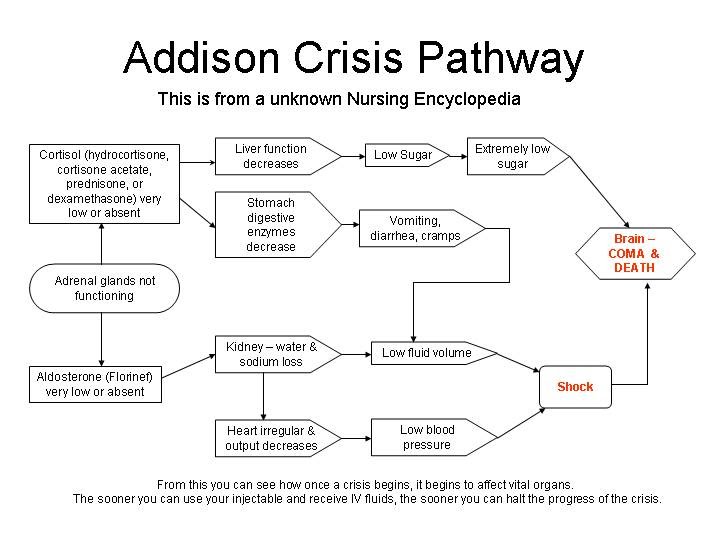
Adrenal Insufficiency Patients Require More Education on Adrenal Crisis

adrenalcrisispathway

Greater efforts to educate patients with adrenal insufficiency and their families about prevention of adrenal crisis may be necessary, according to data presented at the American Association of Clinical Endocrinologists (AACE) 24th Annual Scientific & Clinical Congress.

Additionally, the researchers, who looked at patients treated for adrenal insufficiency, found that many are not being adequately trained or equipped to deal with an adrenal crisis.

“These patients can crash and we are not doing enough to help prevent problems,” study investigator Nitika Malhotra, MD, endocrinologist in Lansing, Michigan, said. “We did this study because we think this is a big problem.”

Malhotra, who presented the study findings at the meeting, explained that patients with adrenal insufficiency are at risk for developing adrenal crisis, and it is now estimated that 8% of patients with adrenal insufficiency are hospitalized for adrenal crisis each year.

The problem, according to Malhotra, is that far too many patients are failing to receive crises prevention education. Moreover, they are not receiving emergency glucocorticoid kits.

“All of the families need to be taught and that is not happening,” Malhotra said in an interview with Endocrinology Advisor. “It will reduce the morbidity and mortality and the hospitalization, and it may improve the quality of life of patients too.”

For their study, Malhotra and her colleagues collected data from patients with adrenal insufficiency who were seen at a single institution between March 2009 and March 2014.

The investigators conducted a retrospective chart review and examined age, gender, causes of adrenal insufficiency, glucocorticoid dose, and monitoring for hyponatremia and hyperkalemia. They also looked at postural blood pressure, crises prevention education for glucocorticoid dose adjustments during stress, and whether patients had a Medic Alert ID or a parenteral glucocorticoid kit.

The researchers identified 85 patients (29 males and 56 females) with adrenal insufficiency. Of these patients, 33 patients had primary adrenal insufficiency (38.8%) and 52 had secondary adrenal insufficiency (61.2%). The mean age of the patients was 55.8 years.

Among the 85 patients, 23 (27%) had postural blood pressures checked — five of whom were positive (21.7%). Seventy-seven patients (90.6%) were monitored for electrolytes, and 41 patients (48.2%) were on steroid doses above 20 mg per day.

However, the researchers found that only 57 patients (67.1%) had received steroid dose adjustment instructions. In addition, only 29 patients (34.1%) had a Medic Alert ID, and only 17 patients (20%) were setup with emergency parenteral glucocorticoid kits.

Even though this study has many inherent limitations, Malhotra said, it appears that the preventive strategies for adrenal crisis in patients with adrenal insufficiency are not being consistently followed.

Patient education is paramount for achieving a successful prevention strategy for adrenal crisis, and endocrinologists have a responsibility to make sure that all patients with adrenal insufficiency have a Medic Alert ID and access to emergency glucocorticoid kits, according to Malhotra.

Furthermore, she said families should receive adequate education about parenteral steroid administration and steroid dose adjustments in stressful situations.

At her institution, Malhotra said, endocrinologists are introducing an automated electronic alert in their electronic medical records to determine if this electronic prompt will improve adherence.

Reference

  1. Malhotra N et al. Abstract #102. Presented at: American Association of Clinical Endocrinologists (AACE) 24th Annual Scientific & Clinical Congress; May 13-17, 2015; Nashville, Tenn.


From http://www.endocrinologyadvisor.com/aace-2015/adrenal-crisis-in-adrenal-insufficiency/article/415123/

Young people with Cushing syndrome may be at higher risk for suicide, depression

Children with Cushing syndrome may be at higher risk for suicide as well as for depression, anxiety and other mental health conditions long after their disease has been successfully treated, according to a study by researchers at the National Institutes of Health.

Cushing syndrome results from high levels of the hormone cortisol. Long-term complications of the syndrome include obesity, diabetes, bone fractures, high blood pressure, kidney stones and serious infections. Cushing’s syndrome may be caused by tumors of the adrenal glands or other parts of the body that produce excess cortisol. It also may be caused by a pituitary tumor that stimulates the adrenal glands to produce high cortisol levels. Treatment usually involves stopping excess cortisol production by removing the tumor.

“Our results indicate that physicians who care for young people with Cushing syndrome should screen their patients for depression-related mental illness after the underlying disease has been successfully treated,” said the study’s senior author, Constantine Stratakis, D(med)Sci, director of the Division of Intramural Research at NIH’s Eunice Kennedy Shriver National Institute of Child Health and Human Development. “Patients may not tell their doctors that they’re feeling depressed, so it’s a good idea for physicians to screen their patients proactively for depression and related conditions.”

Cushing syndrome may affect both adults and children. A recent study estimated that in the United States, there are 8 cases of Cushing syndrome per 1 million people per year.

The researchers published their findings in the journal Pediatrics. They reviewed the case histories of all children and youth treated for Cushing syndrome at NIH from 2003 to 2014, a total of 149 patients. The researchers found that, months after treatment, 9 children (roughly 6 percent) had thoughts of suicide and experienced outbursts of anger and rage, depression, irritability and anxiety. Of these, 7 experienced symptoms within 7 months of their treatment.

Two others began experiencing symptoms at least 48 months after treatment.

The authors noted that children with Cushing syndrome often develop compulsive behaviors and tend to become over-achievers in school. After treatment, however, they then become depressed and anxious. This is in direct contrast to adults with Cushing syndrome, who tend to become depressed and anxious before treatment and gradually overcome these symptoms after treatment.

The authors stated that health care providers might try to prepare children with Cushing syndrome before they undergo treatment, letting them know that their mood may change after surgery and may not improve for months or years. Similarly, providers should consider screening their patients periodically for suicide risk in the years following their treatment.

Source: NIH/Eunice Kennedy Shriver National Institute of Child Health and Human Development