Cushing’s Awareness Challenge: Day 11

robin-uncontrolled

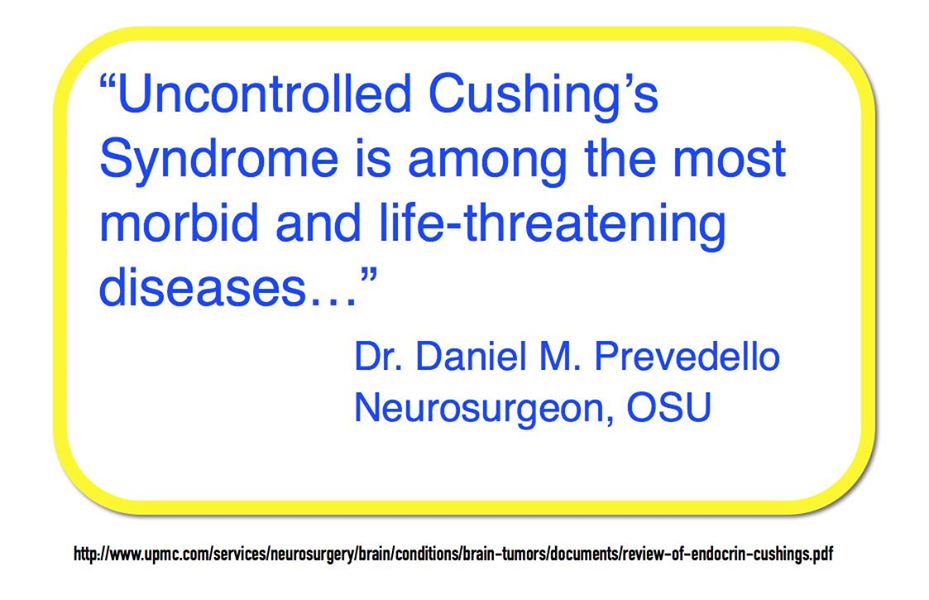
Robin has shared this quote from Dr. Prevedallo.  You can read more at the link at http://brainsurgery.upmc.com/_pdf/Review-of-Endocrin-Cushings.pdf

Over the years, I have seen that this is true, sometimes even for controlled Cushing’s.  Far too many Cushies have died.

Here are some of those that I know of:

Cushing’s is a terrible disease.

There is another Cushie I should add to this list. During the time I was home from NIH just before pituitary surgery, a college classmate of mine (I didn’t know her) did die at NIH of a Cushing’s-related problem. I’m so glad I didn’t find out until a couple months later!  I still have the college alumni magazine that mentioned this.  I’ll have to find that and add it to the In Memory list.

My husband shared a bit about her in my bio:

During the same time Mary was at NIH, another woman had the same operation. She came from Mary’s home town. They were class mates at college. They had the same major. They were the same age. They had the same surgical and medical team. Mary recovered. The other woman died during surgery.


I know we’re always fighting with doctors to get diagnosed, to get treated but reading the stories of these people will hopefully inspire people to fight even harder to be heard.

Stay safe – don’t get added to this list!

8e1d2-maryo_colorful_zebra


Cushing’s Awareness Challenge, Day 4

Another idea I borrowed from Robin – using a Wordle as inspiration for today’s post.
Even though I’m “in remission” since 1987, I’m still way too fatigued, napping every afternoon for several hours.  People think I should be normal since my pituitary surgery was so long ago.  Well, no.
me-tired
Just a few days ago, I posted this abstract on Severe fatigue in patients with adrenal insufficiency.  I don’t think that they needed to do this study at all.  Just ask any Cushie!

Abstract

BACKGROUND:

Fatigue is a frequently experienced complaint in patients with adrenal insufficiency (AI) and may be influenced by cortisol levels.

AIM:

The objective of this study was to determine the prevalence of severe fatigue in adrenal insufficiency (AI) patients, to assess which dimensions contribute to fatigue severity and to determine the association between salivary cortisol levels and momentary fatigue.

SUBJECTS AND METHODS:

We performed a cross-sectional study in the outpatient department of a university hospital. Included were 27 patients with congenital adrenal hyperplasia (CAH), 26 patients with primary AI (PAI), 24 patients with secondary AI (SAI) and 31 patients with adrenal insufficiency after treatment for Cushing’s syndrome (Cush-AI). Measurements included computerised questionnaires to determine fatigue severity and physical and psychosocial contributors. Patients took four saliva samples at home, in which cortisol levels were measured.

RESULTS:

Severe fatigue was experienced by 41 % of the CAH patients, 42 % of the PAI patients, 50 % of the SAI patients and 42 % of the Cush-AI patients. Psychological distress, functional impairment, sleep disturbance, physical activity, concentration problems and social functioning contributed to the subjective experience of fatigue. Salivary cortisol levels were not correlated with momentary fatigue.

CONCLUSIONS:

A considerable proportion of AI patients experience severe fatigue. Salivary cortisol level is not a significant predictor for momentary fatigue in AI patients.

PMID:
24615365
[PubMed – in process]

From http://www.ncbi.nlm.nih.gov/pubmed/24615365


Back to my nap now…

maryo colorful zebra

Severe fatigue in patients with adrenal insufficiency: physical, psychosocial and endocrine determinants

Abstract

BACKGROUND:

Fatigue is a frequently experienced complaint in patients with adrenal insufficiency (AI) and may be influenced by cortisol levels.

AIM:

The objective of this study was to determine the prevalence of severe fatigue in adrenal insufficiency (AI) patients, to assess which dimensions contribute to fatigue severity and to determine the association between salivary cortisol levels and momentary fatigue.

SUBJECTS AND METHODS:

We performed a cross-sectional study in the outpatient department of a university hospital. Included were 27 patients with congenital adrenal hyperplasia (CAH), 26 patients with primary AI (PAI), 24 patients with secondary AI (SAI) and 31 patients with adrenal insufficiency after treatment for Cushing’s syndrome (Cush-AI). Measurements included computerised questionnaires to determine fatigue severity and physical and psychosocial contributors. Patients took four saliva samples at home, in which cortisol levels were measured.

RESULTS:

Severe fatigue was experienced by 41 % of the CAH patients, 42 % of the PAI patients, 50 % of the SAI patients and 42 % of the Cush-AI patients. Psychological distress, functional impairment, sleep disturbance, physical activity, concentration problems and social functioning contributed to the subjective experience of fatigue. Salivary cortisol levels were not correlated with momentary fatigue.

CONCLUSIONS:

A considerable proportion of AI patients experience severe fatigue. Salivary cortisol level is not a significant predictor for momentary fatigue in AI patients.

PMID:
24615365
[PubMed – in process]

From http://www.ncbi.nlm.nih.gov/pubmed/24615365

The Role of Adrenal Scintigraphy in the Diagnosis of Subclinical Cushing’s Syndrome and the Prediction of Post-surgical Hypoadrenalism

World J Surg. 2014 Mar 11. [Epub ahead of print]

Abstract

BACKGROUND:

Management of subclinical Cushing’s syndrome (SCS) remains controversial; it is not possible to predict which patients would benefit from adrenalectomy. In the present study we aimed to evaluate the role of adrenocortical scintigraphy (ACS) in the management of patients with SCS.

METHODS:

The medical records of 33 consecutive patients with adrenal “incidentaloma” and proven or suspected SCS who underwent 131I-19-iodocholesterol ACS between 2004 and 2010 were reviewed. Sixteen underwent laparoscopic adrenalectomy (surgical group-S-group) and 17 were medically managed (medical group-M-group). Follow-up evaluation was obtained by outpatient consultation.

RESULTS:

Overall 25 patients (15 in the S-group and 10 in the M-group) had concordant unilateral uptake at ACS (ACS+). In the S-group, the mean follow-up duration was 30.9 ± 16.1 months and, irrespective of the presence of hormonal diagnosis of SCS, in patients who were ACS+ adrenalectomy resulted in a significant increase in HDL cholesterol and decreases in body mass index, glycemia, and blood pressure (BP). One patient reduced antihypertensive medication and three others were able to discontinue it altogether. Prolonged postoperative hypoadrenalism (PH) occurred in 14 patients in the S-group. The overall accuracy in predicting PH was 93.7 % for ACS and 68.7 % for laboratory findings. In the M-group, the mean follow-up duration was 31.5 ± 26.3 months and no patient developed overt Cushing’s syndrome, although ACS+ patients experienced a worsening in glycemia and diastolic BP.

CONCLUSIONS:

Adrenal scintigraphy seems the most accurate diagnostic test for SCS. It is able to predict the metabolic outcome and the occurrence of PH, identifying the patients who could benefit from adrenalectomy irrespective of hormonal diagnosis.

PMID:
24615601
[PubMed – as supplied by publisher]

From http://www.ncbi.nlm.nih.gov/pubmed/24615601

Salivary cortisol performs better than urinary free cortisol to diagnose Cushing’s syndrome

Late-night salivary cortisol has a better performance than urinary free cortisol in the diagnosis of Cushing’s syndrome.

Salimetrics highlights a recent study:  Abstract

Context: The comparison of variability, reproducibility, and diagnostic performance of late-night salivary cortisol (LNSF) and urinary free cortisol (UFC) using concurrent and consecutive samples in Cushing’s syndrome (CS) is lacking.

Objectives, Patients and Methods: In a prospective study, we evaluate three simultaneous and consecutive samples of LNSF by RIA and UFC by LC-MS/MS in Cushing’s disease (CD; n=43), adrenal CS patients (n=9) and obese subjects (n=18) in order to compare their diagnostic performances. In CS patients we also performed a modified Cushing’s syndrome severity index (CSI).

Results: There was no difference in the coefficient of variation (%) between LNSF and UFC among the three samples obtained for each patient with CD (35±26vs31±24), adrenal CS (28±14vs22±14) and obesity (39±37vs48±20). LNSF confirmed the diagnosis of hypercortisolism even in the presence of normal UFC in 17.3% of CS, whereas the inverse situation was not observed for UFC. The area under the ROC curves for LNSF was 0.999 (95%CI 0.990-1.00) and for UFC was 0.928 (95%CI 0.809- 0.987). The ratio between AUCs was 0.928 (95%CI 0.810-0.988) indicating better performance of LNSF than UFC in diagnosing CS. There was no association between the severity of CSI and the degree of biochemical hypercortisolism.

Conclusion: Our data show that despite similar variability between both methods, LNSF has a superior diagnostic performance than UFC and should be used as the primary biochemical diagnostic test for Cushing’s syndrome diagnosis.

Authors Elias P, Martinez E, Barone B, Mermejo L, Castro M, Moreira A
Division of Endocrinology-Department of Medicine and Division of Statistics- Department of Social Medicine, Ribeirao Preto Medical School – University of Sao Paulo, Ribeirao Preto, SP- Brazil
LINK to Paper
Salimetrics guide to Cortisol
LINK to Salimetrics Diagnostic Salivary Cortisol Assay