Doctor’s Notes: Part 2, Adrenal

The adrenal glands sit atop the kidneys.

The adrenal glands sit atop the kidneys. (Photo credit: Wikipedia)

Acronyms or abbreviations for “Adrenal”

AD: adrenal vein
AG: adrenal gland
AdNA: adrenal gland
AC: adrenal cortex
adc: adrenal cortex
ADM: adrenal medulla
AA: adrenal adenoma
AF: adrenal failure
AM: adrenal medulla
AA: adrenal androgen
PA: pituitary-adrenal
AA: adrenal androgens
AAs: adrenal androgens
AM: adrenal medullary
LAV: left adrenal vein
AH: adrenal hypoplasia
AH: adrenal hemorrhage
AE: adrenal enucleation
AG: adrenal glomerulosa
AH: adrenal hyperplasia
HFA: human fetal adrenal
BAC: bovine adrenal cells
ADM: adrenal demedullation
AI: adrenal incidentaloma
AI: adrenal insufficiency
AVS: adrenal vein sampling
AI: adrenal incidentalomas
BAM: Bovine Adrenal Medulla
PAA: pituitary-adrenal axis
AMQD: Adrenal Move Quick Draw
AVS: Adrenal venous sampling
ach: adrenal cortical hormone
ACCs: adrenal chromaffin cells
AZF: adrenal zona fasciculata
BAM: Bovine adrenal medullary
PAL: Primary adrenal lymphoma
Ad4BP: Adrenal 4-binding protein
BAC: bovine adrenal chromaffin
ACC: adrenal cortical carcinoma
acca: adrenal cortical carcinoma
BAG: bovine adrenal glomerulosa
SAM: sympatho-adrenal-medullary
NAH: neonatal adrenal hemorrhage
PAH: primary adrenal hyperplasia
AHC: adrenal hypoplasia congenita
ACA: adrenal cortex autoantibodies
ACTH: adrenal corticotropic hormone
BAH: bilateral adrenal hyperplasia
CAH: congenital adrenal hypoplasia
HPA: hypothalamo-pituitary-adrenal
PAI: primary adrenal insufficiency
SAM: sympathetic-adrenal medullary
cah: congenital adrenal hyperplasia
HPA: hypothalamic-pituitary-adrenal
IAH: idiopathic adrenal hyperplasia
ACTH: adrenal corticotrophic hormone
ahc: adrenal hypoplasia, congenital
BAMC: bovine adrenal medullary cells
H-P-A: hypothalamic-pituitary-adrenal
HPA: hypothalamic-adrenal-pituitary
HPA: hypothalamus-pituitary-adrenal
HPAA: hypothalamic-pituitary-adrenal
IHA: idiopathic adrenal hyperplasia
LOAH: late-onset adrenal hyperplasia
NCAH: nonclassic adrenal hyperplasia
UAH: unilateral adrenal hyperplasia
BACC: bovine adrenal chromaffin cells
BACCs: bovine adrenal chromaffin cells
BCC: Bovine adrenal chromaffin cells
CAH: congenital adrenal hyperplasias
HHA: hypothalamo-hypophyseal-adrenal
BAC: bovine adrenal fasciculata cells
ARH: adrenal regeneration hypertension
HPAA: hypothalamo-pituitary-adrenal axis
ASNA: adrenal sympathetic nerve activity
HPA: hypothalamo-pituitary-adrenal axis
BAMC: bovine adrenal medullary chromaffin
FAH: Functional adrenal hyperandrogenism
HPA: hypothalamic-pituitary-adrenal axis
HPA-axis: hypothalamic-pituitary-adrenal axis
HPAA: hypothalamic-pituitary-adrenal axis
HPAA: hypothalamus-pituitary-adrenal axis
AASH: adrenal androgen stimulating hormone
BAME: bovine adrenal medullary endothelial
HPA: hypothalamus-pituitary-adrenal gland
NADF: National Adrenal Diseases Foundation
PAMC: porcine adrenal medullary chromaffin
CLAH: congenital lipoid adrenal hyperplasia
APA: aldosterone-producing adrenal adenoma
HPA: hypothalamic-pituitary-adrenal system
HPAT: hypothalamus-pituitary-adrenal-thymus
LHPA: limbic-hypothalamic-pituitary-adrenal
PCAI: primary chronic adrenal insufficiency
HHAS: hypothalamo-hypophyseal-adrenal system
HPA: hypothalamo-pituitary-adrenal cortical
HPA: hypothalamic-pituitary-adrenal cortical
RAMEC: rat adrenal medullary endothelial cells
CVAH: congenital virilizing adrenal hyperplasia
CAH: congenital virilizing adrenal hyperplasia
LOCAH: late-onset congenital adrenal hyperplasia
LHPA: limbic-hypothalamic-pituitary-adrenal axis
NC-CAH: non-classical congenital adrenal hyperplasia
AIMAH: ACTH-independent bilateral macronodular adrenal
pre-ASNA: preganglionic adrenal sympathetic nerve activity
AIMAH: ACTH-independent macronodular adrenal hyperplasia
CAHSA: Congenital Adrenal Hyperplasia Support Association
AIMAH: ACTH-independent bilateral macronodular adrenal hyperplasia

Cushing’s Syndrome is Hazardous to Your Health

morbidity

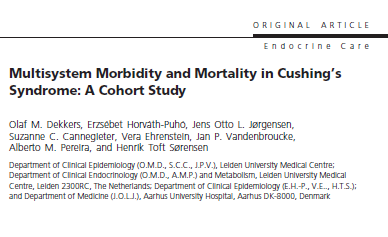
People with Cushing’s syndrome, even when treated, have higher morbidity and mortality rates that comparable controls. That is the conclusion of a new study published in the June issue of the Journal of Clinical Endocrinology Metabolism. The study by Olaf Dekkers et al, examined data records from the Danish National Registry of Patients and the Danish Civil Registration System of 343 patients with benign Cushing’s syndrome of adrenal or pituitary origin (i.e., Cushing’s disease) and a matched population comparison cohort (n=34,300).  Due to the lengthy delay of many patients being diagnosed with Cushing’s syndrome, morbidity was investigated in the 3 years before diagnosis while  morbidity and mortality were assessed during complete follow-up after diagnosis and treatment.

The study found that mortality was twice as high in Cushing’s syndrome patients (HR 2.3, 95% CI 1.8-2.9) compared with controls over a mean follow-up period of 12.1 years. Furthermore, patients with Cushing’s syndrome were at increased risk for:

  • venous thromboembolism (HR 2.6, 95% CI 1.5-4.7)
  • myocardial infarction (HR 3.7, 95% CI 2.4-5.5)
  • stroke (HR 2.0, 95% CI 1.3-3.2)
  • peptic ulcers (HR 2.0, 95% CI 1.1-3.6)
  • fractures (HR 1.4, 95% CI 1.0-1.9)
  • infections (HR 4.9, 95% CI 3.7-6.4).

The study also found that this increased multimorbidity risk was present before diagnosis indicating that it was due to cortisol overproduction rather than treatment.

Many of the Cushing’s syndrome patients underwent surgery to remove the benign tumor. For this group, the investigators performed a sensitivity analysis of the  long-term mortality and cardiovascular risk in this  subgroup (n=186)  considered to be cured after operation (adrenal surgery and patients with pituitary surgery in combination with a diagnosis of hypopituitarism in the first 6 months after operation).  The risk estimates for mortality (HR 2.31, 95% CI 1.62-3.28), venous thromboembolism (HR 2.03, 95% CI 0.75-5.48), stroke (HR 1.91, 95% CI 0.90-4.05), and acute myocardial infarction (HR 4.38, 95% CI 2.31-8.28) were also increased in this subgroup one year after the operation.

The standard treatment for endogenous Cushing’s syndrome is surgery. This past year, Signifor (pasireotide) was approved for treatment of adults patients with Cushing’s disease for whom pituitary surgery is not an option or has not been curative.  Cushing’s disease, which accounts for the majority of Cushing’s syndrome patients, is defined as the presence of an ACTH producing tumor on the pituitary grand. In the study by Dekker’s et al, the percentage of patients with Cushing’s disease is not known. We look forward to reexamination of this dataset in a few years following the introduction of more treatment options for Cushing’s disease as well as an analysis that explores the differences in mortality/morbidity rates in the different subsets of patients that make of Cushing’s syndrome (Cushing’s disease, ectopic Cushing’s syndrome, Exogenous Cyshing’s syndrome).

References

Dekkers OM, Horvath-Pujo, Jorgensen JOL, et al, Multisystem morbidity and mortality in Cushing’s syndrome: a cohort study. J Clin Endocrinol Metab 2013 98(6): 2277–2284. doi: 10.1210/jc.2012-3582

– See more at: http://www.raredr.com/medicine/articles/cushing%E2%80%99s-syndrome-hazardous-your-health-0

Have You Gone to the ER With an Adrenal Crisis?

This Survey is to gather information for the Adrenal Insufficiency Awareness Organization’s grant project to create educational materials for ER personnel.

The survey is for those of you who have been to the ER during an impending or full blown Adrenal Crisis. (you may fill it out for a child or yourself)

Your help is appreciated!

At the end of the survey you will have the chance to enter for a chance to win an Adrenal Insufficiency Awareness Pin.

https://www.surveymonkey.com/s/ERcare

Adrenal Glands

adrenal-glandsAnatomy of the adrenal glands:

Adrenal glands, which are also called suprarenal glands, are small, triangular glands located on top of both kidneys. An adrenal gland is made of two parts: the outer region is called the adrenal cortex and the inner region is called the adrenal medulla.

Function of the adrenal glands:

The adrenal glands work interactively with the hypothalamus and pituitary gland in the following process:

  • the hypothalamus produces corticotropin-releasing hormones, which stimulate the pituitary gland.
  • the pituitary gland, in turn, produces corticotropin hormones, which stimulate the adrenal glands to produce corticosteroid hormones.

Both parts of the adrenal glands — the adrenal cortex and the adrenal medulla — perform very separate functions.

What is the adrenal cortex?

The adrenal cortex, the outer portion of the adrenal gland, secretes hormones that have an effect on the body’s metabolism, on chemicals in the blood, and on certain body characteristics. The adrenal cortex secretes corticosteroids and other hormones directly into the bloodstream. The hormones produced by the adrenal cortex include:

  • corticosteroid hormones
    • hydrocortisone hormone – this hormone, also known as cortisol, controls the body’s use of fats, proteins, and carbohydrates.
    • corticosterone – this hormone, together with hydrocortisone hormones, suppresses inflammatory reactions in the body and also affects the immune system.
  • aldosterone hormone – this hormone inhibits the level of sodium excreted into the urine, maintaining blood volume and blood pressure.
  • androgenic steroids (androgen hormones) – these hormones have minimal effect on the development of male characteristics.

What is the adrenal medulla?

The adrenal medulla, the inner part of the adrenal gland, is not essential to life, but helps a person in coping with physical and emotional stress. The adrenal medulla secretes the following hormones:

  • epinephrine (also called adrenaline) – this hormone increases the heart rate and force of heart contractions, facilitates blood flow to the muscles and brain, causes relaxation of smooth muscles, helps with conversion of glycogen to glucose in the liver, and other activities.
  • norepinephrine (also called noradrenaline) – this hormone has little effect on smooth muscle, metabolic processes, and cardiac output, but has strong vasoconstrictive effects, thus increasing blood pressure.

From: University of Maryland Center for Diabetes and Endocrinology

From the CushieWiki: Personal Stories

Cushie Warriors

Personal Stories – Autumn

Personal Stories – Deb

Personal Stories – HockeyGirl

Personal Stories – Jessica

Personal Stories – Kate

Personal Stories – MaryO

Personal Stories – Staticnrg

All Personal experiences