Rare Nasal Cancer May Have Caused Cushing’s Syndrome

A very rare case of Cushing’s syndrome developing as a result of a large and also rare cancer of the nasal sinuses gives insights into how to screen and treat such an anomaly, of which fewer than 25 cases have been reported in literature.

Paraneoplastic esthesioneuroblastoma (ENB), a very rare type of nasal tumor, may sometimes produce excess adrenocorticotrophic hormone (ACTH), leading to symptoms of Cushing’s syndrome, according to a recent case report that describes a case of ACTH-secreting ENB. The report aims to demonstrate the importance of recognizing its pathophysiology and treatment.

The case report, “A Case of Cushing’s Syndrome due to Ectopic Adrenocorticotropic Hormone Secretion from Esthesioneuroblastoma with Long Term Follow-Up after Resection,” was published in the journal Case Reports in Endocrinology.

It describes a 52-year-old Caucasian male who had a history of high blood pressure, severe weakness, abnormal production of urine, extreme thirstiness, and confusion.

He was scheduled to undergo surgery for a 7-centimeter skull base mass; the surgery was postponed due to severe high serum potassium concentrations and abnormally high pH levels. His plasma ACTH levels also were elevated and Cushing’s syndrome was suspected. Since imaging of the chest, abdomen, and pelvis did not show any ectopic (abnormal) sources of ACTH, the ENB was suspected to be the source.

Surgery was performed to remove the tumor, which was later found to be secreting ACTH. Consequently, following the procedure, his ACTH levels dropped to normal (below detection limit) and he did not need medication to normalize serum potassium levels. He then underwent subsequent chemoradiation and has shown no sign of recurrence 30 months after the operation, which is considered to be one of the longest follow-up periods for such a case.

Researchers declared it “a case of olfactory neuroblastoma with ectopic ACTH secretion that was treated with resection and adjuvant chemoradiation.”

“Given the paucity of this diagnosis, little is known about how best to treat these patients and how best to screen for complications such as adrenal insufficiency and follow-up,” they wrote. “Our case adds more data for better understanding of this disease.”

From https://cushingsdiseasenews.com/2018/04/03/rare-nasal-cancer-caused-cushings-syndrome-case-report-says/

Day 3: Cushing’s Awareness Challenge

me-tired

Sleep.  Naps.  Fatigue, Exhaustion.  I still have them all.  I wrote on my bio in 1987 after my pituitary surgery “I am still and always tired and need a nap most days. I do not, however, still need to take whole days off just to sleep.

That seems to be changing back, at least on the weekends.  A recent weekend, both days, I took 7-hour naps each day and I still woke up tired. That’s awfully close to taking a whole day off to sleep again.

In 2006, I flew to Chicago, IL for a Cushing’s weekend in Rockford.  Someone else drove us to Lake Geneva, Wisconsin for the day.  Too much travel, too Cushie, whatever, I was too tired to stay awake.  I actually had put my head down on the dining room table and fallen asleep but our hostess suggested the sofa instead.  Amazing that I traveled that whole distance – and missed the main event 😦

This sleeping thing really impacts my life.  Between piano lessons, I take a nap.  I sleep as late as possible in the mornings and afternoons are pretty much taken up by naps.  I nod off at night during TV. One time I came home between church services and missed the third service because I fell asleep.

I only TiVo old tv shows that I can watch and fall asleep to since I already know the ending.

Since  mid-February, I have been doing physical therapy twice a week for 2 hours at a time for a knee injury (read more about that in Bees Knees).  I come home from that exhausted – and in more pain than I went.  I know it’s working and my knee is getting better, but it’s such a time and energy sapper.  Neither of which I can really spare.

Maybe now that I’m nearly 10  years out from my kidney cancer (May 9, 2006) I could theoretically go back on Growth Hormone again.  My surgeon says he “thinks” it’s ok.  I’m sort of afraid to ask my endo about it, though.  I want to feel better and get the benefits of the GH again but I don’t want any type of cancer again and I certainly can’t afford to lose another kidney.

I’ll probably just muddle through without it.  I always laugh when I see that commercial online for something called Serovital.  I saw it in Costco the other day and it mentions pituitary right on the package.  I wish I could take the people buying this, sit them down and tell them not to mess with their pituitary glands.  But I won’t.  I’ll take a nap instead because I’m feeling so old and weary today, and yesterday.

And tomorrow…

Day 2, Cushing’s Awareness Challenge

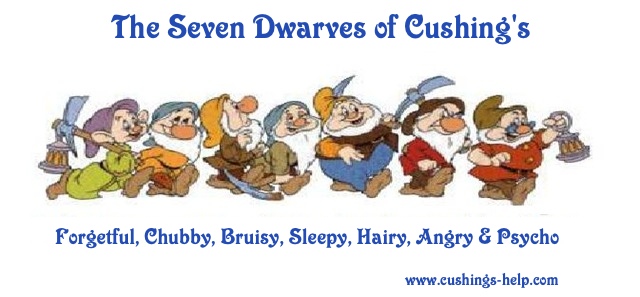
The Seven Dwarves of Cushing's

So, these are only seven of the many, many symptoms of Cushing’s.  I had those above – and I often felt like I looked like one of those little bearded dwarves.

Cushing’s affects every part of the body.  It’s not like when I had kidney cancer and only the kidney was affected.

Here are some of the many areas affected.

  • Progressive obesity and skin changes
  • Weight gain and fatty tissue deposits, particularly around the midsection and upper back, in the face (moon face) and between the shoulders (buffalo hump). Some symptoms such as sudden weight gain, are caused by excess cortisol. The excess cortisol in the body does not increase protein and carbohydrate metabolism. It slows or nearly disables metabolism function, which can cause weight gain (fat accumulation) in the buttocks, abdomen, cheeks, neck, or upper back.
  • Loss of muscle mass. Some areas of the body, such as the arms and legs, will remain thin.
  • Pink or purple stretch marks (striae) on the skin of the abdomen, thighs, breasts and arms
  • Thinning, fragile skin that bruises easily
  • Slow healing of cuts, insect bites and infections
  • Acne

Women with Cushing’s syndrome may experience:

  • Thicker or more visible body and facial hair (hirsutism)
  • Irregular or absent menstrual periods

Men with Cushing’s syndrome may experience:

  • Decreased libido
  • Decreased fertility
  • Erectile dysfunction

Other signs and symptoms include:

  • Fatigue
  • Muscle weakness
  • Depression, anxiety and irritability
  • Loss of emotional control
  • Cognitive difficulties
  • New or worsened high blood pressure
  • Glucose intolerance that may lead to diabetes
  • Headache
  • Bone loss, leading to fractures over time
  • Hyperlipidemia (elevated lipids – cholesterol – in the blood stream)
  • Recurrent opportunistic or bacterial infections
Think you have Cushing’s?  Get to a doctor and don’t give up!

MaryO
         MaryO

Metastatic Pituitary Carcinoma Successfully Treated with Radiation, Chemo.

A man with Cushing’s disease — caused by an adrenocorticotrophic hormone (ACTH)-secreting pituitary adenoma — who later developed metastases in the central nervous system without Cushing’s recurrence, was successfully treated over eight years with radiation and chemotherapy, according to a case report.

The report, “Long-term survival following transformation of an adrenocorticotropic hormone secreting pituitary macroadenoma to a silent corticotroph pituitary carcinoma: Case report,” was published in the journal World Neurosurgery.

Pituitary carcinomas make up only 0.1-0.2% of all pituitary tumors and are characterized by a primary pituitary tumor that metastasizes into cranial, spinal, or systemic locations. Fewer than 200 cases have been reported in the literature.

Most of these carcinomas secrete hormones, with ACTH being the most common. Though the majority of ACTH-secreting carcinomas present with Cushing’s disease, about one-third do not show symptoms of the condition and have normal serum cortisol and ACTH levels. These are called silent corticotroph adenomas and are considered more aggressive.

A research team at the University of Alabama at Birmingham presented the case of a 51-year-old Caucasian man with ACTH-dependent Cushing’s disease. He had undergone an incomplete transsphenoidal (through the nose) resection of an ACTH-secreting pituitary macroadenoma – larger than 10 mm in size – and radiation therapy the year before.

At referral in August 1997, the patient had persistent high cortisol levels and partial hypopituitarism, or pituitary insufficiency. He exhibited Cushing’s symptoms, including facial reddening, moon facies, weight gain above the collarbone, “buffalo hump,” and abdominal stretch marks.

About two years later, the man was weaned off ketoconazole — a medication used to lower cortisol levels — and his cortisol levels had been effectively reduced. He also had no physical manifestations of Cushing’s apart from facial reddening.

In May 2010, the patient reported two episodes of partial seizures, describing two spells of right arm tingling, followed by impaired peripheral vision. Imaging showed a 2.1-by-1-cm mass with an associated cyst within the brain’s right posterior temporal lobe, as well as a 1.8-by-1.2-cm mass at the cervicomedullary junction, which is the region where the brainstem continues as the spinal cord. His right temporal cystic mass was then removed by craniotomy.

A histopathologic analysis was consistent with pituitary carcinoma. Cell morphology was generally similar to the primary pituitary tumor, but cell proliferation was higher. Physical exams showed no recurrence of Cushing’s disease and 24-hour free urinary cortisol was within the normal range.

His cervicomedullary metastasis was treated with radiation therapy in July 2010. He took the oral chemotherapy temozolomide until August 2011, and Avastin (bevacizumab, by Genentech) was administered from September 2010 to November 2012.

At present, the patient continues to undergo annual imaging and laboratory draws. He receives treatment with hydrocortisone, levothyroxine — synthetic thyroid hormone — and testosterone replacement with androgel.

His most recent exam showed no progression over eight years of a small residual right temporal cyst, a residual mass along the pituitary stalk — the connection between the hypothalamus and the pituitary gland — and a small residual mass at the cervicomedullary junction. Lab results continue to show no Cushing’s recurrence.

“Our case is the first to document a patient who initially presented with an endocrinologically active ACTH secreting pituitary adenoma and Cushing’s disease who later developed cranial and spinal metastases without recurrence of Cushing’s disease and transformation to a silent corticotroph pituitary carcinoma,” the scientists wrote.

They added that the report is also the first documenting “8 years of progression-free survival in a patient with pituitary carcinoma treated with radiotherapy, [temozolomide] and bevacizumab.”

Adapted from https://cushingsdiseasenews.com/2019/01/03/successful-treatment-pituitary-carcinoma-radiation-chemo-case-report/

Paraneoplastic Cushing’s Syndrome Due to ACTH-Secreting Acinic Cell Carcinoma of the Parotid Gland: A Rare Case

​​​​​​​​​​​​​​Although acinic cell carcinoma — a cancer of the glands that produce saliva — is usually considered low risk, it can behave aggressively and cause Cushing’s syndrome, according to researchers who described such a case involving a 58-year-old man in Turkey.

They added that if not recognized and treated at an early stage, it can rapidly become life-threatening.

“The rarity of this entity poses a diagnostic challenge,” wrote the group of four researchers from a hospital in Turkey. “Awareness of this association is critical, as early identification and intervention may be lifesaving in selected patients.”

The case was described in a letter to the editor, titled “Paraneoplastic Cushing’s syndrome due to ACTH-secreting acinic cell carcinoma of the parotid gland: A rare case,” in the European Annals of Otorhinolaryngology, Head and Neck Diseases.