Prolactin Measure Didn’t Help Localize Pituitary Adenoma

By: SHERRY BOSCHERT, Clinical Endocrinology News Digital Network

SAN FRANCISCO – Measurements of prolactin levels during inferior petrosal sinus sampling did not help localize pituitary adenomas in patients with Cushing’s disease in a study of 28 patients, contradicting findings from a previous study of 28 patients.

The value of prolactin measurements in tumor localization using inferior petrosal sinus sampling (IPSS) remains unclear and needs further study in a larger, prospective study, Dr. Susmeeta T. Sharma said at the Endocrine Society’s Annual Meeting. The current and previous studies were retrospective analyses.

Although IPSS has been considered the standard test in patients with ACTH-dependent Cushing’s syndrome to differentiate between ectopic ACTH secretion and Cushing’s disease, there has been controversy about its value in localizing adenomas within the pituitary gland once a biochemical diagnosis of Cushing’s disease has been made. Various studies that used an intersinus ACTH ratio of 1.4 or greater before or after corticotropin-releasing hormone (CRH) stimulation have reported success rates as low as 50% and as high as 100% for tumor location.

A previous retrospective study of 28 patients with Cushing’s disease reported that adjusting the ACTH intersinus gradient by levels of prolactin before or after CRH stimulation, and combining the prolactin-adjusted ACTH intersinus ratio, improved pituitary adenoma localization. Magnetic resonance imaging (MRI) alone correctly localized the pituitary adenoma in 17 patients (61%), a prolactin-adjusted ACTH intersinus ratio of at least 1.4 improved the localization rate to 21 patients (75%), and combining MRI and the prolactin-adjusted ACTH intersinus ratio improved localization further to 23 patients, or 82% (Clin. Endocrinol. 2012;77:268-74).

The findings inspired the current retrospective study. The investigators looked at prolactin levels measured in stored petrosal and peripheral venous samples at baseline and at the time of peak ACTH levels after CRH stimulation for 28 patients with Cushing’s disease and ACTH-positive pituitary adenomas who underwent IPSS in 2007-2013. The investigators calculated prolactin-adjusted values by dividing each ACTH value by the concomitant ipsilateral prolactin value. They used an intersinus ACTH ratio of 1.4 or greater to predict tumor location.

At surgery, 26 patients had a single lateral tumor (meaning its epicenter was not in the midline), 1 patient had a central microadenoma, and 1 patient had a macroadenoma, reported Dr. Sharma of the National Institute of Child Health and Human Development, Bethesda, Md.

MRI findings accurately identified the location of 21 of the 26 lateral tumors (81%), compared with accurate localization in 18 patients using either the unadjusted ACTH intersinus ratio or the prolactin-adjusted ACTH intersinus ratio (69% for each), she said.

Incorrect tumor localization occurred with one patient using MRI alone and seven patients using either ratio. In four patients whose tumors could not be localized by MRI, the uncorrected and prolactin-adjusted ratios localized one tumor correctly and three tumors incorrectly. Only MRI correctly localized the one central microadenoma.

“We did not find any difference in localization rates by measurement of prolactin during IPSS,” she said. The small size of the study and its retrospective design invite further research in a more robust study.

Dr. Sharma reported having no financial disclosures.

From Clinical Endocrinology News

Research on Cushing’s Disease Presented at ENDO 2013

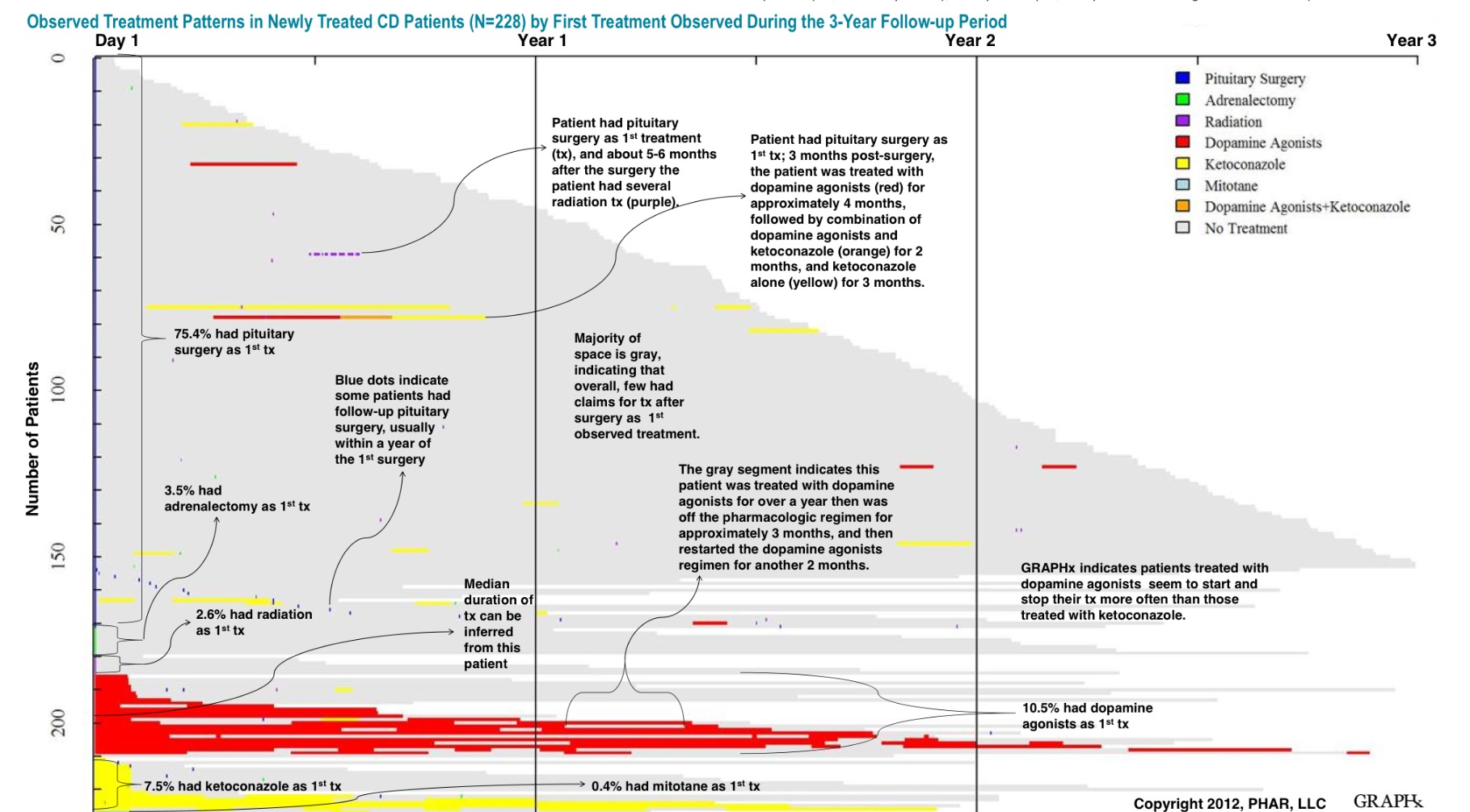
endo-chart

Researchers at PHAR, in conjunction with experts from Novartis Pharmaceuticals Corporation, presented the results of several studies on Cushing’s disease at the Endocrine Society’s 95th Annual Meeting on June 19th, 2013.

Cushing’s disease, a pituitary disorder, is poorly studied because of its rarity. The PHAR research team reported on the incidence, treatment patterns, and annual economic burden associated with the disease–topics on which very little was previously known.

The three posters presented at ENDO can be viewed by clicking the links below:

Incidence of Cushing’s Disease in the United States

Real-World Treatment Patterns in Cushing’s Disease Patients in Two Large US Nationwide Databases: Application of a Novel, Graphical Methodology

Annual Economic Burden Associated with Cushing’s Disease in the United States

Researchers May Have Found the Cause of Cushing’s Disease

A team of researchers may have zeroed in on the cause of Cushing’s disease, a condition that leads to diabetes, obesity and the risk of premature death.

Location of the pituitary gland in the human brain

Location of the pituitary gland in the human brain (Photo credit: Wikipedia)(TR4). By reducing the TR4 in lab mice, they were able to reverse tumor growth and excess ACTH production.

More women than men get the disease, which begins usually between 20 and 50 with mostly benign tumors in the pituitary gland. It’s known that that condition results in excess production of adrenocorticotrophic hormone (ACTH). But until now, scientists haven’t been sure what drives the production of ACTH.

Now, UCLA researchers and their colleagues have zeroed in on the culprit: excessive production of testicular orphan nuclear receptor (TR4). By reducing the TR4 in lab mice, they were able to reverse tumor growth and excess ACTH production.

The findings, published in the journal Proceedings of the National Academy of Sciences, could point the way to targeted treatment of Cushing’s.

From http://www.thirdage.com/medical-care/researchers-find-the-cause-of-cushing-s-disease

Hypercortisolism Is Associated With Increased Coronary Arterial Atherosclerosis

Hypercortisolism Is Associated With Increased Coronary Arterial Atherosclerosis: Analysis of Noninvasive Coronary Angiography Using Multidetector Computerized Tomography

Journal of Clinical Endocrinology and Metabolism, 05/21/2013  Clinical Article

  1. Nicola M. Neary*,
  2. O. Julian Booker*,
  3. Brent S. Abel,
  4. Jatin R. Matta,
  5. Nancy Muldoon,
  6. Ninet Sinaii,
  7. Roderic I. Pettigrew,
  8. Lynnette K. Nieman and
  9. Ahmed M. Gharib

Author Affiliations


  1. Program in Reproductive and Adult Endocrinology (N.M.N., L.K.N., B.S.A.), Eunice Kennedy Shriver National Institute of Child Health and Human Development, National Institutes of Health, Bethesda, Maryland 20892; Laboratory of Cardiac Energetics (O.J.B.), National Heart, Lung, and Blood Institute, National Institutes of Health, Bethesda, Maryland 20892; Integrative Cardiovascular Imaging Laboratory (J.R.M., R.I.P., A.M.G.), National Institute of Diabetes and Digestive and Kidney Diseases, National Institutes of Health, Bethesda, Maryland 20892; Critical Care Medicine (N.M.), Clinical Center, National Institutes of Health, Bethesda, Maryland 20892; and Biostatistics and Clinical Epidemiology Service (N.S.), Clinical Center, National Institutes of Health, Bethesda, Maryland 20892
  1. Address all correspondence and requests for reprints to: Ahmed M. Gharib, MB, ChB, National Institutes of Health, Building 10, Room 3-5340, Mail Stop Code 1263, 10 Center Drive, Bethesda, MD 20892. E-mail: agharib@mail.nih.gov.
  1. * N.M.N. and O.J.B. contributed equally to this work.

Abstract

Background: Observational studies show that glucocorticoid therapy and the endogenous hypercortisolism of Cushing’s syndrome (CS) are associated with increased rates of cardiovascular morbidity and mortality. However, the causes of these findings remain largely unknown.

Objective: To determine whether CS patients have increased coronary atherosclerosis.

Design: A prospective case-control study was performed.

Setting: Subjects were evaulated in a clinical research center.

Subjects: Fifteen consecutive patients with ACTH-dependent CS, 14 due to an ectopic source and 1 due to pituitary Cushing’s disease were recruited. Eleven patients were studied when hypercortisolemic; 4 patients were eucortisolemic due to medication (3) or cyclic hypercortisolism (1). Fifteen control subjects with at least one risk factor for cardiac disease were matched 1:1 for age, sex, and body mass index.

Primary outcome variables: Agatston score a measure of calcified plaque and non-calcified coronary plaque volume were quantified using a multidetector CT (MDCT) coronary angiogram scan. Additional variables included fasting lipids, blood pressure, history of hypertension or diabetes, and 24-hour urine free cortisol excretion.

Results: CS patients had significantly greater noncalcified plaque volume and Agatston score (noncalcified plaque volume [mm3] median [interquartile ranges]: CS 49.5 [31.4, 102.5], controls 17.9 [2.6, 25.3], P < .001; Agatston score: CS 70.6 [0, 253.1], controls 0 [0, 7.6]; P < .05). CS patients had higher systolic and diastolic blood pressures than controls (systolic: CS 143 mm Hg [135, 173]; controls, 134 [123, 136], P < .02; diastolic CS: 86 [80, 99], controls, 76 [72, 84], P < .05).

Conclusions: Increased coronary calcifications and noncalcified coronary plaque volumes are present in patients with active or previous hypercortisolism. Increased atherosclerosis may contribute to the increased rates of cardiovascular morbidity and mortality in patients with glucocorticoid excess.

  • Received October 29, 2012.
  • Accepted March 7, 2013.

From JCEM

Signifor® (Pasireotide) is now Commercially Available

November 7, 2012 The US Food and Drug Administration’s (FDA) Endocrinologic and Metabolic Drugs Advisory Committee (EMDAC) voted unanimously in support of the use of Signifor® (pasireotide) for the treatment of patients with Cushing’s disease who require medical therapeutic intervention. The recommendation was based on data from clinical trials of pasireotide, including PASPORT-CUSHINGS (PASireotide clinical trial PORTfolio – CUSHING’S disease), the largest randomized Phase III study to evaluate a medical therapy in patients with Cushing’s disease.

Patient Assistance for SIGNIFOR support for patients includes:
– Therapy-specific support programs for out-of-pocket costs
– Alternative assistance searches and referrals to Federal and State assistance programs
– Referrals to Independent Charitable Foundations for assistance with co-pay costs
– Patient assistance for low-income and uninsured patients

For more information, or to speak to a Patient Assistance NOW Endocrinology representative, please call 1-877-503-3377 (select option #3 for SIGNIFOR) Monday to Friday 8 am – 8 pm ET.