Day 10, Cushing’s Awareness Challenge

This is one of the suggestions from the Cushing’s Awareness Challenge post:

What have you learned about the medical community since you have become sick?

This one is so easy. I’ve said it a thousand times – you know your own body better than any doctor will. Most doctors have never seen a Cushing’s patient, few ever will in the future.

If you believe you have Cushing’s (or any other rare disease), learn what you can about it, connect with other patients, make a timeline of symptoms and photographs. Read, take notes, save all your doctors notes, keep your lab findings, get second/third/ten or more opinions.  Make a calendar showing which days you had what symptoms.  Google calendars are great for this.

This is your life, your one and only shot (no pun intended!) at it. Make it the best and healthiest that you can.

When my friend and fellow e-patient Dave deBronkart learned he had a rare and terminal kidney cancer, he turned to a group of fellow patients online and found a medical treatment that even his own doctors didn’t know. It saved his life.

In this video he calls on all patients to talk with one another, know their own health data, and make health care better one e-Patient at a time.

7a4e4-maryoonerose

Urinary free cortisol analyses: Enhancing their clinical performance in Cushing’s syndrome management by means of LC-MS/MS

Highlights

  • An LC-MS/MS method was developed for UFC, cortisone and dexamethasone monitoring.
  • Direct injection was found to be suitable, even in cases of hypocortisolism.
  • Cortisone and cortisol/cortisone ratio complementary role in UFC tests was proved.
  • Dexamethasone monitoring in urine allowed to exclude invalid samples.
  • Population-based LC-MS/MS reference ranges were established.

Abstract

24 h urinary free cortisol (UFC) analysis constitutes one of the three first level recommended tests in Cushing’s syndrome (CS) diagnostic confirmation work up. However, it occasionally leads to inaccurate results due to the use of immunoassays (IAs) or the concomitant administration of exogenous glucocorticoids, among others.
This study aimed to develop a rapid and accurate LC-MS/MS method which may ultimately replace the use of IAs, and also provide relevant clinical information through the simultaneous monitoring of UFC, cortisone, and dexamethasone.
An LC-MS/MS method based on direct injection approach was developed and fully characterized for the quantitation of the target analytes. A population-based reference range was established, and the potential supporting role of cortisone and cortisol/cortisone ratio was comprehensively assessed in patients under CS follow-up or clinical suspicion for hypercortisolism. The presence of dexamethasone was also assessed in order to exclude invalid samples from evaluation.
Significant differences were observed for cortisone and cortisol/cortisone ratio between the control group and patients with hyper−/hypocortisolism, and an ideal level of biochemical agreement was observed with UFC LC-MS/MS values when the combination of both biomarkers was considered. Dexamethasone was detected in up to 7.7% of the studied population.
The herein presented LC-MS/MS approach not only offers the possibility of discontinuing the use of IAs, but also provides additional biomarkers which are significantly relevant in CS management, thus enhancing the overall clinical performance of UFC analyses.

Introduction

Cushing’s syndrome (CS) is characterized by a state of hypercortisolism that can be detected and monitored by means of clinical laboratory tests, such as 24 h urinary freecortisol (UFC). UFC measurement constitutes one of the three first level recommended tests, along with overnight 1 mg dexamethasone suppression and late night salivary cortisol tests [1], [2].
UFC levels are in general highly variable, and at least two 24 h urine collections are necessary for screening/monitoring of CS [1], [2]. In addition to this, 24 h urine samples are often further required due to unexpected or biochemically inconsistent results. This makes the process even more tedious for the patient, and ultimately causes delays in CS diagnosis and management.
Such discordant results may derive from an undeclared use of exogenous glucocorticoids or analytical limitations, among other reasons. The latter occurs especially when UFC analyses are performed by immunoassays (IAs), due to their limited specificity.
Therefore, improvements in UFC tests concerning the analytical methodology, and the inclusion of complementary biomarkers that reinforce their clinical interpretation in the light of unexpected/inconsistent results, appear necessary.
Besides, the simultaneous monitoring of exogenous glucocorticoids in UFC analyses, which is not often considered in clinical practice, should be included.
Liquid chromatography-tandem mass spectrometry (LC-MS/MS) has been suggested as the most suitable alternative for UFC quantification [3], [4], [5], [6], [7], since it overcomes IAs analytical limitations. Besides, it also allows for the simultaneous monitoring of different analytes.
In the context of CS management, the simultaneous LC-MS/MS determination of UFC and cortisone, as well as the use of cortisol/cortisone ratio have been previously suggested [8], [9], [10], [11], [12], [13], [14], [15], [16], [17], [18], [19]. With regard to the monitoring of exogenous glucocorticoids, at our center (Hospital Universitario Son Espases, Palma, Spain), it would be of particular importance in the case of dexamethasone. This is because the UFC determination is often followed by an overnight 1 mg dexamethasone suppression test, and its intake may occur by mistake prior or during urine collection.
Despite their advantages, LC-MS/MS methods usually require time-consuming sample preparations, e.g. liquid-liquid extraction (LLE) protocols [20], thus not allowing to completely avoid using IAs in most clinical laboratories. In Spain, to the best of our knowledge, all hospitals in the public healthcare system still use IAs for UFC analysis. Mass spectrometry is only available at tertiary-care centers or academic hospitals, where is still used in combination with IAs to cope with the large volume of samples received on a daily basis. In this case, the use of complementary biomarkers in LC-MS/MS UFC analyses would be of particular interest, as discordant results may occur between methods due to IA analytical limitations.
For all these reasons, in the herein presented study, a novel, rapid and accurate LC-MS/MS method based on direct injection approach for the quantitation of UFC, cortisone, and dexamethasone was developed. Given the lack of standardization in reference ranges, appropriate population-based LC-MS/MS reference values were established.
Most research only focuses on the ability of cortisone and cortisol/cortisone ratio to discriminate ectopic ACTH production from other subtypes of CS [3], [4], [5], [6], [7], [8], [9], [10], [11], [12], [13], [14], [15], [16], [17], [18], [19]. For this reason, this study assessed their suitability as complementary biomarkers, and therefore their ability to reinforce the clinical interpretation of UFC analyses.
To the best of our knowledge, they have not been previously assessed in the context of hypocortisolism. This would be of substantial importance in the follow-up of CS since adrenal insufficiency secondary to adrenalectomy/pituitary surgery or pharmacological treatment (e.g. ketoconazole, metyrapone) may occur. Therefore, such scenario was further considered.

Bimonthly Growth Hormone Injections to Replace Daily Injections?

At the Annual ENDO 2017 meeting in Orlando, FL, Moore et al provided an update on somavaratan, the long acting recombinant human growth hormone being investigated for children and adults with growth hormone deficiency.

Current treatment for these patients is somewhat burdensome given the need for daily subcutaneous injections. Somavaratan provides the option for bimonthly injections.

At ENDO 2017, 3 year data was presented in children given somavaratan and the data is impressive.

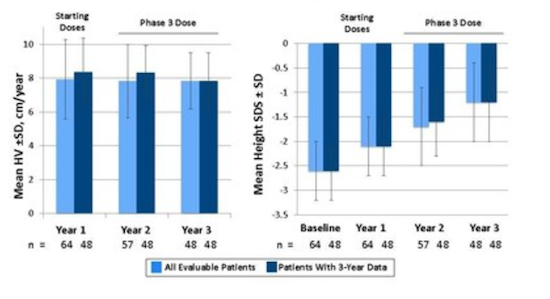
The 3 year data is part of an ongoing extension study following a 6 month Phase 2 trial in which 64 patients received 5.0 mg/kg/month at various dosing schedules. Of those patients, 60 continued in an open label extension study (dose adjusted to 3.5 mg/kg given twice-monthly by the beginning of Year 2 of treatment).  At ENDO 2017, data from 30 of those patients who had completed 3 years of treatment were presented.

(Insulin-like growth factor standard deviation score (IGF-I SDS) increased from -1.7 ± 0.8 at baseline to 1.1 ± 1.6 at peak (3–5 days post-injection) and -0.2 ± 0.9 at trough (end of dosing cycle) in Year 3. Of the 30 patients, 8 had transient IGF-I SDS excursions > 2.0, of which 3 events were > 3.0 (range, 2.3–3.9).

Height velocity (HV) remained consistent at 8.5 ± 1.8, 8.5 ± 1.7, and 8.1 ± 1.5 cm/year, for years 1, 2, and 3 respectively.

Height-SDS increased from -2.6 ± 0.5 at baseline to -1.9 ± 0.6, -1.4 ± 0.7, and -1.0 ± 0.7 at years 1, 2, and 3, respectively.

Treatment-related adverse events were generally mild and transient.

In an exclusive interview with Rare Disease Report, one of the investigators of the study, Bradley Miller, MD, PhD, of the University of Minnesota Masonic Children’s Hospital, said that compliance is an issue with growth hormone replacement therapy and any options that can remove the daily injection requirements would likely be well received by both patients and clinicians.

A Phase 3 study is currently underway to comparing bimonthly somavaratan treatment with daily growth hormone treatments (NCT02339090).

Somavaratan is being developed by Versartis Inc

About Growth Hormone Deficiency 

Growth hormone deficiency occurs when the pituitary gland does not produce enough growth hormone, resulting in short stature, delayed or absent puberty, and changes in muscle mass, cholesterol levels, and bone strength. The condition can be congenital, structural (malformations in the brain) or acquired (resulting from trauma, infections, tumors, radiation therapy, or other causes).

Currently, the standard of care is subcutaneous injection of a biosynthetic recombinant human growth hormone (rhGH). The frequency of the injections is based on the patient’s level of growth hormone deficiency (ie, whether growth hormone is completely absent or some growth hormone is present), but most patients require daily administration.

The rhGH treatments are typically given until the child’s maximum growth potential is achieved, often requiring many years of treatment (and increasing the risk of poor compliance).

Reference

Moore WV, Fechner PY, Nguyan HJ, et al. Safety and Efficacy of Somavaratan (VRS-317), a Long-Acting Recombinant Human Growth Hormone (rhGH), in Children with Growth Hormone Deficiency (GHD): 3-Year Update of the Vertical & VISTA Trials (NCT01718041, NCT02068521). Presented at: ENDO 2017; Orlando, FL; April 1-4, 2017. Abstract OE31-1.

From http://www.raredr.com/news/bimonthly-growth-hormone

Day 9, Cushing’s Awareness Challenge

Uh, Oh – I’m nearly a day late (and a dollar short?)…and I’m not yet sure what today’s topic will be.  I seem swamped by everything lately, waking up tired, napping, going to bed tired, waking up in the middle of the night, traveling, work, starting all over again…and my DH was recently diagnosed with cancer which makes everything more hectic and tiring.

It’s been like this since I was being diagnosed with Cushing’s in the mid-1980’s.  You’d think  things would be improved in the last 29 years.  But, no.

My mind wants things to have improved, so I’ve taken on more challenges, and my DH has provided some for me (see one of my other blogs, MaryOMedical).

Thank goodness, I have only part-time jobs (4 0f them!), that I can mostly do from home.  I don’t know how anyone post-Cushing’s could manage a full-time job!

I can see this post morphing into the topic “My Dream Day“…

I’d wake up refreshed and really awake at about 7:00AM and take the dog out for a brisk run.

Get home about 8:00AM and start on my website work.

Later in the morning, I’d get some bills paid – and there would be enough money to do so!

After lunch, out with the dog again, then practice the piano some, read a bit, finish up the website work, teach a few piano students, work on my church job, then dinner.

After dinner, check email, out with the dog, maybe handbell or choir practice, a bit of TV, then bed about 10PM

Nothing fancy but NO NAPS.  Work would be getting done, time for hobbies, the dog, 3 healthy meals.

Just a normal life that so many take for granted. Or, do they?

me-tired

How To Tell if You Have “Cortisol Face” And What to Do About It

If you have been anywhere near wellness content lately, you have encountered cortisol face or “moon face”.

Posts claim that stress is literally reshaping people’s faces. The coverage tends to split into two camps: content that oversells the trend or content that dismisses it entirely. The more useful truth sits in the middle.

Cortisol face is not a medical term, but the facial feature it describes is real.

Endocrinologists at Ohio State University’s Wexner Medical Center clarify that what it points to has been documented in medicine as moon facies, caused by fat accumulation and soft tissue swelling. Moon facies is the clinical term. Cortisol face is the social media translation. They describe the same phenomenon but carry very different implications for how concerned you should be.

When the body produces too much cortisol it can cause Cushing’s syndrome, a hormonal disorder whose symptoms include weight gain, inflammation and facial rounding, per the Cleveland Clinic. That is what people online are calling cortisol face or moon face. Cushing’s syndrome affects about 40 to 70 people per million according to the NIH, and its symptoms extend well beyond a round face to include skin that bruises easily, a puffy neck and a worsening upper-back hump.

Can Everyday Stress Change Your Face?

UCI Health endocrinologist Dr. Mehboob Hussain says everyday life stressors are unlikely to be the cause of facial puffiness. More common culprits include a high-salt diet, eczema, allergies and sleep position.

That said, chronically elevated cortisol from sustained stress, poor sleep or overexercising does produce real effects. It increases sodium retention, causes the body to hold water in soft tissues including the face, and shifts fat distribution toward the face and midsection. A

board-certified endocrinologist at Trinity Health confirms that inappropriately elevated cortisol over a long period can cause more rounding and weight gain in the face and abdomen. There is a wide gap between that and a hectic week at work.

What to Watch For

University of Colorado endocrinologists recommend looking for multiple symptoms together. Signs worth bringing to a doctor include persistent facial rounding developing over weeks or months alongside weight gain in the abdomen, thin arms and legs, purple stretch marks, increased acne or facial hair in women, easy bruising or muscle weakness.

Texas A&M’s Dr. Maria Olenick offers a practical rule: true moon face does not just appear or disappear from one day to the next. Temporary morning puffiness, swelling after a salty meal or a rounder face with no other symptoms are probably not cause for concern. One additional flag: long-term corticosteroid medications like prednisone are the most common non-tumor cause of clinical moon face, so mention any facial changes to your doctor if you are on these.

What Actually Lowers Cortisol

Sleep is the most evidence-supported starting point. Chronic sleep issues are directly associated with higher cortisol levels per Healthline.

A meta-analysis of 58 randomized controlled trials found mindfulness and relaxation interventions were the most effective approaches for measurably reducing cortisol.

Moderate exercise helps, but high-intensity overtraining can raise cortisol further, worth knowing if punishing workouts are already part of a stressed routine.

OSF HealthCare notes that magnesium-rich foods including leafy greens, avocados and dark chocolate support cortisol balance, while refined sugars can spike blood sugar and trigger further release. Walking in natural settings has measurably reduced salivary cortisol in peer-reviewed research.

Alcohol and caffeine both raise cortisol and are worth pulling back when symptoms are present. When to See a Doctor If facial changes are persistent, cluster with other symptoms or have not responded to lifestyle changes over several weeks, get evaluated.

UCI Health notes that blood, urine and saliva cortisol tests are available, and a primary care provider can handle initial testing before referring to an endocrinologist if needed.

The biology behind cortisol face is real. A rough week probably is not causing it. But if changes persist and stack up alongside other symptoms, it is worth taking seriously.

This article was created by content specialists using various tools, including AI.

Read more at: https://www.miamiherald.com/living/article315266634.html#storylink=cpy