8 medical conditions that could cause sudden weight gain

Weight gain can be associated with hormonal conditions, mood disorders, or other physiological factors. A sudden and unexplained weight gain could be your body’s way of signalling an underlying medical issue that needs to be addressed. For the sake of health and long-term well-being, it is important to differentiate between a few harmless extra kilos and a fluctuation that could be hiding a bigger problem. You can only be certain after consulting a healthcare practitioner.

If the weighing scale says your numbers are up but you haven’t changed your eating and exercise habits, you might consider any of the 8 medical conditions:

1.     Hypothyroidism The American Thyroid Association reveals that one in eight women will develop a thyroid disorder during her lifetime. Hypothyroidism refers to an underactive thyroid. The thyroid controls several body functions and your metabolism is one of them. If you’re not producing enough thyroid hormone your body can’t burn as much energy. Symptoms appear throughout your system. They include: weight gain, exhaustion, drier skin, thinner hair, bloating, muscle weakness, constantly feeling cold, and constipation. Once diagnosis is confirmed a doctor can prescribe an oral replacement for thyroid hormone that can relieve symptoms within weeks.

2.     Polycystic ovary syndrome (PCOS) One in 10 women of childbearing age undergoes PCOS. It is an endocrine disorder characterised by an imbalance in the sex hormones oestrogen and testosterone.  This results in irregular periods, acne and even facial hair growth. The disorder also disrupts the way the body uses insulin — which is the hormone responsible for converting carbohydrates into energy. As a result the sugars and starches you consume are stored as fat instead of energy, thus, weight gain. PCOS has no cure but women who have it can manage their symptoms with lifestyle changes and medication. A doctor’s consultation will help you find an appropriate method.

3. Insomnia Avoid fake news! Subscribe to the Standard SMS service and receive factual, verified breaking news as it happens. Text the word ‘NEWS’ to 22840 Sleep deprivation can negatively impact both your metabolism and your hunger hormones. Sleeping too little increases ghrelin, the hormone that signals the body that it’s time to eat, while lowering leptin, the hormone that says you are full. The result: increased cravings and snacking to get more energy through the day. Insomnia increases impulsive eating. A 2018 study published in the American Journal of Clinical Nutrition found that the right amount of sleep could mean consuming up to 10 fewer grams of sugar throughout the day.

4.     Tumours Weight gain around your belly as opposed to your lower body or other areas can be more dangerous to your health. Large pelvic area tumours like uterine or ovarian tumours can inflate the abdomen the way excess fat does. In some cases they can also be cancerous. In addition to weight gain, symptoms of ovarian or uterine tumours include vaginal bleeding, lower back pain, constipation and painful intercourse. But these signs are common for other conditions as well so it‘s worth confirming with a doctor to rule out any possible complications.

5. Peri menopause and menopause Perimenopause -the transition period to menopause can start as early as a woman’s mid-thirties, but usually starts in their forties. This period triggers hormones like oestrogen to rise and fall unevenly, which can cue weight gain in some women. Genetics are a good starting point on how your body experiences these changes, so it would be helpful to look into how it affected your mother and other older women in your family. Other signs of perimenopause are mood swings, irregular periods, hot flashes, and changes in libido. Age also contributes to loss of muscle mass and increase in body fat. An Ob-Gyn should be able to talk you through these changes and recommend management options.

6.     Mood disorders Depression and anxiety can result in fatigue, lack of focus and irritability. Some people cope with anxious or sad feelings by mindlessly munching on food they don’t really need. Additionally chronic stress throws your body into fight-or-flight mode, leading to a surge of adrenaline, as well as a heavy dose of the hormone cortisol –responsible for restoring energy reserves and storing fat.

7. Cushing syndrome Sometimes tumours on the pituitary or adrenal glands can contribute to a condition known as Cushing’s disease which is characterised by high levels of cortisol in the blood. Taking long term steroids could also result in this disease. Patients with Cushing syndrome will experience rapid weight gain in the face, abdomen and chest. They also display slender arms and legs compared to the heavy weight in the core of the body. Other symptoms include: high blood pressure, mood swings, osteoporosis, discoloured stretch marks, acne, and fragile skin. Depending on the cause, Cushing‘s disease can be treated in a different ways.

8. New medication Before starting on any new prescription medication, ask your doctor if weight gain is a possible side effect. Birth control pills may lead to weight gain depending on the brand, dosage, and the person’s hormonal levels. Psychiatric medications, especially for depression and bipolar disorder, have been known to cause weight gain, as they target the brain. Similarly, taking insulin to manage diabetes or medications that treat high blood pressure can also lead to extra kilos, so staying active and sticking to a strict meal plan can help you take insulin without unnecessarily weight gain.

Adapted from https://www.standardmedia.co.ke/lifestyle/article/2001297348/8-medical-conditions-that-could-cause-sudden-weight-gain

Fluconazole Found to Be Safe Alternative for Patient with Recurrent Cushing’s

Treatment with fluconazole after cabergoline eased symptoms and normalized cortisol levels in a patient with recurrent Cushing’s disease who failed to respond to ketoconazole, a case study reports.

The case report, “Fluconazole as a Safe and Effective Alternative to Ketoconazole in Controlling Hypercortisolism of Recurrent Cushing’s Disease: A Case Report,” was published in the International Journal of Endocrinology Metabolism.

Ketoconazole, (brand name Nizoral, among others) is an anti-fungal treatment used off-label for Cushing’s disease to prevent excess cortisol production, a distinct symptom of the disease. However, severe side effects associated with its use often result in treatment discontinuation and have led to its unavailability or restriction in many countries.

Consequently, there is a need for alternative medications that help manage disease activity and clinical symptoms without causing adverse reactions, and that could be given to patients who do not respond to ketoconazole treatment.

In this case report, researchers in Malaysia reported on a 50-year-old woman who fared well with fluconazole treatment after experiencing severe side effects with ketoconazole.

The woman had been in remission for 16 years after a transsphenoidal surgery — a minimally invasive brain surgery to remove a pituitary tumor — but went to the clinic with a three-year history of high blood pressure and gradual weight gain.

She also showed classic symptoms of Cushing’s disease: moon face, fragile skin that bruised easily, and purple stretch marks on her thighs.

Blood and urine analysis confirmed high cortisol levels, consistent with a relapse of the pituitary tumor. Accordingly, magnetic resonance imaging (MRI) of her brain showed the presence of a small tumor on the right side of the pituitary gland, confirming the diagnosis of recurrent Cushing’s disease.

Doctors performed another transsphenoidal surgery to remove the tumor, and a brain MRI then confirmed the success of the surgery. However, her blood and urine cortisol levels remained markedly high, indicating persistent disease activity.

The patient refused radiation therapy or adrenal gland removal surgery, and was thus prescribed ketoconazole twice daily for managing the disease. But after one month on ketoconazole, she experienced low cortisol levels.

Hydrocortisone — a synthetic cortisol hormone — was administered to maintain steady cortisol levels. However, she developed severe skin itching and peeling, which are known side effects of ketoconazole. She also suffered a brain bleeding episode, for which she had to have a craniotomy to remove the blood clot.

Since she experienced adverse effects on ketoconazole, which also hadn’t decreased her disease activity, the doctors switched her to cabergoline. Cabergoline (marketed as Dostinex, among others) is a dopamine receptor agonist that has been shown to be effective in managing Cushing’s disease.

But cabergoline treatment also did not lower the disease activity, and her symptoms persisted.

The doctors then added fluconazole (marketed as Diflucan, among others), an anti-fungal medication, based on studies that showed promising results in managing Cushing’s syndrome. Three months after the addition of fluconazole to her treatment plan, the patient’s clinical symptoms and cortisol levels had responded favorably.

At her next clinical visit 15 months later, her condition remained stable with no adverse events.

“This case demonstrates the long-term efficacy of fluconazole in tandem with cabergoline for the control of recurrent Cushing’s disease,” the researchers wrote.

The favorable outcome in this case also “supports the notion that fluconazole is a viable substitute for ketoconazole in the medical management of this rare but serious condition,” they concluded.

From https://cushingsdiseasenews.com/2018/09/27/fluconazole-safe-effective-alternative-recurrent-cushings-patient-case-report/

Cushing Syndrome Results in Poor Quality of Life Even After Remission

Functional remission did not occur in most patients with Cushing syndrome who were considered to be in biochemical and clinical remission, according to a study published in Endocrine. This was evidenced by their quality of life, which remained impaired in all domains.

The term “functional remission” is a psychiatric concept that is defined as an “association of clinical remission and a recovery of social, professional, and personal levels of functioning.” In this observational study, investigators sought to determine the specific weight of psychological (anxiety and mood, coping, self-esteem) determinants of quality of life in patients with Cushing syndrome who were considered to be in clinical remission.

The cohort included 63 patients with hypercortisolism currently in remission who completed self-administered questionnaires that included quality of life (WHOQoL-BREF and Cushing QoL), depression, anxiety, self-esteem, body image, and coping scales. At a median of 3 years since remission, participants had a significantly lower quality of life and body satisfaction score compared with the general population and patients with chronic diseases. Of the cohort, 39 patients (61.9%) reported having low or very low self-esteem, while 16 (25.4%) had high or very high self-esteem. Depression and anxiety were seen in nearly half of the patients and they were more depressed than the general population. In addition, 42.9% of patients still needed working arrangements, while 19% had a disability or cessation of work.

Investigators wrote, “This impaired quality of life is strongly correlated to neurocognitive damage, and especially depression, a condition that is frequently confounded with the poor general condition owing to the decreased levels of cortisol. A psychiatric consultation should thus be systematically advised, and [selective serotonin reuptake inhibitor] therapy should be discussed.”

Reference

Vermalle M, Alessandrini M, Graillon T, et al.  Lack of functional remission in Cushing’s Syndrome [published online July 17, 2018]. Endocrine. doi:10.1007/s12020-018-1664-7

From https://www.endocrinologyadvisor.com/general-endocrinology/functional-remission-quality-of-life-cushings-syndrome/article/788501/

Steroid Medication for Nasal Obstruction in Infants May Cause Cushing’s Syndrome

Intranasal steroid drops used to treat nasal obstruction may cause Cushing’s syndrome and adrenal insufficiency in infants, a case study of two patients suggests.

The study, “Iatrogenic Cushing’s syndrome and adrenal insufficiency in infants on intranasal dexamethasone drops for nasal obstruction – Case series and literature review,” was published in the International Journal of Pediatric Otorhinolaryngology.

Children with nasal obstruction may have severe delays in development and can face life-threatening complications later in life such as obstructive sleep apnea and cardiopulmonary problems.

While intranasal steroid drops have become increasingly popular as a substitute for surgery, they can have adverse effects. In addition to suppressing the immune system and changing metabolism, high levels of corticosteroids in the blood may cause Cushing’s syndrome.

Researchers at Weill Cornell Medical College presented two cases of adrenal gland insufficiency and Cushing’s syndrome caused by intranasal dexamethasone drops. Dexamethasone is a type of corticosteroid medication.

First, they described the case of a 3-month-old boy who was taken to the hospital following a life-threatening episode at home after feeding. A physical evaluation revealed nasal congestion with no additional anatomic abnormalities.

Treatment with nasal dexamethasone drops three times a day improved his breathing. While the dosage was later decreased to three drops once daily, a congestion episode led the mother to increase the dose back to the initial recommendation.

After seven weeks of treatment, the boy was noted to have facial puffiness, leading to an endocrine evaluation that revealed low cortisol levels. The dose was eventually reduced, and the boy’s cortisol levels returned to normal after several months.

The second case was a 6-week-old boy with a history of chronic congestion and difficulty feeding. He had severe nasal obstruction and required intubation due to respiratory distress. A nasal exam revealed damaged mucosa with severe nasal cavity narrowing, and he began treatment with three ciprofloxacin-dexamethasone drops three times a day.

After two and a half weeks of treatment, the boy’s cortisol levels were considerably low, and adrenal insufficiency was diagnosed. The treatment dose was reduced in an attempt to improve cortisol levels, but nasal obstruction symptoms continued.

The child then underwent surgery to resolve his nasal obstruction, and the treatment with steroid drops was discontinued. While his cortisol levels subsequently improved, they continued to be low, suggesting that he may have a hormone-related disease.

Despite the benefits of steroid-based nasal drops, small infants are more sensitive to steroid compounds. In addition, nasal drops are more easily absorbed than nasal sprays, suggesting that infants taking these medications should be better controlled for side effects.

“Patients started on this therapy must be closely monitored in a multi-disciplinary fashion to ensure patient safety and optimal symptom resolution,” the researchers suggested.

From https://cushingsdiseasenews.com/2018/03/09/cushing-syndrome-infants-can-be-caused-by-steroid-based-nasal-drops-study-suggests/

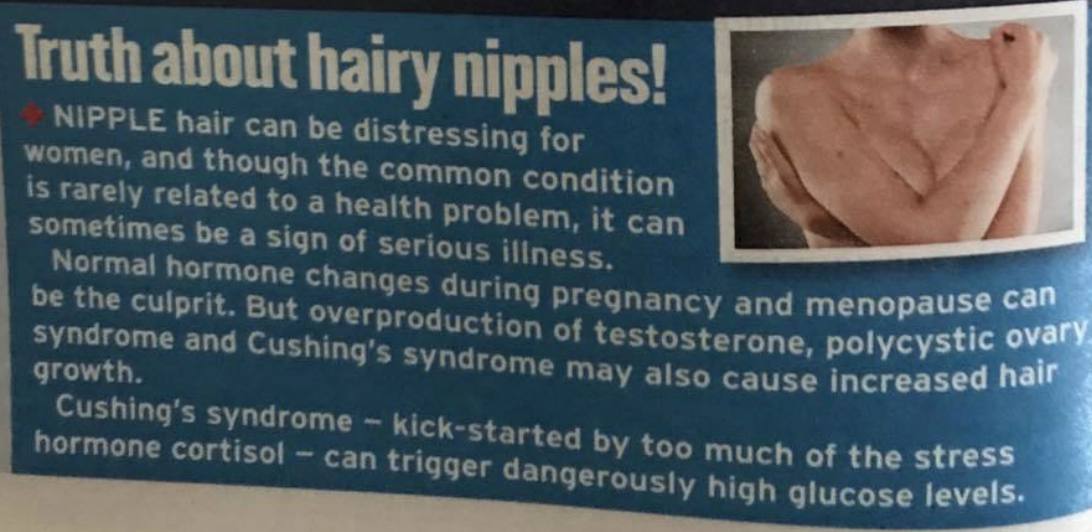
Cushing’s and Hairy Nipples

Hairy nipples are a common condition in women. The amount of hair on the nipples varies, but some women find that the hair becomes long, coarse, and dark, which can be distressing.

Hairy nipples are rarely a cause for concern and are usually not a sign of any underlying health issues. However, occasionally they can signify something more serious, in which case, it is essential to consult a doctor.

Almost every part of a person’s skin is covered in hair and hair follicles. On certain parts of the body, such as the top of the head, the hair usually grows longer and thicker, while on other parts, it is thin and transparent.

Fast facts on hairy nipples:

  • It is not known how common hairy nipples are or how many women have them.
  • Many women do not report the condition and instead manage it themselves.
  • It is possible for hair that used to be fine and light to turn coarse and dark with age.

Causes of hairy nipples in women

There are several underlying reasons that might cause nipple hairs to grow. These are:

Cushing’s syndrome

Cushing’s syndrome is another condition caused by hormonal imbalance. When it occurs, there is an excess of cortisol in the body. In this case, a person may experience several symptoms, such as:

  • increased hair growth
  • abnormal menstrual periods
  • high blood pressure
  • a buildup of fat on the chest and tummy, while arms and legs remain slim
  • a buildup of fat on the back of the neck and shoulders
  • a rounded and red, puffy face
  • bruising easily
  • big purple stretch marks
  • weakness in the upper arms and thighs
  • low libido
  • problems with fertility
  • mood swings
  • depression
  • high blood glucose level

Cushing’s syndrome is fairly rare, and the cause is usually associated with taking glucocorticosteroid medicine, rather than the body overproducing the hormone on its own.

It is possible, however, that a tumor in the lung, pituitary gland, or adrenal gland is the cause.

Also:

Hormonal changes and fluctuations

Hormonal changes in women can cause many different symptoms, one of which is changes in nipple hair growth and color.

Some common hormonal changes happen during pregnancy and menopause.

However, hormonal changes can also occur when a woman is in her 20s and 30s, which may cause nipple hair to change appearance or become noticeable for the first time.

Overproduction of male hormones

It is possible for hormonal imbalances to cause hairy nipples. Overproduction of male hormones, including testosterone, can cause hair growth, while other symptoms include:

  • oily skin that can lead to breakouts and acne
  • menstrual periods stopping
  • increase in skeletal muscle mass
  • male pattern baldness, leading to a woman losing hair on her head

If overproduction of male hormones is suspected, it is a good idea to make an appointment with a doctor who can confirm this with a simple test.

Polycystic ovary syndrome

Polycystic ovary syndrome (PCOS) occurs because of a hormonal imbalance. PCOS is a condition that affects the way the ovaries work.

Common symptoms of PCOS are:

  • infertility
  • irregular menstrual periods
  • ovarian cysts
  • excessive hair growth in unusual places, such as the nipples

PCOS is believed to affect around 1 in 5 women.

Medication

The side effects of particular medicines can cause unusual hair growth.

Medicines, such as testosterone, glucocorticosteroids, and certain other immunotherapy drugs may cause hairy nipples.

What are the treatment options?

Treatment for hairy nipples is not usually necessary for health reasons.

However, many women with the condition prefer to try and reduce or get rid of the appearance of hair on their nipples for cosmetic purposes.

There are several methods by which they can try and do this:

Trimming the nipple hair

Trimming the nipple hair may be enough to reduce its appearance. Small nail scissors are ideal, and hair can be cut close to the skin. It is essential to do this carefully and avoid catching the skin.

Trimming will need to be carried out regularly when the hair grows back.

Tweezing the nipple hair

Tweezing nipple hair is an effective way to get rid of unwanted nipple hair. However, this option can be painful as the skin around the nipple area is particularly soft and sensitive.

It is also important to bear in mind that the hair will return, and tweezing the hair increases the risk of infection and ingrown hairs.

Shaving the nipple hair

Shaving is another option to reduce the appearance of nipple hair. However, it is advisable to do so with caution to avoid nicking the sensitive skin.

This option also carries an increased risk of developing ingrown hairs and infection.

Waxing

Sugaring or waxing is a good hair removal option, though either one is likely to be painful. A salon is the best place to get this treatment type, as doing this at home may cause damage to the skin. Infection and ingrown hairs are again a risk.

Laser hair removal

These popular treatments can help to reduce the hair growth and slow or even prevent regrowth for a while. However, they can be painful, too.

Laser treatment is by far the most expensive option, as it will need to be performed by a plastic surgeon or cosmetic dermatologist.

Hormonal treatment

If a hormonal imbalance is the cause of hairy nipples, a doctor may prescribe or adjust a woman’s medication therapy to restore a healthy hormonal balance.

Other treatments and how to choose

The above treatments are all commonly used to remove and reduce nipple hair and usually have minimal side effects.

Bleaching or using hair removal cream to treat the condition, however, is not advised as these methods are usually too harsh for this sensitive area and may cause irritation and damage.

At what point should you see a doctor?

Hairy nipples in women are quite common, and there is usually no need to see a doctor. However, if they are accompanied by any other unusual symptoms, it is a good idea to make an appointment.

A doctor will be able to perform tests to determine whether an underlying cause, such as PCOS, is causing the growth of nipple hair. If so, they will give advice and medication therapy to help manage the condition.

A doctor will also be able to advise how to remove nipple hair safely.

Takeaway

For the majority of women, nipple hair may seem unsightly, but it is not a cause for any concerns about their health.

However, because some medical conditions can cause nipple hair to darken and grow, it is important to see a doctor if any other symptoms are experienced.

Nipple hair can usually be easily treated and managed, should a woman choose to try to remove the hair for cosmetic reasons.

Adapted from https://www.medicalnewstoday.com/articles/320835.php