Cushing Syndrome in Children: Growth after Surgical Cure

Cushing syndrome (CS) occurs only rarely in children, but when it does, it causes weight gain and stunting. In young children, adrenal tumors are usually the cause while in adolescents, pituitary tumors are more likely.

The September 2014 issue of Endocrine-Related Cancer examines growth patterns in 19 pediatric patients with ACTH-dependent CS (CD) and 18 patients with a form of ACTH-independent CS, micronodular adrenal hyperplasia (MAH). The researchers gathered data at the time of surgery and also followed up one year later.

Patients in the CD and the MAH groups had similar demographic characteristics, baseline heights and BMI scores before surgery. All patients experienced significant improvements in height and BMI after surgery. Patients with MAH, however, fared significantly better than those with CD and had better post-operative growth.

The researchers propose several reasons:

  • When ACTH-secreting pituitary adenoma requires extensive surgical exploration, remaining pituitary cells often lose some of their function.
  • CD patients tend to be older and have consistent and increased glucocorticoid exposure; they develop vertebral fractures more often leading to compromised skeletal and overall growth potential. MAH patients often have cyclical CS, with intermittent hypercortisolism and an overall milder CS.
  • CD patients often need a longer-than-expected course of therapy with steroids after surgery, which alters metabolism and growth.
  • CD patients have been shown to have advance bone age because of ACTH-induced metabolic changes.

The authors indicate that CS patients are often considered for growth hormone therapy once the underlying problem is corrected. They remind clinicians that MAH patients are less likely to need growth hormone. They recommend close monitoring for CD patients, and early intervention with growth hormone if growth does not meet expectation. –

See more at: http://www.hcplive.com/articles/Cushing-Syndrome-in-Children-Growth-after-Surgical-Cure

Adult Growth Hormone Deficiency Research

Earn money for Adult Growth Hormone Deficiency research

The purpose of this research is to obtain your feedback on the design of a new pen injector and the instructional materials. No injections or medication will be given during the research session; this is strictly an observational research project, and all responses will be kept confidential.

Qualified participants will receive a total stipend of $250. This study will take place over 2 days, 1 hour each day.

If you or someone you know fits this description and lives in the San Francisco, Los Angeles, Dallas, Philadelphia or the San Diego area, please call:

Trotta Associates (San Francisco/Los Angeles)- Michelle @ 310-306-6866 x65

Dallas by Definition (Dallas)- Jessie @ 1-800-336-1417

Group Dynamics (Philadelphia)- Alice @ 610-822-1010

Taylor Research (San Diego)- Ben @ 858-810-8400 x203

Notes on the Magic Foundation Cushing’s Conference, 2012

Here are links to all the posts in order, although some still need to be edited.  I posted these directly from the meeting hall with no rereads or rewrites.  If anyone has anything to add, edit or delete, please let me know!


  • Magic Conference: Understanding your Pituitary Gland in Health and Disease

Dr. Frohman will present an overview of the pituitary gland. He will cover general aspects of pituitary function and testing and also review the types of pituitary disease that occur, including pituitary tumors and Sheehan’s Syndrome. Many people ask and wonder if Growth Hormone Deficiency can be inherited. Dr. Frohman will also briefly address that concern.


http://cushingshelp.blogspot.com/2012/07/magic-conference-understanding-your.html


  • Magic Conference: Testing and Diagnosis Process for Pituitary Disorders

Pituitary disorders can be difficult to diagnose in many cases. Dr. Salvatori will discuss the different testing and diagnostic procedures to determine the pituitary disorder. MAGIC receives many calls asking about diagnostic procedures. This segment will be helpful in understanding what procedures are used today to provide the best treatment available.

http://cushingshelp.blogspot.com/2012/07/magic-conference-testing-and-diagnosis.html


  • Magic Conference: Managing Medications and Aftercare of Treatments

It is crucial to monitor your treatments and aftercare of treatments when living with a pituitary disorder. Dr. Salvatori will discuss the importance of these issues so you will be aware of how to manage your pituitary disorder. A simple diagnosis does not mean that medications may be altered or changed in the future. This segment will assist you with information on how to manage your future.

http://cushingshelp.blogspot.com/2012/07/magic-conference-managing-medications.html


  • Magic Conference: Cushing’s Disease, Are We Closer to Medical Therapies?

A significant proportion of patients with Cushing’s Disease are not cured by primary surgical treatment, the disease is prone to relapse and significantly damages quality of life. Adjuvant radiotherapy is an increasingly unattractive option for clinicians who wish to spare their patients hypopituitarism and other potential complications. Some pharmacological options are currently available but tend to have dose-limiting side effects. New agents recently approved or under investigation will be discussed and strategies to select the optimal drug or drug combination for individual patients reviewed.

http://cushingshelp.blogspot.com/2012/07/magic-conference-cushings-disease-are.html


  • The Trip So Far…

MaryO’s personal experiences and thoughts

http://cushingshelp.blogspot.com/2012/07/the-trip-so-far.html


  • Cushing’s Help Turned Twelve During the Conference!

Twelve  years ago I was talking with my dear friend Alice, who runs a wonderful menopause site, Power Surge, wondering why there weren’t many support groups online (OR off!) for Cushing’s and I wondered if I could start one myself.  We decided that I could.

This website (http://www.cushings-help.com) first went “live” July 21, 2000 and the message boards September 30, 2000. Hopefully, with this site, I’ve made  some helpful differences in someone else’s life.

http://cushingshelp.blogspot.com/2012/07/today-we-twelve.html


  • Magic Conference: Treating Cushing’s Disease with Surgery: Ways of Achieving a Cure

Dr. McCutcheon will discuss the ways of treating Cushing’s disease from the surgical perspective, including the different ways of getting to the pituitary, the chances of success, and the potential complications. In addition, special nuances and pitfalls ofsurgery in Cushing’s (as opposed to other types of pituitary tumor) will be addressed.

http://cushingshelp.blogspot.com/2012/07/magic-conference-treating-cushings.html


  • Phil and the Zebra Undies

Dr. McCutcheon is a surprise participant in a gift to Phil.

http://cushingshelp.blogspot.com/2012/07/phil-and-zebra-undies.html


  • Real Talk: Psychological Process of Illness, part 1

This Segment will be broken into two sections. Part I will be provide an open opportunity for participants to ask relevant questions around the emotional/mental issues in living with a chronic illness. Participants will be able to openly talk about depression, anxiety, trauma, and other processes that occur when living illness.


Due to confidentiality issues, most of this segment is not shared.

http://cushingshelp.blogspot.com/2012/07/real-talk-psychological-process-of.html


  • Real Talk: Psychological Process of Illness, part 2

Part II will focus on seeing ourselves as survivors of illness and the process of staying empowered through illness that impacts us in such a powerful way. Principles of empowerment and how one can turn adversity into opportunity will be discussed. This segment should create an environment that is non judgmental and motivating.


Due to confidentiality issues, most of this segment is not shared.

http://cushingshelp.blogspot.com/2012/07/real-talk-psychological-process-of_21.html


  • The Rest Of The Trip

Wind-up and heading home

http://cushingshelp.blogspot.com/2012/07/the-rest-of-trip.html

Eventually, all these posts will be edited, cleaned up and typos corrected.;

Day Fourteen, Cushing’s Awareness Challenge

And today, we talk about pink jeeps and ziplines…

How in the world did we get here in a Cushing’s Challenge?  I’m sliding these in because in Day Twelve I linked (possibly!) my growth hormone use as a cause of my cancer – and I took the GH due to Cushing’s issues.  Clear?  LOL


I had found out that I had my kidney cancer on Friday, April 28, 2006 and my surgery on May 9, 2006.  I was supposed to go on a Cushie Cruise to Bermuda on May 14, 2006.  My surgeon said that there was no way I could go on that cruise and I could not postpone my surgery until after that cruise.


I got out of the hospital on the day that they left for the cruise and realized that I wouldn’t have been much (ANY!) fun and I wouldn’t have had any.

An especially amusing thread from that cruise is The Adventures of Penelopee Cruise.  Someone had brought a UFC jug and  decorated her and had her pose around the ship.  The beginning text reads:

Penelopee had a lovely time on Explorer of the Seas which was a five day cruise to Bermuda. She needed something to cheer her up since her brother, Tom, went off the deep end, but that’s another story!

Penelopee wanted to take in all of the sights and sounds of this lovely vessel. Every day she needed to do at least one special thing. Being a Cushie, she didn’t have enough spoons to do too much every day.

On the first day, she went sunning on the Libido deck……she didn’t last too long, only about 10 minutes. Goodness, look at her color! Do you think maybe her ACTH is too high?

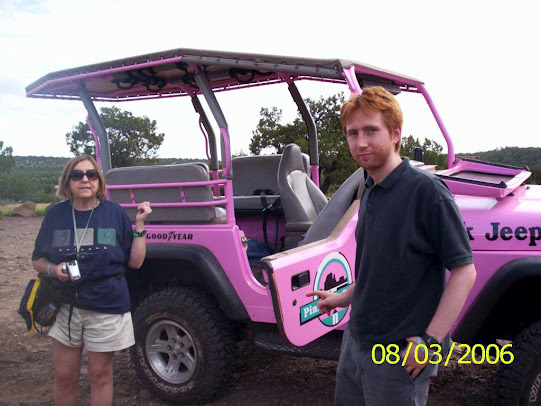
Although I missed this trip, I was feeling well enough to go to Sedona, Arizona in August, 2006.  I convinced everyone that I was well enough to go off-road in a pink jeep,  DH wanted to report me to my surgeon but I survived without to much pain and posed for the header image.

In 2009, I figured I have “extra years” since I survived the cancer and I wanted to do something kinda scary, yet fun. So, somehow, I decided on ziplining. Tom wouldn’t go with me but Michael would so I set this up almost as soon as we booked a Caribbean cruise to replace the Cushie Cruise to Bermuda.

Each person had a harness around their legs with attached pulleys and carabiners. Women had them on their chests as well. In addition, we had leather construction gloves and hard hats.

We climbed to the top of the first platform and were given brief instructions and off we went. Because of the heavy gloves, I couldn’t get any pictures. I had thought that they would take some of us on the hardest line to sell to us later but they didn’t. They also didn’t have cave pictures or T-Shirts. What a missed opportunity!

This was so cool, so much fun. I thought I might be afraid at first but I wasn’t. I just followed instructions and went.

Sometimes they told us to break. We did that with the right hand, which was always on the upper cable.

After the second line, I must have braked too soon because I stopped before I got to the platform. Michael was headed toward me. The guide on the end of the platform wanted me to do some hand over hand maneuver but I couldn’t figure out what he was saying so he came and got me by wrapping his legs around me and pulling me to the platform.

After that, no more problems with breaking!

The next platform was very high – over 70 feet in the air – and the climb up was difficult. It was very hot and the rocks were very uneven. I don’t know that I would have gotten to the next platform if Michael hadn’t cheered me on all the way.

We zipped down the next six lines up to 250-feet between platforms and 85-feet high in the trees, at canopy level. It seemed like it was all over too soon.

But, I did it! No fear, just fun.

Enough of adventures – fun ones like these, and scary ones like transsphenoidal surgery and radical nephrectomy!


Day Twelve, Cushing’s Awareness Challenge

Today’s Cushing’s Awareness Challenge post is about kidney cancer (renal cell carcinoma). You might wonder how in the world this is related to Cushing’s. I think it is, either directly or indirectly.

I alluded to this in Day Nine when I said:

I finally started the Growth Hormone December 7, 2004.
Was the hassle and 3 year wait worth it?
Stay tuned for Day 12, April 12, 2012 when all will be revealed.

So, as I said, I started Growth Hormone for my panhypopituitarism on December 7, 2004.  I took it for a while but never really felt any better, no more energy, no weight loss.  Sigh.

April 14 2006 I went back to the endo and found out that the argenine test that was done in 2004 was done incorrectly. The directions were written unclearly and the test run incorrectly, not just for me but for everyone who had this test done there for a couple years. My endo discovered this when he was writing up a research paper and went to the lab to check on something.

So, I went off GH again for 2 weeks, then was retested. The “good news” was that the argenine test is only 90 minutes now instead of 3 hours.

Wow, what a nightmare my argenine retest started! I went back for that Thursday, April 27, 2006. Although the test was shorter, I got back to my hotel and just slept and slept. I was so glad that I hadn’t decided to go home after the test.

Friday I felt fine and drove back home, no problem. I picked up my husband for a biopsy and took him to an outpatient surgical center. While I was there waiting for the biopsy to be completed, I started noticing blood in my urine and major abdominal cramps. I left messages for several of my doctors on what I should do. I finally decided to see my PCP after I got my husband home.

When Tom was done with his testing, his doctor took one look at me and asked if I wanted an ambulance. I said no, that I thought I could make it to the emergency room ok – Tom couldn’t drive because of the anaesthetic they had given him. I barely made it to the ER and left the car with Tom to park. Tom’s doctor followed us to the ER and became my new doctor.

They took me in pretty fast since I was in so much pain, and had the blood in my urine. They thought it was a kidney stone. After a CT scan, my new doctor said that, yes, I had a kidney stone but it wasn’t the worst of my problems, that I had kidney cancer. Wow, what a surprise that was! I was admitted to that hospital, had more CT scans, MRIs, bone scans, they looked everywhere.

My open radical nephrectomy was May 9, 2006 in another hospital from the one where the initial diagnosis was made. My surgeon felt that he needed a specialist from that hospital because he believed preop that my tumor had invaded into the vena cava because of its appearance on the various scans. Luckily, that was not the case.

My entire left kidney and the encapsulated cancer (10 pounds worth!) were removed, along with my left adrenal gland and some lymph nodes. Although the cancer (renal cell carcinoma AKA RCC) was very close to hemorrhaging, the surgeon believes he got it all. He said I was so lucky. If the surgery had been delayed any longer, the outcome would have been much different. I will be repeating the CT scans every 3 months, just to be sure that there is no cancer hiding anywhere. As it turns out, I can never say I’m cured, just NED (no evidence of disease). This thing can recur at any time, anywhere in my body.

I credit the argenine re-test with somehow aggravating my kidneys and revealing this cancer. Before the test, I had no clue that there was any problem. The argenine test showed that my IGF is still low but due to the kidney cancer I couldn’t take my growth hormone for another 5 years – so the test was useless anyway, except to hasten this newest diagnosis.

So… either Growth Hormone helped my cancer grow or testing for it revealed a cancer I might not have learned about until later.

My five years are up now.  My kidney surgeon *thinks* it would be ok to try the growth hormone again.  I’m still a little leery about this, especially where I didn’t notice that much improvement.

What to do?