Action For Adrenal Disease

Watch online Saturday April 16 at 1:00 PM eastern at https://plus.google.com/events/cpjbd8celcbfgngp8und662s198?hl=en
Secondary Adrenal Insufficiency and Addison’s Disease can be deadly, mostly because of the lack of education and awareness. We have lost too many and need to be proactive in preventing unnecessary deaths! Join us as we educate on what these diseases are, how easily they can become deadly and preventive measures we can all take to help this community. Brought to you by the National Adrenal Disease Foundation, with speakers who have personal experience with these diseases.

Our program will include:

Senior Administrator Nichole Klute Rushton••• of the Addison’s Disease Support Group (https://www.facebook.com/groups/addisons.support/) on Facebook, will speak in detail about the unfortunate adrenal insufficient patients who have tragically passed, reminding us that the danger of loss of life is a reality for every person with adrenal insufficiency who doesn’t receive the vital hormones they need

Administrator Debby Hunter ••• of the Living With Addison’s Disease Support on Facebook (https://www.facebook.com/groups/LivingWithAddisonsDisease/) who will give us tips on how we can approach our local emergency facilities and hospitals with information about adrenal insufficiency and its care in a crisis situation. She will also share her own personal experience with going through an adrenal crisis.

Deputy Sheriff Chris Spires••• who will speak on life as the husband of an Addison’s disease patient, and share with us how the law enforcement community views adrenal insufficient patients

Melanie Wong ••• National Adrenal Disease Foundation (http://www.NADF.us) Executive Director, who will speak about the recent tragic losses, and the vital importance of reminding the medical community about adrenal insufficiency, as well as NADF’s latest project to get NADF Adrenal Crisis Care posters displayed in every emergency room facility in the United States.

Webinar on Management Options for Pituitary Tumors March 22

Dr. Andaluz will cover the full breadth of treatment options from managing endocrine function, surgical procedures (transsphenoidal, endoscopic, and keyhole approaches), radiotherapy / radiosurgery, and the importance of getting care at a multidisciplinary center.

Dr. Norberto Andaluz is a neurosurgeon with the Mayfield Clinic and University of Cincinnati Brain Tumor Center. He is also Associate Professor of Neurosurgery at the University of Cincinnati, Surgical Director of the Neuroscience Intensive Care Unit, and Director of Neurotrauma at the University of Cincinnati Neuroscience Institute. He specializes in the treatment of all disorders and diseases of the brain and spine, but in particular, traumatic brain injury, aneurysms, arteriovenous malformations (AVMs), intracerebral hemorrhage, stroke, carotid artery disease, moyamoya disease and brain tumors (with special training in skull base tumors like pituitary adenoma). Dr. Andaluz received his medical degree from Unversidad Nacional de Rosario in Argentina. He completed his residency in neurosurgery at Instituto de Neurología y Neurocirugía at Sanatorio Parque in Rosario, Argentina and earned a fellowship in cerebrovascular surgery from the University of Cincinnati. Professional memberships include the American Heart Association, Congress of Neurological Surgeons, National Neurotrauma Society, Neurocritical Care Society and North American Skull Base Society.

Register at http://pituitary.org/events/webinar-management-options-for-pituitary-tumors

Interview with Deborah March 30, 2016

Deborah has many symptoms but is not yet diagnosed.

interview

Deborah will be our guest in an interview on BlogTalk Radio  Wednesday, March 30 at 6:00 PM eastern.  The Call-In number for questions or comments is (845) 241-9850.

The archived interview will be available after 7:00 PM Eastern through iTunes Podcasts (Cushie Chats) or BlogTalkRadio.  While you’re waiting, there are currently 89 other past interviews to listen to!

~~~~~~

Deborah’s Bio:

Hello all,

I do not know where to begin. For many years I have been struggling with these symptoms. I have proximal weakness, intolerance to stress, blood pressure fluctuations, hyperpigmentation, reactive hypoglycemia, sweating, severe dehydration, very bad confusion, vision, memory problems, physical body changes (hump, bruises), carb intolerance, and inability to exercise.

My endocrinologist did a workup for Cushing’s disease and the midnight saliva test was high. She brushed it off as “stress”. I am seeing a doctor now that says I have POTS and Dysautonomia. My doctor says I have inappropriate adrenaline rushes.

My body is falling apart because I haven’t found a doctor who will take my symptoms and test results serious. I would like to talk to others who are having trouble getting diagnosed and also to those who have gotten diagnosed who have a good doctor.

God Bless and Thank You,
Deborah

HOME | Sitemap | Adrenal Crisis! | Abbreviations | Glossary | Forums | Donate | Bios | Add Your Bio | Add Your Doctor | MemberMap | CushieWiki

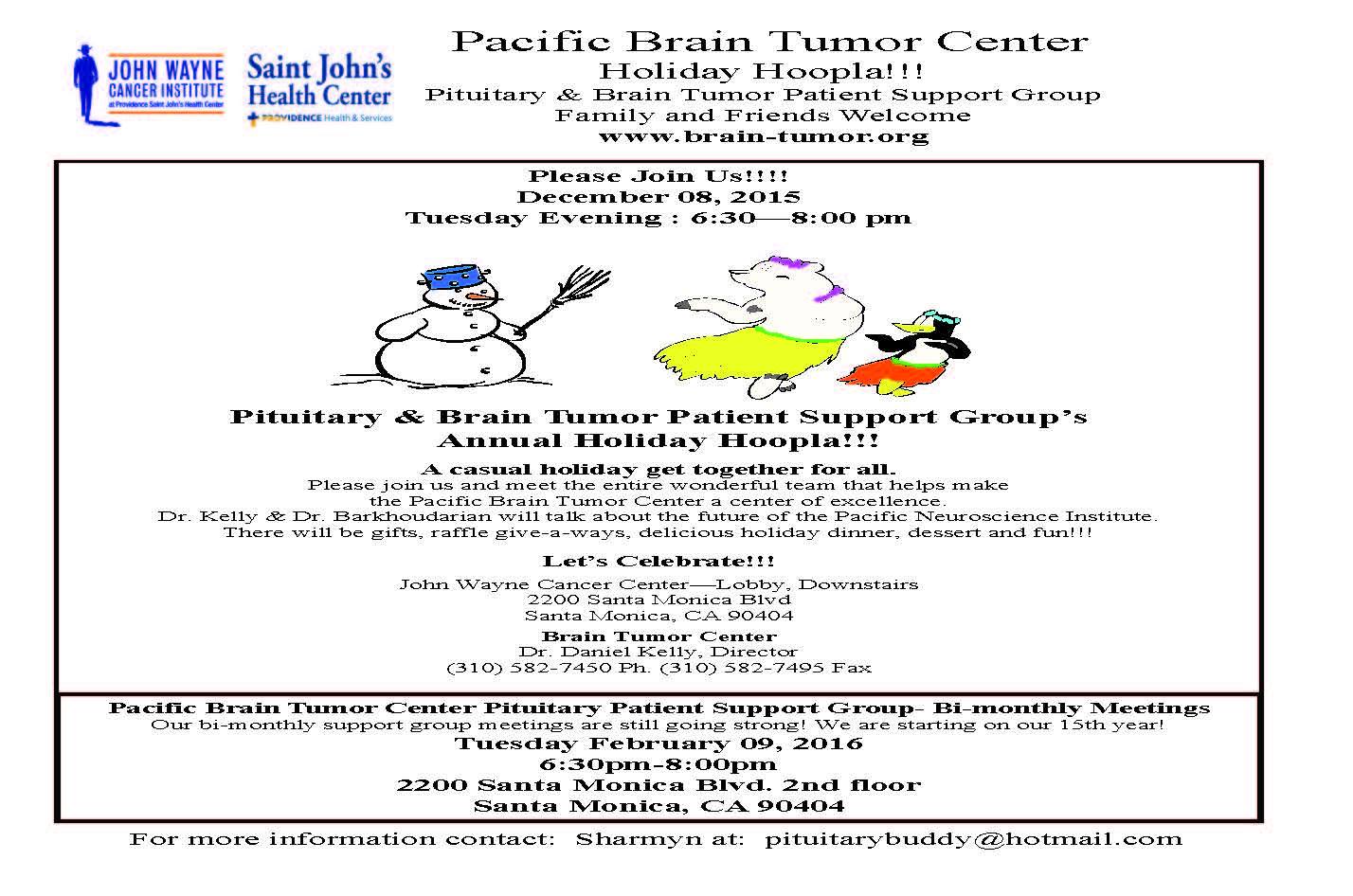
Annual Holiday Hoolpa

pituitary-meeting


It’s that time of year again.

It’s time for the  Pituitary Patient Annual Holiday Party at the Pacific Brain Tumor Center.
John Wayne Cancer Institute Lobby, Santa Monica, CA.

December 08, 2015, 6:30-8:00pm

Family and Friends are Welcome!

View the flyer.

RARE Webinar! Learning More on Informed Consent

a doctor in his office showing an informed consent document and pointing with a pen where the patient must to sign

a doctor in his office showing an informed consent document and pointing with a pen where the patient must to sign


Wednesday, November 18, 2015 10:00 am
Pacific Standard Time (San Francisco, GMT-08:00)


Informed consent is intended to provide patients, clinical trial participants, and others undergoing medical procedures with the information they need to make a decision about whether to undergo a specific procedure or participate in research. The process of informed consent can sometimes be very legal in nature leading to lack of clarity and misunderstanding. This webinar will explain the informed consent process, why patients should pay attention to it, and why rare disease advocates may want to get involved in the process.

Rare disease organizations play a critical role in connecting patients with researchers and the informed consent document is critically important. It outlines who will have access to research data that results from a study. Understanding the informed consent process and how to engage will help patients receive the greatest benefit.


Panelists:
Megan O'Boyle bio photoMegan O’Boyle

Megan’s 15-year-old daughter, Shannon has Phelan-McDermid Syndrome (PMS), an ultra rare condition. This diagnosis includes autism, intellectual disabilities, epilepsy, ADHD, lymphedema, and other medical conditions.

For the past 5 years Megan has volunteered for the PMS Foundation’s Research Support Committee. She is the Principal Investigator for the Phelan-McDermid Syndrome Data Network (PMS_DN, PCORnet) and the Phelan-McDermid Syndrome International Registry (PMSIR). She directed the biosample collection at the 2012 PMSF Family Conference, creating a biorepository of over 30 DNA and fibroblast samples.

Megan is passionate about the importance of the patient’s voice in: research, drug development, clinical trial design, development of related legislation, and quality of life decisions. She advocates for data sharing, collaborating with other advocacy groups, sharing resources, a genetics-first approach and streamlining IRB practices and policies.

Megan and her family live in Arlington, VA.

 

john-wilbanksJohn Wilbanks

John Wilbanks is the Chief Commons Officer at Sage Bionetworks. Previously, Wilbanks worked as a legislative aide to Congressman Fortney “Pete” Stark, served as the first assistant director at Harvard’s Berkman Center for Internet & Society, founded and led to acquisition the bioinformatics company Incellico, Inc., and was executive director of the Science Commons project at Creative Commons. In February 2013, in response to a We the People petition that was spearheaded by Wilbanks and signed by 65,000 people, the U.S. government announced a plan to open up taxpayer-funded research data and make it available for free. Wilbanks holds a B.A. in philosophy from Tulane University and also studied modern letters at the Sorbonne.

Moderator:
Danny_LevineDaniel Levine, Founder & Principal, Levine Media Group

Daniel Levine is an award-winning business journalist who has reported on the life sciences, economic development, and business policy issues throughout his 25-year career. Since 2011, he has served as the lead editor and writer of Burrill Media’s acclaimed annual book on the biotech industry and hosts The Burrill Report’s weekly podcast. His work has appeared in The New York Times, The Industry Standard, TheStreet.com, and other national publications.


Register here: https://globalgenes.org/webinarinformedconsent/