Higher Doses of ‘Abortion Pill’ Safe in Cushing’s?

Reviewed by Zalman S. Agus, MD; Emeritus Professor, Perelman School of Medicine at the University of Pennsylvania

LAS VEGAS — Higher doses of mifepristone for Cushing’s disease (Korlym) weren’t associated with increases in serious adverse events, researchers reported here.

Korlym is a glucocorticoid receptor antagonist better known as RU-486, or the “abortion pill.” It was approved for treating hyperglycemia associated with Cushing’s disease in 2012.

In an analysis of data from the SEISMIC trial, Dat Nguyen, MD, and colleagues found that similar percentages of patients had serious adverse events across all doses of the drug, reported.

They also reported at the American Association of Clinical Endocrinologists meeting here, that the proportion of the four most common adverse events — headache, fatigue, nausea, and hypokalemia — fell off after 10 weeks of the 24-week trial.

“Recent prescription data indicate that many physicians are not titrating beyond 300 mg per day, potentially limiting patients’ clinical response,” the researchers said.

The 2012 approval was based on the SEISMIC study, which followed 50 Cushing’s disease patients over 24-weeks in an open-label format. It found that daily doses improved blood sugar control and reduced insulin requirements.

Clinicians participating in the trial were told they could titrate beyond the starting dose of 300 mg a day. To look at the relationship between dose and safety, as well as response, Nguyen and colleagues looked at data on 40 of the patients who responded to therapy.

Most of them (90%) were taking at least 600 mg a day, 68% were taking at least 900 mg per day, and 44% took 1,200 mg daily.

Most of the responders (85%) had their initial clinical response at a dose of at least 600 mg daily.

Overall, there were 26 serious adverse events:

  • 10 at the 300 mg dose
  • 8 at the 600 mg dose
  • 3 at the 900 mg dose
  • 3 at the 1200 mg dose
  • 2 while off drug


When the researchers adjusted for the number of patients who had ever reached a given dose, the frequency of serious adverse events was similar across doses:

  • 10% of patients at 300 mg
  • 16% of patients at 600 mg
  • 15% of patients at 900 mg
  • 14% of patients at 1200 mg


The four most common adverse events decreased after week 10 – although that tracked an increase in dose (mean 588 mg/day before week 10 versus 895 mg/day thereafter).

Nguyen and colleagues concluded that higher doses of mifepristone weren’t associated with increases in serious adverse events or in the most common adverse events – and that better response was seen with higher doses.

Korlym was developed by Corcept Therapeutics of Menlo Park, Calif., as an orphan drug given that it is is believed only 5,000 patients are eligible for treatment. That gave the company 7 years of exclusive rights to market the agent for Cushing’s disease.

The label limits the drug’s indication to patients with endogenous Cushing’s disease who have type 2 diabetes or glucose intolerance and aren’t candidates for surgery, or failed to respond to surgical intervention.

The drug doesn’t reduce cortisol production but prevents it from binding to its receptor – an action separate from its blockade of the progesterone receptor, which makes it an effective agent in abortion.

Since the daily doses are in the same range as those used to induce abortion, the drug is contraindicated in pregnant women. It also carries a boxed warning that the drug will terminate a pregnancy.

From http://www.medpagetoday.com/MeetingCoverage/AACE/45790

Interview May 7 with Kathy C, Pituitary Patient

My name is Kathy Casey. I am a 63 year old retired school nurse. I am married with two wonderful sons and a grandson. My husband and I live in the mountain town of Mt. Shasta in northern California. I have always been athletic.

In 1995, I was diagnosed with a pituitary tumor. At the time the only symptom I was aware of was a severe headache. I had a transphenoidal resection by Dr. Wilson at UCSF Medical Center followed by radiation therapy for 23 days. At the time they said they could not remove all of the tumor.

In 2008/2009. I exhibited symptoms of Cushing’s and my cortisol level was outrageous, and I had to be hospitalized initially for a potassium level of 2. I returned to UCSF and Dr. Anwar Sandeep operated . By removing part of the tumor. My Cushing symptoms resolved. However, he said that the tumor was not encapsulated and was invading the cavernous sinus and stella turcica so it was still not possible to remove it all.

I was OK until December 2013 when I began exhibiting the symptoms of Cushings. One of my 24 hr. urines was 14,000. I had to be hospitalized for a potassium level of 1.9. Dr. Heaney said he has never seen a cortisol level that high. This time I decided to go to the UCLA Pituitary Tumor and Endocrinology Program where they were more oriented to follow-up and treating this disorder. Dr. Bergsneider decided that surgery was not an option. He and Dr. Heaney decided radiation was not an option. So now I am being followed by Dr. Heaney to see if medication can help.

I am now on Cabergoline 0.5 mg three tabs twice a week and Signifor 0.9 mg subcutaneosly twice a day. I think they are alleviating some of the symptoms. However, the Signifor caused my blood sugar to rise, and I had to go on Metformin which is causing nausea to a point where I have a hard time eating.

Anyway, this whole situation is depressing and overwhelming. I am tryng to stay positive, but I wonder how it will turn out. I am fortunate to have a supportive and helpful husband.

I am interested in communicating with people who may be going through a similar experience and learning more about this rare condition.

Kathy will be interviewed May 7, 2014 in BlogTalkRadio

HOME | Contents | Adrenal Crisis! | Abbreviations | Glossary | Forums | Donate | Bios | Add Your Bio

Cushing’s Awareness Challenge 17

robin-causes

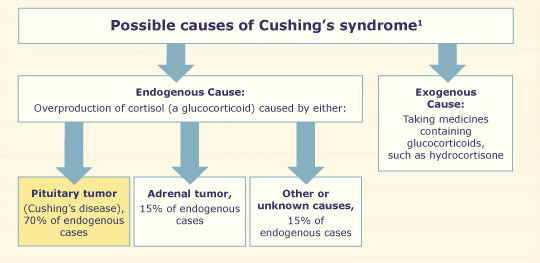
Another of Robin’s wonderful images.

A similar image from the CushieWiki

cushings-causes

No wonder Cushing’s is so hard to diagnose!

maryo colorful zebra

Cushing’s Awareness Challenge 16

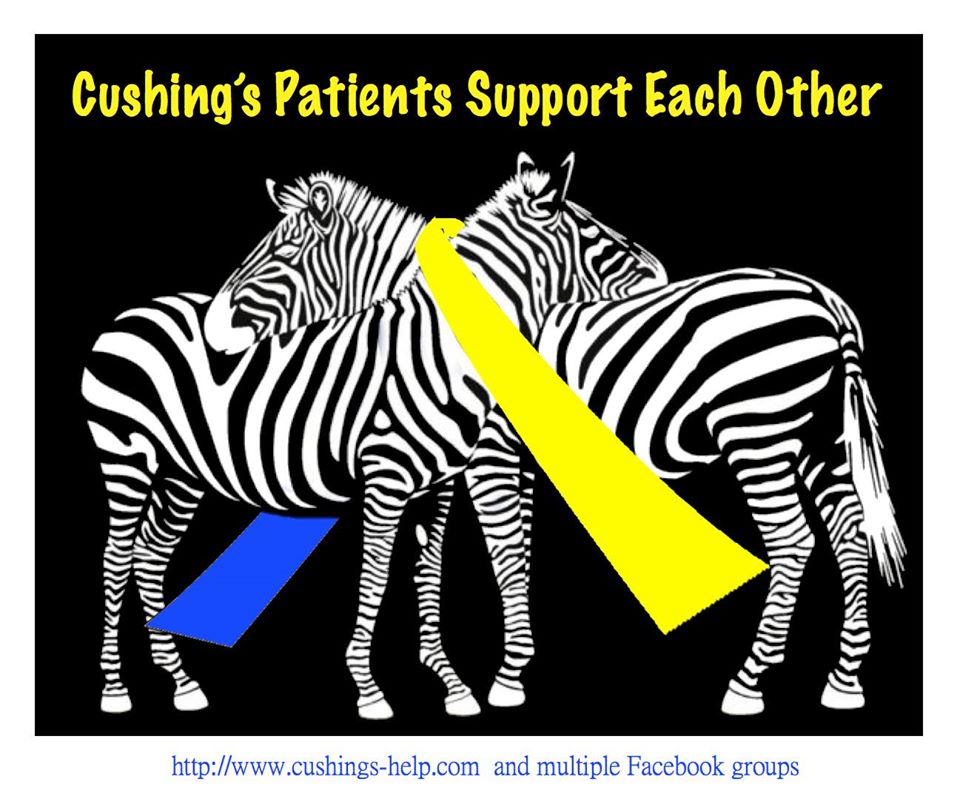
robin-support

That’s for sure!  Cushing’s patients have a lot of support these days, at least online.  I’m not seeing much offline in the way of regular group support meetings.

Over the years, there have been lots of local meetings but they’re mostly one-time events.  There are pictures of some of the past meetings here: https://www.facebook.com/CushingsInfo/photos_albums listed by place and date.

Many Cushing’s patients on the message boards and in Facebook groups exchange phone numbers and email addresses to get offline support.

Other ways to help support others you may never meet are to agree to be interviewed in a live voice chat (these are added to the podcast for later listening) or submit a bio.

The more you share, the more support others get…and the more they’ll share with you.


maryo colorful zebra


Could you Shed Some Light on Cushing’s Disease?

Dear Dr. Roach: Could you shed some light on Cushing’s disease? Four people in the same family have it. The doctors say it has something to do with the thyroid gland.

— Anon.

A: Cushing’s syndrome, which is different from Cushing’s disease, is an excess of cortisone or similar corticosteroids. It can be caused by taking too much steroid for too long, usually as treatment for a serious medical condition. Cushing’s disease is a special case of Cushing’s syndrome, when the excess cortisone is caused by a tumor in the pituitary gland, which spurs the adrenal gland to make excess amounts of hormone. Weight gain, almost exclusively in the abdomen, a striking round “moon” face, a fat pad on the back of the neck and upper back (“buffalo hump”), diabetes, pigmented stretch marks and high blood pressure are common findings in any form of Cushing’s syndrome.

It is very unusual for Cushing’s disease to run in families. Also, it does not affect the thyroid, although thyroid conditions can sometimes mimic Cushing’s (and vice versa). I suspect that what this might be is a rare condition called multiple endocrine neoplasia type I (MEN-1). This does run in families, and combines risk for pituitary, parathyroid and pancreatic islet cell tumors. (The parathyroid glands sit on top of the thyroid gland and secrete parathyroid hormone, responsible for calcium metabolism. The pancreatic islet cells are where insulin is made.) Not everybody with MEN-1 will have tumors in all of these glands. Parathyroid tumors are the most common.

An endocrinologist is the expert in Cushing’s and the MEN syndromes.

​Dr. Keith Roach writes for North America Syndicate. Send letters to Box 536475, Orlando, FL 32853-6475 or email ToYourGoodHealth@med.cornell.edu.

From http://herald-review.com/news/opinion/editorial/columnists/roach/dr-keith-roach-teeth-grinding-is-common-in-the-elderly/article_bef63ba4-9b5e-5bff-b66a-3530be158857.html