8th Annual Johns Hopkins Pituitary Patient Day

Johns Hopkins Pituitary Patient Day

Join us on Saturday, September 17, 2016

8th Annual Johns Hopkins Pituitary Patient Day
Saturday, September 17, 2016, 9:30 a.m.
Location:
Johns Hopkins Mt. Washington Conference Center
5801 Smith Avenue
Baltimore, MD 21209
map and directions

This is a free event, but seating is limited. Reserve your space now: Please R.S.V.P. by September 9, 2016 by email (preferred) to PituitaryDay@jhmi.edu  or by calling Alison Dimick at 410-955-3921.

Agenda

9:30 – 9:55 a.m.: Registration

9:55 – 10:00 a.m.: Welcome and Acknowledgements

10:00 – 10:25 a.m.: Different Kinds of Tumors in the Pituitary Area: Non-Functioning, Acromegaly, Cushing, etc. (Roberto Salvatori, M.D.)

10:25 – 10:50 a.m.: The Pituitary Gland, Cortisol and Stress (Gary Wand, M.D.)

10:50 – 11:10 a.m.: A Patient’s Story

11:10 – 11:30 a.m.: The Eye and the Pituitary Gland: Why It’s Important to SEE the Right Doctor (Pun Intended) (Dan Gold, D.O.)

11:30 – 11:50 a.m.: Surgery for Pituitary Tumors: (Not So Scary) Pictures from the Operating Room Treating Acromegaly, Cushing and Non-Functioning Tumors (Gary Gallia, M.D., Ph.D.)

11:50 a.m. – 12:10 p.m.: Coordinating the Care of Pituitary Patients: It Takes a Village (Pituitary Nurse)

12:10 – 12:30 p.m.: Radiation Therapy for Cushing, Acromegaly and Non-Functioning Tumors: A Good Option when Needed (Lawrence Kleinberg, M.D.)

12:30 – 1:25 p.m.: Lunch

1:30 – 3:00 p.m. Round Table Discussions:

  • Medical: Making Sense of So Many Medications
  • Surgical: Meet Surgeons and Patients Who Have Had Pituitary Surgery
  • Radiation: Share Your eX-peRience!

Patients with ARMC5 mutations: The NIH clinical experience

Screenshot 2016-05-27 13.12.55


Adrenal Disorders

R Correa, M Zilbermint, A Demidowich, F Faucz, A Berthon, J Bertherat, M Lodish, C Stratakis

Summary: Researchers conducted this study to describe the different phenotypical characteristics of patients with armadillo repeat containing 5 (ARMC5) mutations, located in 16p11.2 and a likely tumor-suppressor gene. They determined that patients with bilateral adrenal enlargement, found on imaging tests, should be screened for ARMC5 mutations, which are associated with subclinical Cushing’s syndrome (CS) and primary hyperaldosteronism (PA).

Methods:

  • Researchers identified 20 patients with ARMC5 mutations (germline and/or somatic) who were enrolled in a National Institutes of Health (NIH) protocol.
  • They obtained sociodemographic, clinical, laboratory, and radiological data for all participants.

Results:

  • Three families (with a total of 8 patients) were identified with ARMC5 germline mutations; the rest of the patients (13/20) had sporadic mutations.
  • The male to female ratio was 1.2:1; mean age was 48 years and 60% of patients were African American.
  • Forty percent of patients were diagnosed with CS, 20% with subclinical CS, 30% with hyperaldosteronism, and 10% had no diagnosis.
  • The mean serum cortisol (8 am) and Urinary Free Cortisol were 13.1 mcg/dl and 77 mcg/24 hours, respectively.
  • Nearly all patients (95%) had bilateral adrenal enlargement found on CT or MRI.
  • Patients underwent the following treatments: Bilateral adrenalectomy (45%), unilateral adrenalectomy (25%), medical treatment (20%), and no treatment (10%).
  • ARMC5 mutations are associated with primary macronodular adrenal hyperplasia (PMAH) and are also seen in patients with PA, especially among African Americans.

From http://www.mdlinx.com/endocrinology/conference-abstract.cfm/ZZ37C4C5D3BF1A4FAE9C479A696660535B/57884/?utm_source=confcoveragenl&utm_medium=newsletter&utm_content=abstract-list&utm_campaign=abstract-AACE2016&nonus=0

Rally for Medical Research Hill Day

Held every September, this Capitol Hill Day event continues the momentum established in 2013, and includes nearly 300 national organizations coming together in support of the Rally for Medical Research.

The purpose of the Rally is to call on our nation’s policymakers to make funding for National Institutes of Health (NIH) a national priority and raise awareness about the importance of continued investment in medical research that leads to MORE PROGRESS, MORE HOPE and MORE LIVES SAVED.

The next Rally for Medical Research Hill Day is Sept. 22, 2016.

Sign up to receive updates, including a link to register once it becomes available.

Nominations Now Open for RareVoice Awards

rare-voice

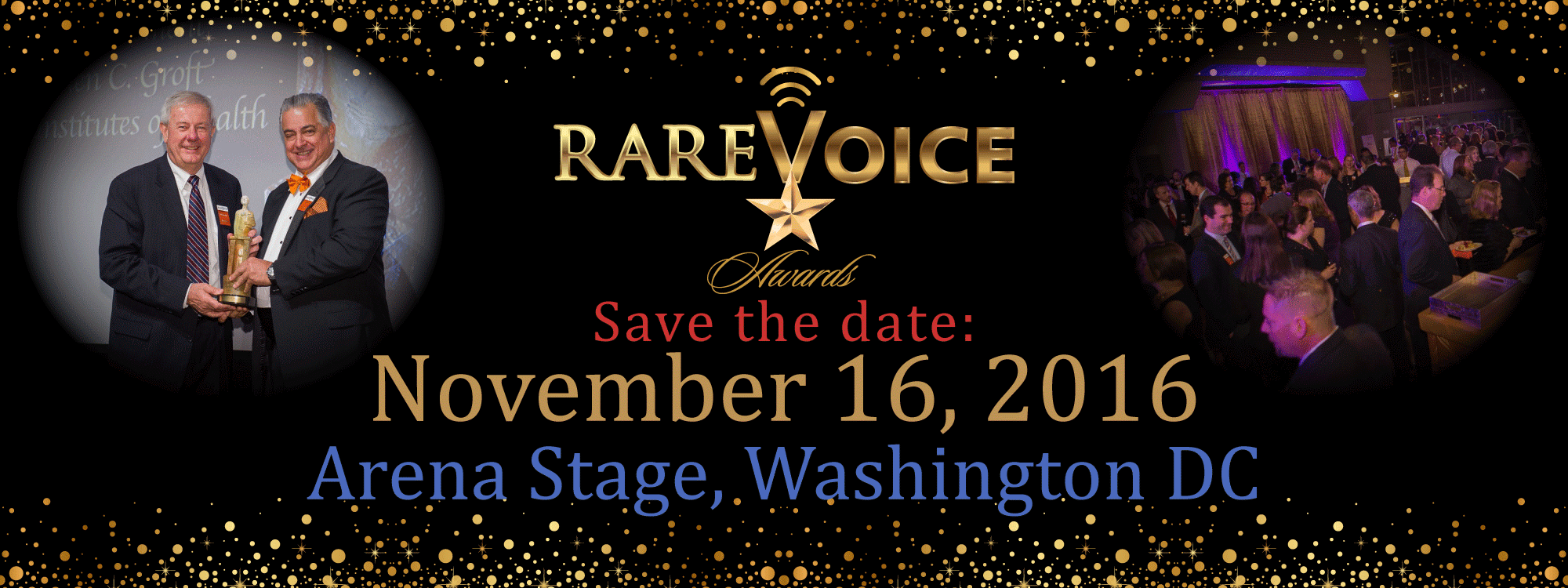
Rare Disease Legislative Advocates is pleased to open nominations for the 5th Annual RareVoice Awards, a celebration to honor advocates who give rare disease patients a voice on Capitol Hill and in state government.

Wednesday, November 16, 2016
Arena Stage in Washington, DC

If you know of someone who has been a “Voice” for the rare disease community and should be honored for their work, please click here to submit your nomination.

RareVoice Award nominations are open to the public.  We encourage the community to nominate individuals and organizations who have gone above and beyond to become rare disease policy leaders and political advocates in their state and our nation. We have nominations open for the following categories: Congressional Staff, Patient Advocate or Patient Organization (at the state or federal level), and Government Agency Staff.

Deadline to submit nominations is July 31, 2016.

Pituitary Patient Support Group Meeting

pituitary-meeting

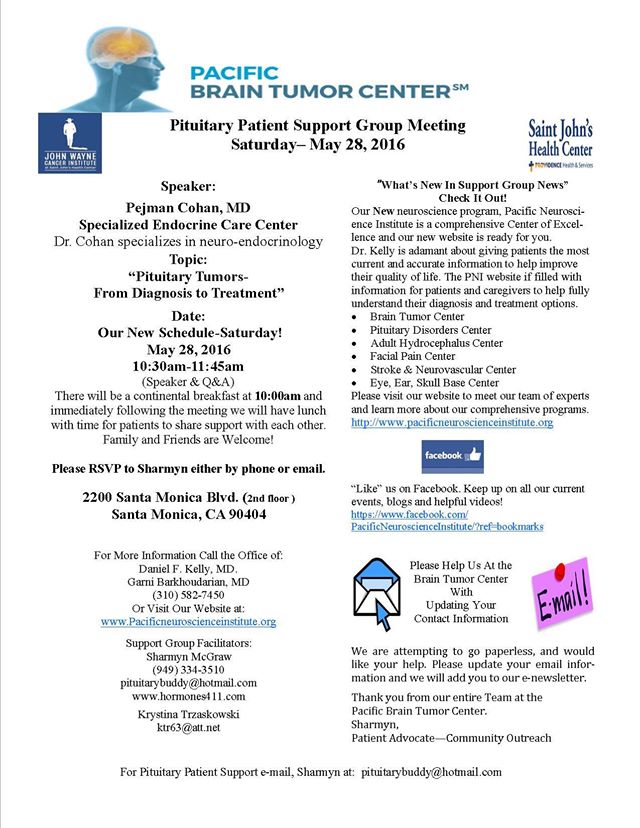
Pituitary Patient Support Group Meeting, Saturday May 28, 2016.

Neuro Endocrine expert Dr. Pejman Cohan will be speaking. “From Diagnosis to Treatments”

There will be time for Q&A and lunch served after the meeting.

Meeting 10:30am-11:45am Lunch 11:45am-1:00pm

Location: John Wayne Cancer Institute- 2nd floor conference room, 2200 Santa Monica Blvd. Santa Monica, CA 90404

Free parking with validation, behind building in the JWCI parking lot.

Please RSVP to Sharmyn at  pituitarybuddy@hotmail.com

Download flyer here.