Utility of measurement of dexamethasone levels in the diagnostic testing for Cushing’s syndrome

From Day 1 of the 16th International Congress of Endocrinology and the Endocrine Society’s 96th Annual Meeting and Expo »

Chicago, IL – June 21, 2014

ST Sharma, JA Yanovski, SB Abraham, LK Nieman

Summary: Dexamethasone (dex) suppression tests (DST) are used for screening and differential diagnosis of Cushing’s syndrome (CS). The 1 mg overnight (LD) DST is used to diagnose CS, the dex-suppressed CRH stimulation (Dex-CRH) test to differentiate CS from pseudocushings (PCS) while the 8 mg overnight (HD) DST is used to differentiate Cushing’s disease (CD) from ectopic ACTH syndrome (EAS). Researchers assessed the utility of dex levels in improving the diagnostic accuracy of these tests and they found that low dex and high CBG levels can account for false positive (FP) DST and Dex-CRH test results. Use of a higher dex dose in pts with low dex levels can help decrease FP results.

Methods:

  • This is a retrospective study of patients (pts) with CS, PCS and normal volunteers (NV) who had a dex level measured as part of LDDST, HDDST or Dex-CRH test.
  • A post-dex cortisol (F) level ≥1.8 mcg/dl in the LDDST and a 15 min post-CRH F level ≥1.4 mcg/dl in the Dex-CRH test suggested CS.
  • A ≥69% suppression of F levels in HDDST indicated CD.
  • Dex levels

Results:

  • LDDST (n=77): Post-dex F was abnormal in 44 pts, 37 of these did not have CS on follow-up.
  • Proportion of pts with low dex levels was similar in those with incorrect or correct LDDST results (P=0.7).
  • Three of 5 pts with an abnormal result and low dex levels (44-117 ng/dl) had suppressed post-dex F levels after a 2 mg overnight DST. HDDST (N=56): Results were not consistent with the final diagnosis (CD or EAS) in 13 (23%) pts.
  • Of these, 5 had low dex levels (400-1220 ng/dl).
  • Proportion of pts with low dex levels was similar between those with correct and incorrect HDDST results (P=0.5).
  • HDDST in 1 pt with ACTH-dependent CS suggested EAS (28% suppression) with low dex level.
  • IPSS indicated CD.
  • After a doubled dex dose (16 mg), F levels suppressed by 76%, changing the HDDST result to CD.
  • Dex-CRH (n=139): Results were consistent with the final diagnosis in 133 pts (74 CS, 20 NV, 39 PCS).
  • Six pts with an abnormal result had dex levels
  • Of these, repeat testing with doubled dex dose (1 mg every 6 hours) in 2 pts led to higher dex levels (610, 757 ng/dl) and normal F level in one.
  • Two pts with abnormal result were on OCPs, 1 with a known high cortisol binding globulin (CBG) level.
  • None had CS on follow-up.
  • There was no correlation between dex and post-dex F levels in LDDST, 15 min post-CRH F levels in Dex-CRH test and % suppression of F post-dex in HDDST (P=NS).

Diagnosing and Treating Cortisol Excess and Deficiency

From Day 1 of the 16th International Congress of Endocrinology and the Endocrine Society’s 96th Annual Meeting and Expo »

Chicago, IL – June 21, 2014

A phase 2 study of Chronocort®, a modified release formulation of hydrocortisone, in the treatment of adults with classic congenital adrenal hyperplasia

A Mallappa, L-A Daley, N Sinaii, C Van Ryzin, H Huatan, D Digweed, D Eckland, M Whitaker, LK Nieman, RJ Ross, DP Merke

Summary: Classic congenital adrenal hyperplasia (CAH) due to 21-hydroxylase deficiency is characterized by cortisol and aldosterone deficiency and androgen excess. Current conventional glucocorticoid therapy is suboptimal as it cannot replace the normal cortisol circadian rhythm and inadequate or inappropriate suppression of adrenal androgens are common. In the preliminary results of a phase 2 study of Chronocort®, a modified release hydrocortisone capsule formulation, researchers found that Chronocort®, a novel modified release hydrocortisone capsule formulation, approximates physiological cortisol secretion, and improves biochemical control of CAH. Further analyses are underway.

Methods:

  • The study objectives were to characterize pharmacokinetics and examine disease control following 6 months dose titration.
  • Serial profiling was obtained at baseline (conventional glucocorticoid) and every 2 months.
  • Twice-daily Chronocort® was initiated: 20 mg at 2300 h, 10 mg at 0700 h.
  • Dose titration was based on clinical status and optimal hormonal ranges (17OHP 300-1200 ng/dL, normal androstenedione (males: 40-150, females: 30-200 ng/dL), with androstenedione prioritized.
  • Chronocort® cortisol pharmacokinetic profile was the primary endpoint.
  • Secondary endpoints included biomarkers of disease control.

Results:

  • A total of 16 adults (8 females; age 29 ±13 years) with classic CAH (12 salt-wasting, 4 simple virilizing) participated.
  • Conventional therapy varied (5 dexamethasone, 7 prednisone, 4 hydrocortisone).
  • Chronocort® cortisol pharmacokinetic profile approximated physiological cortisol secretion.
  • Ten patients required Chronocort® dose adjustments (decrease in 8, increase in 2; mean hydrocortisone equivalent dose conventional vs 6 months: 16.1 ± 6.4 vs 14.7 ± 6.4 mg/m2).
  • Serial androstenedione levels were in the normal range in 8 (50%) of patients on conventional therapy compared with 12 (75%) on Chronocort® at 6 months.
  • The majority of patients on Chronocort® achieved 17O HP levels within the normal range, rather than within the mildly elevated range currently used for management.
  • At 6 months, Chronocort® resulted in lower 24-hr (P=0.02), morning (0700-1500; P=0.008), and afternoon (1500-2300; P=0.03) area-under-the-curve androstenedione compared with conventional therapy.
  • No serious adverse events occurred.
  • Common adverse events were headache, fatigue, early awakening, and anemia.
  • Three patients had unexpected carpal tunnel syndrome, which resolved with wrist splints.

From http://www.mdlinx.com/endocrinology/conference-abstract.cfm/ZZ5BA369FDE9DE4CED82CB6A7CD5BFD1BE/16521/?utm_source=confcoveragenl&utm_medium=newsletter&utm_content=abstract-list&utm_campaign=abstract-ICE/EN2014&nonus=0#

Global Pituitary ACTH Hypersecretion (Cushing’s Disease) Therapeutics Pipeline Review 2014

DUBLIN–(BUSINESS WIRE)–Research and Markets (http://www.researchandmarkets.com/research/zp4qhh/pituitary_acth) has announced the addition of the “Pituitary ACTH Hypersecretion (Cushing’s Disease) – Pipeline Review, H1 2014” report to their offering.

“Pituitary ACTH Hypersecretion (Cushing’s Disease) – Pipeline Review, H1 2014”

This report provides comprehensive information on the therapeutic development for Pituitary ACTH Hypersecretion (Cushing’s Disease), complete with comparative analysis at various stages, therapeutics assessment by drug target, mechanism of action (MoA), route of administration (RoA) and molecule type, along with latest updates, and featured news and press releases. It also reviews key players involved in the therapeutic development for Pituitary ACTH Hypersecretion (Cushing’s Disease) and special features on late-stage and discontinued projects.

The report enhances decision making capabilities and help to create effective counter-strategies to gain competitive advantage. It strengthens R&D pipelines by identifying new targets and MOAs to produce first-in-class and best-in-class products.

Scope

  • The report provides a snapshot of the global therapeutic landscape of Pituitary ACTH Hypersecretion (Cushing’s Disease)
  • The report reviews key pipeline products under drug profile section which includes product description, MoA and R&D brief, licensing and collaboration details & other developmental activities
  • The report reviews key players involved in the therapeutics development for Pituitary ACTH Hypersecretion (Cushing’s Disease) and enlists all their major and minor projects
  • The report summarizes all the dormant and discontinued pipeline projects
  • A review of the Pituitary ACTH Hypersecretion (Cushing’s Disease) products under development by companies and universities/research institutes based on information derived from company and industry-specific sources
  • Pipeline products coverage based on various stages of development ranging from pre-registration till discovery and undisclosed stages
  • A detailed assessment of monotherapy and combination therapy pipeline projects
  • Coverage of the Pituitary ACTH Hypersecretion (Cushing’s Disease) pipeline on the basis of target, MoA, route of administration and molecule type
  • Latest news and deals relating related to pipeline products

Companies Involved in Therapeutics Development

  • Isis Pharmaceuticals, Inc.
  • Ipsen S.A.
  • Novartis AG
  • Corcept Therapeutics Incorporated
  • HRA Pharma, SA
  • Cortendo Invest AB
  • Orphagen Pharmaceuticals, Inc.
  • ElexoPharm GmbH

Drug Profiles

  • mifepristone
  • ketoconazole
  • pasireotide LAR
  • LCI-699
  • DG-3173
  • ISIS-GCCRRx
  • Next Generation Cortisol Inhibitor
  • Small Molecule to Inhibit CYP11B1 for Cushing Disease
  • Peptides to Antagonize ACTH Receptor for Cushing Syndrome
  • Steroidogenic Factor-1 Antagonists
  • Drug to Inhibit Melanocortin Receptor 2 for Cushing Disease

For more information visit http://www.researchandmarkets.com/research/zp4qhh/pituitary_acth

Contacts

Research and Markets
Laura Wood, Senior Manager.
press@researchandmarkets.com
U.S. Fax: 646-607-1907
Fax (outside U.S.): +353-1-481-1716
Sector: Pharmaceuticals

Cushing’s Awareness Challenge 17

robin-causes

Another of Robin’s wonderful images.

A similar image from the CushieWiki

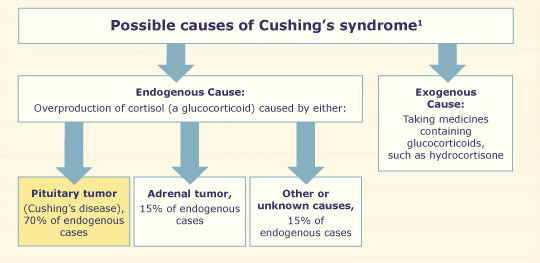
cushings-causes

No wonder Cushing’s is so hard to diagnose!

maryo colorful zebra

Could you Shed Some Light on Cushing’s Disease?

Dear Dr. Roach: Could you shed some light on Cushing’s disease? Four people in the same family have it. The doctors say it has something to do with the thyroid gland.

— Anon.

A: Cushing’s syndrome, which is different from Cushing’s disease, is an excess of cortisone or similar corticosteroids. It can be caused by taking too much steroid for too long, usually as treatment for a serious medical condition. Cushing’s disease is a special case of Cushing’s syndrome, when the excess cortisone is caused by a tumor in the pituitary gland, which spurs the adrenal gland to make excess amounts of hormone. Weight gain, almost exclusively in the abdomen, a striking round “moon” face, a fat pad on the back of the neck and upper back (“buffalo hump”), diabetes, pigmented stretch marks and high blood pressure are common findings in any form of Cushing’s syndrome.

It is very unusual for Cushing’s disease to run in families. Also, it does not affect the thyroid, although thyroid conditions can sometimes mimic Cushing’s (and vice versa). I suspect that what this might be is a rare condition called multiple endocrine neoplasia type I (MEN-1). This does run in families, and combines risk for pituitary, parathyroid and pancreatic islet cell tumors. (The parathyroid glands sit on top of the thyroid gland and secrete parathyroid hormone, responsible for calcium metabolism. The pancreatic islet cells are where insulin is made.) Not everybody with MEN-1 will have tumors in all of these glands. Parathyroid tumors are the most common.

An endocrinologist is the expert in Cushing’s and the MEN syndromes.

​Dr. Keith Roach writes for North America Syndicate. Send letters to Box 536475, Orlando, FL 32853-6475 or email ToYourGoodHealth@med.cornell.edu.

From http://herald-review.com/news/opinion/editorial/columnists/roach/dr-keith-roach-teeth-grinding-is-common-in-the-elderly/article_bef63ba4-9b5e-5bff-b66a-3530be158857.html