Gene test for growth hormone deficiency developed

A new test developed by University of Manchester and NHS scientists could revolutionise the way children with growth hormone deficiency are diagnosed.

Children suspected of having GHD – which cause growth to slow down or stop and other serious physical problems—currently require a test involving fasting for up to 12 hours.

The fasting is followed by an intravenous infusion in hospital and up to 10 blood tests over half a day to measure growth hormone production.

Because the current test is unreliable, it often has to be done twice before growth hormone injections can be prescribed.

Now the discovery—which the team think could be available within 2 to 5 years -could reduce the process to a single blood test, freeing up valuable time and space for the NHS.

Dr. Adam Stevens from The University of Manchester and Dr. Philip Murray from Manchester University NHS Foundation Trust, were part of the team whose results are published in JCI Insight today.

Dr. Stevens said: “We think this is an important development in the way doctors will be able to diagnose growth hormone deficiency – a condition which causes distress to many thousands of children in the UK

“This sort of diagnostic would not be available even a few years ago but thanks to the enormous computing power we have, and advances in genetics, it is now possible for this aspect of care to be made so much easier for patients – and the NHS.

“These volume of data involved is so huge and complicated that traditional data-processing application software is inadequate to deal with it.”

Comparing data from 72 patients with GHD and 26 healthy children, they used high powered computers to examine 30,000 genes—the full gene expression- of each child.

A sophisticated mathematical technique called Random Forest Analysis analysed around three million separate data points to compare different gene patterns between the children with and without GHD.

The research identified 347 genes which when analysed with the computer algorithm can determine whether a child has GHD or not and thus whether they will benefit from treatment.

Growth hormone deficiency (GHD) occurs when the pituitary gland—which is size of a pea- fails to produce enough growth hormone. It more commonly affects children than adults.

Many teenagers with GHD have poor bone strength, fatigue and lack stamina as well as depression, lack of concentration, poor memory and anxiety problems.

GHD occurs in roughly 1 in 5,000 people. Since the mid-1980s, synthetic growth hormones have been successfully used to treat children—and adults—with the deficiency.

Dr. Murray added: “This study provides strong proof of concept, but before it is in a position to be adopted by the NHS, we must carry out a further validation exercise which will involve comparing our new diagnostic with the existing test.

“Once we have crossed that hurdle, we hope to be in a position for this to be adopted within 2 to 5 years – and that can’t come soon enough for these children.”

Child Growth Foundation manager Jenny Child’s daughter has Growth Hormone Deficiency.

She said: Growth Hormone Deficiency isn’t just about growth, as lack of growth hormone impacts the child in many ways, such as lack of strength and they can find it difficult to keep up physically with their peers. It impacts the child’s self-esteem as they are often treated as being much younger, because of their size. Growth hormone treatment allows the child to grow to their genetic potential.

“A growth hormone stimulation test can be very daunting for both child and parents. The test can make the child feel quite unwell and they can experience headaches, nausea and unconsciousness through hypoglycaemia.”

 Explore further: Northern climes make a difference with growth hormone treatment

More information: Philip G. Murray et al. Transcriptomics and machine learning predict diagnosis and severity of growth hormone deficiency, JCI Insight (2018). DOI: 10.1172/jci.insight.93247

Bimonthly Growth Hormone Injections to Replace Daily Injections?

At the Annual ENDO 2017 meeting in Orlando, FL, Moore et al provided an update on somavaratan, the long acting recombinant human growth hormone being investigated for children and adults with growth hormone deficiency.

Current treatment for these patients is somewhat burdensome given the need for daily subcutaneous injections. Somavaratan provides the option for bimonthly injections.

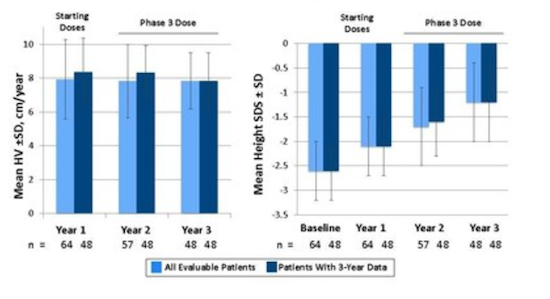
At ENDO 2017, 3 year data was presented in children given somavaratan and the data is impressive.

The 3 year data is part of an ongoing extension study following a 6 month Phase 2 trial in which 64 patients received 5.0 mg/kg/month at various dosing schedules. Of those patients, 60 continued in an open label extension study (dose adjusted to 3.5 mg/kg given twice-monthly by the beginning of Year 2 of treatment).  At ENDO 2017, data from 30 of those patients who had completed 3 years of treatment were presented.

(Insulin-like growth factor standard deviation score (IGF-I SDS) increased from -1.7 ± 0.8 at baseline to 1.1 ± 1.6 at peak (3–5 days post-injection) and -0.2 ± 0.9 at trough (end of dosing cycle) in Year 3. Of the 30 patients, 8 had transient IGF-I SDS excursions > 2.0, of which 3 events were > 3.0 (range, 2.3–3.9).

Height velocity (HV) remained consistent at 8.5 ± 1.8, 8.5 ± 1.7, and 8.1 ± 1.5 cm/year, for years 1, 2, and 3 respectively.

Height-SDS increased from -2.6 ± 0.5 at baseline to -1.9 ± 0.6, -1.4 ± 0.7, and -1.0 ± 0.7 at years 1, 2, and 3, respectively.

Treatment-related adverse events were generally mild and transient.

In an exclusive interview with Rare Disease Report, one of the investigators of the study, Bradley Miller, MD, PhD, of the University of Minnesota Masonic Children’s Hospital, said that compliance is an issue with growth hormone replacement therapy and any options that can remove the daily injection requirements would likely be well received by both patients and clinicians.

A Phase 3 study is currently underway to comparing bimonthly somavaratan treatment with daily growth hormone treatments (NCT02339090).

Somavaratan is being developed by Versartis Inc

About Growth Hormone Deficiency 

Growth hormone deficiency occurs when the pituitary gland does not produce enough growth hormone, resulting in short stature, delayed or absent puberty, and changes in muscle mass, cholesterol levels, and bone strength. The condition can be congenital, structural (malformations in the brain) or acquired (resulting from trauma, infections, tumors, radiation therapy, or other causes).

Currently, the standard of care is subcutaneous injection of a biosynthetic recombinant human growth hormone (rhGH). The frequency of the injections is based on the patient’s level of growth hormone deficiency (ie, whether growth hormone is completely absent or some growth hormone is present), but most patients require daily administration.

The rhGH treatments are typically given until the child’s maximum growth potential is achieved, often requiring many years of treatment (and increasing the risk of poor compliance).

Reference

Moore WV, Fechner PY, Nguyan HJ, et al. Safety and Efficacy of Somavaratan (VRS-317), a Long-Acting Recombinant Human Growth Hormone (rhGH), in Children with Growth Hormone Deficiency (GHD): 3-Year Update of the Vertical & VISTA Trials (NCT01718041, NCT02068521). Presented at: ENDO 2017; Orlando, FL; April 1-4, 2017. Abstract OE31-1.

From http://www.raredr.com/news/bimonthly-growth-hormone

Day 9, Cushing’s Awareness Challenge

Uh, Oh – I’m nearly a day late (and a dollar short?)…and I’m not yet sure what today’s topic will be.  I seem swamped by everything lately, waking up tired, napping, going to bed tired, waking up in the middle of the night, traveling, work, starting all over again…and my DH was recently diagnosed with cancer which makes everything more hectic and tiring.

It’s been like this since I was being diagnosed with Cushing’s in the mid-1980’s.  You’d think  things would be improved in the last 29 years.  But, no.

My mind wants things to have improved, so I’ve taken on more challenges, and my DH has provided some for me (see one of my other blogs, MaryOMedical).

Thank goodness, I have only part-time jobs (4 0f them!), that I can mostly do from home.  I don’t know how anyone post-Cushing’s could manage a full-time job!

I can see this post morphing into the topic “My Dream Day“…

I’d wake up refreshed and really awake at about 7:00AM and take the dog out for a brisk run.

Get home about 8:00AM and start on my website work.

Later in the morning, I’d get some bills paid – and there would be enough money to do so!

After lunch, out with the dog again, then practice the piano some, read a bit, finish up the website work, teach a few piano students, work on my church job, then dinner.

After dinner, check email, out with the dog, maybe handbell or choir practice, a bit of TV, then bed about 10PM

Nothing fancy but NO NAPS.  Work would be getting done, time for hobbies, the dog, 3 healthy meals.

Just a normal life that so many take for granted. Or, do they?

me-tired

How To Tell if You Have “Cortisol Face” And What to Do About It

If you have been anywhere near wellness content lately, you have encountered cortisol face or “moon face”.

Posts claim that stress is literally reshaping people’s faces. The coverage tends to split into two camps: content that oversells the trend or content that dismisses it entirely. The more useful truth sits in the middle.

Cortisol face is not a medical term, but the facial feature it describes is real.

Endocrinologists at Ohio State University’s Wexner Medical Center clarify that what it points to has been documented in medicine as moon facies, caused by fat accumulation and soft tissue swelling. Moon facies is the clinical term. Cortisol face is the social media translation. They describe the same phenomenon but carry very different implications for how concerned you should be.

When the body produces too much cortisol it can cause Cushing’s syndrome, a hormonal disorder whose symptoms include weight gain, inflammation and facial rounding, per the Cleveland Clinic. That is what people online are calling cortisol face or moon face. Cushing’s syndrome affects about 40 to 70 people per million according to the NIH, and its symptoms extend well beyond a round face to include skin that bruises easily, a puffy neck and a worsening upper-back hump.

Can Everyday Stress Change Your Face?

UCI Health endocrinologist Dr. Mehboob Hussain says everyday life stressors are unlikely to be the cause of facial puffiness. More common culprits include a high-salt diet, eczema, allergies and sleep position.

That said, chronically elevated cortisol from sustained stress, poor sleep or overexercising does produce real effects. It increases sodium retention, causes the body to hold water in soft tissues including the face, and shifts fat distribution toward the face and midsection. A

board-certified endocrinologist at Trinity Health confirms that inappropriately elevated cortisol over a long period can cause more rounding and weight gain in the face and abdomen. There is a wide gap between that and a hectic week at work.

What to Watch For

University of Colorado endocrinologists recommend looking for multiple symptoms together. Signs worth bringing to a doctor include persistent facial rounding developing over weeks or months alongside weight gain in the abdomen, thin arms and legs, purple stretch marks, increased acne or facial hair in women, easy bruising or muscle weakness.

Texas A&M’s Dr. Maria Olenick offers a practical rule: true moon face does not just appear or disappear from one day to the next. Temporary morning puffiness, swelling after a salty meal or a rounder face with no other symptoms are probably not cause for concern. One additional flag: long-term corticosteroid medications like prednisone are the most common non-tumor cause of clinical moon face, so mention any facial changes to your doctor if you are on these.

What Actually Lowers Cortisol

Sleep is the most evidence-supported starting point. Chronic sleep issues are directly associated with higher cortisol levels per Healthline.

A meta-analysis of 58 randomized controlled trials found mindfulness and relaxation interventions were the most effective approaches for measurably reducing cortisol.

Moderate exercise helps, but high-intensity overtraining can raise cortisol further, worth knowing if punishing workouts are already part of a stressed routine.

OSF HealthCare notes that magnesium-rich foods including leafy greens, avocados and dark chocolate support cortisol balance, while refined sugars can spike blood sugar and trigger further release. Walking in natural settings has measurably reduced salivary cortisol in peer-reviewed research.

Alcohol and caffeine both raise cortisol and are worth pulling back when symptoms are present. When to See a Doctor If facial changes are persistent, cluster with other symptoms or have not responded to lifestyle changes over several weeks, get evaluated.

UCI Health notes that blood, urine and saliva cortisol tests are available, and a primary care provider can handle initial testing before referring to an endocrinologist if needed.

The biology behind cortisol face is real. A rough week probably is not causing it. But if changes persist and stack up alongside other symptoms, it is worth taking seriously.

This article was created by content specialists using various tools, including AI.

Read more at: https://www.miamiherald.com/living/article315266634.html#storylink=cpy


How Patients Are Driving Research & Cures For Their Own Rare Diseases

By definition, a rare disease is one that strikes fewer than 200,000 Americans, sometimes only a few dozen. But with 7,000 rare diseases known to doctors, and more emerging all the time, nearly 1 in 10 Americans has a rare disease. For most, there is no treatment, let alone a cure. Just getting an accurate diagnosis often requires a medical odyssey, and 30 percent of children with a rare disease die before age 5.

For decades, drugmakers were reluctant to invest in rare-disease treatments, preferring to focus on mass-market drugs for cholesterol, heart trouble and other common problems. Then, starting a decade ago, patents on some of the industry’s most lucrative medicines began to expire, and cheap generic drugs started wiping out tens of billions of dollars in annual revenue.

So many companies shifted money to rare-disease drugs, knowing that those medicines cost less to develop and will face limited competition. Some already sell for $100,000 or more for a year of treatment, although drugmakers usually give financial aid to patients and big discounts to insurers and government health programs.

“They’re recreating the blockbuster,” said analyst Steve Brozak of WBB Securities. “There’s more money, fewer patients and it’s 10 times easier to defend high prices to payers.”

Last year, the Food and Drug Administration approved a record 17 medicines for rare diseases. More than 450 others are in development to treat a wide variety of ailments — rare cancers, sickle-cell disease, the hormonal disorder Cushing’s disease and a bleeding ailment called thrombocytopenic purpura, as well as hemophilia, Hodgkin’s lymphoma and pulmonary fibrosis.

Patient-advocacy groups are getting better at raising money for research and building registries of patients that could be used to recruit participants for drug studies, a process that otherwise can take years.

Read more at How Patients Are Driving Research & Cures For Their Own Rare Diseases.