Diagnosing and Treating Cortisol Excess and Deficiency

From Day 1 of the 16th International Congress of Endocrinology and the Endocrine Society’s 96th Annual Meeting and Expo »

Chicago, IL – June 21, 2014

A phase 2 study of Chronocort®, a modified release formulation of hydrocortisone, in the treatment of adults with classic congenital adrenal hyperplasia

A Mallappa, L-A Daley, N Sinaii, C Van Ryzin, H Huatan, D Digweed, D Eckland, M Whitaker, LK Nieman, RJ Ross, DP Merke

Summary: Classic congenital adrenal hyperplasia (CAH) due to 21-hydroxylase deficiency is characterized by cortisol and aldosterone deficiency and androgen excess. Current conventional glucocorticoid therapy is suboptimal as it cannot replace the normal cortisol circadian rhythm and inadequate or inappropriate suppression of adrenal androgens are common. In the preliminary results of a phase 2 study of Chronocort®, a modified release hydrocortisone capsule formulation, researchers found that Chronocort®, a novel modified release hydrocortisone capsule formulation, approximates physiological cortisol secretion, and improves biochemical control of CAH. Further analyses are underway.

Methods:

  • The study objectives were to characterize pharmacokinetics and examine disease control following 6 months dose titration.
  • Serial profiling was obtained at baseline (conventional glucocorticoid) and every 2 months.
  • Twice-daily Chronocort® was initiated: 20 mg at 2300 h, 10 mg at 0700 h.
  • Dose titration was based on clinical status and optimal hormonal ranges (17OHP 300-1200 ng/dL, normal androstenedione (males: 40-150, females: 30-200 ng/dL), with androstenedione prioritized.
  • Chronocort® cortisol pharmacokinetic profile was the primary endpoint.
  • Secondary endpoints included biomarkers of disease control.

Results:

  • A total of 16 adults (8 females; age 29 ±13 years) with classic CAH (12 salt-wasting, 4 simple virilizing) participated.
  • Conventional therapy varied (5 dexamethasone, 7 prednisone, 4 hydrocortisone).
  • Chronocort® cortisol pharmacokinetic profile approximated physiological cortisol secretion.
  • Ten patients required Chronocort® dose adjustments (decrease in 8, increase in 2; mean hydrocortisone equivalent dose conventional vs 6 months: 16.1 ± 6.4 vs 14.7 ± 6.4 mg/m2).
  • Serial androstenedione levels were in the normal range in 8 (50%) of patients on conventional therapy compared with 12 (75%) on Chronocort® at 6 months.
  • The majority of patients on Chronocort® achieved 17O HP levels within the normal range, rather than within the mildly elevated range currently used for management.
  • At 6 months, Chronocort® resulted in lower 24-hr (P=0.02), morning (0700-1500; P=0.008), and afternoon (1500-2300; P=0.03) area-under-the-curve androstenedione compared with conventional therapy.
  • No serious adverse events occurred.
  • Common adverse events were headache, fatigue, early awakening, and anemia.
  • Three patients had unexpected carpal tunnel syndrome, which resolved with wrist splints.

From http://www.mdlinx.com/endocrinology/conference-abstract.cfm/ZZ5BA369FDE9DE4CED82CB6A7CD5BFD1BE/16521/?utm_source=confcoveragenl&utm_medium=newsletter&utm_content=abstract-list&utm_campaign=abstract-ICE/EN2014&nonus=0#

Cushing’s Awareness Challenge 17

robin-causes

Another of Robin’s wonderful images.

A similar image from the CushieWiki

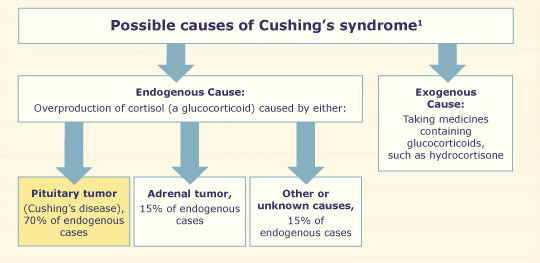
cushings-causes

No wonder Cushing’s is so hard to diagnose!

maryo colorful zebra

Could you Shed Some Light on Cushing’s Disease?

Dear Dr. Roach: Could you shed some light on Cushing’s disease? Four people in the same family have it. The doctors say it has something to do with the thyroid gland.

— Anon.

A: Cushing’s syndrome, which is different from Cushing’s disease, is an excess of cortisone or similar corticosteroids. It can be caused by taking too much steroid for too long, usually as treatment for a serious medical condition. Cushing’s disease is a special case of Cushing’s syndrome, when the excess cortisone is caused by a tumor in the pituitary gland, which spurs the adrenal gland to make excess amounts of hormone. Weight gain, almost exclusively in the abdomen, a striking round “moon” face, a fat pad on the back of the neck and upper back (“buffalo hump”), diabetes, pigmented stretch marks and high blood pressure are common findings in any form of Cushing’s syndrome.

It is very unusual for Cushing’s disease to run in families. Also, it does not affect the thyroid, although thyroid conditions can sometimes mimic Cushing’s (and vice versa). I suspect that what this might be is a rare condition called multiple endocrine neoplasia type I (MEN-1). This does run in families, and combines risk for pituitary, parathyroid and pancreatic islet cell tumors. (The parathyroid glands sit on top of the thyroid gland and secrete parathyroid hormone, responsible for calcium metabolism. The pancreatic islet cells are where insulin is made.) Not everybody with MEN-1 will have tumors in all of these glands. Parathyroid tumors are the most common.

An endocrinologist is the expert in Cushing’s and the MEN syndromes.

​Dr. Keith Roach writes for North America Syndicate. Send letters to Box 536475, Orlando, FL 32853-6475 or email ToYourGoodHealth@med.cornell.edu.

From http://herald-review.com/news/opinion/editorial/columnists/roach/dr-keith-roach-teeth-grinding-is-common-in-the-elderly/article_bef63ba4-9b5e-5bff-b66a-3530be158857.html

The Role of Adrenal Scintigraphy in the Diagnosis of Subclinical Cushing’s Syndrome and the Prediction of Post-surgical Hypoadrenalism

World J Surg. 2014 Mar 11. [Epub ahead of print]

Abstract

BACKGROUND:

Management of subclinical Cushing’s syndrome (SCS) remains controversial; it is not possible to predict which patients would benefit from adrenalectomy. In the present study we aimed to evaluate the role of adrenocortical scintigraphy (ACS) in the management of patients with SCS.

METHODS:

The medical records of 33 consecutive patients with adrenal “incidentaloma” and proven or suspected SCS who underwent 131I-19-iodocholesterol ACS between 2004 and 2010 were reviewed. Sixteen underwent laparoscopic adrenalectomy (surgical group-S-group) and 17 were medically managed (medical group-M-group). Follow-up evaluation was obtained by outpatient consultation.

RESULTS:

Overall 25 patients (15 in the S-group and 10 in the M-group) had concordant unilateral uptake at ACS (ACS+). In the S-group, the mean follow-up duration was 30.9 ± 16.1 months and, irrespective of the presence of hormonal diagnosis of SCS, in patients who were ACS+ adrenalectomy resulted in a significant increase in HDL cholesterol and decreases in body mass index, glycemia, and blood pressure (BP). One patient reduced antihypertensive medication and three others were able to discontinue it altogether. Prolonged postoperative hypoadrenalism (PH) occurred in 14 patients in the S-group. The overall accuracy in predicting PH was 93.7 % for ACS and 68.7 % for laboratory findings. In the M-group, the mean follow-up duration was 31.5 ± 26.3 months and no patient developed overt Cushing’s syndrome, although ACS+ patients experienced a worsening in glycemia and diastolic BP.

CONCLUSIONS:

Adrenal scintigraphy seems the most accurate diagnostic test for SCS. It is able to predict the metabolic outcome and the occurrence of PH, identifying the patients who could benefit from adrenalectomy irrespective of hormonal diagnosis.

PMID:
24615601
[PubMed – as supplied by publisher]

From http://www.ncbi.nlm.nih.gov/pubmed/24615601

Salivary cortisol performs better than urinary free cortisol to diagnose Cushing’s syndrome

Late-night salivary cortisol has a better performance than urinary free cortisol in the diagnosis of Cushing’s syndrome.

Salimetrics highlights a recent study:  Abstract

Context: The comparison of variability, reproducibility, and diagnostic performance of late-night salivary cortisol (LNSF) and urinary free cortisol (UFC) using concurrent and consecutive samples in Cushing’s syndrome (CS) is lacking.

Objectives, Patients and Methods: In a prospective study, we evaluate three simultaneous and consecutive samples of LNSF by RIA and UFC by LC-MS/MS in Cushing’s disease (CD; n=43), adrenal CS patients (n=9) and obese subjects (n=18) in order to compare their diagnostic performances. In CS patients we also performed a modified Cushing’s syndrome severity index (CSI).

Results: There was no difference in the coefficient of variation (%) between LNSF and UFC among the three samples obtained for each patient with CD (35±26vs31±24), adrenal CS (28±14vs22±14) and obesity (39±37vs48±20). LNSF confirmed the diagnosis of hypercortisolism even in the presence of normal UFC in 17.3% of CS, whereas the inverse situation was not observed for UFC. The area under the ROC curves for LNSF was 0.999 (95%CI 0.990-1.00) and for UFC was 0.928 (95%CI 0.809- 0.987). The ratio between AUCs was 0.928 (95%CI 0.810-0.988) indicating better performance of LNSF than UFC in diagnosing CS. There was no association between the severity of CSI and the degree of biochemical hypercortisolism.

Conclusion: Our data show that despite similar variability between both methods, LNSF has a superior diagnostic performance than UFC and should be used as the primary biochemical diagnostic test for Cushing’s syndrome diagnosis.

Authors Elias P, Martinez E, Barone B, Mermejo L, Castro M, Moreira A
Division of Endocrinology-Department of Medicine and Division of Statistics- Department of Social Medicine, Ribeirao Preto Medical School – University of Sao Paulo, Ribeirao Preto, SP- Brazil
LINK to Paper
Salimetrics guide to Cortisol
LINK to Salimetrics Diagnostic Salivary Cortisol Assay