Pituitary tumor size not definitive for Cushing’s

By: SHERRY BOSCHERT, Family Practice News Digital Network

SAN FRANCISCO – The size of a pituitary tumor on magnetic resonance imaging in a patient with ACTH-dependent Cushing’s syndrome can’t differentiate between etiologies, but combining that information with biochemical test results could help avoid costly and difficult inferior petrosal sinus sampling in some patients, a study of 131 cases suggests.

If MRI shows a pituitary tumor larger than 6 mm in size, the finding is 40% sensitive and 96% specific for a diagnosis of Cushing’s disease as the cause of adrenocorticotropic hormone (ACTH)-dependent Cushing’s syndrome, and additional information from biochemical testing may help further differentiate this from ectopic ACTH secretion, Dr. Divya Yogi-Morren and her associates reported at the Endocrine Society’s Annual Meeting.

Pituitary tumors were seen on MRI in 6 of 26 patients with ectopic ACTH secretion (23%) and 73 of 105 patients with Cushing’s disease (69%), with mean measurements of 4.5 mm in the ectopic ACTH secretion group and 8 mm in the Cushing’s disease group. All but one tumor in the ectopic ACTH secretion group were 6 mm or smaller in diameter, but one was 14 mm.

Because pituitary “incidentalomas” as large as 14 mm can be seen in patients with ectopic ACTH secretion, the presence of a pituitary tumor can’t definitively discriminate between ectopic ACTH secretion and Cushing’s disease, said Dr. Yogi-Morren, a fellow at the Cleveland Clinic.

That finding contradicts part of a 2003 consensus statement that said the presence of a focal pituitary lesion larger than 6 mm on MRI could provide a definitive diagnosis of Cushing’s disease, with no further evaluation needed in patients who have a classic clinical presentation and dynamic biochemical testing results that are compatible with a pituitary etiology (J. Clin. Endocrinol. Metab. 2003;88:5593-602). The 6-mm cutoff, said Dr. Yogi-Morren, came from an earlier study reporting that 10% of 100 normal, healthy adults had focal pituitary abnormalities on MRI ranging from 3 to 6 mm in diameter that were consistent with a diagnosis of asymptomatic pituitary adenomas (Ann. Intern. Med. 1994;120:817-20).

A traditional workup of a patient with ACTH-dependent Cushing’s syndrome might include a clinical history, biochemical testing, neuroimaging, and an inferior petrosal sinus sampling (IPSS). Biochemical testing typically includes tests for hypokalemia, measurement of cortisol and ACTH levels, a high-dose dexamethasone suppression test, and a corticotropin-releasing hormone (CRH) stimulation test. Although IPSS is the gold standard for differentiating between the two etiologies, it is expensive and technically difficult, especially in institutions that don’t regularly do the procedure, so it would be desirable to avoid IPSS if it’s not needed in a subset of patients, Dr. Yogi-Morren said.

The investigators reviewed charts from two centers (the Cleveland Clinic and the M.D. Anderson Cancer Center, Houston) for patients with ACTH-dependent Cushing’s syndrome seen during 2000-2012.

ACTH levels were significantly different between groups, averaging 162 pg/mL (range, 58-671 pg/mL) in patients with ectopic ACTH secretion, compared with a mean 71 pg/mL in patients with Cushing’s disease (range, 16-209 pg/mL), she reported. Although there was some overlap between groups in the range of ACTH levels, all patients with an ACTH level higher than 210 pg/mL had ectopic ACTH secretion.

Median serum potassium levels at baseline were 2.9 mmol/L in the ectopic ACTH secretion group and 3.8 mmol/L in the Cushing’s disease group, a significant difference. Again, there was some overlap between groups in the range of potassium levels, but all patients with a baseline potassium level lower than 2.7 mmol/L had ectopic ACTH secretion, she said.

Among patients who underwent a high-dose dexamethasone suppression test, cortisol levels decreased by less than 50% in 88% of patients with ectopic ACTH secretion and in 26% of patients with Cushing’s disease.

Most patients did not undergo a standardized, formal CRH stimulation test, so investigators extracted the ACTH response to CRH in peripheral plasma during the IPSS test. As expected, they found a significantly higher percent increase in ACTH in response to CRH during IPSS in the Cushing’s disease group, ranging up to more than a 1,000% increase. In the ectopic ACTH secretion group, 40% of patients did have an ACTH increase greater than 50%, ranging as high as a 200%-300% increase in ACTH in a couple of patients.

“Although there was some overlap in the biochemical testing, it is possible that it provides some additional proof to differentiate between ectopic ACTH secretion and Cushing’s disease,” Dr. Yogi-Morren said.

In the ectopic ACTH secretion group, the source of the secretion remained occult in seven patients. The most common identifiable cause was a bronchial carcinoid tumor, in six patients. Three patients each had small cell lung cancer, a thymic carcinoid tumor, or a pancreatic neuroendocrine tumor. One patient each had a bladder neuroendocrine tumor, ovarian endometrioid cancer, medullary thyroid cancer, or a metastatic neuroendocrine tumor from an unknown primary cancer.

The ectopic ACTH secretion group had a median age of 41 years and was 63% female. The Cushing’s disease group had a median age of 46 years and was 76% female.

Dr. Yogi-Morren reported having no financial disclosures.

sboschert@frontlinemedcom.com

On Twitter @sherryboschert

From Famiiy Practice News

Doctor’s Notes: Part 2, Adrenal

The adrenal glands sit atop the kidneys.

The adrenal glands sit atop the kidneys. (Photo credit: Wikipedia)

Acronyms or abbreviations for “Adrenal”

AD: adrenal vein
AG: adrenal gland
AdNA: adrenal gland
AC: adrenal cortex
adc: adrenal cortex
ADM: adrenal medulla
AA: adrenal adenoma
AF: adrenal failure
AM: adrenal medulla
AA: adrenal androgen
PA: pituitary-adrenal
AA: adrenal androgens
AAs: adrenal androgens
AM: adrenal medullary
LAV: left adrenal vein
AH: adrenal hypoplasia
AH: adrenal hemorrhage
AE: adrenal enucleation
AG: adrenal glomerulosa
AH: adrenal hyperplasia
HFA: human fetal adrenal
BAC: bovine adrenal cells
ADM: adrenal demedullation
AI: adrenal incidentaloma
AI: adrenal insufficiency
AVS: adrenal vein sampling
AI: adrenal incidentalomas
BAM: Bovine Adrenal Medulla
PAA: pituitary-adrenal axis
AMQD: Adrenal Move Quick Draw
AVS: Adrenal venous sampling
ach: adrenal cortical hormone
ACCs: adrenal chromaffin cells
AZF: adrenal zona fasciculata
BAM: Bovine adrenal medullary
PAL: Primary adrenal lymphoma
Ad4BP: Adrenal 4-binding protein
BAC: bovine adrenal chromaffin
ACC: adrenal cortical carcinoma
acca: adrenal cortical carcinoma
BAG: bovine adrenal glomerulosa
SAM: sympatho-adrenal-medullary
NAH: neonatal adrenal hemorrhage
PAH: primary adrenal hyperplasia
AHC: adrenal hypoplasia congenita
ACA: adrenal cortex autoantibodies
ACTH: adrenal corticotropic hormone
BAH: bilateral adrenal hyperplasia
CAH: congenital adrenal hypoplasia
HPA: hypothalamo-pituitary-adrenal
PAI: primary adrenal insufficiency
SAM: sympathetic-adrenal medullary
cah: congenital adrenal hyperplasia
HPA: hypothalamic-pituitary-adrenal
IAH: idiopathic adrenal hyperplasia
ACTH: adrenal corticotrophic hormone
ahc: adrenal hypoplasia, congenital
BAMC: bovine adrenal medullary cells
H-P-A: hypothalamic-pituitary-adrenal
HPA: hypothalamic-adrenal-pituitary
HPA: hypothalamus-pituitary-adrenal
HPAA: hypothalamic-pituitary-adrenal
IHA: idiopathic adrenal hyperplasia
LOAH: late-onset adrenal hyperplasia
NCAH: nonclassic adrenal hyperplasia
UAH: unilateral adrenal hyperplasia
BACC: bovine adrenal chromaffin cells
BACCs: bovine adrenal chromaffin cells
BCC: Bovine adrenal chromaffin cells
CAH: congenital adrenal hyperplasias
HHA: hypothalamo-hypophyseal-adrenal
BAC: bovine adrenal fasciculata cells
ARH: adrenal regeneration hypertension
HPAA: hypothalamo-pituitary-adrenal axis
ASNA: adrenal sympathetic nerve activity
HPA: hypothalamo-pituitary-adrenal axis
BAMC: bovine adrenal medullary chromaffin
FAH: Functional adrenal hyperandrogenism
HPA: hypothalamic-pituitary-adrenal axis
HPA-axis: hypothalamic-pituitary-adrenal axis
HPAA: hypothalamic-pituitary-adrenal axis
HPAA: hypothalamus-pituitary-adrenal axis
AASH: adrenal androgen stimulating hormone
BAME: bovine adrenal medullary endothelial
HPA: hypothalamus-pituitary-adrenal gland
NADF: National Adrenal Diseases Foundation
PAMC: porcine adrenal medullary chromaffin
CLAH: congenital lipoid adrenal hyperplasia
APA: aldosterone-producing adrenal adenoma
HPA: hypothalamic-pituitary-adrenal system
HPAT: hypothalamus-pituitary-adrenal-thymus
LHPA: limbic-hypothalamic-pituitary-adrenal
PCAI: primary chronic adrenal insufficiency
HHAS: hypothalamo-hypophyseal-adrenal system
HPA: hypothalamo-pituitary-adrenal cortical
HPA: hypothalamic-pituitary-adrenal cortical
RAMEC: rat adrenal medullary endothelial cells
CVAH: congenital virilizing adrenal hyperplasia
CAH: congenital virilizing adrenal hyperplasia
LOCAH: late-onset congenital adrenal hyperplasia
LHPA: limbic-hypothalamic-pituitary-adrenal axis
NC-CAH: non-classical congenital adrenal hyperplasia
AIMAH: ACTH-independent bilateral macronodular adrenal
pre-ASNA: preganglionic adrenal sympathetic nerve activity
AIMAH: ACTH-independent macronodular adrenal hyperplasia
CAHSA: Congenital Adrenal Hyperplasia Support Association
AIMAH: ACTH-independent bilateral macronodular adrenal hyperplasia

Quality of Life and Other Outcomes in Children Treated for Cushing Syndrome

Abstract

Journal of Clinical Endocrinology and Metabolism, 05/16/2013  Review Article  Clinical Article

Keil MF – Cushing syndrome (CS) in children is associated with residual impairment in measures of health–related quality of life, even after successful resolution of hypercortisolemia, highlighting the need for early identification of morbidities and improvements in long–term management of these patients.

A review of the literature identifies significant morbidities associated with CS of pediatric onset, which must not be treated in isolation. CS affects children and adolescents in many ways that are different than adults.

Post–treatment challenges for the child or adolescent treated for CS include: optimize growth and pubertal development, normalize body composition, and promote psychological health and cognitive maturation. All these factors impact health–related quality of life, which is an important outcome measure to assess the burden of disease as well as the effect of treatment.

Get this article here

Endoscopic transsphenoidal pituitary surgery: a good and safe primary treatment option for Cushings disease, even in case of macroadenomas or invasive adenomas.

Abstract – European Journal of Endocrinology, 06/24/2013  Clinical Article

Wagenmakers MA et al. – This study aims to gain insight in the role of endoscopic TS as a primary treatment option for CD, especially in patients with MRI negative CD and (invasive) macroadenomas.

The data suggest that in patients with non–invasive and invasive macroadenomas the endoscopic technique of TS should be the technique of choice as remission rates seem to be higher than remission rates reported for microscopic TS, although no comparative study has been performed.

Get this article here.

Research on Cushing’s Disease Presented at ENDO 2013

endo-chart

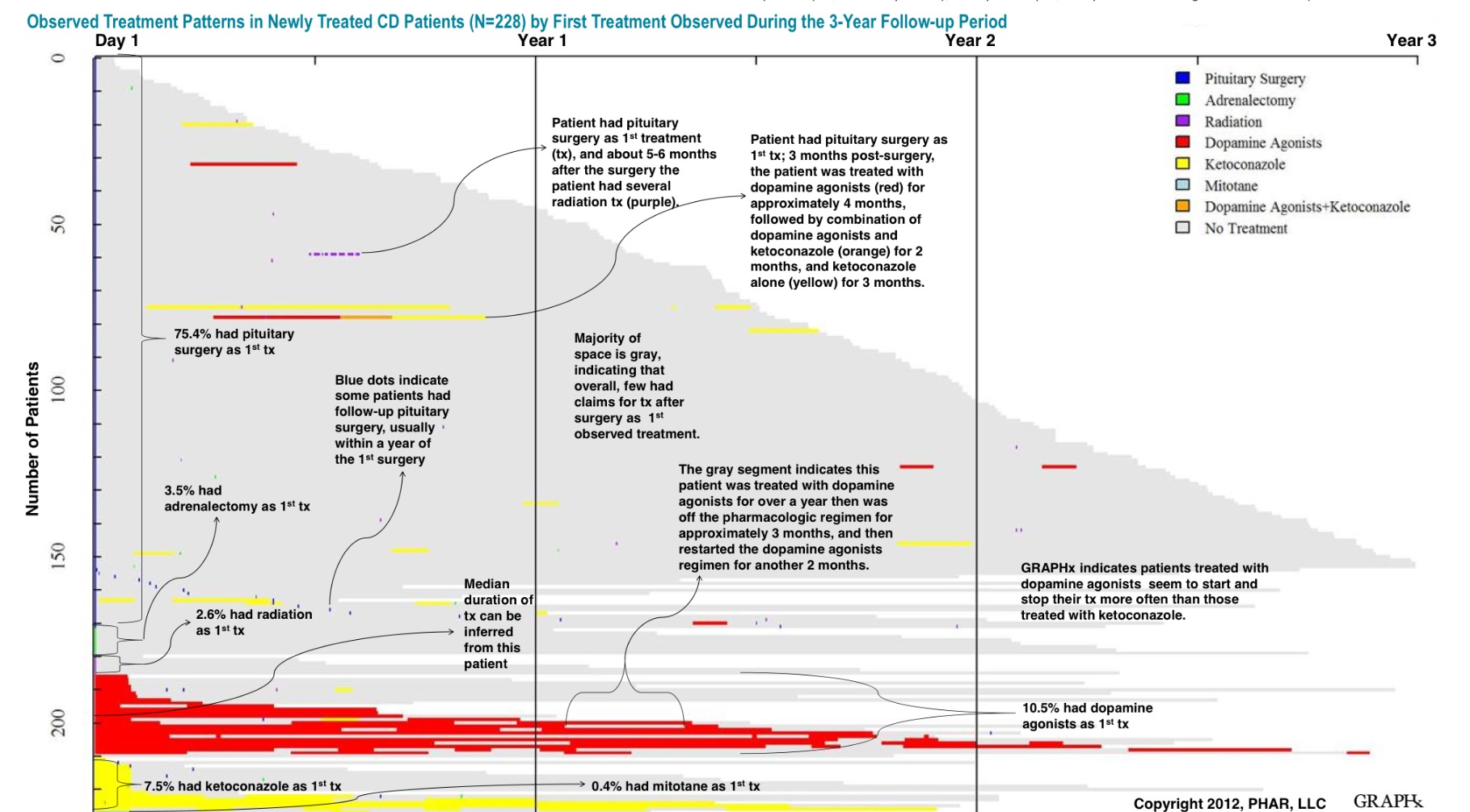
Researchers at PHAR, in conjunction with experts from Novartis Pharmaceuticals Corporation, presented the results of several studies on Cushing’s disease at the Endocrine Society’s 95th Annual Meeting on June 19th, 2013.

Cushing’s disease, a pituitary disorder, is poorly studied because of its rarity. The PHAR research team reported on the incidence, treatment patterns, and annual economic burden associated with the disease–topics on which very little was previously known.

The three posters presented at ENDO can be viewed by clicking the links below:

Incidence of Cushing’s Disease in the United States

Real-World Treatment Patterns in Cushing’s Disease Patients in Two Large US Nationwide Databases: Application of a Novel, Graphical Methodology

Annual Economic Burden Associated with Cushing’s Disease in the United States