Suspected case of Cushing’s Syndrome with history of taking medicines prescribed by registered Chinese medicine practitioner

The Department of Health (DH) today (February 18) alerted clients who have consulted a registered Chinese medicine practitioner (CMP) Mr Chan Kong-kin (CMP Chan), practising at G/F, No.25, Leung Tin Village in Tuen Mun, should consult health-care professionals for advice if they have been supplied with medicines suspected to be Western medicines.

The appeal followed the DH’s investigation into two public complaints. The first complaint involved a 23-year-old woman who consulted CMP Chan for management of eczema. She was given a type of green pills, two types of yellow pills and a type of red-yellow capsules for treatment of her disease for about one year.

She developed round face and increased facial hair which are features compatible with Cushing’s syndrome and steroid overdose can cause the syndrome. The patient was admitted to a public hospital on February 5 for investigation and was discharged on February 7.

The second complaint involved a 24-year-old woman who was recommended by the first complainant to consult CMP Chan for management of allergic rhinitis and eczema. She was given similar medicines as those for the first complainant for three days.

Her condition was stable.

Today, chemical analysis by the Government Laboratory on the patients’ drug samples showed that Western medicine Dexamethasone was detected in the red-yellow capsule.

Dexamethasone is a potent steroid. Taking dexamethasone for a long time, especially when in substantial dosage, can cause side effects such as moon face, high blood pressure, high blood sugar, muscle atrophy, peptic ulcer and even osteoporosis.

DH has set up a hotline 2125 1133 for public enquiries related to the medicines prescribed by the CMP.

It will operate from 9am to 9pm, Monday to Friday.

“Preliminary investigation by the DH revealed that pills and capsules were found in the CMP’s premises and all have been seized for further investigation,” the spokesman said.

“In December 31, 2012, the DH announced that CMP Chan was found in possession of Part I poisons and unregistered pharmaceutical products in the same clinic which also involved medicines with steroid. The DH subsequently took enforcement action and the relevant legal proceeding is in progress.

The case has also been referred to the Chinese Medicine Council of Hong Kong for follow-up action,” the spokesman added

“On completion of our investigation, the DH will seek advice from the Department of Justice regarding possible contravention of the Pharmacy and Poisons Ordinance (Cap 138) for the illegal sale or possession of Part I poisons. According to the Ordinance, the maximum penalty for each offence is a fine of $100,000 and two years’ imprisonment. Besides, the DH will also refer this case to the Chinese Medicine Council of Hong Kong for possible disciplinary action”, the spokesman remarked.

People who have been supplied with medicines by the concerned CMP and are in doubt should consult health-care professionals as soon as possible.

They should submit the medicines to the Chinese Medicine Division of DH at 16/F, AIA Kowloon Tower, Landmark East, 100 How Ming Street, Kwun Tong, during office hours for disposal.

Source: HKSAR Government

From http://7thspace.com/headlines/453015/suspected_case_of_cushings_syndrome_with_history_of_taking_medicines_prescribed_by_registered_chinese_medicine_practitioner.html

Are you carrying adrenal Cushing’s syndrome without knowing it?

Genetic research that will be published tomorrow in the New England Journal of Medicine suggests to Dr. André Lacroix, professor at the University of Montreal, that clinicians’ understanding and treatment of a form of Cushing’s syndrome affecting both adrenal glands will be fundamentally changed, and that moreover, it might be appropriate to begin screening for the genetic mutations that cause this form of the disease.

“Screening family members of bilateral adrenal Cushing’s syndrome patients with  may identify affected silent carriers,” Lacroix said in an editorial in the Journal. “The development of drugs that interrupt the defective genetic chemical link that causes the syndrome could, if confirmed to be effective in people, provide individualized specific therapies for hypercortisolism, eliminate the current practice of removing both , and possibly prevent disease progression in genetically affected .”

Adrenal glands sit above the kidneys are mainly responsible for releasing cortisol, a stress hormone. Hypercortiolism means a high level of the adrenal hormone cortisol, which causes many symptoms including weight gain, , diabetes, osteoporosis, concentration deficit and increased cardiovascular deaths.

Cushing’s syndrome can be caused by corticosteroid use (such as for asthma or arthritis), a tumor on the adrenal glands, or a  that releases too much ACTH. The pituitary gland sits under the brain and releases various hormones that regulate our bodies’ mechanisms.

Jérôme Bertherat is a researcher at Cochin Hospital in Paris. In the study he published today, he showed that 55% of Cushing’s Syndrome patients with bilaterally very enlarged adrenal glands have mutations in a gene that predisposes to the development of adrenal tumours. This means that bilateral adrenal Cushing’s is much more hereditary than previously thought. The new knowledge will also enable clinicians to undertake genetic screening. Hervé Lefebvre is a researcher at the University Hospital in Rouen, France. His research shows that the adrenal glands from the same type of patients with two large adrenal glands can produce ACTH, which is normally produced by the pituitary gland. Hormone receptors are the chemical link that cause a cell to behave differently when a hormone is present. Several misplaced hormone receptors cause the ACTH to be produced in the enlarged benign adrenal tissue. Knowing this means that researchers might be able to develop drugs that interrupt the receptors for these hormones and possibly even prevent the benign tissue from developing in the first place.

 Explore further: Scientists discover a curable cause for some cases of high blood pressure

More information: André Lacroix, M.D., Heredity and Cortisol Regulation in Bilateral Macronodular Adrenal Hyperplasia, New England Journal of Medicine 369;22, November 28, 2013

Estelle Louiset, Ph.D., Céline Duparc, Ph.D., Jacques Young, M.D., Ph.D., Sylvie Renouf, Ph.D., Milène Tetsi Nomigni, M.Sc., Isabelle Boutelet, Ph.D., Rossella Libé, M.D., Zakariae Bram, M.Sc., Lionel Groussin, M.D., Ph.D., Philippe Caron, M.D., Antoine Tabarin, M.D., Ph.D., Fabienne Grunenberger, M.D., Sophie Christin-Maitre, M.D., Ph.D., Xavier Bertagna, M.D., Ph.D., Jean-Marc Kuhn, M.D., Youssef Anouar, Ph.D., Jérôme Bertherat, M.D., Ph.D., and Hervé Lefebvre, M.D., Ph.D., Intraadrenal Corticotropin in Bilateral Macronodular Adrenal Hyperplasia, New England Journal of Medicine 369;22, November 28, 2013

Guillaume Assié, M.D., Ph.D., Rossella Libé, M.D., Stéphanie Espiard, M.D., Marthe Rizk-Rabin, Ph.D., Anne Guimier, M.D., Windy Luscap, M.Sc., Olivia Barreau, M.D., Lucile Lefèvre, M.Sc., Mathilde Sibony, M.D., Laurence Guignat, M.D., Stéphanie Rodriguez, M.Sc., Karine Perlemoine, B.S., Fernande René-Corail, B.S., Franck Letourneur, Ph.D., Bilal Trabulsi, M.D., Alix Poussier, M.D., Nathalie Chabbert-Buffet, M.D., Ph.D., Françoise Borson-Chazot, M.D., Ph.D., Lionel Groussin, M.D., Ph.D., Xavier Bertagna, M.D., Constantine A. Stratakis, M.D., Ph.D., Bruno Ragazzon, Ph.D., and Jérôme Bertherat, M.D., Ph.D., ARMC5 Mutations in Macronodular Adrenal Hyperplasia with Cushing’s Syndrome, New England Journal of Medicine 369;22, November 28, 2013

Remaining calm = Reducing illness

Have you ever noticed that when you are “stressed” you can feel either emotionally/physically depleted or energized?  When our body is under stress the brain responds by producing epheniphrine or adrenaline, sending signals to our adrenal glands, increasing the rate at which our heart beats while releasing oxygen to our muscles.  The long term response to this process produces cortisol (aka the stress hormone) facilitating the release of energy throughout our body.  However, when our body isn’t properly balanced these hormones can wreak havoc on our wellness possibly resulting in one of three conditions:  Cushing’s syndrome, Cushing’s disease or Addison’s disease.

adrenal-glandsThe actual Adrenal glands sit physically atop both kidneys, taking on a triangular shape and a roundish rectangular type shape.  These glands are responsible for our sex hormones and cortisol, helping us respond to stress amongst other functions.  When our body is under stress, physically and/or nutritionally, it responds one of two ways:  Produces too much or too little of the cortisol hormone.  Our Adrenal glands also contribute to regulating our blood sugar, blood pressure, salt and water.

Adrenal disorders can cause our body to make too much or not enough of these hormones, bringing about adrenal gland related syndromes and disease.  Cushing’s syndrome results from our body making too much versus Addison’s disease produces too little.

Cushing’s syndrome vs. Cushing’s disease

Glucocorticoids (naturally produced in our body or received through medicine) are groups of corticosteroids (cortisol or dexamethasone) involved in metabolizing our carbohydrate and protein.  When taken synthetically (i.e. treatment of allergies, skin problems, and respiratory problems) or over-produced naturally, the side effects can result in “Cushing’s syndrome”.

Cushing’s syndrome can occur one of two ways:  Endogenous or Exogenous.  Endogenous is caused by the body (usually through tumors).  Exogenous is caused by medication.  In both cases, the body produces too much cortisol.

Symptoms: Severe fatigue/muscle weakness, high blood sugar and high blood pressure, upper body obesity, thin arms/legs, bruising easily

Treatment:  The cure and treatment for Cushing’s disease can come through medicine, surgery, or by lowering the dosage of your current synthetic hormone treatment.  Cushing’s syndrome can be cured.

Cushing’s disease is the most common form of endogenous Cushing’s syndrome and is likely treatable.  Caused by a tumor in the pituitary gland secreting too much Adrenocorticotropic hormone (ACTH), this type of tumor does not spread and can be removed through surgery.

Nutrition:  See a nutritionist or dietician for your condition.  Mostly, avoid excess sodium.  High blood sugar (hyperglycemia) and high blood pressure can easily occur with this condition.  Bone loss density is common with this condition, so be extra aware of your calcium (800 – 1200 mg per day, based upon age) and Vitamin D intake (5mcg from age 0-50, increasing up to 10 mcg 50-71, and 15 mcg after 71).  Eating healthy, balanced and whole food (versus processed) is extremely important.

(Resource:  http://www.aboutcushings.com/understanding-cushings-disease/causes-and-differences.jsp)

Addison’s disease

Opposite from Cushing’s syndrome, Addison’s disease doesn’t make “enough” of the sex hormones and cortisol.  The result of this disease causes our immune system to attack our tissue, damaging our adrenal glands.

Symptoms:  Weight loss, muscle weakness, increasingly worse fatigue, low blood pressure and patchy or dark skin.

Treatment:  If left untreated, the condition can be fatal.  Lifetime hormone treatment is usually required. Addison disease patients should always carry medical/emergency ID on them, listing their medication, dosage and disease

Lab tests can confirm that you have Addison’s disease. If you don’t treat it, it can be fatal. You will need to take hormone pills for the rest of your life. If you have Addison’s disease, you should carry an emergency ID. It should say that you have the disease, list your medicines and say how much you need in an emergency.”

(Ref: http://www.nlm.nih.gov/medlineplus/cushingssyndrome.html, NIH: National Institute of Neurological Disorders and Stroke)                                                                                                                                                                                                                                        Learning how to balance our stress-filled lives is extremely important to our overall health.  Healthy nutrition always contributes benefits to our overall wellness.  We can overwhelm our endocrine system by simply not eating nutritionally.  Understanding that “Food is a drug” is vitally important to how we help our body naturally heal itself.  The above two conditions are the result of our body not handling the stress we are putting it through, causing our body to producing too much or too little of the sex hormones and cortisol.

Unless we first address what we can do naturally through nutrition, the medicine we consume will only do so much in helping our body heal completely.  You simply cannot continue doing the same thing over and over again, expecting the medicine to do all the work.  Some diseases are brought upon us through our environment (emotionally as well as physically) as well as our diet/nutrition.  Reviewing our entire wellness is always wisdom whenever we’re diagnosed with anything.

Certainly listen to your doctor and their advice.  But also ask your doctor to refer you to a nutritionist or clinical/registered dietician for a complete evaluation that includes a review of your nutritional diet/wellness.  Too often we reach for a pill or a procedure to “fix” our health problems, ignoring what we should be doing on our own to help our body heal.  Medical intervention is the result of providing our body with what it cannot produce on its own.  Nutrition should always be the “natural” medicine we take, as well as what we might need through prescribed medication.

Adapted from (Spelling errors corrected) http://hamptonroads.com/2013/10/remaining-calm-reducing-illness

Enzyme linked to obesity

Researchers find that increased levels of an enzyme in fat cells lead to dangerous levels of abdominal obesity.

Previous studies have shown that the stress hormone cortisol can lead to an accumulation of fat round the abdomen. For instance, people with Cushing’s disease – where there’s excess cortisol in the blood – have too much abdominal fat. It’s bad for health to have fat in this area – it’s linked to diabetes and heart disease. That’s why it’s healthier to be a ‘pear shape’ rather than an ‘apple shape’. The distribution of fat in your body really does matter.

Researchers in Scotland and the US have now focussed upon an enzyme that produces cortisol to see what effect it has on abdominal fat. Working on mice genetically-modified to produce the enzyme – and therefore cortisol – in fat cells, they find that even a small increase in levels produces dramatic effects. The mice, compared with normal animals, gained fat in the abdominal area even on a low fat diet. They developed diabetes, high blood pressure, and also tended to eat more. It opens up the possibility of further studies on human obesity, and also perhaps could lead to therapies that block this enzyme and so reduce fat accumulation.

From http://www.tele-management.ca/2013/09/enzyme-linked-to-obesity/

Cushing’s Disease – Rare Disease Quick Facts

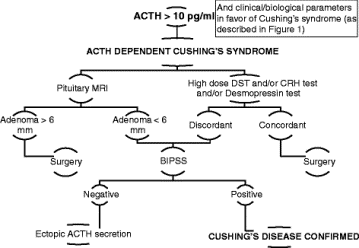
cushings-diagnosis


Cushing’s disease is a rare condition due to excess cortisol levels that result from a pituitary tumor secreting adrenocorticotropic hormone (ACTH), which stimulates cortisol secretion.  Cushing’s disease should not be confused with Cushing’s syndrome which is increased cortisol levels but that increase can be due to any number of factors. However, Cushing’s disease is the most common form of Cushing’s syndrome.

Symptoms

The symptoms related to Cushing’s disease and Cushing’s syndrome are the same, since both are related to an excess of cortisol. Also, symptoms vary extensively among patients and that, with the inherent fluctuation in hormone levels make it difficult to diagnosis both conditions.

Changes in physical characteristics of the body

  • Fullness and rounding of the face
  • Added fat on back of neck (so-called “buffalo hump”)
  • Easy bruising
  • Purplish stretch marks on the abdomen (abdominal striae)
  • Excessive weight gain, especially in abdominal region
  • Red cheeks
  • Excess hair growth on the face, neck, chest, abdomen and thighs

Changes in physiology/psychology

  • Generalized weakness and fatigue
  • Menstrual disorder
  • Decreased fertility and/or sex drive
  • High blood pressure that is often difficult to treat
  • Diabetes mellitus
  • Mood and behavior disorders

Diagnosis

The early stages of Cushing’s disease may be difficult to recognize. However, if it is suspected, diagnosis is generally a 2 stage process. First to determine if cortisol levels are high, and if so, why they are high.

Tests to confirm high cortisol levels:

  • 24-hour urine cortisol
  • Dexamethasone suppression test (low dose)

Tests to determine cause:

  • Blood ACTH level
  • Brain MRI
  • Corticotropin-releasing hormone test
  • Dexamethasone suppression test (high dose)
  • Petrosal sinus sampling

Treatment

Surgery

  • Most patients with Cushing’s disease undergo surgery to remove the pituitary adenoma offers.
  • If the tumor is isolated to the pituitary, cure rates of 80-85% are common.
  • If the tumor has spread to nearby organs, cure rates of 50-55% are common.

Medicine (approved orphan drugs)

Signifor (pasireotide)

  • Approved for patients with Cushing’s disease for whom pituitary is not an option or surgery has been ineffective.
  • Signifor is a somatostatin receptor agonist that leads to inhibition of ACTY secretion (and subsequently decreased cortisol levels).

Korlym (mifepristone)

  • Approved for patients with Cushing’s syndrome who have type 2 diabetes or glucose intolerance and have failed surgery (or not candidates for surgery).
  • Korlym is a glucocorticoid receptor antagonist which in turn blocks the effects of the high levels of cortisol in the body. Korlym is used to treat high glucose levels due to elevated cortisol.

Medicines used but not indicated for Cushing’s disease include

Mitoden

ketoconazole

Metyrapone

Etomidate

Radiation

  • Radiation therapy may be used in some patients and can be very effective in controlling the growth of these tumors.

Prognosis

In most cases, treatment can cure Cushing’s disease. If not treated properly, the chronic hypercortisolism can lead to excess morbidity and mortality due to increased cardiovascular and other risk factors.

For more information

National Library of Medicine, National Institute of Health

Cushing’s Disease Information (provided by Novartis Pharmaceuticals)


Images courtesy of the open access journal Orhanet Journal for Rare Diseases.  Castinetti et al. Orphanet J Rare Dis. 2012 7:41   doi:10.1186/1750-1172-7-41

– See more at: http://www.raredr.com/front-page-medicine/articles/cushings-disease-rare-disease-quick-facts-0