Cushing Syndrome Test Choice Should Fit Patient Factors & Disease Stage

Caused by excessive exposure to the hormone cortisol, endogenous Cushing syndrome (CS) is difficult to diagnose. Currently available biochemical tests that assess cortisol production have limited diagnostic specificity and sensitivity, and their performance can vary depending on the patient, according to a review article in Current Opinion in Endocrinology, Diabetes and Obesity.

“Whether performed on blood, urine, saliva, or hair, all biochemical tests for CS have advantages and disadvantages. It is therefore essential to select them based on the individual characteristics of the patient and the stage of the disease in order to improve their diagnostic performance,” wrote corresponding author Antoine Tabarin, MD, and coauthor Amandine Ferriere, MD, of the University Hospital of Bordeaux in Pessac, France.

The Endocrine Society recommends initial screening of patients with suspected CS using 24-hour urinary-free cortisol (UFC), late-night salivary cortisol (LNSC), or the overnight dexamethasone suppression test (ONDST). To avoid false negatives from variability in cortisol production, UFC and LNSC tests should be performed twice.

Among the three screening options, meta-analysis findings suggest comparable diagnostic performance, the authors reported.

“However, they also concluded that these investigations should not be used indiscriminately,” the review continued, “and should be selected according to various circumstances.”

ONDST results can be affected by medications, age, a history of bariatric surgery, and even individual differences in dexamethasone metabolism, according to the review. UFC requires patient education and a complete 24-hour urine collection. LNSC testing, which biochemically assesses the loss of circadian rhythmicity consistent in CS, may not be appropriate for people with highly variable sleep schedules, including shift workers.

For early detection of Cushing disease (CD) recurrence after pituitary surgery, LNSC is the recommended first-line procedure for biochemical follow-up. LNSC is also the tool of choice for monitoring patients with CS treated with medication, the article reported.

For patients with adrenocorticotropic hormone (ACTH)-dependent CS, UFC offers high accuracy for assessing the likelihood of CD and ectopic adrenocorticotropin. However, for the diagnosis of cyclical or intermittent CS, repeat UFC tests are “cumbersome and nearly impossible,” the authors wrote.

LNSC, on the other hand, allows for frequent daily assessment of cortisol secretion which is helpful for identifying cyclical CS. Similarly, measurements of cortisol and cortisone levels in the hair can assess mid- to long-term tissular exposure to cortisol and signal cyclical CS as well, the review explained.

References

Ferriere A, et al. Curr Opin Endocrinol Diabetes Obes. 2025;32(5):233-239. doi:10.1097/MED.0000000000000923

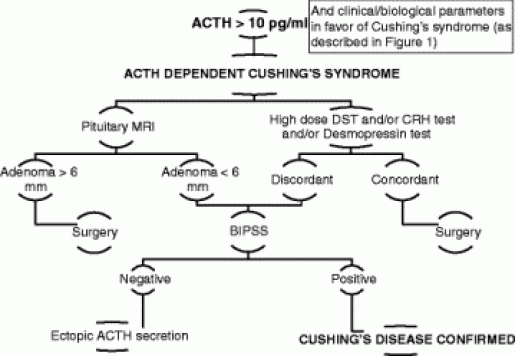
Day 6: Cushing’s Awareness Challenge

cushings-diagnosis.gif?resize=515%2C356

The above is the official Cushing’s path to a diagnosis but here’s how it seems to be in real life:

Egads!  I remember the naive, simple days when I thought I’d give them a tube or two of blood and they’d tell me I had Cushing’s for sure.

Who knew that diagnosing Cushing’s would be years of testing, weeks of collecting every drop of urine, countless blood tests, many CT and MRI scans…

Then going to NIH, repeating all the above over 6 weeks inpatient plus an IPSS test, an apheresis (this was experimental at NIH) and specialty blood tests…

The path to a Cushing’s diagnosis is a long and arduous one but you have to stick with it if you believe you have this Syndrome.

stick-with-it.jpeg?resize=575%2C87&ssl=1

maryo-blue.gif?resize=228%2C70&ssl=1

New way to study pituitary tumors holds potential for better diagnoses and treatments

Houston Methodist neurosurgeons and neuroscientists are looking at a new way to classify pituitary tumors that could lead to more precise and accurate diagnosing for patients in the future.

Found in up to 10% of the population, pituitary tumors, also called adenomas, are noncancerous growths on the pituitary gland and very common. Although these pituitary tumors are benign in nature, they pose a major health challenge in patients.

The new tests being investigated at Houston Methodist not only have the potential to lead to better diagnoses for patients with pituitary adenomas, but also for many other types of brain tumors in the future. The findings, which were published Jan. 28 in Scientific Reports, an online journal from Nature Publishing Group, describe a new way being looked at to study the blood of patients with pituitary tumors to determine exactly what tumor type they have and whether they might respond to medical treatment rather than surgery.

“Often called the ‘master gland,’ the pituitary gland controls the entire endocrine system and regulates various body functions by secreting hormones into the bloodstream to control such things as metabolism, growth and development, reproduction and sleep,” said corresponding author Kumar Pichumani, Ph.D., a research physicist at the Houston Methodist Research Institute. “When pituitary adenomas occur, they may secrete too much of one or more hormones that could lead to a variety of issues, ranging from infertility and sexual dysfunction to vision problems and osteoporosis, among many other health problems.”

Neurosurgeon David S. Baskin, M.D., director of the Kenneth R. Peak Center for Brain and Pituitary Tumor Treatment and Research in the Department of Neurosurgery at Houston Methodist Hospital, collaborated with Pichumani on this study. He said some pituitary tumors can be treated with medication rather than surgery, but a precise diagnosis of the type of tumor someone has and what  it’s secreting is essential for proper treatment. This is sometimes very difficult to do based on standard endocrine hormone testing.

“To guide our decisions on diagnosis and treatment, we currently rely on a blood-based hormone panel test that measures the levels of hormones in the blood to determine which hormones are overproducing in the tumor,” Baskin said. “However, some tumors secrete too much of more than one hormone, making this test ambiguous for diagnosis.”

Led by Pichumani and Baskin, a team of researchers from the Peak Brain and Pituitary Tumor Treatment and Research Center and Houston Methodist Neurological Institute studied 47 pituitary adenoma patients of different subtypes by collecting blood during surgery to remove their tumors. They confirmed that elevated blood levels of a non-hormonal compound called betahydroxybutyrate, also known as BHB, was found only in patients with the prolactinoma subtype of noncancerous pituitary gland brain tumor that overproduces the hormone prolactin. This compound is known to supply energy to the brain during starvation, which led the researchers to speculate that BHB might be providing non-hormonal energy to these prolactinoma tumors causing them to grow and spread. The discovery could be further developed into a diagnostic lab test.

This study is part of a developing field called metabolomics in which researchers study small molecules in tumors to see what’s unique about their metabolism and how they’re used as nutrients to supply energy. This contributes to better diagnoses and discovering new ways to kill tumors by poisoning the specific energy they use without causing damage to normal cells.

The researchers are now enrolling more patients in a larger study currently underway to validate the results of their pilot study. If successful, they say BHB could be used as a non-hormonal metabolic biomarker for prolactinoma pituitary tumor diagnosis and prognosis to supplement the current hormone panel tests. They’re also looking for biological reasons why only prolactin-secreting tumors have elevated BHB blood levels to inform therapeutic intervention.

From https://medicalxpress.com/news/2020-02-pituitary-tumors-potential-treatments.html

Cushing’s Disease Treatment Market to Witness an Outstanding Growth by 2017 – 2025

Cushing disease is caused by tumour in the pituitary gland which leads to excessive secretion of a hormone called adrenocorticotrophic (ACTH), which in turn leads to increasing levels of cortisol in the body. Cortisol is a steroid hormone released by the adrenal glands and helps the body to deal with injury or infection. Increasing levels of cortisol increases the blood sugar and can even cause diabetes mellitus. However the disease is also caused due to excess production of hypothalamus corticotropin releasing hormone (CRH) which stimulates the synthesis of cortisol by the adrenal glands.

The condition is named after Harvey Cushing, the doctor who first identified the disease in 1912. Cushing disease results in Cushing syndrome. Cushing syndrome is a group of signs and symptoms developed due to prolonged exposure to cortisol.

Signs and symptoms of Cushing syndrome includes hypertension, abdominal obesity, muscle weakness, headache, fragile skin, acne, thin arms and legs, red stretch marks on stomach, fluid retention or swelling, excess body and facial hair, weight gain, acne, buffalo hump, tiredness, fatigue, brittle bones, low back pain, moon shaped face etc.

Symptoms vary from individual to individual depending upon the disease duration, age and gender of the patient.  Disease diagnosis is done by measuring levels of cortisol in patient’s urine, saliva or blood. For confirming the diagnosis, a blood test for ACTH is performed. The first-line treatment of the disease is through surgical resection of ACTH-secreting pituitary adenoma, however disease management is also done through medications, Cushing disease treatment market comprises of the drugs designed for lowering the level of cortisol in the body. Thus patients suffering from Cushing disease are prescribed medications such as ketoconazole, mitotane, aminoglutethimide metyrapone, mifepristone, etomidate and pasireotide.

Request to View Tables of Content @ http://www.persistencemarketresearch.com/toc/14155

Cushing’s disease treatment market revenue is growing with a stable growth rate, this is attributed to increasing number of pipeline drugs. Also increasing interest of pharmaceutical companies to develop Cushing disease drugs is a major factor contributing to the revenue growth of Cushing disease treatment market over the forecast period. Current and emerging players’ focuses on physician education and awareness regarding availability of different drugs for curing Cushing disease, thus increasing the referral speeds, time to diagnosis and volume of diagnosed Cushing disease individuals. Growing healthcare expenditure and increasing awareness regarding Cushing syndrome aids in the revenue growth of Cushing’s disease treatment market. Increasing number of new product launches also drives the market for Cushing’s disease Treatment devices. However availability of alternative therapies for curing Cushing syndrome is expected to hamper the growth of the Cushing’s disease treatment market over the forecast period.

The Cushing’s disease Treatment market is segment based on the product type, technology type and end user

Cushing’s disease Treatment market is segmented into following types:

By Drug Type

  • Ketoconazole
  • Mitotane
  • Aminoglutethimide
  • Metyrapone
  • Mifepristone
  • Etomidate
  • Pasireotide

By End User

  • Hospital Pharmacies
  • Retail Pharmacies
  • Drug Stores
  • Clinics
  • e-Commerce/Online Pharmacies

Cushing’s disease treatment market revenue is expected to grow at a good growth rate, over the forecast period. The market is anticipated to perform well in the near future due to increasing awareness regarding the condition. Also the market is anticipated to grow with a fastest CAGR over the forecast period, attributed to increasing investment in R&D and increasing number of new product launches which is estimated to drive the revenue growth of Cushing’s disease treatment market over the forecast period.

Depending on geographic region, the Cushing’s disease treatment market is segmented into five key regions: North America, Latin America, Europe, Asia Pacific (APAC) and Middle East & Africa (MEA).

North America is occupying the largest regional market share in the global Cushing’s disease treatment market owing to the presence of more number of market players, high awareness levels regarding Cushing syndrome. Healthcare expenditure and relatively larger number of R&D exercises pertaining to drug manufacturing and marketing activities in the region. Also Europe is expected to perform well in the near future due to increasing prevalence of the condition in the region.

Asia Pacific is expected to grow at the fastest CAGR because of increase in the number of people showing the symptoms of Cushing syndrome, thus boosting the market growth of Cushing’s disease treatment market throughout the forecast period.

Some players of Cushing’s disease Treatment market includes CORCEPT THERAPEUTICS, HRA Pharma, Strongbridge Biopharma plc, Novartis AG, etc. However there are numerous companies producing branded generics for Cushing disease. The companies in Cushing’s disease treatment market are increasingly engaged in strategic partnerships, collaborations and promotional activities to capture a greater pie of market share.

Buy Now: You can now buy a single user license of the report at http://www.persistencemarketresearch.com/checkout/14155

The final report customized as per your specific requirement will be sent to your e-mail id within 7-20 days, depending on the scope of the report.

The research report presents a comprehensive assessment of the market and contains thoughtful insights, facts, historical data, and statistically supported and industry-validated market data. It also contains projections using a suitable set of assumptions and methodologies. The research report provides analysis and information according to categories such as market segments, geographies, types, technology and applications.

For more information, please e-mail us at sales@persistencemarketresearch.com

About Us 

Persistence Market Research (PMR) is a U.S.-based full-service market intelligence firm specializing in syndicated research, custom research, and consulting services. PMR boasts market research expertise across the Healthcare, Chemicals and Materials, Technology and Media, Energy and Mining, Food and Beverages, Semiconductor and Electronics, Consumer Goods, and Shipping and Transportation industries. The company draws from its multi-disciplinary capabilities and high-pedigree team of analysts to share data that precisely corresponds to clients’ business needs.

PMR stands committed to bringing more accuracy and speed to clients’ business decisions. From ready-to-purchase market research reports to customized research solutions, PMR’s engagement models are highly flexible without compromising on its deep-seated research values.

Contact

Persistence Market Research Pvt. Ltd

305 Broadway

7th Floor, New York City,

NY 10007, United States,

USA – Canada Toll Free: 800-961-0353

Email: sales@persistencemarketresearch.com

 media@persistencemarketresearch.com

 Web: http://www.persistencemarketresearch.com

Hair Test for Cushing Syndrome?

Cortisol levels in hair correlated strongly with standard tests

by Jeff Minerd
Contributing Writer, MedPage Today

Analyzing the levels of cortisol in hair may aid in the diagnosis of Cushing syndrome, perhaps one day replacing invasive blood tests, scientists said.

Cortisol levels in the proximal ends of hair samples taken from patients with the syndrome correlated strongly with blood tests (R=0.4; P=0.03) and urine tests (R=0.5; P=0.005) for cortisol, reported Mihail Zilbermint, MD, of the National Institute of Child Health and Human Development in Bethesda, Md., and colleagues.

“The diagnosis of Cushing syndrome is often challenging and inconclusive, despite numerous tests used for the detection of hypercortisolemia and its origin, and is associated with high morbidity and high risk for mortality, if undiagnosed and untreated,” Zilbermint and colleagues wrote online in Endocrine: International Journal of Basic and Clinical Endocrinology.

“As a potential solution to the limitations of these tests, hair cortisol has been increasingly studied as an additional means to diagnose patients with Cushing Syndrome. Much like hemoglobin A1C is a longitudinal marker of blood glucose levels, hair cortisol can be a measure of the body’s glucocorticoid levels over the previous several weeks to months.”

“Our results are encouraging,” Zilbermint said in a statement. “We are hopeful that hair analysis may ultimately prove useful as a less-invasive screening test for Cushing syndrome or in helping to confirm the diagnosis.”

The study included 30 patients with Cushing syndrome and six control individuals without the disease. The participants’ average age was 26, and 75% were female and 75% were Caucasian.

The investigators took 3 cm-long hair samples from all patients, analyzed the proximal, medial, and distal segments of the samples for cortisol, and compared the results with results of standard blood and urine tests. Cortisol levels were highest in the proximal segments and correlated best with the standard tests, the investigators reported.

“We found that proximal hair cortisol directly correlates with late night serum cortisol and UFC [urinary free cortisol] in patients with and without Cushing syndrome. The most proximal 1 cm of hair was the best section of hair for stratifying the two groups of patients in our cohort.

“These findings support further research on the use of this modality in the workup for Cushing syndrome.”

Regarding the study’s limitations, the team pointed to the small control group of only six patients. Another limitation is that more than half of the participants (58%) were younger than age 18, and pubertal status on cortisol metabolism may be a factor in hair cortisol measurement.

“However, our study’s strengths are that it is the largest sample so far to analyze segmental hair cortisol in Cushing syndrome, and that it is the largest study to compare hair cortisol to any biochemical test for hypercortisolemia in patients with Cushing syndrome,” Zilbermint and colleagues said. “Our study also included a large cohort of Cushing Disease patients, which has been under-represented in prior studies on hair cortisol.”

The study was funded by the National Institutes of Health. Zilbermint and colleagues reported having no relevant financial relationships with industry.