8 Things You Should Know About Addison’s Disease

adrenal-insufficiency


Cortisol gets a bad rap these days. (Guilty!) Yes, this hormone surges when you’re stressed. And yes, chronic stress is bad news for your health. But while too much cortisol can lead to all sorts of stress-related side effects, too little cortisol is equally debilitating.

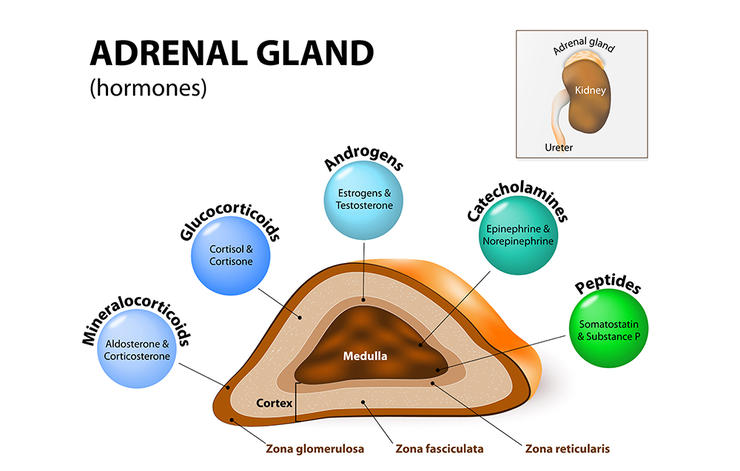
Just ask someone with Addison’s disease. If you suffer from this condition, your adrenal glands fail to make adequate amounts of cortisol, says Betul Hatipoglu, MD, an endocrinologist at Cleveland Clinic.

Cortisol plays a role in regulating your blood pressure, heart function, digestion, and a lot else, Hatipoglu explains. So if your adrenal glands poop out and your cortisol levels plummet, a lot can go wrong. (In as little as 30 days, you can be a whole lot slimmer, way more energetic, and so much healthier just by following the simple, groundbreaking plan in The Thyroid Cure!)

Here’s what you need to know about this condition—starting with its craziest symptom.

It can make your teeth appear whiter.

Hatipoglu once met with a patient who was suffering from fatigue, belly pain, and mild weight loss. “Her doctors thought she was depressed,” Hatipoglu recalls. Toward the end of their appointment, Hatipoglu noticed the woman’s teeth looked very white. She realized they looked white because the woman’s skin was tan. “I asked her if she’d been on vacation, and she said she hadn’t been in the sun, and that’s when I knew,” Hatipoglu says. Some Addison’s-related hormone shifts can make the skin appear darker, almost like a tan. “Addison’s is the only disease I know of that can cause darkening of the skin,” she says.

Its (other) symptoms are popular ones.

 Along with darker skin, other symptoms of Addison’s include nausea, mild-to-severe abdominal or bone pain, weight loss, a lack of energy, forgetfulness, and low blood pressure, Hatipoglu says. Of course, those same symptoms are linked to many other health issues, from thyroid disease to cancer. “It’s very easy to confuse with other disorders, so many people see a lot of doctors before finally receiving a proper diagnosis,” she says. (One exception: For young women who develop Addison’s disease, loss of body hair is a warning sign, Hatipoglu adds.)
It’s rare.
Doctors also miss or misinterpret the symptoms of Addison’s disease because it’s very uncommon. “I’m not sure if it’s quite one in a million, but it’s very rare,” Hatipoglu says. “It makes sense that many doctors don’t think of it when examining a patient with these symptoms.”
It’s often confused with adrenal insufficiency.

A lot of online resources mention Addison’s disease and adrenal insufficiency as though they were two names for the same condition. They’re not the same, Hatipoglu says. While a thyroid issue or some other hormone-related imbalance could mess with your adrenal function, Addison’s disease refers to an autoimmune disorder in which your body attacks and destroys your adrenal glands.

That destruction can happen quickly.

While it takes months or even years for some Addison’s sufferers to lose all hormone production in their adrenal glands, for others the disease can knock out those organs very rapidly—in a matter of days, Hatipoglu says. “That’s very uncommon,” she adds. But compared to other less-severe adrenal issues, the symptoms of Addison’s tend to present more dramatically, she explains. That means a sufferer is likely to experience several of the symptoms mentioned above, and those symptoms will continue to grow worse as time passes.

Anybody can get it.

Addison’s is not picky. It can strike at any age, regardless of your sex or ethnicity, Hatipoglu says. While there’s some evidence that genetics may play a role—if other people in your family have the disease or some other endocrine disorder, that may increase your risk—there’s really no way to predict who will develop the disease, she adds.

Screening for Addison’s is pretty simple.

If your doctor suspects Addison’s, he or she will conduct a blood test to check for your levels of cortisol and another hormone called ACTH. “Usually the results of that screening are very clear,” Hatipoglu says. If they’re not, some follow-up tests can determine for sure if you have the condition.

There are effective treatments.

Those treatments involve taking oral hormone supplements.  In extreme cases, if the patient’s body does not properly absorb those supplements, injections may be necessary, Hatipoglu explains. “But patients live a normal life,” she adds. “It’s a treatable disease, and the treatments are effective.”

From http://www.prevention.com/health/addisons-disease-symptoms

Day 4: Cushing’s Awareness Challenge 2015


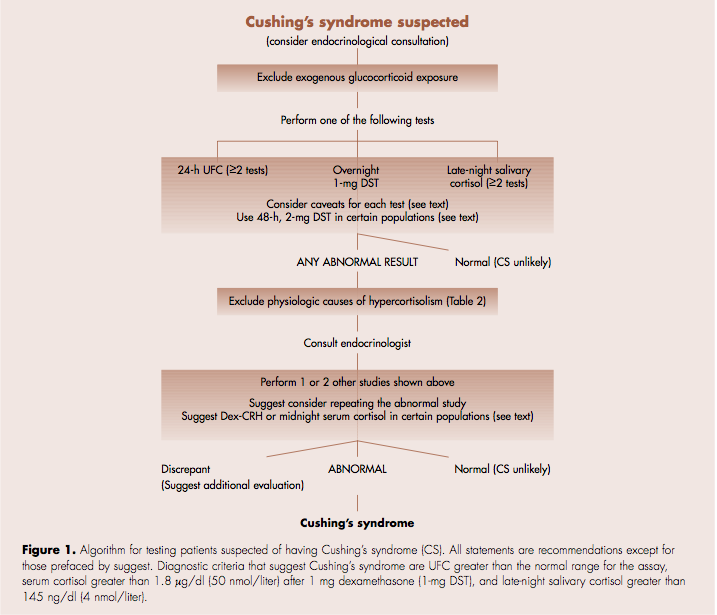
The above is the official Cushing’s path to a diagnosis but here’s how it seems to be in real life:


Egads!  I remember the naive, simple days when I thought I’d give them a tube or two of blood and they’d tell me I had Cushing’s for sure.

Who knew that diagnosing Cushing’s would be years of testing, weeks of collecting every drop of urine, countless blood tests, many CT and MRI scans…

Then going to NIH, repeating all the above over 6 weeks inpatient plus an IPSS test, an apheresis (this was experimental at NIH) and specialty blood tests…

The path to a Cushing’s diagnosis is a long and arduous one but you have to stick with it if you believe you have this Syndrome.


Cushing’s Awareness Challenge, Day 7

A Cushing’s diagnosis can be a long and frustrating event with testing, repeat testing, redoing testing.

Sometimes, I think that this was the path that some of my UFCs took on the way to my diagnosis:


cushie-diagnosis


It took three years from 1983 to 1986 before doctors would consider testing me for Cushing’s, even though I was sure that this was what my problem was.

My first 24-hour urine free cortisol was run by a Hematologist/Oncologist.  After that, things seemed to move a little better, if not faster.  That UFC got me to my first endo.

The Endocrinologist, of course, didn’t trust the other test so I was back to square one. He ran his own multitude of tests. He had to draw blood at certain times like 9 AM. and 5 PM. There was a dexamethasone suppression test where I took a pill at 10 p.m. and gave blood at 9 am the next day.

ufcI collected gallons of urine in BIG boxes (Fun in the fridge!). Those were from 6 a.m. to 6 a.m. to be delivered to his office by 9 a.m. same day. I was always worried that I’d be stopped in rush hour and the police would ask about what was in that big container. I did those daily for a week.

When the endo confirmed that I had Cushing’s in 1987 he sent me to a local hospital where they repeated all those same tests for another week and decided that it was not my adrenal gland (Cushing’s Syndrome) creating the problem. The doctors and nurses had no idea what to do with me, so they put me on the brain cancer ward.

When I left this hospital after a week, we didn’t know any more than we had before.

As luck would have it, NIH (National Institutes of Health, Bethesda, Maryland) was doing a clinical trial of Cushing’s. I live in the same area as NIH so it was not too inconvenient but very scary at first to think of being tested there. At that time I only had a choice of NIH, Mayo Clinic and a place in Quebec to do this then-rare pituitary surgery called a Transsphenoidal Resection. I chose NIH – closest and free. After I was interviewed by the Doctors there, I got a letter that I had been accepted into the clinical trial. The first time I was there was for 6 weeks as an inpatient. More of the same tests.

Six weeks of daily UFC testing.  To this day, I still remember nurses waking me just after 6 am to “close out your urine”.  Sounded like a bank account!

The testing pathway today looks a little more organized but it still takes far too long:

testing-cushings


What would Harvey Cushing say about Cushing’s disease today?

harvey-book

(BPT) – More than 80 years ago renowned neurosurgeon, Dr. Harvey Cushing, discovered a tumor on the pituitary gland as the cause of a serious, hormone disorder that leads to dramatic physical changes in the body in addition to life-threatening health concerns. The discovery was so profound it came to be known as Cushing’s disease. While much has been learned about Cushing’s disease since the 1930s, awareness of this rare pituitary condition is still low and people often struggle for years before finding the right diagnosis.

Read on to meet the man behind the discovery and get his perspective on the present state of Cushing’s disease.

* What would Harvey Cushing say about the time it takes for people with Cushing’s disease to receive an accurate diagnosis?

Cushing’s disease still takes too long to diagnose!

Despite advances in modern technology, the time to diagnosis for a person with Cushing’s disease is on average six years. This is partly due to the fact that symptoms, which may include facial rounding, thin skin and easy bruising, excess body and facial hair and central obesity, can be easily mistaken for other conditions. Further awareness of the disease is needed as early diagnosis has the potential to lead to a more favorable outcome for people with the condition.

* What would Harvey Cushing say about the advances made in how the disease is diagnosed?

Significant progress has been made as several options are now available for physicians to use in diagnosing Cushing’s disease.

In addition to routine blood work and urine testing, health care professionals are now also able to test for biochemical markers – molecules that are found in certain parts of the body including blood and urine and can help to identify the presence of a disease or condition.

* What would Harvey Cushing say about disease management for those with Cushing’s disease today?

Patients now have choices but more research is still needed.

There are a variety of disease management options for those living with Cushing’s disease today. The first line and most common management approach for Cushing’s disease is the surgical removal of the tumor. However, there are other management options, such as medication and radiation that may be considered for patients when surgery is not appropriate or effective.

* What would Harvey Cushing say about the importance of ongoing monitoring in patients with Cushing’s disease?

Routine check-ups and ongoing monitoring are key to successfully managing Cushing’s disease.

The same tests used in diagnosing Cushing’s disease, along with imaging tests and clinical suspicion, are used to assess patients’ hormone levels and monitor for signs and symptoms of a relapse. Unfortunately, more than a third of patients experience a relapse in the condition so even patients who have been surgically treated require careful long-term follow up.

* What would Harvey Cushing say about Cushing’s disease patient care?

Cushing’s disease is complex and the best approach for patients is a multidisciplinary team of health care professionals working together guiding patient care.

Whereas years ago patients may have only worked with a neurosurgeon, today patients are typically treated by a variety of health care professionals including endocrinologists, neurologists, radiologists, mental health professionals and nurses. We are much more aware of the psychosocial impact of Cushing’s disease and patients now have access to mental health professionals, literature, patient advocacy groups and support groups to help them manage the emotional aspects of the disease.

Learn More

Novartis is committed to helping transform the care of rare pituitary conditions and bringing meaningful solutions to people living with Cushing’s disease. Recognizing the need for increased awareness, Novartis developed the “What Would Harvey Cushing Say?” educational initiative that provides hypothetical responses from Dr. Cushing about various aspects of Cushing’s disease management based on the Endocrine Society’s Clinical Guidelines.

For more information about Cushing’s disease, visit www.CushingsDisease.com or watch educational Cushing’s disease videos on the Novartis YouTube channel at www.youtube.com/Novartis.


From http://www.jsonline.com/sponsoredarticles/health-wellness/what-would-harvey-cushing-say-about-cushings-disease-today8087390508-253383751.html

Botch-up Costs Doctor an Adrenal Gland

Chennai, India: The state consumer forum has asked a Coimbatore hospital to pay 15 lakh to a doctor whose adrenal gland was surgically removed after a botched-up diagnosis.

In May 2006, A Indumathi, an ophthalmologist, started showing symptoms like rapid weight gain, hypertension, joint pain, puffiness of face and fatigue. She approached Kovai Medical Centre & Hospital in Coimbatore, where the consultant endocrinologist conducted various tests. Her condition was diagnosed as Cushing’s syndrome, a hormonal disorder, and she was advised to undergo surgery for removal of the left adrenal gland.

On September 18, she was operated on. However, the symptoms persisted and the doctor told her it would take some more time to get relief. She waited three more months, but when her condition worsened, she approached the doctor again. He asked her to undergo another surgery for removing her right adrenal gland.

Not willing to take a chance, Indumathi approached Christian Medical College, Vellore, in December, where doctors told her she was suffering from Cushing’s disease, not syndrome. After a month of treatment, she recovered.

She then approached the state commission saying she was misdiagnosed and because of the wrong surgery, she has to regularly go for blood tests for the rest of her life and could develop life-threatening complications. She said she also incurred medical expense of around 5 lakh and had to leave her medical practice for six months.

Denying the charges, the hospital said tests conducted on her showed she was suffering from Cushing’s syndrome. She, being a doctor, was aware of the test reports and gave consent for surgery, it said.

The state consumer disputes redressal commission bench comprising its president Justice(rtd )RRegupati and judicial member J Jayaram, in a recent order, said after a wrong diagnosis and surgery, the hospital should have been more diligent in reassessment but instead suggested removing the right adrenal gland. The bench said the hospital wrongly diagnosed her and removed “a precious, healthy adrenal gland.”

Stating it was a case of “gross negligence and deficiency in service,” the bench asked the hospital and two doctors to pay Indumathi 4 lakh towards medical and travelling expense, 1 lakh for loss of professional income and 10 lakh for “lifelong mental agony.”

From http://timesofindia.indiatimes.com/city/chennai/Botch-up-costs-doctor-a-gland-hospital-fined-Rs-15-lakh/articleshow/29925290.cms