Cushing’s appears to begin its cardiovascular effects during childhood

– Cushing’s disease may begin to exert its harmful cardiovascular effects quite early, a small pediatric study has found.

Children as young as 6 years old with the disorder already may show signs of cardiovascular remodeling, with stiffer aortas and higher aortic pulse-wave velocity than do age-matched controls, Hailey Blain and Maya Lodish, MD, said at the annual meeting of the Endocrine Society.

“The study, which included 10 patients, is small, but we continue to add new patients,” said Dr. Lodish, director of the pediatric endocrinology fellowship program at the Eunice Kennedy Shriver National Institute of Child Health and Human Development. Ten more children are being added to the cohort now, and she and Ms. Blain, a former research fellow at NIH, intend to grow the group and follow patients longitudinally.

Cushing’s disease has long been linked with increased cardiovascular risk in adults, but the study by Dr. Lodish and Ms. Blain is one of the first to examine the link in children. Their findings suggest that early cardiovascular risk factor management should be a routine part of these patients’ care, Dr. Lodish said in an interview.

“It’s very important to make sure that there is recognition of the cardiovascular risk factors that go along with this disease. Elevated levels of cholesterol, hypertension, and other risk factors that are in these individuals should be ameliorated as soon as possible from an early age and, most importantly, physicians should be diagnosing and treating children early, once they are identified as having Cushing’s disease. And, given that we are not sure whether these changes are reversible, we need to make sure these children are followed very closely.”

Indeed, Dr. Lodish has reason to believe that the changes may be long lasting or even permanent.

“We are looking at these children longitudinally and have 3-year data on some patients already. We want to see if they return to normal pulse wave velocity after surgical cure, or whether this is permanent remodeling. There is an implication already that it may be in a subset of individuals,” she said, citing her own 2009 study on hypertension in pediatric Cushing’s patients. “We looked at blood pressure at presentation, after surgical cure, and 1 year later. A significant portion of the kids still had hypertension at 1 year. This leads us to wonder if they will continue to be at risk for cardiovascular morbidity as adults.”

Ms. Blaine, an undergraduate at Bowdoin College, Brunswick, Maine, worked on the study during a summer internship with Dr. Lodish and presented its results in a poster forum during meeting. She examined two indicators of cardiovascular remodeling – aortic pulse wave velocity and aortic distensibility – in 10 patients who were a mean of 13 years old. All of the children came to NIH for diagnosis and treatment of Cushing’s; as part of that, all underwent a cardiac MRI.

The patients had a mean 2.5-year history of Cushing’s disease Their mean midnight cortisol level was 18.8 mcg/dL and mean plasma adrenocorticotropic hormone level, 77.3 pg/mL. Five patients were taking antihypertensive medications. Low- and high-density lipoprotein levels were acceptable in all patients.

The cardiovascular measures were compared to an age-matched historical control group. In this comparison, patients had significantly higher pulse wave velocity compared with controls (mean 4 vs. 3.4 m/s). Pulse wave velocity positively correlated with both midnight plasma cortisol and 24-hour urinary free cortisol collections. In the three patients with long-term follow-up after surgical cure of Cushing’s, the pulse wave velocity did not improve, either at 6 months or 1 year after surgery. This finding echoes those of Dr. Lodish’s 2009 paper, suggesting that once cardiovascular remodeling sets in, the changes may be long lasting.

“The link between Cushing’s and cardiovascular remodeling is related to the other things that go along with the disease,” Dr. Lodish said. “The hypertension, the adiposity, and the high cholesterol all may contribute to arterial rigidity. It’s also thought to be due to an increase in connective tissue. The bioelastic function of the aorta may be affected by having Cushing’s.”

That connection also suggests that certain antihypertensives may be more beneficial to patients with Cushing’s disease, she added. “It might have an implication in what blood pressure drug you use. Angiotensin-converting enzyme inhibitors increase vascular distensibility and inhibit collagen formation and fibrosis. It is a pilot study and needs longitudinal follow up and additional patient accrual, however, finding signs of cardiovascular remodeling in young children with Cushing’s is intriguing and deserves further study.”

Neither Ms. Blain nor Dr. Lodish had any financial disclosures.

Pituitary dysfunction after traumatic brain injury: are there definitive data in children?

Arch Dis Child doi:10.1136/archdischild-2016-311609

  1. Correspondence toDr Paula Casano-Sancho, Pediatric Endocrinology Unit, Sant Joan de Déu Hospital, Passeig Sant Joan de Déu, Santa Rosa 39-57, Esplugues, Barcelona 08950, Spain; pcasano@hsjdbcn.org
  • Received 14 July 2016
  • Revised 26 October 2016
  • Accepted 27 October 2016
  • Published Online First 21 November 2016

Abstract

In the past decade, several studies in adults and children have described the risk of pituitary dysfunction after traumatic brain injury (TBI). As a result, an international consensus statement recommended follow-up on the survivors. This paper reviews published studies regarding hypopituitarism after TBI in children and compares their results.

The prevalence of hypopituitarism ranges from 5% to 57%. Growth hormone (GH) and ACTH deficiency are the most common, followed by gonadotropins and thyroid-stimulating hormone. Paediatric studies have failed to identify risk factors for developing hypopituitarism, and therefore we have no tools to restrict screening in severe TBI. In addition, the present review highlights the lack of a unified follow-up and the fact that unrecognised pituitary dysfunction is frequent in paediatric population.

The effect of hormonal replacement in patient recovery is important enough to consider baseline screening and reassessment between 6 and 12 months after TBI. Medical community should be aware of the risk of pituitary dysfunction in these patients, given the high prevalence of endocrine dysfunction already reported in the studies. Longer prospective studies are needed to uncover the natural course of pituitary dysfunction, and new studies should be designed to test the benefit of hormonal replacement in metabolic, cognitive and functional outcome in these patients.

From http://adc.bmj.com/content/early/2016/11/21/archdischild-2016-311609.short?rss=1

Day 14, Cushing’s Awareness Challenge 2016

Way back when we first got married, my husband thought we might have a big family with a lot of kids.  He was from a family of 6 siblings, so that’s what he was accustomed to.  I am an only child so I wasn’t sure about having so many.

I needn’t have worried.

In January, 1974 I had a miscarriage.  I was devastated. My father revealed that my mother had also had a miscarriage.  I had no idea.

At some point after this I tried fertility drugs.  Clomid and another drug.  One or both drugs made me very angry/depressed/bitchy (one dwarf I left off the image)  Little did I know that these meds were a waste of time.

Eventually,  I did get pregnant and our wonderful son, Michael was born.  It wasn’t until he was seven that I was finally, actually diagnosed with Cushing’s.

When I had my early Cushing’s symptoms, I thought I was pregnant again but it was not to be.

I’ll never forget the fall when he was in second grade.  He was leaving for school and I said goodbye to him.  I knew I was going into NIH that day for at least 6 weeks and my future was very iffy.  The night before, I had signed my will – just in case.  He just turned and headed off with his friends…and I felt a little betrayed.

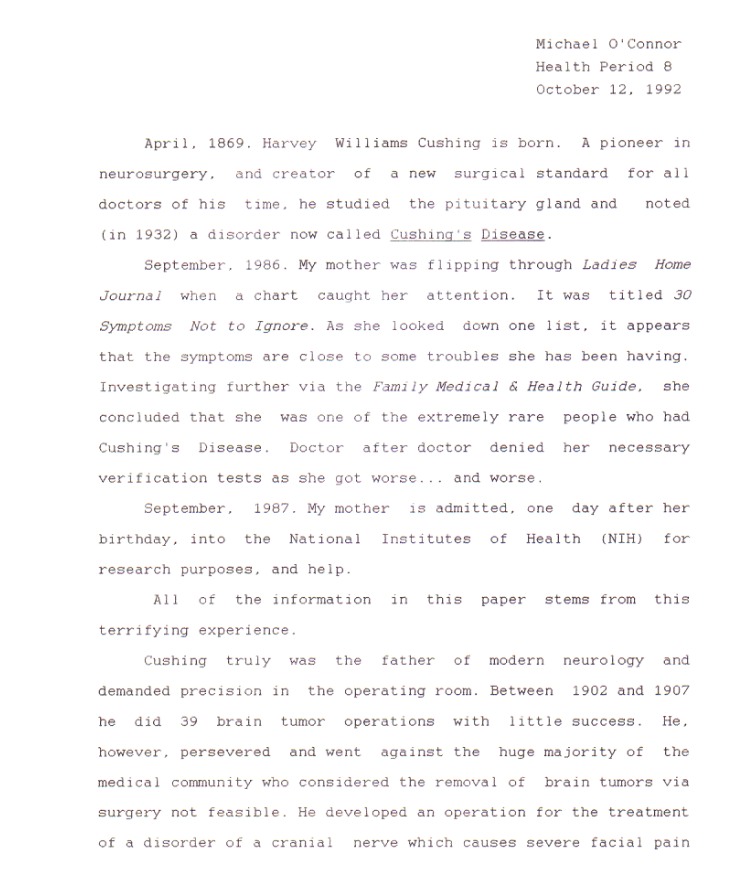
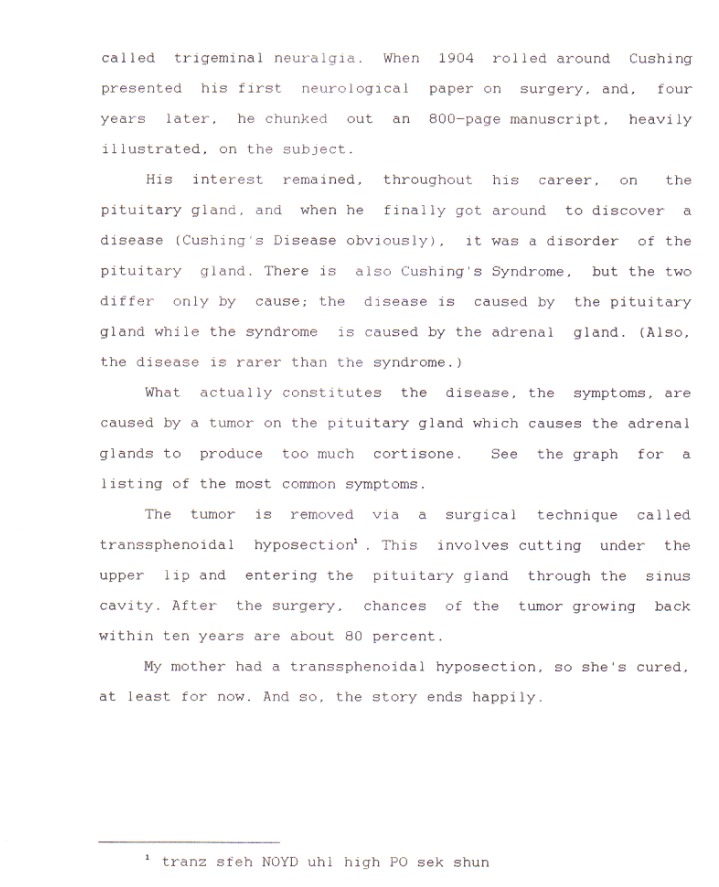
Michael wrote this paper on Cushing’s when he was in the 7th grade. From the quality of the pages, he typed this on typing paper – no computers yet!

Click on each page to enlarge.

When Michael started having headache issues in middle school, I had him tested for Cushing’s.  I had no idea yet if it could be familial but I wasn’t taking any chances.  It turned out that my father had also had some unnamed endocrine issues.  Hmmm…

I survived my time and surgery at NIH and Michael grew up to be a wonderful young man, if an only child.  🙂

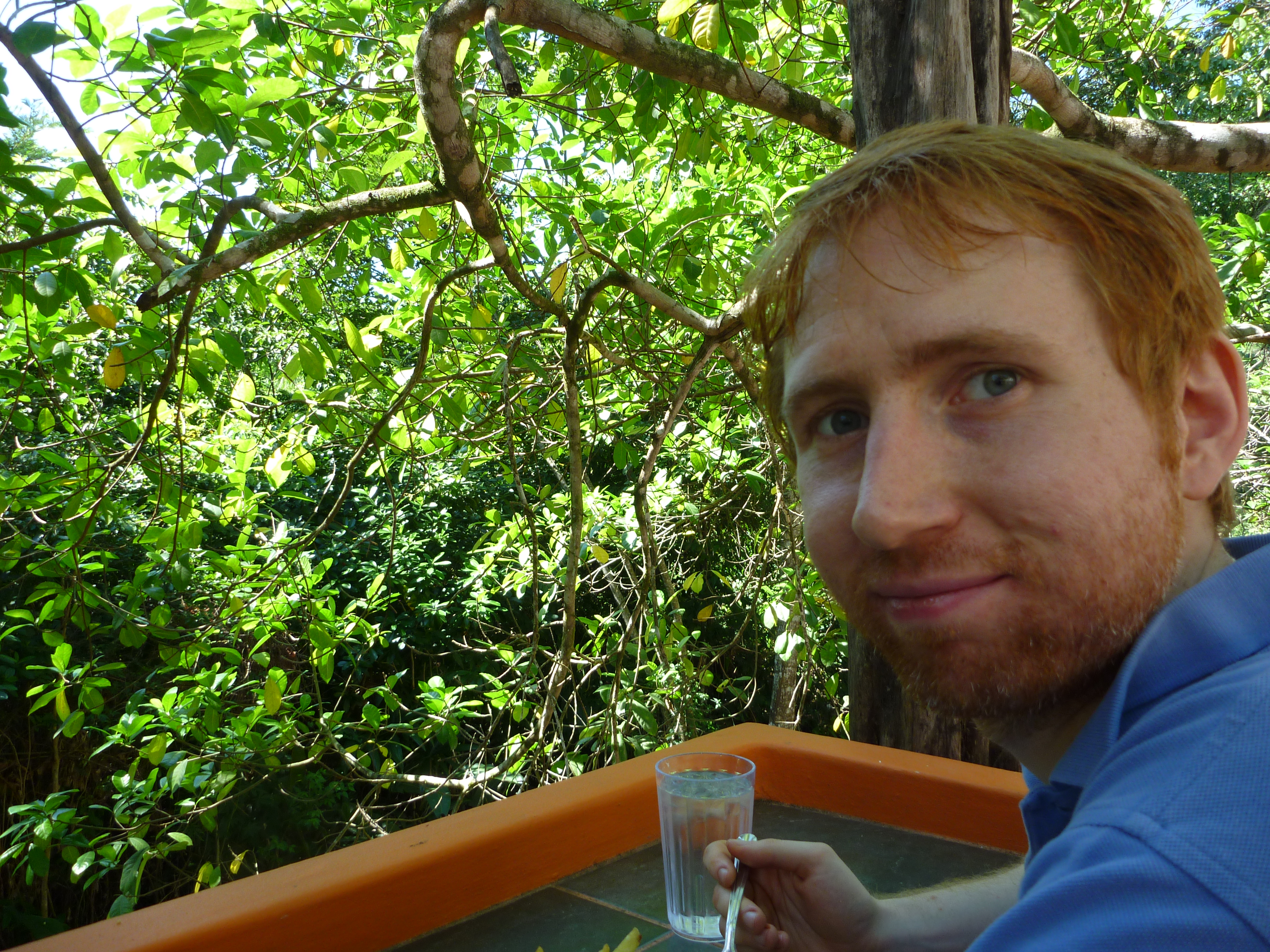
After I survived kidney cancer (Day Twelve, Cushing’s Awareness Challenge 2015) Michael and I went zip-lining – a goal of mine after surviving that surgery.  This photo was taken in a treetop restaurant in Belize.

For the mathematically inclined, this is his blog.  Xor’s Hammer.  I understand none of it.  He also has a page of Math and Music, which I also don’t understand.

I know it doesn’t fit into a Cushing’s awareness post but just because I’m a very proud mama – Michael got a PhD in math from Cornell and his thesis was Using Tree Automata to Investigate Intuitionistic Propositional Logic


proud-mom


Young people with Cushing syndrome may be at higher risk for suicide, depression

Children with Cushing syndrome may be at higher risk for suicide as well as for depression, anxiety and other mental health conditions long after their disease has been successfully treated, according to a study by researchers at the National Institutes of Health.

Cushing syndrome results from high levels of the hormone cortisol. Long-term complications of the syndrome include obesity, diabetes, bone fractures, high blood pressure, kidney stones and serious infections. Cushing’s syndrome may be caused by tumors of the adrenal glands or other parts of the body that produce excess cortisol. It also may be caused by a pituitary tumor that stimulates the adrenal glands to produce high cortisol levels. Treatment usually involves stopping excess cortisol production by removing the tumor.

“Our results indicate that physicians who care for young people with Cushing syndrome should screen their patients for depression-related mental illness after the underlying disease has been successfully treated,” said the study’s senior author, Constantine Stratakis, D(med)Sci, director of the Division of Intramural Research at NIH’s Eunice Kennedy Shriver National Institute of Child Health and Human Development. “Patients may not tell their doctors that they’re feeling depressed, so it’s a good idea for physicians to screen their patients proactively for depression and related conditions.”

Cushing syndrome may affect both adults and children. A recent study estimated that in the United States, there are 8 cases of Cushing syndrome per 1 million people per year.

The researchers published their findings in the journal Pediatrics. They reviewed the case histories of all children and youth treated for Cushing syndrome at NIH from 2003 to 2014, a total of 149 patients. The researchers found that, months after treatment, 9 children (roughly 6 percent) had thoughts of suicide and experienced outbursts of anger and rage, depression, irritability and anxiety. Of these, 7 experienced symptoms within 7 months of their treatment.

Two others began experiencing symptoms at least 48 months after treatment.

The authors noted that children with Cushing syndrome often develop compulsive behaviors and tend to become over-achievers in school. After treatment, however, they then become depressed and anxious. This is in direct contrast to adults with Cushing syndrome, who tend to become depressed and anxious before treatment and gradually overcome these symptoms after treatment.

The authors stated that health care providers might try to prepare children with Cushing syndrome before they undergo treatment, letting them know that their mood may change after surgery and may not improve for months or years. Similarly, providers should consider screening their patients periodically for suicide risk in the years following their treatment.

Source: NIH/Eunice Kennedy Shriver National Institute of Child Health and Human Development

Day Fifteen, Cushing’s Awareness Challenge 2015

Way back when we first got married, my husband thought we might have a lot of kids.  He was from a family of 6 siblings, so that’s what he was accustomed to.  I am on only child so I wasn’t sure about having so many.

I needn’t have worried.

In January, 1974 I had a miscarriage.  I was devastated. My father revealed that my mother had also had a miscarriage.  I had no idea.

At some point after this I tried fertility drugs.  Clomid and another drug.  One or both drugs made me very angry/depressed/bitchy (one dwarf I left off the image)  Little did I know that these meds were a waste of time.

Eventually,  I did get pregnant and my wonderful son, Michael was born.  It wasn’t until he was seven that I was finally, actually diagnosed with Cushing’s.

When I had my early Cushing’s symptoms, I thought I was pregnant again but it was not to be.

I’ll never forget the fall when he was in second grade.  He was leaving for school and I said good bye to him.  I knew I was going into NIH that day for at least 6 weeks and my future was very iffy.  The night before, I had signed my will – just in case.  He just turned and headed off with his friends…and I felt a little betrayed.

Michael wrote this paper on Cushing’s when he was in the 7th grade. From the quality of the pages, he typed this on typing paper – no computers yet!

Click on each page to enlarge.

When Michael started having headache issues in middle school, I had him tested for Cushing’s.  I had no idea yet if it could be familial but I wasn’t taking any chances.  It turned out that my father had also had some unnamed endocrine issues.  Hmmm…

I survived my time and surgery at NIH and Michael grew up to be a wonderful young man, if an only child.  🙂

After I survived kidney cancer (Day Twelve, Cushing’s Awareness Challenge 2015) Michael and I went zip-lining – a goal of mine after surviving that surgery.  This was taken in a treetop restaurant in Belize.

For the mathematically inclined, this is his blog.  Xor’s Hammer.  I understand none of it.  He also has a page of Math and Music, which I also don’t understand.